Category Keywords: What SaaS Brands Need to Know
If you run marketing for a SaaS company, you’ve probably spent more hours than you’d like to admit staring at a keyword list, trying to figure out which terms are actually worth chasing. Somewhere in that list is a group of keywords that quietly does more work than almost anything else on your site: category keywords.
They don’t get talked about as much as branded terms or long-tail blog topics, but they’re often the reason a prospect finds you in the first place, before they even know your product name exists. Let’s break down what they are, why they matter more than ever right now, and how to actually use them without falling into the traps most SaaS teams stumble into.

Key Takeaways
- Category keywords help SaaS brands reach potential customers before they know which product or company to choose.
- Building strong category pages improves your visibility in both Google Search and AI-powered search engines.
- Successful category keyword strategies focus on search intent, customer language, and comprehensive content rather than search volume alone.
- Avoid treating category pages like sales pages; educational, well-structured content earns more trust and better rankings.
- Queen of Clicks helps SaaS brands build category authority that increases organic traffic, strengthens AI search visibility, and attracts high-intent buyers.
What Are Category Keywords?
Category keywords are the terms people search when they know the type of solution they need, but haven’t picked a specific product yet. Think “project management software,” “email marketing platform,” or “AI writing tool.” No brand name attached. Just a description of the problem they’re trying to solve.
This is different from a branded search like “Asana pricing” or a feature-specific query like “Gantt chart software with time tracking.” Category keywords sit earlier in the funnel. They’re the entry point, the moment someone types their problem into Google (or asks an AI assistant) before they’ve narrowed things down to a shortlist.
For SaaS companies, this is a big deal. A huge share of your future customers are out there right now searching for your category, not your company. If you’re not visible for those searches, you’re invisible to people who don’t even know you exist yet, and that’s a hard gap to close later.
Why Category Keywords Matter for SaaS Brands
They Capture Demand Before Brand Awareness Exists
Nobody wakes up searching for a SaaS product they’ve never heard of. They search for the outcome or the category first. Ranking for category keywords means you show up during that exact window, before your competitors get the chance to introduce themselves.
They Build Category Authority Over Time
When your brand consistently shows up for the terms that define your space, something interesting happens. Search engines, and increasingly AI models, start associating your name with that category. That association compounds. It’s the difference between being “a project management tool” and being one of the first names that comes to mind for project management, period.
They Feed AI Search and LLM Visibility
This part matters more every month. AI-driven search tools and chat-based assistants pull from content that already ranks well and reads clearly around a topic. If your site is thin on category-level content, there’s simply less for those tools to point to when someone asks an AI which software solves their problem. Strong category keyword coverage gives you a real shot at being the answer, not just a link on page two.
They Support Every Other Keyword Strategy You’re Running
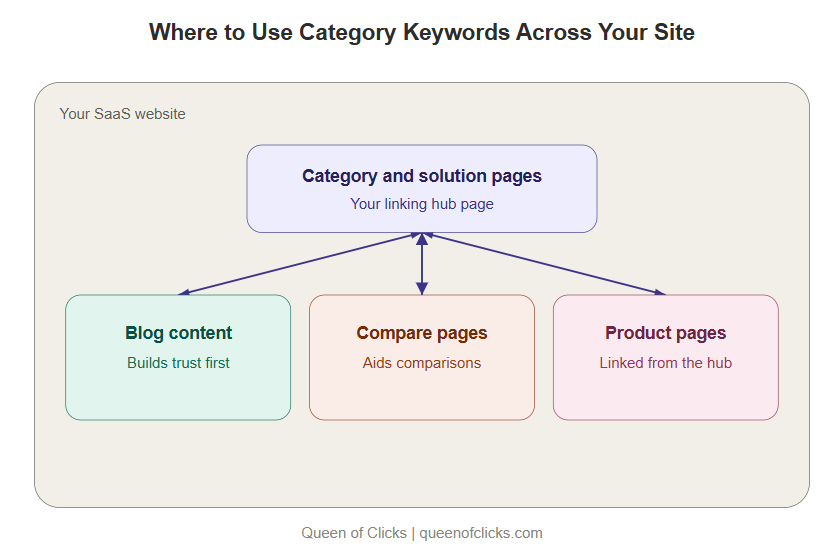
Category pages and category-focused content often act as the hub that your branded pages, comparison pages, and blog content all link back to. Without that hub, your site structure feels scattered, and search engines have a harder time understanding what you’re actually about.

Category Keywords vs Branded Keywords vs Product Keywords
It helps to see these side by side, because SaaS teams mix them up more often than you’d expect.
- Category keywords: “CRM software,” “AI writing assistant.” Broad, top-of-funnel, high competition, but massive reach.
- Branded keywords: “HubSpot login,” “Notion pricing.” Someone already knows your name and wants something specific from you.
- Product or feature keywords: “CRM with email automation,” “AI tool for agencies.” More specific, closer to a buying decision, still not tied to a brand name.
Most SaaS marketing teams pour effort into branded and feature keywords because they convert well and feel easier to measure. Fair enough. But category keywords are what fill the top of that funnel in the first place. Skip them, and you’re only fishing in the pond of people who already know your name.
| Keyword Category | Examples | Search Intent | Competition | Role in the Funnel |
| Category Keywords | CRM software, AI writing assistant | Users are exploring solutions and comparing options. | High | Top of the funnel. Drives awareness and attracts a broad audience. |
| Branded Keywords | HubSpot login, Notion pricing | Users already know the brand and are looking for specific information. | Low to Medium | Bottom of the funnel. Captures existing brand demand and high-intent visitors. |
| Product/Feature Keywords | CRM with email automation, AI tool for agencies | Users are searching for a specific capability or use case and are closer to purchasing. | Medium | Middle to bottom of the funnel. Attracts qualified prospects with clear buying intent. |
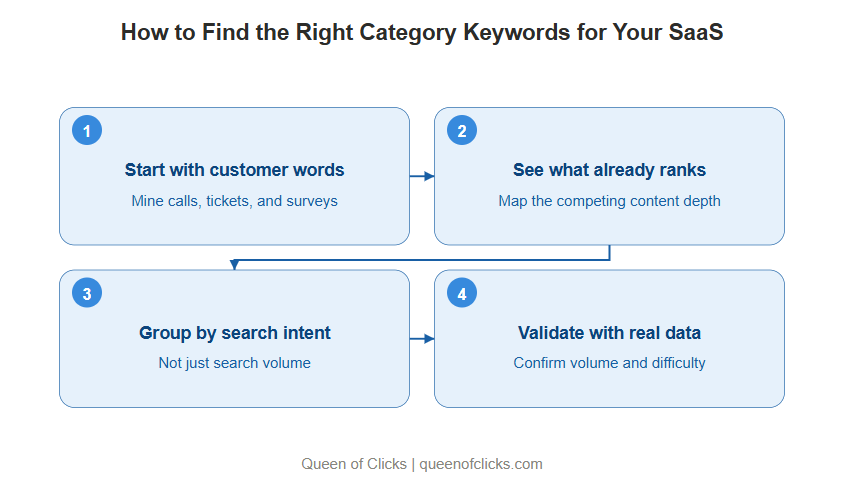
How to Find the Right Category Keywords for Your SaaS
Start With How Customers Actually Describe Their Problem
Pull up your sales call notes, support tickets, and onboarding surveys. Customers rarely describe their problem the way your product team does internally. They say things like “tool to keep my team organized” rather than “asynchronous workflow management platform.” Write down their exact phrasing. That’s your real keyword goldmine.
Look at What Your Category Actually Ranks For
Search the broad terms that describe your space and see who shows up. Look at the pages ranking on page one. What structure are they using? What subtopics do they cover? This gives you a realistic map of the content depth needed to compete, which ties directly into a proper competitive SEO analysis rather than guessing at difficulty.
Group Keywords by Search Intent, Not Just Volume
A high search volume keyword with vague intent isn’t automatically valuable. Group your category keywords by what the searcher actually wants: are they comparing options, learning what a category even means, or ready to try something? This grouping should guide your content plan far more than volume alone.
Validate With Real Search Data
Once you’ve got a working list, run it through proper keyword research tools to confirm volume, difficulty, and related terms you might have missed. This step is part of a broader SEO strategy for SaaS that ties keyword research to actual pipeline goals rather than vanity traffic.
Where to Use Category Keywords Across Your Site
Category and Solution Pages
If you don’t already have a page built specifically around your core category term, that’s the first gap to close. This is the page that should rank when someone searches your category name directly, and it needs to clearly explain what the category is, what problems it solves, and where your product fits.
Blog Content That Educates Before It Sells
Not every category keyword deserves a sales page. Some deserve an educational blog post that answers the question honestly, builds trust, and links back to your product where it makes sense. This is where a lot of your SEO deliverables should be focused if you want steady, compounding traffic.
Comparison and Alternatives Pages
People searching a category term often end up comparing multiple options. Pages that walk through how different types of solutions within the category work can capture that research phase and keep them on your site longer.
Internal Linking Between Category and Product Pages
Your category content should link naturally to your feature and product pages, and vice versa. This helps search engines understand the relationship between your broad category authority and your specific product offering, something we cover in more detail when talking about the best platforms for SaaS SEO.
Common Mistakes to Avoid
A few things trip up SaaS teams over and over again:
- Treating category pages as an afterthought. Many SaaS sites bury their category content under product pages, when it should often be the other way around.
- Writing category content that sounds like a sales pitch. Buyers at this stage want clarity, not a hard sell. Save the pitch for later in the journey.
- Ignoring search intent shifts. The way people search a category can change as new tools and AI features enter the market. What worked two years ago might not reflect how people search today.
- Forgetting AI search entirely. If your category content isn’t structured clearly, with real answers and not just marketing fluff, you’re less likely to get pulled into AI-generated answers where a growing number of buyers now start their research.
It’s worth noting that 71% of B2B researchers start with a generic search rather than searching for a particular company. That single stat says a lot about why category keywords deserve a real seat at the table in your SEO strategy, not a leftover afterthought.
🚀 Own Your Category with Queen of Clicks
Getting category keywords right takes more than a spreadsheet of search volumes. It takes a strategy that connects those keywords to real content, real site structure, and real visibility across both traditional search and AI-driven discovery. That’s exactly what we do at Queen of Clicks.
We help SaaS brands build the kind of category authority that gets them found by buyers, and increasingly, gets them cited directly by AI search engines when someone asks which tool solves their problem. If you’re ready to stop losing category searches to competitors, book a strategy call with our team and let’s map out where the opportunity actually is for your product.
Conclusion
Category keywords aren’t flashy, and they don’t always show up at the top of a priority list next to branded terms or high-intent product searches. But they’re doing the quiet work of putting your brand in front of people before they’ve made up their mind, which is exactly when you have the best chance to shape that decision. Get your category strategy right, and everything else in your SEO plan, from branded searches to AI visibility, gets a whole lot easier to build on.
FAQs
How many category keywords should a SaaS brand target at once?
There’s no fixed number, but most SaaS teams do better focusing on two or three core category terms and building depth around them before spreading into a dozen loosely related ones. Depth beats breadth here.
Do category keywords work differently for early-stage startups versus established SaaS companies?
Yes. Early-stage companies often need to build category authority from scratch, which takes longer and requires more foundational content. Established companies usually already have some visibility and can focus more on defending and expanding their existing rankings.
How long does it typically take to rank for a competitive category keyword?
It varies by niche and competition level, but competitive category terms in SaaS often take several months to a year of consistent content and technical work before meaningful movement shows up.
Should category keywords be included in paid search campaigns too?
Many SaaS companies do run paid campaigns on category terms alongside organic efforts, especially while organic rankings are still building. The two channels can support each other rather than compete.
What’s the difference between a category keyword and a “problem aware” keyword?
Problem-aware keywords describe a pain point without naming a solution type at all, like “team keeps missing deadlines.” Category keywords go one step further and name the type of solution, like “task management software.” They often overlap in a content strategy.
Can a SaaS company create its own category if one doesn’t exist yet?
It’s possible, and some of the fastest-growing SaaS brands have done exactly this by naming a new category and becoming the default reference point for it. It’s a harder, longer path, but it can pay off significantly if the market is ready for it.
Do category keywords lose value once a company builds strong brand recognition?
Not really. Even well-known SaaS brands still see a steady stream of new buyers entering the market who haven’t heard of them yet. Category keywords keep capturing that fresh demand no matter how strong brand awareness becomes.