
How to Get Cited by AI Search Engines: A Practical Guide for SaaS Brands
If you have checked your analytics lately and noticed a strange new source of traffic labeled “chatgpt.com” or “perplexity.ai,” you are not imagining things. Buyers have quietly changed how they research software. Instead of typing a keyword into Google and clicking through ten blue links, a growing number of them are just asking an AI assistant to do the digging for them.
That shift creates a new problem for marketers: it does not matter how well you rank on page one if the AI tool answering the question never mentions your brand at all. Getting cited by AI search engines like ChatGPT, Perplexity, Gemini, and Google’s AI Overviews has quickly become one of the most important (and least understood) parts of a modern SEO strategy.
This guide breaks down exactly how these systems decide what to cite, what you can do to earn a spot in their answers, and where most SaaS companies go wrong. We will keep it practical, because there is enough vague advice about “AI optimization” floating around already.

Key Takeaways:
- AI search engines like ChatGPT, Perplexity, Gemini, and Google AI Overviews are becoming a critical part of the SaaS buyer journey, making AI citations just as important as traditional search rankings.
- To increase your chances of being cited, create content that answers questions immediately, uses clear headings, includes structured data, and supports claims with credible evidence.
- AI models rely heavily on third-party mentions, strong entity authority, and consistent brand signals across the web, not just your own website.
- Common mistakes like publishing vague content, ignoring schema markup, and never updating pages can significantly reduce your visibility in AI-generated answers.
- Queen of Clicks helps SaaS companies improve their visibility in both traditional search engines and AI search by combining technical SEO, content strategy, entity authority, and AI search optimization.
Why Getting Cited by AI Search Engines Matters Now
A few years ago, ranking on Google was the whole game. Today, a large share of research and buying decisions start somewhere else entirely. Prospective customers ask an AI assistant to compare tools, summarize reviews, or recommend a solution to a specific problem, and whatever the assistant says next often shapes the shortlist before a human even visits a website.
This is especially true for B2B SaaS buyers, who tend to research heavily before ever booking a demo. We covered this shift in more detail in our guide to agentic search and what it means for SaaS companies, but the short version is this: AI tools are becoming a real part of the buyer journey, and brands that are not showing up inside those answers are losing visibility they cannot easily win back later.
The stakes are only going up. According to Superlines’ 2026 research on AI search behavior, around 93% of AI search sessions end without a single website click, which means the AI’s answer often is the entire interaction a potential customer has with your brand. If you are not part of that answer, you are simply not part of the conversation.
How AI Search Engines Actually Choose What to Cite
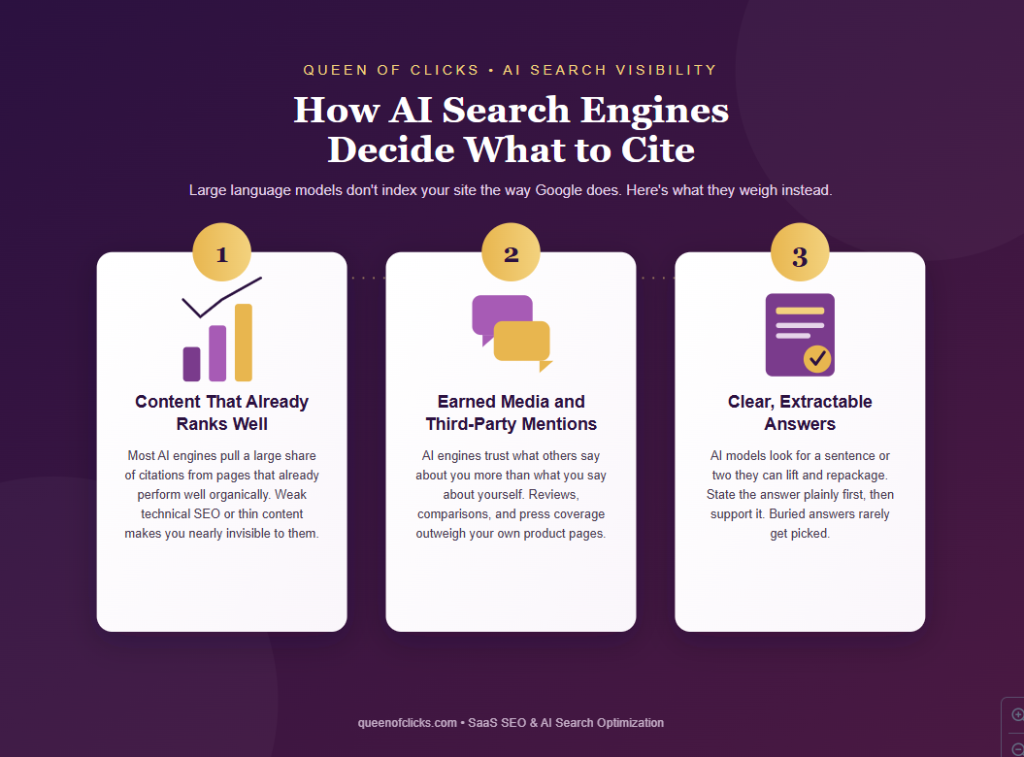
Before you can get cited, it helps to understand what these systems are actually doing. Large language models do not “know” your website the way Google’s index does. Most AI search tools pull in real-time web results, evaluate them against the user’s question, and then decide which sources are trustworthy and specific enough to reference in the answer.
They Lean Heavily On Content That Already Ranks Well
Traditional SEO is not dead, it is just not the whole story anymore. Most AI engines still draw a large portion of their citations from pages that already perform well in organic search. If your site has weak technical SEO or thin content, it is much harder for an AI model to find you in the first place, let alone trust what you have written.
They Favor Earned Media And Third-Party Mentions
Here is something that surprises a lot of marketing teams: AI engines tend to trust what other people say about you far more than what you say about yourself. Independent coverage, comparison articles, review sites, and industry publications carry more weight than your own product pages. Building a presence beyond your own domain is no longer optional.
They Reward Clear, Extractable Answers
AI models are essentially looking for a sentence or two they can lift and repackage. Content that buries the answer under three paragraphs of introduction rarely gets picked. Content that states the answer plainly, then supports it with detail, gets cited far more often.
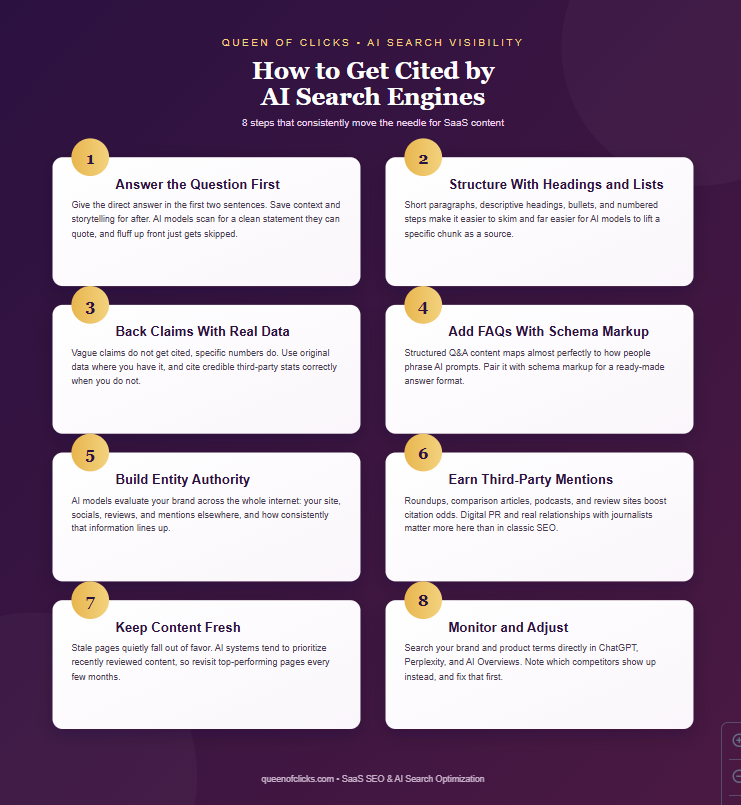
How to Get Cited by AI Search Engines: 8 Steps That Work
1. Answer the Question in the First Two Sentences
Whatever question your page or blog post is targeting, answer it immediately. Save the storytelling and context for after the direct answer. AI models scan for a clean, self-contained statement they can quote or paraphrase, and burying it under fluff just means it gets skipped.
2. Structure Content With Clear Headings and Lists
Break your content into logical sections with descriptive headings, short paragraphs, bullet points, and numbered steps. This is not just easier for humans to skim, it also makes it far easier for an AI model to pull out a specific chunk of your page and use it as a source. We go deeper on formatting and technical structure in our post on how to improve SEO for SaaS companies.
3. Back Up Claims With Original Data and Statistics
Vague claims do not get cited. Specific numbers do. If you have internal data, survey results, or original research, use it. If you do not, cite credible third-party statistics correctly and give AI models something concrete to reference. This one change alone can meaningfully increase how often your content gets picked up.
4. Add an FAQ Section With Schema Markup
Structured Q&A content maps almost perfectly to how people phrase prompts in AI tools. A well-written FAQ section, paired with proper schema markup, gives AI engines a ready-made answer format they can lift with very little extra work on their end.
5. Build Entity Authority Across the Web
AI models do not just evaluate a single page, they evaluate your brand as an entity across the entire internet: your website, your social profiles, your reviews, your mentions on other sites, and how consistently your information appears everywhere. We wrote a full breakdown of this in our guide to entity-based SEO for LLMs, which is worth a read if this concept is new to you.
6. Earn Mentions From Third-Party and Industry Sites
Since AI engines lean so heavily on earned media, getting featured in industry roundups, comparison articles, podcasts, and review platforms directly increases your odds of being cited. Digital PR, guest contributions, and genuine relationships with journalists and reviewers matter more here than they ever did for classic SEO.
7. Keep Content Fresh and Updated
Stale content quietly falls out of favor. AI systems tend to prioritize pages that have been recently reviewed or updated, since freshness signals that the information is still accurate. Set a recurring reminder to revisit your best-performing pages every few months instead of publishing once and forgetting about them.
8. Monitor Your AI Citations and Adjust
You cannot improve what you are not tracking. Regularly search your brand and product terms directly inside ChatGPT, Perplexity, and Google’s AI Overviews to see whether and how you are being mentioned. Note which competitors show up instead of you, and use that as a starting point for what to fix next.
Common Mistakes That Keep Brands Out of AI Answers
Most SaaS teams do not fail at this because they are lazy, they fail because they are applying old SEO habits to a system that works a little differently. A few patterns come up again and again:
- Writing content that is optimized for keyword density instead of clear, direct answers
- Ignoring earned media and third-party coverage in favor of only publishing on-site
- Skipping schema markup, which makes it harder for AI crawlers to parse structured data
- Publishing once and never updating a page again, even after it goes stale
- Never actually checking whether AI tools mention the brand at all
None of these mistakes are hard to fix once you know they are there, but they are easy to miss if nobody on the team is specifically watching for them.
🚀 Show Up in AI Answers, Not Just Google Results with Queen of Clicks
Getting cited by AI search engines takes a mix of technical SEO, structured content, and genuine off-site authority, and doing all three well at once is a full-time job on top of everything else running a SaaS business already demands. If your team would rather focus on building product while someone else handles visibility, that is exactly where we come in.
At Queen of Clicks, we help SaaS companies get found by both traditional search engines and AI tools like ChatGPT and Perplexity. Our SaaS SEO services are built specifically around this shift, combining content strategy, entity authority, and AI search optimization so your brand actually shows up when buyers ask an AI tool for a recommendation. If you want to see what that kind of growth could look like for your business, get in touch for a free consultation and we will walk you through exactly where you stand today.
Conclusion
AI search engines are not replacing Google overnight, but they are already changing where a meaningful share of buying decisions begin. Getting cited comes down to a fairly consistent formula: answer questions clearly, structure your content so it is easy to extract, back up what you say with real data, and build genuine authority beyond your own website. None of that happens by accident, and none of it happens overnight either, but the brands that start now will have a real head start over the ones still waiting to see how this all plays out.
FAQs
Is getting cited by AI search engines the same thing as ranking on Google?
Not exactly. Ranking well on Google often helps, since many AI tools pull from top organic results, but citation in an AI answer depends on additional factors like clarity, structure, and third-party authority that do not always line up with a page’s Google ranking.
Which AI search engines matter most for SaaS companies right now?
ChatGPT, Perplexity, Google’s AI Overviews, and Gemini currently drive the most volume for B2B and SaaS research queries, though the landscape shifts often enough that it is worth checking your own citation presence across all of them periodically rather than assuming one platform covers it.
How long does it typically take to start showing up in AI-generated answers?
There is no fixed timeline, since it depends on your current authority, content quality, and how competitive your niche is, but most teams start seeing early citation activity within a few months of consistent, structured publishing paired with off-site authority building.
Do I need to rewrite my entire website to get cited by AI search engines?
Usually not. Most sites benefit more from restructuring key pages, such as adding direct answers, FAQs, and clearer headings, than from a full rebuild. Prioritize your highest-intent pages first rather than trying to overhaul everything at once.
Can small or early-stage SaaS startups realistically compete for AI citations against bigger brands?
Yes, and often more easily than they can compete for competitive Google rankings. AI engines tend to reward specific, well-structured answers over sheer brand size, which gives smaller companies with genuinely useful content a real shot at being cited.
Does having a blog help with AI search citations, or does it need to be a different kind of content?
A blog absolutely helps, as long as the content is structured for direct answers rather than written purely for keyword volume. Comparison pages, how-to guides, and data-backed articles tend to perform especially well for this purpose.
Is there a way to see exactly which pages on my site are being cited by AI tools?
There is no single universal dashboard yet, since each AI platform handles this differently, but you can manually test relevant prompts across ChatGPT, Perplexity, and Google AI Overviews, and several emerging AI visibility tracking tools are starting to offer more automated reporting on this.