How to Recover Rankings for Your SaaS Website
You checked your dashboard on a normal Tuesday and something looked off. Impressions down. A keyword that used to sit at position 4 is now buried on page two. Trial signups from organic search have gone quiet.
If you are reading this, you already know the feeling. The good news is that you can recover rankings for a SaaS website without guessing your way through it, and most drops are far more fixable than they first appear. This guide walks through why SaaS sites lose visibility, how to recover SEO rankings once you know the real cause, and the exact sequence to follow so you are not wasting weeks on the wrong fix.

Key Takeaways
- Diagnose the real cause of your ranking drop before making changes, as the wrong fix can waste valuable time.
- Prioritize technical SEO issues first, then improve outdated content, backlinks, search intent alignment, and trust signals for sustainable recovery.
- SEO recovery takes time, so monitor performance consistently and focus on long-term improvements rather than expecting instant results.
- Protect your future rankings with regular content audits, proactive monitoring, and a documented SEO maintenance process.
- Queen of Clicks helps SaaS companies recover lost rankings with technical SEO, content optimization, and AI search strategies designed for long-term organic growth.
Why SaaS Companies Feel Ranking Drops Harder Than Most
A dip in rankings is stressful for any website owner, but for a SaaS business it hits differently. Your organic traffic is not just readers browsing content. It is product qualified leads who searched for a solution, found your comparison page or feature page, and were one click away from starting a trial.
When those pages slide out of the top results, you lose more than traffic. You lose pipeline. A drop on a “best [category] software” page or a bottom-of-funnel comparison page can quietly dent monthly recurring revenue weeks before anyone connects the dots in a board meeting.
That is why speed and accuracy matter here. Guessing at fixes, like most generic advice tells you to do, wastes the exact window where a quick, correct diagnosis would have limited the damage.
What Is Actually Causing Your Ranking Drop
Before you touch a single page, you need to know what you are dealing with. Most SaaS ranking drops fall into one of five categories.
A Core Algorithm Update
Google rolls out broad core updates several times a year, and each one recalibrates how content quality, expertise, and user experience are scored. If your traffic dropped in a gradual slide over several days rather than overnight, and it lines up with a known update window, this is likely your cause.
Technical Problems Blocking Crawlability
Broken redirects, a botched robots.txt change, an accidental noindex tag pushed during a deploy, or a sitemap that stopped updating can all quietly choke off your visibility. These issues are common after a product launch, a rebrand, or a migration to a new framework, and they often get missed because nothing “looks” broken from the front end.
Content That Has Gone Stale
SaaS content ages faster than most industries realize. Screenshots show an old UI. Pricing details are out of date. A feature you mention was deprecated two releases ago. Search engines and readers both notice, and thin or outdated pages lose ground to competitors who kept theirs current.
A Weakened Backlink Profile
Losing high-authority backlinks, whether from a partner site restructuring, a directory shutting down, or a link removal after an acquisition, can chip away at the authority signals that helped you rank in the first place.
Site Changes That Were Not Handled Carefully
Domain migrations, URL restructuring, a new CMS, or a full website redesign are common triggers. Even a well-planned migration can cause a temporary or lasting drop if redirects, canonical tags, or internal linking were not mapped correctly beforehand.

How to Diagnose the Drop Before You Change Anything
Jumping straight to fixes without a diagnosis is how businesses waste months. Work through this order instead.
Confirm It Is Real, Not a Reporting Glitch
Check Google Search Console and your analytics platform side by side. Occasionally a drop is caused by a tracking tag firing incorrectly or a temporary indexing delay rather than an actual ranking change. Rule this out first.
Map the Timeline Against Known Updates
Compare the date your traffic started sliding against Google’s confirmed update rollouts. A drop that starts precisely when a core update begins points toward an algorithmic cause. A drop tied to a deploy date points toward something your team changed.
Segment by Page Type
Look at which pages lost visibility. If it is only your blog content, that points to content quality or freshness. If it is your comparison pages, pricing page, or product pages, that often signals a trust or E-E-A-T issue, or a technical problem specific to that template.
Check for Manual Actions
Open Search Console’s Manual Actions report. It is rare, but if Google issued a manual penalty, you will see it there, and the fix path is completely different from an algorithmic drop.
Our team at Queen of Clicks starts every recovery engagement with exactly this kind of audit, because the right fix depends entirely on getting the diagnosis right. If you want a second set of eyes on your own data, our SaaS SEO services include this diagnostic work as the very first step.

A Step-By-Step Plan to Recover Rankings
Once you know the cause, recovery becomes a matter of sequencing the right fixes.
Step 1: Fix Technical Issues First
Technical problems block everything else you do from working. Confirm your key pages are indexable, your sitemap is current, redirects resolve correctly, page speed is healthy, and mobile usability has no errors. Nothing else on this list matters if search engines cannot properly crawl and render your site.
Step 2: Refresh and Strengthen Underperforming Content
Update outdated screenshots, pricing, integrations, and statistics. Add genuine depth: first-hand product knowledge, real customer outcomes, and specifics that a competitor scraping the SERP could not easily replicate. If a page is thin, decide whether to expand it meaningfully or consolidate it into a stronger, related page.
Step 3: Repair Your Backlink Profile
Audit which referring domains you have lost and why. Reach out to reclaim broken or removed links where it makes sense, and continue building new ones through partnerships, guest contributions, and digital PR. Our guide on link building for SaaS breaks down channels that work well for software companies specifically.
Step 4: Realign Content With Current Search Intent
Search intent shifts over time. A keyword that used to be informational might now trigger comparison-style results, or vice versa. Pull up the current top-ranking pages for your target keywords and check whether your content format, depth, and angle still match what is winning today.
Step 5: Strengthen Trust Signals on High-Value Pages
Product pages, pricing pages, and comparison pages carry the most commercial weight, so they deserve the most scrutiny. Add clear author or reviewer credentials, cite real data, link to your documentation, and make sure claims about your product are specific and verifiable rather than vague.
How Long It Actually Takes to Recover SEO Rankings
This is the question every client asks first, and honesty matters more than optimism here. Technical fixes can show early movement within a couple of weeks. Content and authority fixes typically take longer, often six to twelve weeks before you see stable improvement, and full recovery from a major core update can take until Google’s next significant update cycle.
Industry tracking backs this up. Recent analysis of a major 2026 core update found that more than half of tracked domains registered measurable ranking movement within the first two weeks of rollout, which shows just how widespread and gradual these shifts can be. Set expectations with your team accordingly. Rankings that dropped over weeks rarely snap back overnight, and any agency promising a guaranteed recovery timeline is telling you what you want to hear, not what actually happens.
How to Protect Your Rankings After You Recover Them
Recovery is not the finish line. Once your rankings stabilize, build habits that prevent the next drop.
Schedule quarterly content audits so pages get refreshed before they go stale. Monitor Search Console weekly, not monthly, so you catch issues within days rather than after a quarter of lost traffic. Keep a running log of every major site change, from CMS updates to redesigns, so you have a clear paper trail if something shifts later. And treat SEO as a system that needs ongoing attention rather than a project you finish once. Our SaaS SEO consulting clients build this kind of monitoring cadence directly into their growth strategy, which is usually what separates a one-time recovery from lasting stability.
If you want to see the potential impact of consistent, well-executed SEO on your own pipeline, our SaaS SEO ROI calculator is a useful place to start.
🚀 Let Queen of Clicks Help You Recover and Protect Your Rankings
Recovering lost rankings while still running a SaaS business is a lot to manage on top of your regular roadmap. Queen of Clicks works exclusively with SaaS companies, which means we already understand how your trial funnel, product pages, and documentation all tie back to organic visibility. We combine a thorough technical audit, content strategy grounded in what is actually ranking today, and AI search optimization so your pages stay visible as search itself keeps changing. If your rankings have slipped and you want a team that has done this before, reach out for a free consultation and we will walk you through exactly what we would prioritize first.

Conclusion
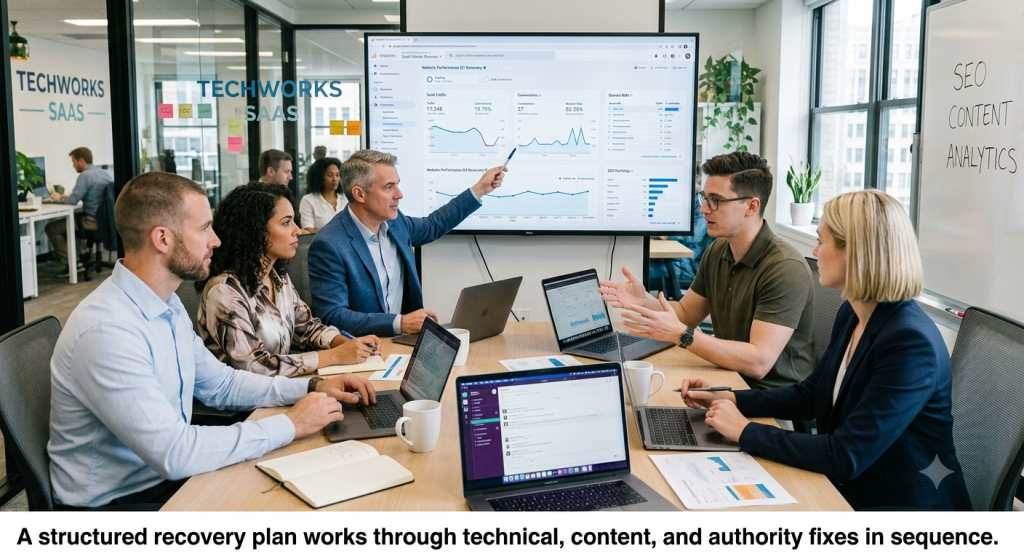
A ranking drop feels urgent because it is urgent, but panic rarely leads to the right fix. The businesses that recover rankings fastest are the ones that diagnose calmly, work through technical, content, and authority issues in the right order, and set realistic expectations for how long it takes to recover SEO rankings.
Your SaaS site can regain the visibility it lost, and often end up stronger than before, as long as the recovery plan is built on what is actually happening in your data rather than a generic checklist.
If you would rather have an experienced team handle the diagnosis and execution, see how Queen of Clicks has helped other SaaS companies recover and grow their organic visibility.
FAQs
Can migrating to a new domain or rebranding cause a permanent rankings drop?
It can, but it does not have to be permanent. The most common cause of lasting damage after a migration is incomplete redirect mapping, where old URLs do not point to their closest equivalent on the new domain. Done carefully, with 301 redirects, updated internal links, and a submitted sitemap, most migrations recover fully within a few months.
Should I pause publishing new content while I focus on recovery?
No. Pausing content production usually slows recovery rather than helping it, since fresh, relevant content is one of the signals that shows a site is active and trustworthy. It is fine to shift your calendar toward updating existing pages first, but stopping entirely tends to work against you.
Does a ranking drop always reduce trial signups and demo requests at the same rate as traffic?
Not necessarily. If the pages that lost rankings were mostly top-of-funnel blog content, your trial signups may barely move. If the drop hit comparison pages, feature pages, or your pricing page, the impact on signups will usually be disproportionately larger than the raw traffic numbers suggest.
Should I increase paid search spend while my organic rankings recover?
Many SaaS companies do lean on paid search temporarily to protect pipeline while organic recovery is underway, and that is a reasonable short-term bridge. Just be careful not to treat it as a permanent substitute, since paid and organic serve different roles in the funnel and organic typically carries a lower long-term cost per acquisition.
Can switching CMS platforms or replatforming trigger a drop even if nothing else changed?
Yes, and this catches teams off guard often. A new CMS can change URL structures, page speed, how metadata is rendered, or how internal links are generated, even when the visible content stays identical. Always run a full technical crawl before and after a replatform to catch these differences early.
Why did only some of my product pages lose rankings while others held steady?
This usually points to a content or trust gap specific to those pages rather than a site-wide issue. Compare the affected pages against the ones that held steady: check depth, freshness, internal linking, and whether competitors published something stronger for that specific keyword around the same time.
Is it possible to recover rankings without waiting for the next algorithm update?
Yes, for technical and content-quality issues, Google can reassess and re-rank pages as soon as it recrawls and reprocesses them, which does not require a new update cycle. Recovery tied specifically to a broad core update tends to be the exception, since those recalibrations are usually confirmed at the next core update rather than continuously.