Agentic Search: A Comprehensive Guide for SaaS Companies
If you run a SaaS company, you have probably noticed that search does not work the way it used to. Buyers are not just typing three or four keywords into Google anymore. They are asking AI tools to research vendors, compare pricing tiers, and even shortlist options on their behalf. That shift has a name: agentic search.
Agentic search is a form of AI-powered search where an autonomous agent breaks down a complex request into smaller steps, pulls information from multiple sources, and returns a synthesized answer or completed task rather than a list of links. For SaaS companies, this is not a minor technical update. It is a new discovery layer that sits between your product and the people who need it, and it rewards brands that structure their content differently than traditional SEO ever required.
This guide walks through what agentic search actually is, how it differs from the AI search experiences you already know, why it matters for SaaS growth, and what your team can do this quarter to show up in it. If you are still working through the fundamentals of SEO for SaaS first, this guide will make a lot more sense once that foundation is in place.

Key Takeaways
- Agentic search is transforming SaaS discovery by enabling AI agents to research, compare, and recommend software instead of simply returning search results.
- SaaS companies need clear, structured, and detailed content because AI agents prioritize accurate information when building product recommendations.
- Optimizing for agentic search requires strengthening topical authority, using structured data, maintaining consistent product information, and improving internal linking.
- Although agentic search presents challenges such as hallucinations and inconsistent AI behavior, early adoption can create a lasting competitive advantage for SaaS brands.
- As AI agents become a bigger part of the SaaS buying journey, companies that consistently produce trustworthy, agent-friendly content will be more likely to appear on buyers’ shortlists.
What Is Agentic Search?
Agentic search applies the principles of agentic AI (systems that plan, reason, and take multi-step action with limited human input) to the act of finding information. Instead of matching keywords to indexed pages, an agentic system understands the goal behind a request, decides which tools or sources it needs, gathers information iteratively, and keeps refining its answer until the goal is met.
A simple way to picture the difference: a keyword search finds pages that mention “best project management software for remote teams.” An agentic search process behaves more like a research assistant. It might pull recent reviews, check pricing pages, compare feature sets across five vendors, and hand the user a shortlist with reasoning attached, all without the user writing a second query.
The Building Blocks of an Agentic System
Most agentic search implementations share a few common components:
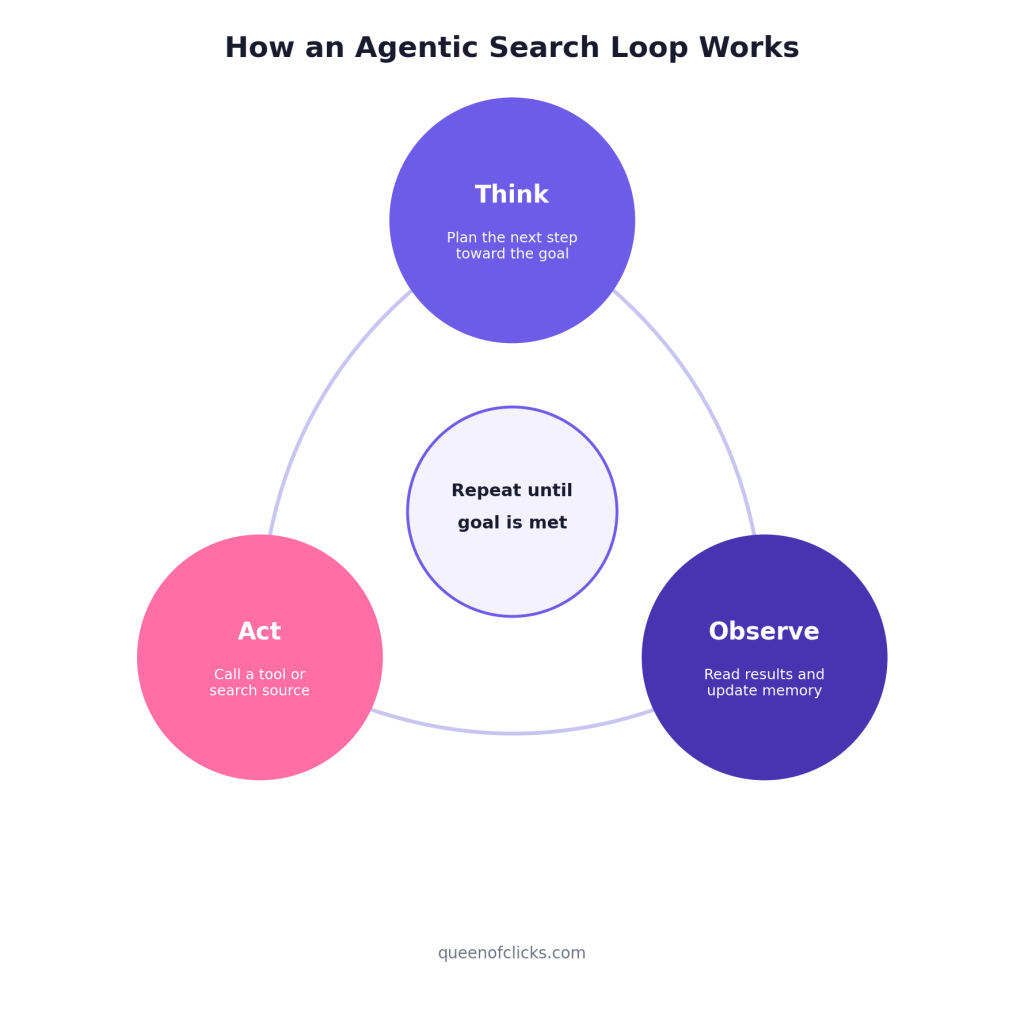
- A reasoning engine, typically a large language model, that plans the next step based on the goal and what it has learned so far
- A set of tools, such as web search, internal databases, or APIs, that the agent can call to gather information
- Memory, so the agent can track what it has already found and avoid repeating steps
- A synthesis step, where the agent combines everything it gathered into a coherent answer, plan, or recommendation
This loop of reasoning, acting, and observing is often called a ReAct pattern, and it is the foundation behind most of the agentic search tools currently in production.
How Agentic Search Differs From Traditional AI Search
It is easy to lump every AI-powered search experience into one bucket, but there is a real distinction worth understanding, especially if you are trying to plan a content strategy around it.
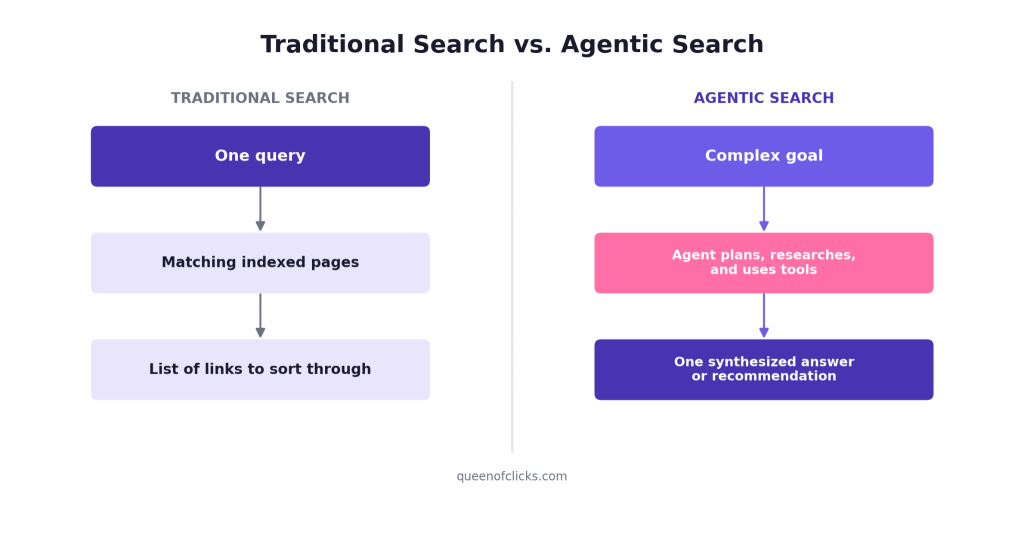
Traditional generative AI search, the kind you get from a standard chatbot answering a single question, is largely reactive. You ask a question, it retrieves relevant information from its training data or a quick web lookup, and it summarizes an answer. It is fast and useful, but it typically stops after one pass.
Agentic search goes further. It is proactive and goal oriented, capable of tackling requests that require more than a single lookup. Ask an agentic system to “find a CRM that integrates with our existing help desk software, fits a 40-person sales team, and stays under $50 per seat,” and it will decompose that into sub-tasks: researching CRMs, checking integration compatibility, comparing pricing, and filtering by team size, before returning a recommendation.
Why Agentic Search Matters for SaaS Companies
SaaS buying decisions have always involved research: comparing features, reading reviews, checking integrations, and evaluating pricing tiers. Agentic search compresses that entire research phase into something a buyer can delegate to an AI agent, which changes where and how your brand gets discovered.
A few reasons this matters right now:
- Buyers are outsourcing evaluation, not just search. When someone asks an agent to build a shortlist of tools that meet specific criteria, your product either gets pulled into that shortlist based on how well your content answers those criteria, or it gets left out entirely. There is no scrolling to page two.
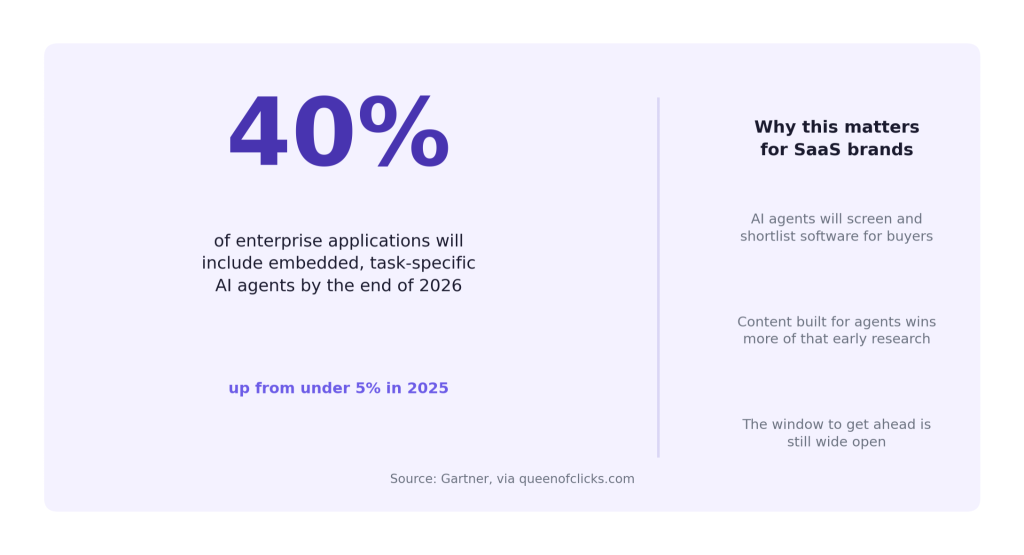
- Adoption is moving fast. Gartner projects that by the end of 2026, 40% of enterprise applications will include embedded, task-specific AI agents, up from under 5 percent just a year earlier. That kind of growth means agentic systems will touch a meaningful share of B2B software research within the next few buying cycles, not in some distant future.
- Structured, specific content wins. Agents work best when they can extract clear facts: exact pricing, specific integrations, defined use cases, and named limitations. Vague marketing copy that never quite states what your product does or does not do is much harder for an agent to use confidently, which means it is more likely to get skipped in favor of a competitor with clearer answers.
- Trust signals carry more weight, not less. Because agents synthesize across multiple sources, having consistent, accurate information about your product across your site, review platforms, and third-party mentions actually increases the odds an agent surfaces you correctly.
How to Optimize Your SaaS Content for Agentic Search
Showing up well in agentic search is not a complete departure from good SEO practice. It builds on it. Here is where to focus.
Write for Specific Questions, Not Broad Topics
Agentic systems break user goals into sub-tasks and search for answers to each one. Content that directly answers a specific, narrow question (“does this tool support SSO for teams under 20 people?”) performs better than a broad overview page that never gets concrete. Structure your product pages, comparison pages, and documentation around the exact questions a buyer or an agent acting for that buyer would ask.
Strengthen Topical Authority
Publish content that covers a subject from multiple angles rather than one thin post per keyword. If agentic systems are pulling from several sources to build a complete picture, you want to be the source that already covers the full picture, so the agent does not need to look elsewhere.
Use Structured Data and Clear Formatting
Schema markup, well-labeled tables, FAQ sections, and clean headings all make it easier for an agent to extract accurate facts from your pages. This matters more in agentic search than it did in classic keyword search, because agents are parsing for specific data points, not just relevance signals.
Keep Product Information Consistent Everywhere
If your pricing page says one thing and your G2 profile says another, an agentic system doing comparative research may flag the inconsistency or simply trust the source that looks more current. Audit your pricing, feature lists, and integration claims across your site, review platforms, and partner pages regularly.
Build Internal Linking Around Buyer Journeys
Agents that land on one page often follow logical next steps to complete their research. Strong internal linking between related comparison pages, use case pages, and pricing pages helps an agent (and a human) move through your site the way a real buying journey unfolds.
Monitor How AI Systems Represent Your Brand
Set up a regular process to check how your product shows up when agentic and generative AI tools are asked about your category. Some AI visibility platforms can benchmark this for you, and even a manual monthly check with a handful of common buyer prompts will surface gaps worth fixing. For a deeper look at how this compares to older methods, see our breakdown of AI-driven versus traditional SEO agencies for SaaS.

Are There Risks to Watch For?
Agentic search is not without its complications, and it is worth going in with clear eyes.
- Resource intensity. Multi-step agentic workflows can be computationally expensive, which is part of why adoption, while fast, still has a meaningful gap between pilot projects and full production use.
- Errors and hallucinations. Agentic systems are not infallible. Errors compound across multi-step processes, so a wrong assumption early in the chain can throw off the final answer.
- The need for human oversight. Most practitioners agree that a human-in-the-loop approach is still essential for validating outputs and catching mistakes before they influence a real buying decision.
- Uneven results across platforms. Different agentic search tools use different reasoning approaches and tool sets, so your visibility can vary significantly from one platform to the next.
None of this should discourage SaaS teams from preparing for agentic search. It just means treating it as an evolving channel that deserves ongoing attention rather than a one-time project.
Key Benefits of Getting Agentic Search Right
When SaaS companies invest in agentic search readiness early, the payoff tends to show up in a few concrete ways:
- Earlier presence in the buying funnel. Agents often do the research buyers used to do themselves in the early stages, so being cited or recommended at that stage puts you in front of prospects before your competitors even know they exist.
- Higher-quality inbound leads. Buyers who arrive after an agent has already filtered options against their real requirements tend to be closer to a decision than someone browsing a generic search results page.
- Stronger content ROI. The same work that makes your content clear and specific for agents also makes it more useful for human readers, so you are not building a separate strategy from scratch.
- A durable competitive edge. Because most companies have not yet adapted their content for agentic discovery, the SaaS brands that move now have a real window to establish authority before the space gets crowded.
🚀 Why Queen of Clicks Is Your SaaS Partner for Agentic Search
Preparing for agentic search touches content strategy, technical SEO, structured data, and ongoing monitoring, and most in-house marketing teams are already stretched across product launches, demand generation, and everyday content production. Trying to bolt agentic search readiness onto an already full plate usually means it gets deprioritized until a competitor starts showing up in AI-driven recommendations first.
A partner who understands both classic SEO fundamentals and how agentic systems parse, evaluate, and cite content can help you avoid that gap. That means auditing your existing content for the specificity and structure agents look for, closing consistency issues across your web presence, and building a measurement approach so you can see whether your visibility in agentic results is actually improving over time.
If your SaaS company wants to get ahead of this shift instead of reacting to it later, Queen of Clicks works with SaaS teams to build content and search strategies that hold up in both traditional and agentic search environments. Not sure where your content stands today? Try our SaaS SEO ROI calculator to see what improved visibility could be worth, then get in touch and we will map out a practical roadmap together.

Conclusion
Agentic search represents a genuine shift in how SaaS buyers find, compare, and choose software, not just another algorithm update to react to for a few weeks and forget. The companies that treat their content as a resource agents can actually parse, trust, and cite will be the ones showing up when it matters most: at the exact moment a buyer, or an AI agent acting for that buyer, is deciding who makes the shortlist.
Start with the fundamentals covered here, keep your information consistent and specific, and treat agentic search as an ongoing part of your growth strategy rather than a one-time fix.
FAQs
Is agentic search the same as AI Overviews or AI Mode in Google Search?
No. AI Overviews and similar features generally summarize search results for a single query. Agentic search goes further by planning multiple steps, calling tools, and completing a broader task or research goal on the user’s behalf.
Do I need to rebuild my entire website to prepare for agentic search?
Not usually. Most SaaS companies can start by auditing existing pages for clarity, adding structured data, and tightening up inconsistent product information, rather than starting from scratch.
How long does it take to see results from agentic search optimization?
It varies by how much foundational SEO work is already in place. Companies with strong existing content structures often see improvements within a few months, while those starting from thin or inconsistent content should expect a longer runway.
Can small or early-stage SaaS companies compete with larger vendors in agentic search?
Yes. Agentic systems tend to reward specificity and clarity over sheer domain size, so a smaller company with precise, well-structured content about its niche can outperform a larger competitor with vague, generic pages.
What is the difference between agentic search and Answer Engine Optimization (AEO)?
AEO is a broader discipline focused on getting your brand cited or recommended across all AI-driven answer surfaces, including chatbots, AI Overviews, and voice assistants. Agentic search is one specific and increasingly important part of that landscape, defined by the multi-step, tool-using behavior of the AI systems involved.