AI-Driven vs Traditional SEO Agencies for SaaS: Pros and Cons
Choosing the right SaaS SEO agency can feel like a high-stakes gamble for SaaS companies. Get it wrong and you’ve burned six months of runway on strategies that don’t compound. Get it right and organic search becomes your most predictable, scalable acquisition channel.
In fact, organic search drives around 53% of all website traffic, making it the single largest and most consistent growth channel online.
Today, that decision is more complex than ever. A new breed of AI-driven SEO agencies has entered the market, promising faster execution, lower costs, and data-backed precision. Meanwhile, traditional SEO agencies defend their turf with deep human expertise, long-term relationship-building, and holistic brand strategy.
So which is right for your SaaS? This guide breaks down both approaches, objectively, without hype, so you can make a confident, informed decision.

Key Takeaways
- AI-driven agencies deliver faster execution and greater scalability, making them ideal for rapidly growing SaaS companies.
- They are typically more cost-efficient, helping startups maximize limited budgets.
- Traditional agencies offer deeper strategic thinking and long-term planning.
- They excel at building strong brand positioning and nuanced messaging.
- Relationship-based link building from traditional agencies is especially valuable in competitive, high-authority markets.
What Is an AI-Driven SEO Agency?
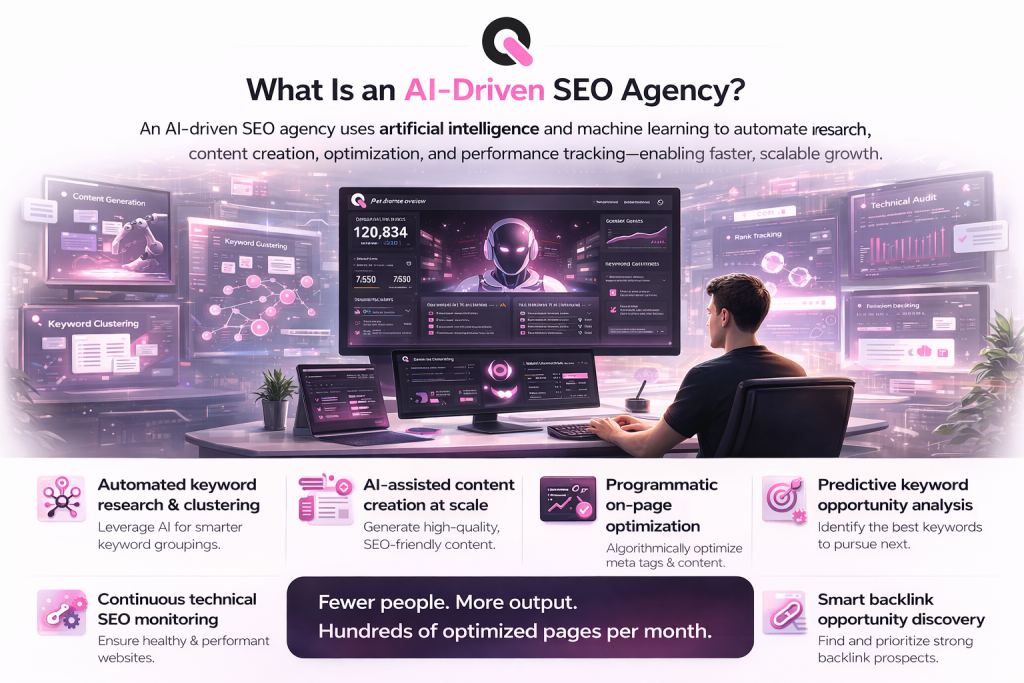
An AI-driven SEO agency uses artificial intelligence and machine learning tools as the backbone of their workflow. This typically includes:
- Automated keyword research and clustering using NLP models
- AI-generated or AI-assisted content production at scale
- Programmatic on-page optimization based on SERP analysis
- Automated technical SEO audits and monitoring
- Predictive analytics for keyword opportunity scoring
- Link prospecting algorithms that identify high-value backlink targets
These agencies often operate with leaner teams, a handful of strategists overseeing AI systems that would otherwise require a team of 15–20 specialists. The result is a service that can publish hundreds of optimized pages per month and monitor thousands of ranking signals simultaneously.
Well-known AI-driven SEO platforms powering some of these agencies include Surfer SEO, MarketMuse, Jasper, Clearscope, and SEMrush‘s AI toolkit. Some agencies build proprietary systems on top of large language models (LLMs) like GPT-4 or Claude to power their content workflows.
What Is a Traditional SEO Agency?
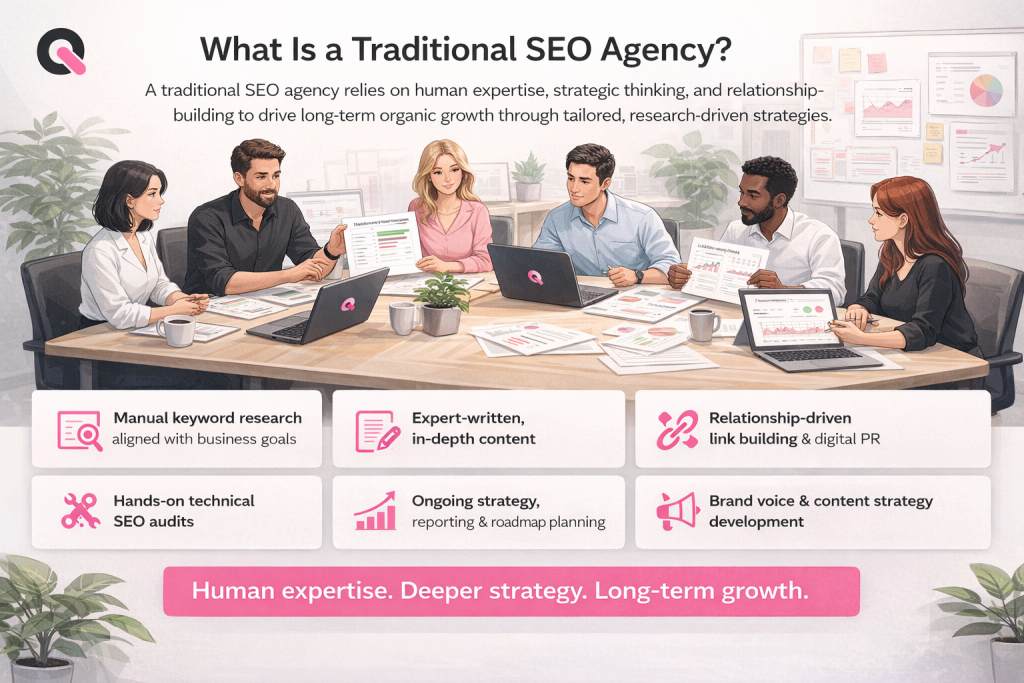
Traditional SEO agencies rely primarily on human expertise, seasoned strategists, content writers, digital PR professionals, and technical SEO specialists, to drive organic growth. Their process is typically research-first, relationship-driven, and bespoke to each client.
A traditional agency engagement usually involves:
- Manual keyword research tied to business intent and ICP analysis
- Original long-form content written by subject matter experts or trained writers
- Outreach-based link building with real editorial relationships
- Technical SEO audits conducted by experienced engineers
- Monthly strategy calls, reporting, and roadmap reviews
- Brand voice development and content strategy consulting
Traditional agencies tend to work across longer engagement timelines and build deep familiarity with a client’s product, audience, and competitive landscape. The best SEO SaaS companies often have specialists for SaaS specifically, understanding concepts like product-led growth, free trial conversion funnels, and the buyer journey from awareness to demo.
AI-Driven SEO Agencies: Pros for SaaS
1. Speed and Scale
AI-driven agencies can produce and optimize content dramatically faster than traditional teams. For SaaS companies trying to establish topical authority across a broad keyword universe, think hundreds of bottom-of-funnel use-case pages or comparison articles, this speed is invaluable.
Where a traditional agency might publish 8–12 articles per month, an AI-driven shop can execute 50–100 pieces in the same window. For SaaS products targeting fragmented, long-tail keyword markets, this velocity is a meaningful competitive advantage.
2. Cost Efficiency
AI-driven agencies typically price lower than traditional counterparts. Their lean team model means lower overhead, and many pass those savings on to clients. For early-stage SaaS companies with limited marketing budgets, the ROI-per-dollar can be significantly higher, especially in the first 6–12 months of an SEO program.
Average monthly retainers for AI-driven agencies often range from $2,500–$8,000, compared to $6,000–$20,000+ for established traditional agencies.
3. Data-Driven Precision
AI tools excel at synthesizing large datasets quickly. They can analyze the top 20 ranking pages for a keyword in seconds, identify content gaps, extract semantic co-occurrence patterns, and recommend exact on-page optimizations with high accuracy. Human strategists could do this, but it takes hours, AI does it in seconds.
This precision means pages are tightly optimized from day one, reducing wasted effort on content that has weak ranking potential.
4. Scalable Programmatic SEO
For SaaS companies with large databases, integrations directories, template libraries, use-case matrices, AI-driven agencies are uniquely positioned to execute programmatic SEO at scale. They can generate and optimize thousands of dynamic pages using structured data, creating massive topical coverage that would be cost-prohibitive with human writers alone.
5. Real-Time Monitoring and Iteration
AI systems can monitor ranking changes, competitor movements, and algorithm updates around the clock. They can flag issues and trigger optimizations faster than any human review cycle, which matters in dynamic SaaS niches where competitive rankings shift frequently.
AI-Driven SEO Agencies: Cons for SaaS
1. Content Quality Ceiling
AI-generated content has improved dramatically, but it still struggles with nuance, original insight, and the kind of authoritative depth that resonates with technical SaaS audiences. A DevOps platform targeting senior engineers, or a fintech SaaS aimed at CFOs, needs content that demonstrates genuine expertise, not optimized filler.
Google’s Helpful Content system and E-E-A-T (Experience, Expertise, Authoritativeness, Trustworthiness) guidelines increasingly reward first-hand experience and genuine insight. AI content that lacks these qualities may rank initially but face headwinds over time.
2. Limited Strategic Thinking
SEO for SaaS is about mapping content to the buyer journey, aligning with product positioning, supporting sales enablement, and building brand authority in competitive categories. AI systems optimize what they can measure, but they can’t yet replace a seasoned strategist who understands how SEO intersects with your go-to-market motion.
3. Link Building Gaps
High-quality backlinks remain one of the most important ranking signals. AI can identify link opportunities, but earning links from authoritative publications, thought leaders, and industry sites still requires human relationship-building. Many AI-driven agencies either outsource this or offer lower-quality link building at scale, which can backfire.
4. Brand Voice Inconsistency
SaaS brands invest heavily in tone, voice, and messaging frameworks. AI-generated content, even when well-prompted, can produce stylistically inconsistent output that requires significant editorial oversight. Without tight human QA, your blog can start to feel generic, exactly the opposite of what premium SaaS brands need.
5. Over-Reliance on Templates
Some AI-driven agencies apply the same content templates across clients with minimal customization. This cookie-cutter approach may deliver short-term ranking gains but rarely produces the breakout content pieces, comprehensive guides, original research, thought leadership, that drive branded search and Domain Authority over time.
Traditional SEO Agencies: Pros for SaaS
1. Deep Strategic Expertise
Experienced traditional agencies bring frameworks honed across dozens of SaaS clients. They understand how to prioritize keywords by funnel stage, how to build a content moat against well-funded competitors, and how to align SEO with broader marketing initiatives like ABM, category creation, and product launches.
2. Superior Content Quality
The best traditional agencies work with specialized writers who understand SaaS, B2B, and technical topics at a deep level. This produces content that converts, builds credibility, and positions your brand as a category leader. In competitive SaaS niches, this quality differential is often what separates first-page rankings from genuine pipeline impact.
3. Authentic Link Building
Traditional agencies with strong digital PR capabilities can earn backlinks from top-tier publications: TechCrunch, Forbes, Gartner, industry-specific media, and influential newsletters. These links carry significant authority and often drive referral traffic alongside SEO value. This type of outreach is relationship-intensive, and human.
4. Holistic Brand Building
SEO doesn’t exist in a vacuum. Traditional agencies are better equipped to integrate SEO with content marketing, PR, social, and demand generation, ensuring that organic search supports and reinforces your broader brand narrative rather than operating as a siloed channel.
5. Accountability and Relationship
A dedicated account manager who knows your business, your product roadmap, your ICPs, and your competitive landscape is genuinely valuable. Traditional agencies typically offer higher-touch relationships, quarterly business reviews, and strategic advisory, partnerships, not just service delivery.
Traditional SEO Agencies: Cons for SaaS
1. Higher Cost
Premium traditional agencies are expensive. Retainers at top SaaS-focused firms can run $10,000–$25,000+ per month. For early-stage startups, this is often prohibitive, especially when other growth channels are competing for the same budget.
2. Slower Execution
Human-driven processes take time. Onboarding, strategy development, content briefing, writing, editing, publishing, even well-run traditional agencies operate on monthly publishing cycles. In fast-moving categories where first-mover content advantage matters, this pace can feel frustrating.
3. Inconsistent Tool Adoption
Not all traditional agencies have modernized their tech stacks. Some still rely on legacy processes for keyword research, reporting, and content optimization, leading to inefficiencies and missed insights that AI-powered tools surface automatically. The best traditional agencies are adopting AI tools; the rest are falling behind.
4. Difficult to Scale Rapidly
If you need to 10x your content output during a growth sprint, traditional agencies are constrained by headcount. Bringing on additional writers, editors, and strategists takes time and affects quality consistency. AI-driven agencies scale output almost instantly.
5. Variable ROI Visibility
Traditional agencies have historically been inconsistent in reporting granular ROI. Monthly PDF reports are standard but often lag behind real-time ranking and traffic changes. Without proactive insight into what’s working, and why, it’s harder to make fast optimization decisions.
Head-to-Head Comparison
Here’s a snapshot comparison across the dimensions that matter most for SaaS companies:
| Factor | AI-Driven Agency | Traditional Agency |
|---|---|---|
| Speed of Execution | Rapid (hours/days) | Slower (weeks) |
| Cost | Lower, scalable pricing | Higher retainers |
| Scalability | Highly scalable | Limited by headcount |
| Creativity & Strategy | Limited for complex briefs | Strong strategic depth |
| Content Quality | Good for volume | Superior for nuanced topics |
| Reporting & Analytics | Real-time dashboards | Monthly manual reports |
| Technical SEO | Strong automation | Strong with hands-on audits |
| Relationship Building | Minimal | Dedicated account managers |
| Best for SaaS Stage | Seed–Series B (growth mode) | Series B+ (brand building) |
Which Type of Agency Is Right for Your SaaS?
The answer depends on your stage, budget, and growth objectives. Here’s a practical decision framework:
Choose an AI-Driven Agency If…
- You’re pre-Series A or early Series B with a lean marketing budget
- You need to establish topical coverage quickly across a broad keyword set
- Your product targets a technical audience with high informational search volume
- You want programmatic SEO for a large catalog of use cases, integrations, or templates
- You have in-house content editors who can QA and elevate AI-generated drafts
- You need transparent, real-time reporting without waiting for monthly reviews
Choose a Traditional Agency If…
- You’re Series B+ and investing in brand authority alongside performance marketing
- Your product competes in a high-authority, high-trust vertical (fintech, healthcare, legal)
- You need deep integration between SEO, content strategy, PR, and demand generation
- Your content needs to demonstrate genuine expertise and first-hand experience (E-E-A-T)
- You’re targeting enterprise buyers who scrutinize vendor credibility heavily
- Link building and digital PR are critical competitive differentiators in your category
Consider a Hybrid Approach
Increasingly, the most sophisticated SaaS marketing teams are taking a hybrid approach: using AI-driven agencies or tools for high-volume, bottom-of-funnel content and programmatic SEO, while retaining a traditional agency or fractional SEO strategist for brand-level content, digital PR, and strategic oversight.
This captures the speed-and-scale advantages of AI while preserving the quality and authority-building that traditional expertise delivers. Many companies also build internal SEO functions that orchestrate both types of vendors.
| Questions to Ask Any SEO Agency (AI-Driven or Traditional): 1. Can you show SaaS-specific case studies with verifiable traffic and revenue outcomes? 2. How do you balance AI automation with human editorial oversight? 3. How do you approach link building, outreach-based or scaled tactics? 4. What does your reporting cadence look like, and what KPIs do you prioritize? 5. How do you stay aligned with Google’s Helpful Content and E-E-A-T guidelines? 6. How will you ramp up execution if we need to scale quickly? |
The Future of SEO for SaaS: AI + Human Collaboration
The binary of “AI vs. traditional” is already becoming outdated. The best SaaS SEO agencies, whatever their origin, are converging on a model where AI handles the heavy lifting of research, optimization, and monitoring, while human strategists focus on what AI genuinely can’t replicate: judgment, creativity, relationships, and brand narrative.
For SaaS companies evaluating their options, the more useful question is not “AI or human?” but rather: “Does this agency combine AI-powered efficiency with the strategic and editorial quality that will actually move our business forward?”
Agencies that answer that question convincingly, with proof, are the ones worth hiring.
🚀 Partner with Queen of Clicks: Your SaaS SEO & AI Growth Agency
If you don’t want to choose between speed and strategy, you don’t have to. At Queen of Clicks, we combine the scalability of AI-driven SEO with the depth of traditional expertise to help SaaS companies grow faster, smarter, and more predictably. We don’t just optimize for Google, we position your brand for the future and optimize for AI search experiences as well.
Here’s how we help you win:
- AI-powered SEO execution to scale high-intent content and capture demand faster
- Strategic SaaS expertise aligned with your funnel, ICP, and revenue goals
- Optimization for AI search (LLMs, generative engines, and zero-click results)
- High-quality content that meets E-E-A-T standards and actually converts
- Data-driven decisions with real-time insights and continuous optimization
- Authority-building link strategies that strengthen your long-term rankings
Whether you’re scaling fast or building category leadership, we act as your growth partner, not just another agency.
👉 Ready to turn SEO into your most predictable growth channel? Contact Queen of Clicks today and let’s build your SaaS growth engine.

Conclusion
SEO remains one of the highest-ROI long-term acquisition channels for SaaS. Getting the agency decision right accelerates compounding returns; getting it wrong delays them by 12–18 months.
AI-driven agencies offer real advantages in speed, scale, and cost, especially for growth-stage SaaS companies building out content infrastructure from scratch. Traditional agencies bring strategic depth, content quality, and relationship-driven authority-building that AI currently cannot replicate at the top end.
Neither is universally superior. The right choice depends on your stage, your market, your content needs, and your internal marketing capacity. Use the framework in this guide to match your specific situation, and don’t be afraid to ask hard questions of any agency you’re evaluating.
FAQs
Can AI-generated content rank well on Google for SaaS topics?
Yes, AI-generated content can rank, especially for low to medium competition keywords. However, for competitive SaaS queries, content often needs human editing, expertise, and unique insights to maintain rankings long-term.
Is AI-driven SEO safe from Google penalties?
AI-driven SEO is safe when done correctly. The risk comes from low-quality, mass-produced content. As long as the content is helpful, relevant, and meets quality standards, it aligns with search engine guidelines.
Do traditional SEO agencies use AI tools at all?
Yes, many modern traditional agencies are integrating AI into their workflows for research, optimization, and data analysis. The difference is that they combine AI efficiency with human strategy and oversight.
What types of SaaS companies benefit most from programmatic SEO?
SaaS companies with large datasets, such as marketplaces, integration platforms, template libraries, or directory-based products, benefit the most from programmatic SEO due to scalable page creation opportunities.
Can I switch from an AI-driven agency to a traditional one later?
Yes, many SaaS companies start with AI-driven SEO for growth and later transition to traditional agencies for brand building and authority. SEO strategies are flexible and can evolve with your business.
Is it better to build an in-house SEO team instead of hiring an agency?
It depends on your resources and growth stage. In-house teams offer control and alignment, but agencies bring specialized expertise, tools, and scalability that are often difficult and expensive to build internally early on.