How to Improve SEO for SaaS Companies: A Complete Guide
SaaS SEO is not conventional SEO. You are not selling a product people can touch or a local service people can visit. You are selling a promise, a software solution that solves a recurring problem. That distinction changes everything about how you rank, convert, and retain.
Unlike traditional businesses, SaaS companies operate in highly competitive digital environments where buyers spend weeks, or even months, researching solutions before making a decision. Your potential customers compare features, read reviews, search for integrations, explore alternatives, and consume educational content long before they book a demo or start a free trial. That means your SEO strategy cannot focus only on rankings. It must support the entire customer journey, from awareness to consideration to conversion.
In 2026, search remains one of the most powerful growth channels available to SaaS brands. In fact, organic search drives around 53% of all SaaS website traffic on average, making it the single largest acquisition channel for many software companies.
This guide cuts through the noise and gives you a structured, evidence-backed approach to how to improve SEO for SaaS companies.

Key Takeaways
- SaaS SEO requires a full-funnel strategy that supports discovery, evaluation, conversion, and customer retention, not just rankings.
- Bottom-of-funnel keywords like “alternatives,” “vs,” and “pricing” often drive the highest-converting organic traffic for SaaS companies.
- A hub-and-spoke content architecture helps SaaS brands build topical authority and improve rankings across entire keyword clusters.
- Technical SEO, including mobile optimisation, Core Web Vitals, structured data, and crawlability, is essential for SaaS websites to scale organic growth.
- In 2026, SaaS SEO must include Answer Engine Optimisation (AEO) so AI tools like ChatGPT, Gemini, and Perplexity can surface your brand during buyer research.
Why SaaS SEO Is Fundamentally Different
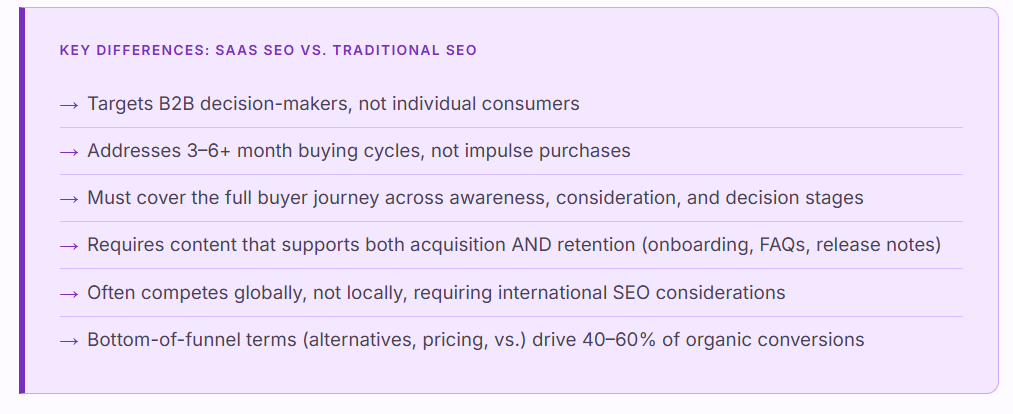
Traditional SEO might help a restaurant rank for “best pizza near me” or an e-commerce brand rank for “red running shoes.” SaaS SEO must navigate a far more complex terrain: longer sales cycles, technical decision-makers, global markets, and recurring revenue models that extend the job of SEO far beyond initial acquisition.
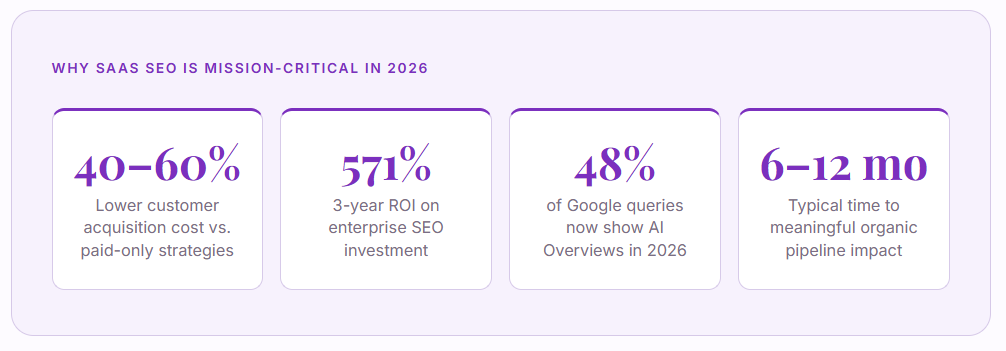
Effective SaaS SEO must guide buyers through a multi-stage journey, from discovery to evaluation to decision, while delivering precise, value-driven content that solves specific challenges at each stage. That means your content strategy cannot be a single funnel; it must be a full architecture.
There is also a retention dimension. For SaaS companies with subscription revenue, SEO efforts extend beyond acquisition to support customer loyalty, through onboarding guides, feature documentation, and FAQ resources that reduce churn and increase lifetime value.
Building a Funnel-Aligned Keyword Architecture
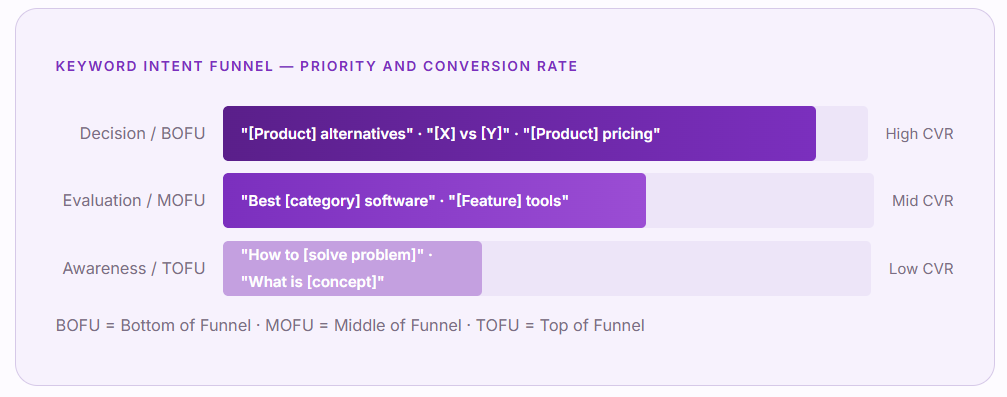
The single most profitable keyword insight for SaaS companies: bottom-of-funnel keywords convert at dramatically higher rates than top-of-funnel terms, yet most SaaS teams spend the majority of their content budget on the latter. Start with the keywords where buyer intent is highest, then expand upward.
Research consistently shows that bottom-of-funnel keywords, alternatives, vs., pricing, reviews, drive 40–60% of organic SaaS conversions. These should be your first targets, not your last.
The Hub-and-Spoke Content Model
Once you have your keyword priorities, structure your content around pillar pages and supporting clusters. A pillar page targets a broad, high-value keyword and links out to 10–30 supporting articles that cover subtopics in depth. This architecture signals topical authority to Google, resulting in improved rankings across the entire cluster, not just individual pages.
The “hub-and-spoke” model works like this: one central hub page targets a broad category keyword, surrounded by spokes targeting long-tail keywords, use cases, integrations, and comparisons. Every spoke article reinforces the hub’s authority while independently capturing lower-competition search queries.

Technical SEO Foundations for SaaS Websites
Content and keywords mean nothing if search engines cannot crawl, render, and index your website efficiently. For SaaS companies, which often run on JavaScript-heavy frameworks, technical SEO is not optional; it is the prerequisite for everything else.
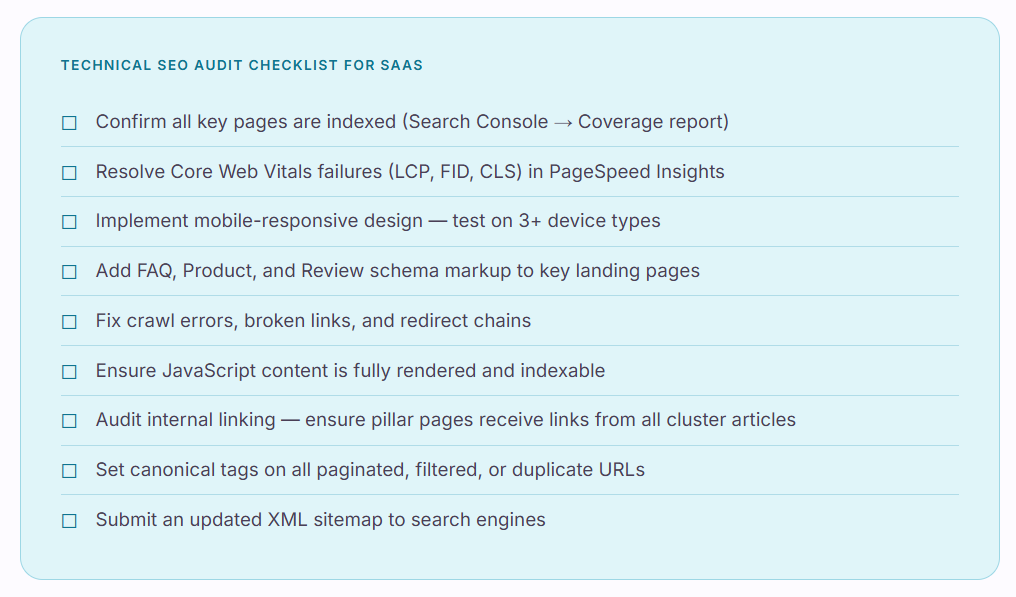
Before scaling any content effort, your website must align with search engine technical requirements. A comprehensive technical audit should be the first step of any SaaS SEO program.
Core Technical Pillars
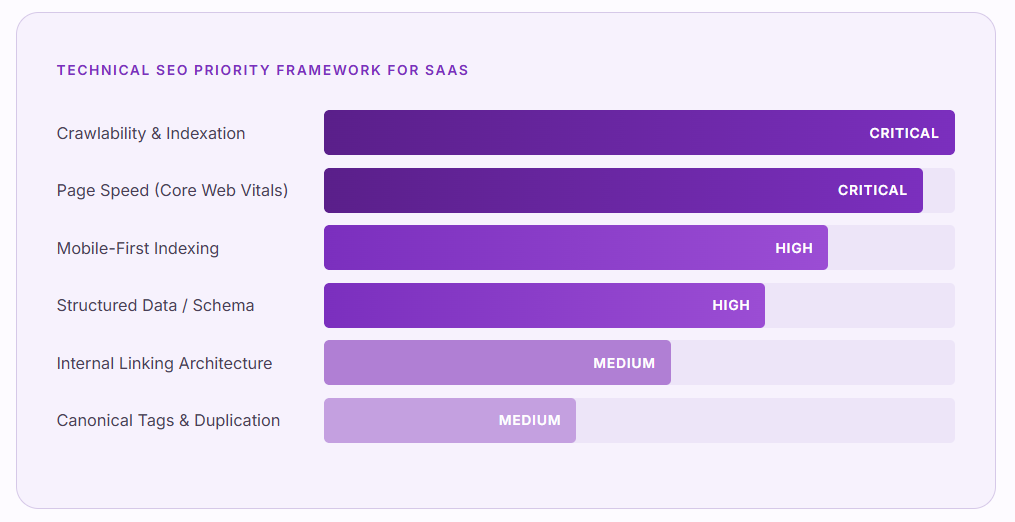
For SaaS websites, implementing structured data across three key schema types is highly recommended: FAQ Schema for landing page questions, Product Schema to highlight software features and pricing, and Review Schema to display ratings in search results. These enrich your appearance in SERPs and meaningfully improve click-through rates.
Mobile-first indexing is non-negotiable. Search engines now use the mobile version of your site as the primary basis for ranking. Responsive design, consistent content across mobile and desktop, and optimized page elements are baseline requirements, not enhancements.
How to Create a Content Strategy That Converts
Rankings without conversions are vanity. The best SaaS content strategies are engineered to move visitors toward trial signups, demo requests, and free tier activations, not just to capture pageviews.
“SEO offers a unique capability to hone in on various stages of the buyer’s journey. By aligning content and search intent with how real SaaS customers think and search, you can build a content engine that compounds over time.”
Every SaaS article should embed strategic calls-to-action contextually throughout the page, not just at the bottom. CTAs placed contextually within content convert far better than those positioned only at the end. Pair intent-matched content with clear conversion paths and your organic traffic becomes a genuine pipeline driver.
Content Types by Funnel Stage
| Stage | Content Type | Goal | Example |
| TOFU | How-to guides, explainers, glossary terms | Awareness, traffic | “What is product-led growth?” |
| MOFU | Comparison pages, listicles, templates | Evaluation, lead generation | “Best project management tools 2026” |
| BOFU | Alternatives, vs. pages, pricing pages | Decision, trial signup | “[Tool A] vs [Tool B] — 2026 comparison” |
| Retention | Onboarding docs, feature guides, FAQs | Reduce churn, increase LTV | “How to set up your first workflow in [Product]” |
Top-performing SaaS content should be reviewed and refreshed every three to six months, updating statistics, adding internal links to new posts, and improving sections based on performance data. Content freshness is a meaningful ranking factor, especially in rapidly evolving SaaS categories.
Link Building Strategies That Work for SaaS
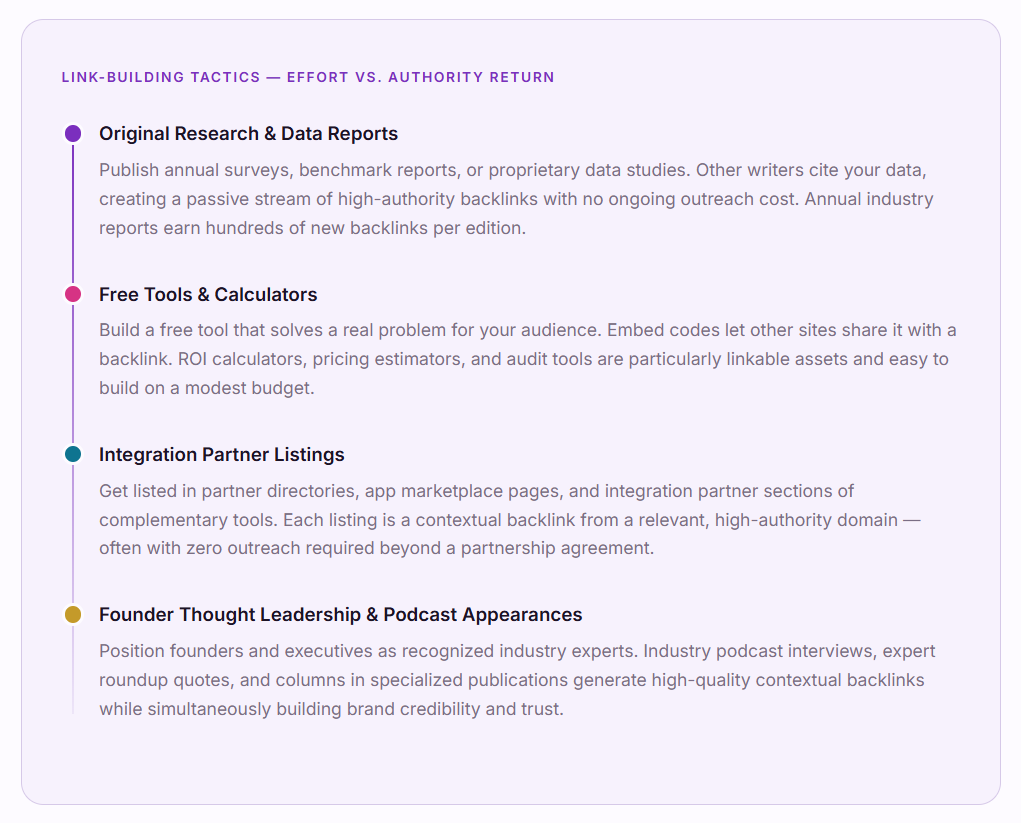
Backlinks remain the single strongest ranking signal for competitive SaaS keywords. A page with exceptional content and no backlinks will consistently lose to a mediocre page with strong backlink authority. The most effective and scalable link-building strategies in 2026 center on earning links rather than chasing them.
Answer Engine Optimisation — The New Frontier
The single biggest shift in SaaS SEO for 2026 is not about keywords or backlinks. It is about fundamentally rethinking who you are optimising for. The answer is no longer just a search algorithm, it is also the AI systems that now mediate an increasing share of B2B research queries.
Major AI chat tools have surpassed hundreds of millions of weekly active users globally. If a VP of Marketing evaluating automation tools asks an AI assistant for recommendations and your product does not appear in that response, you are losing pipeline you never knew existed.
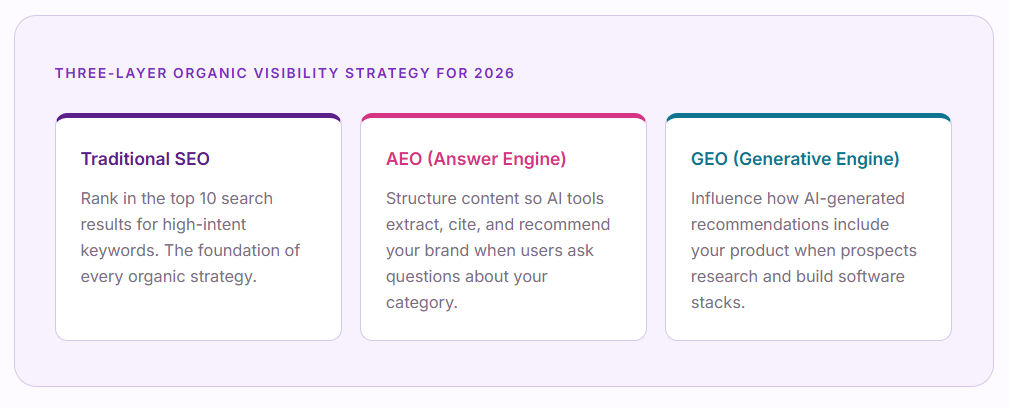
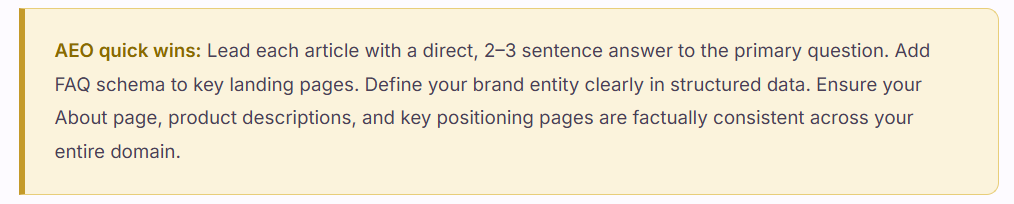
The AEO formula requires direct, authoritative answers (AI systems favour content that answers questions without fluff), comprehensive structured data markup, and a clearly defined brand entity. Well-structured feature pages, use case documentation, and integration guides serve double duty in the AI era, human readers and AI agents alike pull from them when comparing solutions.
The Essential SaaS SEO Tool Stack
Building the right SEO tech stack is about selecting the right combination for research, execution, and performance tracking at your current stage. A tiered approach works best: start with the essentials, and add specialised tools as your program matures.
| Tool | Use Case | Stage |
| Google Search Console | Monitor search performance, crawl issues, index coverage, CTR data | Essential |
| SEO Research Platform | Keyword research, competitor analysis, backlink auditing, rank tracking | Essential |
| Technical Audit Tool | Technical SEO audits: broken links, redirect chains, missing metadata | Essential |
| Google PageSpeed Insights | Core Web Vitals monitoring, page speed diagnostics | Essential |
| Content Optimisation Tool | Content optimisation against top-ranking competitors, NLP keyword coverage | Growth |
| Schema Markup Tool | Implement structured data markup without coding; supports AEO/AI visibility | Growth |
| Enterprise SEO Platform | Content performance, AI visibility tracking, and comprehensive reporting | Enterprise |
The SaaS SEO Implementation Roadmap
SEO for SaaS is a compounding investment, not a one-time project. The companies dominating organic search in 2026 committed to a consistent strategy two to three years ago and are now generating organic traffic that costs nothing incremental per visit. Here is how to structure your first 12 months.
| 12-MONTH SAAS SEO ROADMAP |
| MONTHS 1–2 Foundation | MONTHS 3–5 Build | MONTHS 6–9 Scale | MONTHS 10–12 Compound |
| → Technical SEO audit | → Publish BOFU pages first | → Expand MOFU content | → Add TOFU cluster content |
| → Keyword research & mapping | → Build first content cluster | → Activate link outreach | → Refresh high-traffic posts |
| → Competitor gap analysis | → Launch link-earning asset | → Implement AEO layer | → Track pipeline attribution |
| → Fix critical crawl errors | → Implement schema markup | → Audit content decay | → Set Year 2 strategy |
🚀 How Queen of Clicks Helps SaaS Businesses Grow
You now have the playbook. Queen of Clicks is the partner that executes it with data-driven strategy, creative precision, and a genuine love for SaaS growth.
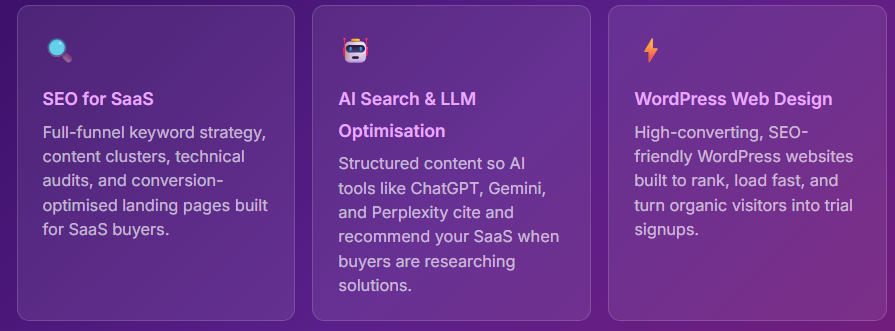
When you work with Queen of Clicks, you get:
- A personalised SaaS SEO strategy rooted in your product, buyers, and competitive landscape
- Feature-based keyword research targeting users closest to signing up
- Content and landing pages optimised for both Google and AI-driven discovery
- A stronger backlink profile and domain authority built over time
- Visibility across traditional search, Google SGE, ChatGPT, Perplexity, and Gemini
- Transparent reporting and a dedicated partner, not a faceless agency
→ Book Your Free Consultation: No commitment. Just a real conversation about your SaaS growth.
Conclusion
SaaS SEO is the highest-leverage marketing investment available to software companies, but only if you commit to the timeline required for compounding to work. The companies dominating organic search today did not arrive there in six months. They executed a consistent strategy for two to three years and now generate millions in organic traffic that costs nothing incremental per visit.
The framework is clear: target bottom-of-funnel keywords first for fast conversions, build hub-and-spoke content clusters for topical authority, fix your technical foundations so search engines can index your content, earn backlinks through original research and free tools, and layer in Answer Engine Optimisation to remain visible in the AI-powered search era.
FAQs
How long does SaaS SEO usually take to show results?
Most SaaS companies start seeing measurable SEO improvements within 3 to 6 months, but highly competitive keywords and significant traffic growth often take 6 to 12 months of consistent work.
What is the biggest SEO mistake SaaS companies make?
One of the biggest mistakes is focusing only on high-volume informational keywords while ignoring bottom-of-funnel keywords that are much more likely to generate demos and trial signups.
Should SaaS companies prioritise blogs or landing pages?
Both are important, but conversion-focused landing pages targeting commercial-intent keywords should usually come first because they directly support revenue generation.
Can a new SaaS website compete with established competitors in SEO?
Yes, but newer SaaS companies should focus on long-tail, niche, and low-competition keywords first before expanding into broader, highly competitive topics.
Is SEO better than paid ads for SaaS companies?
SEO and paid ads work best together, but SEO often delivers a stronger long-term ROI because organic traffic continues generating leads without ongoing ad spend.
Does AI-generated content work for SaaS SEO?
AI-generated content can support research and drafting, but human expertise, original insights, and strategic editing are still necessary to create authoritative SaaS content that ranks and converts.