SaaS SEO Content Writing: How to Increase Traffic and Conversions
The SaaS industry is one of the most competitive industries on the internet. With thousands of companies fighting for the same high-intent keywords, winning in search is about having great content that search engines trust and users love.
This is where SEO content for SaaS becomes your most powerful growth lever. Done right, it puts your product in front of the exact buyers who are already searching for a solution like yours, without spending a fortune on paid ads. In fact, organic search drives around 53% of all SaaS website traffic, making SEO one of the most important acquisition channels for SaaS companies today.
In this complete guide, you’ll learn what SaaS SEO content writing is, why it’s different from other forms of content marketing, and the step-by-step strategies that turn blog posts into pipeline.

Key Takeaways
- SaaS SEO content writing combines search optimization, customer education, and conversion-focused messaging to drive qualified leads through organic search.
- A successful SaaS content strategy targets every stage of the funnel, from awareness-focused educational content to high-converting comparison and alternative pages.
- Keyword intent matters more than search volume in SaaS SEO, especially for commercial and transactional searches that signal buying intent.
- Building topical authority through interconnected content clusters helps SaaS companies improve rankings, trust, and long-term organic visibility.
- The highest-performing SaaS SEO content is technically optimized, aligned with search intent, enriched with original insights, and supported by strong contextual CTAs.
1. What Is SaaS SEO Content Writing?
SaaS SEO content writing is the practice of creating search-engine-optimized content specifically designed for software-as-a-service companies. It combines keyword strategy, technical SEO understanding, and conversion-focused writing to attract, educate, and convert your ideal customer profile (ICP) through organic search.
Unlike generic blog writing, SaaS content must do three things simultaneously:
→ Rank on Google for high-intent keywords your target audience is searching for.
→ Educate potential users about their problem and position your software as the solution.
→ Move readers through the funnel, from awareness to consideration to decision.
This trifecta is what separates content that drives demo requests from content that just exists on a page.
SaaS SEO vs. Traditional SEO Content Writing
Traditional SEO content often targets broad informational queries with little commercial intent. SaaS SEO content writing is laser-focused on queries that signal product interest, things like “best CRM for startups,” “how to automate email follow-ups,” or “[competitor] alternatives.” The audience is more sophisticated, the sales cycle is longer, and the content needs to be technically accurate and deeply useful.
2. Why SaaS Companies Need a Dedicated SEO Content Strategy
Paid acquisition is expensive and temporary. The moment you stop running ads, the traffic stops. SEO content is the opposite: the right piece of content can drive qualified traffic and leads for years after it’s published.
Here’s why a dedicated SaaS SEO content strategy is non-negotiable:
Compounding ROI
High-ranking content compounds over time. A well-optimized blog post published today can outperform a $10,000 ad spend twelve months from now, and it keeps working without ongoing investment.
Capturing High-Intent Buyers
People who search for phrases like “project management software for remote teams” or “best Slack alternative for enterprises” are already in buying mode. SEO content places your product directly in front of them at the exact moment they’re evaluating options.
Building Brand Authority and Trust
SaaS buyers do extensive research before committing to a subscription. When your brand consistently appears as the authoritative voice on topics relevant to your product category, you build the credibility needed to close deals. Google’s E-E-A-T (Experience, Expertise, Authoritativeness, Trustworthiness) framework rewards exactly this kind of depth.
Reducing Customer Acquisition Cost (CAC)
Organic traffic has a significantly lower CAC than paid channels. As your content library grows and rankings solidify, the cost per acquired customer through SEO drops dramatically, making content one of the highest-ROI investments a SaaS company can make.
3. Keyword Research for SaaS Content
Effective SaaS SEO content writing starts with strategic SaaS keyword research. Not all keywords are created equal, and for SaaS, it’s essential to prioritize intent over volume.
Understanding Keyword Intent for SaaS
There are four main types of search intent, and each requires a different content approach:
→ Informational: “How to manage customer data in a CRM” — Blog posts, guides, tutorials.
→ Navigational: “[Your Brand] login” — Homepage, help center.
→ Commercial Investigation: “Best email marketing software” — Comparison posts, listicles, reviews.
→ Transactional: “[Your Brand] pricing” — Pricing page, free trial landing page.
For SaaS companies, the highest-value content targets commercial investigation and transactional intent — these readers are actively evaluating and close to making a purchase.
Key Keyword Categories to Target
A robust SaaS content strategy should target keywords across these categories:
→ BOFU (Bottom of Funnel): [Product] alternatives, [Competitor] vs [Your Product], best [category] software for [use case]
→ MOFU (Middle of Funnel): How to [solve problem your product solves], [Industry] best practices, [workflow] automation tips
→ TOFU (Top of Funnel): What is [relevant concept], [Industry] trends, beginner’s guide to [relevant topic]
Tools to Use for SaaS Keyword Research
→ Ahrefs or Semrush — for competitor gap analysis and keyword difficulty scoring
→ Google Search Console — for identifying existing opportunities and quick wins
→ AnswerThePublic or AlsoAsked — for finding question-based keywords to build FAQ and how-to content around
→ G2, Capterra, and Reddit — for uncovering the language your customers actually use when describing their problems

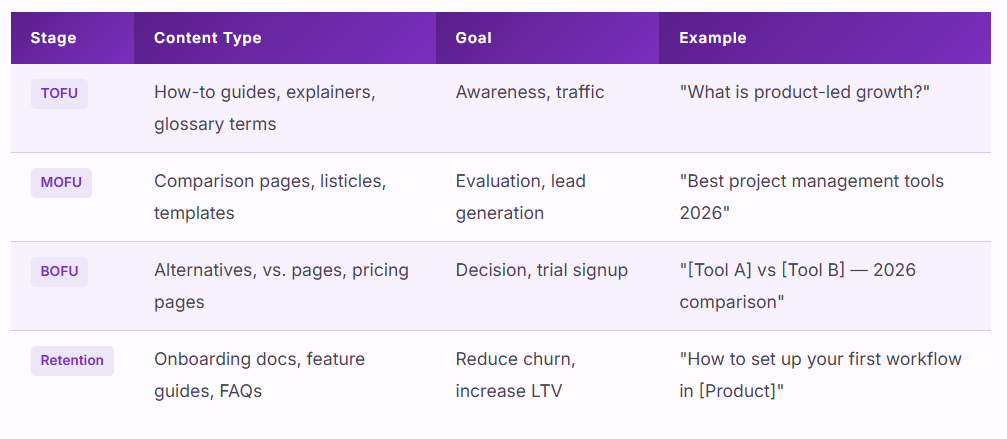
4. The SaaS Content Funnel: Writing for Every Stage
A mature SaaS SEO content strategy maps content to every stage of the buyer journey. Here’s how to approach each stage:
Top of Funnel (TOFU): Awareness Content
TOFU content targets broad, informational keywords. The goal is to introduce your brand to potential customers who are just beginning to realize they have a problem. Examples include “what is customer churn,” “how to improve SaaS retention,” or “remote team productivity challenges.”
TOFU content should be genuinely educational and not overly promotional. Earn the trust of the reader first, conversion comes later.
Middle of Funnel (MOFU): Consideration Content
MOFU content targets readers who understand their problem and are evaluating solutions. This is where you can get more specific about how your product solves their pain points. Examples include “how to reduce churn with automated onboarding,” “5 ways to track SaaS metrics effectively,” or “the complete guide to [relevant workflow].”
This content can include product mentions, internal links to feature pages, and CTAs to sign up for a free trial or demo.
Bottom of Funnel (BOFU): Decision Content
BOFU content is where conversions happen. These pages directly address buyers who are comparing options. Key BOFU content types include:
→ Competitor comparison pages (“[Your Product] vs [Competitor]”)
→ Alternative pages (“Best [Competitor] Alternatives in 2025”)
→ Use case landing pages (“[Your Product] for [Industry]”)
→ Case studies and customer success stories
BOFU content often has lower search volume but dramatically higher conversion rates. Don’t neglect it.
5. How to Write SaaS SEO Content That Actually Ranks
Great SaaS SEO content writing is part strategy, part craft. Here’s a step-by-step framework for producing content that earns and holds top rankings.
Step 1: Nail the Search Intent First
Before writing a single word, study the top-ranking pages for your target keyword. What format do they use: listicle, guide, tutorial, comparison? How long are they? What subtopics do they cover? Google’s rankings tell you exactly what type of content satisfies user intent for that keyword.
Step 2: Create a Comprehensive Content Brief
A strong brief is the foundation of high-ranking content. Include the primary keyword, secondary keywords, target word count, required headers, internal linking opportunities, and specific data points or case studies to reference. Briefs ensure writers stay on-strategy even as they exercise creativity.
Step 3: Write for the Human First, Google Second
The best SaaS content addresses real pain points with specificity, credibility, and clarity. Google’s algorithms are sophisticated enough to reward genuinely helpful, authoritative content, and penalize fluffy filler. Write for your reader, and use your keywords naturally throughout.
Step 4: Optimize On-Page SEO Elements
Every piece of SaaS SEO content should be fully optimized on-page:
→ Title tag: Include the primary keyword near the beginning, keep under 60 characters
→ Meta description: Compelling summary with keyword and CTA, under 155 characters
→ H1 and H2s: Use keywords and related terms naturally in headings
→ Image alt text: Descriptive and keyword-relevant
→ Internal links: Link to relevant product pages, feature pages, and related blog content
→ Schema markup: Add FAQ, How-To, or Article schema where appropriate
Step 5: Add Unique Insights and Original Data
The content that consistently outranks the competition offers something the others don’t, proprietary data, expert quotes, original research, or unique frameworks. Even a single original statistic or a genuinely novel perspective can be the differentiator that earns backlinks and keeps readers engaged.
Step 6: Include Strong, Contextual CTAs
Every piece of SaaS content should have a clear next step for the reader. Use contextual CTAs, not just generic “Sign up” banners, that connect the content topic to your product’s value proposition. For example, an article about reducing customer churn should invite readers to “See how [Product] helps you predict and prevent churn – start your free trial.”
6. The Role of Topical Authority in SaaS SEO
Google doesn’t just rank individual pages, it evaluates the topical authority of your entire website. Topical authority means your site is recognized as a comprehensive, trustworthy resource on a specific subject area.
For SaaS companies, building topical authority means creating an interconnected cluster of content around your core use cases, not just publishing isolated blog posts. This is called the topic cluster model:
→ Pillar page: A comprehensive, long-form guide on a broad topic (e.g., “The Complete Guide to SaaS Customer Onboarding”)
→ Cluster content: A series of supporting articles on subtopics that link back to the pillar (e.g., “How to Create an Onboarding Email Sequence,” “SaaS Onboarding Metrics to Track,” “Common Onboarding Mistakes”)
This architecture signals to Google that your site has depth and breadth on a topic, and it dramatically improves rankings across all pages within the cluster.
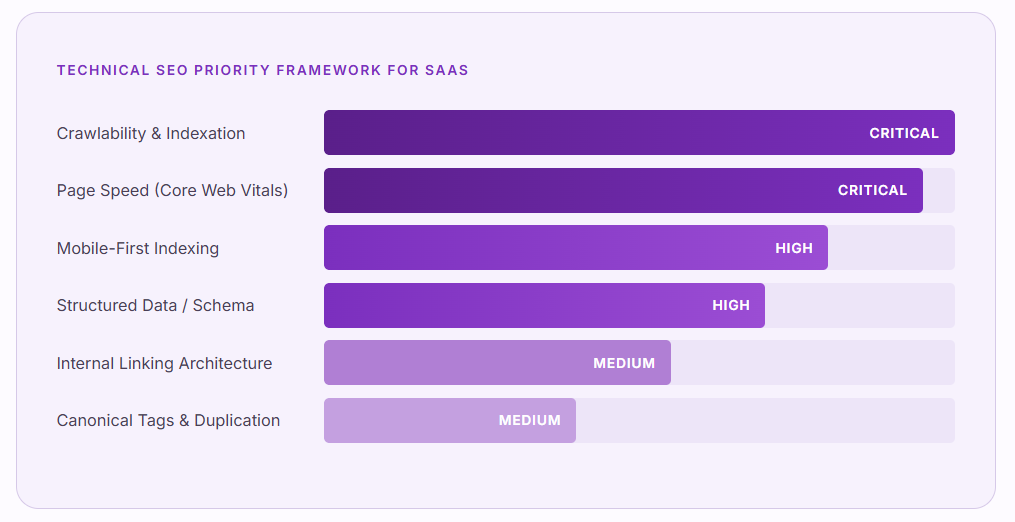
7. Technical SEO Foundations for SaaS Content
Even the best-written content can underperform if your technical SEO foundation is broken. Here are the key technical elements SaaS content teams must get right:
→ Site speed: Core Web Vitals are a ranking factor. Compress images, use a CDN, and eliminate render-blocking scripts.
→ Mobile optimization: The majority of search traffic is mobile. Ensure your content templates are fully responsive.
→ Crawlability: Ensure your content is indexable. Check your robots.txt, sitemap, and canonical tags regularly.
→ URL structure: Use short, descriptive, keyword-rich URLs. Avoid dynamic parameters and avoid changing URLs once content is live.
→ Internal linking: Build a deliberate internal link structure that passes authority from high-ranking pages to newer content.
→ Schema markup: Implement Article, FAQ, and HowTo schema to enhance your search results with rich snippets.
8. Measuring the Performance of Your SaaS SEO Content
What gets measured gets improved. Track these KPIs to evaluate the effectiveness of your SaaS SEO content writing efforts:
→ Organic traffic by page — Are your target pages growing in traffic month over month?
→ Keyword rankings — Track primary and secondary keyword positions using Ahrefs, Semrush, or Search Console.
→ Organic-attributed signups and demos — The ultimate metric. Are content readers converting?
→ Time on page and scroll depth — Signals whether readers are genuinely engaging with your content.
→ Backlinks acquired — Quality content earns links. Monitor link acquisition per piece.
→ Content decay rate — Identify posts whose rankings are declining and need refresh or expansion.
Set up a monthly content performance review to identify your best-performing pages, update underperforming content, and double down on topics that are driving pipeline.
9. Common SaaS SEO Content Writing Mistakes to Avoid
Even experienced marketing teams make these errors, avoid them to get the most out of your content investment:
→ Writing for volume, not intent: Publishing dozens of shallow posts instead of deeply optimized, high-intent pieces.
→ Ignoring BOFU content: Focusing only on TOFU awareness content and neglecting the decision-stage pages where conversions happen.
→ Keyword stuffing: Over-optimizing for keywords at the expense of readability and natural flow.
→ No internal linking strategy: Publishing content in isolation without connecting it to your product pages and related posts.
→ Skipping content updates: Letting old posts decay without refreshing data, statistics, and rankings.
→ Generic CTAs: Using “Learn more” or “Sign up” when a specific, contextual CTA would convert significantly better.
→ Neglecting distribution: Publishing great content and then doing nothing to promote it.
Even the best SEO takes time: amplify with social, email, and community sharing.
🚀 Ready to Grow Your SaaS with SEO Content That Converts?
Queen of Clicks is a specialist SaaS SEO agency. We build SEO-driven content strategies, write authoritative blog posts, and create conversion-optimized content that puts your product in front of the right buyers, consistently and at scale.
We’ve helped SaaS companies climb to page one for their most competitive keywords, build topical authority in crowded niches, and turn organic traffic into a measurable pipeline.
👉 Let’s build your content engine together. Contact us to start the conversation.
Because your SaaS deserves content that works as hard as your product does.

Conclusion
SaaS SEO content writing is one of the highest-leverage marketing activities available to a growing software company. When done strategically, with a clear understanding of your buyer’s journey, rigorous keyword research, technically sound execution, and a commitment to genuine usefulness, it becomes a self-sustaining engine for organic growth.
The companies winning in organic search aren’t just producing more content. They’re producing smarter content: strategically mapped, deeply optimized, and relentlessly helpful. They’re building topical authority, earning backlinks naturally, and guiding readers from first search to paying customer.
The playbook is here. The opportunity is significant. The only question is whether you have the team and strategy to execute it at the level the SaaS competitive landscape demands.
FAQs
What makes SaaS SEO content writing different from regular content marketing?
SaaS SEO content writing is specifically designed to attract software buyers through organic search, not just to generate page views. It combines deep keyword intent research, product-led storytelling, and conversion architecture in a way that general content marketing doesn’t. SaaS content must educate technically sophisticated buyers, reflect the nuances of subscription-based products, and align closely with the full B2B or B2C purchase cycle, which can range from a few days to several months.
How long does it take for SaaS SEO content to rank on Google?
Generally, newly published SaaS SEO content takes between three and six months to reach its peak rankings, though this varies significantly based on your domain authority, keyword competition, and content quality. Highly competitive keywords in established SaaS niches can take nine to twelve months or longer. This is why starting early and building consistently is so important, SEO is a long game with compounding rewards.
How many blog posts does a SaaS company need to see SEO results?
There’s no magic number, but quality and strategy matter far more than volume. A SaaS company with twenty deeply researched, well-optimized pieces of content targeting high-intent keywords will outperform a competitor with two hundred thin, generic articles. Start with a content cluster approach, build out one or two pillar topics comprehensively before expanding to new areas.
Should SaaS companies use AI to write their SEO content?
AI tools can accelerate content production, from ideation and outlining to drafting and optimization, but they shouldn’t replace expert human writers. SaaS SEO content requires subject matter accuracy, original insights, product knowledge, and strategic nuance that AI alone cannot reliably deliver. The best approach is a human-led strategy augmented by AI for efficiency, with all content reviewed and refined by experienced writers and editors.
What types of content work best for SaaS SEO?
The most effective SaaS SEO content types include: comprehensive how-to guides and tutorials targeting MOFU queries, competitor comparison and alternative pages for BOFU buyers, use case landing pages for industry-specific targeting, glossary pages for building authority on core terminology, and original research or data reports that earn backlinks. Case studies and customer success stories also serve a dual purpose, they build trust with readers while improving on-page conversion rates.
How important are backlinks for SaaS SEO content?
Backlinks remain one of Google’s most important ranking signals. For SaaS companies, earning high-quality backlinks from authoritative tech, industry, and business publications can dramatically accelerate your rankings. The best way to earn links organically is to create content that is genuinely reference-worthy: original data studies, comprehensive industry guides, unique frameworks, and expert opinion pieces. Strategic outreach and digital PR can also help amplify link acquisition efforts.
How much should a SaaS company budget for SEO content writing?
Budgets vary widely depending on your market competitiveness, growth stage, and in-house capabilities. Early-stage SaaS companies might start with four to eight high-quality blog posts per month, while growth-stage companies often invest in fifteen to thirty or more pieces monthly across different funnel stages. When budgeting, factor in keyword research, content briefs, writing, editing, SEO optimization, and ongoing content refresh. Working with a specialist SaaS content agency like Queen of Clicks often provides the best ROI, as you benefit from proven frameworks, subject matter expertise, and SEO execution under one roof.