Best SEO Strategies For SaaS Startups That Actually Drive Growth
If you’re a SaaS startup trying to grow, you’re probably asking the same question as every other founder: how do I get consistent, qualified traffic without burning through my budget on ads?
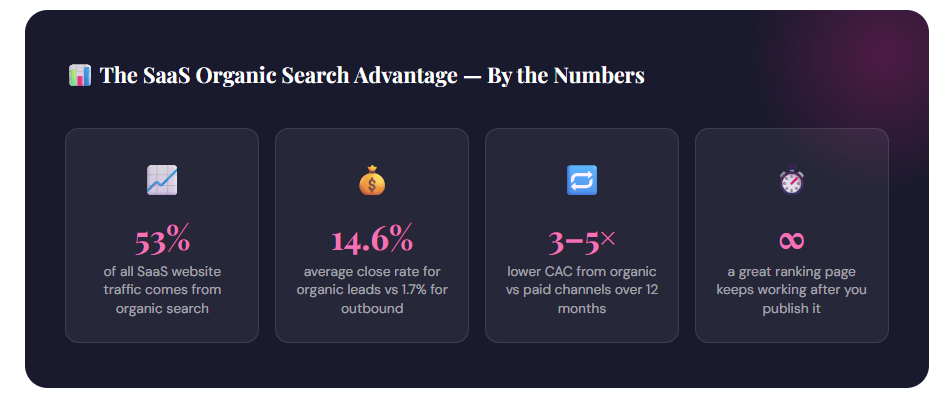
The answer, and the most sustainable growth lever available to early-stage SaaS companies, is search engine optimization. According to recent SaaS SEO statistics, organic search drives around 53% of total SaaS website traffic, making it the single largest acquisition channel for software companies.
The best SEO strategies for SaaS startups are not about chasing generic rankings or gaming algorithms. They’re about building a targeted, compounding content and visibility system that puts your product in front of the right people, at exactly the right moment in their buying journey.
This guide covers everything: keyword research, content strategy, technical foundations, link building, and the emerging world of AI search optimization. Let’s get into it.

Key Takeaways
- The best SEO strategies for SaaS startups focus on matching search intent to every stage of the buyer journey, from awareness to trial signup.
- SaaS startups grow faster with SEO when they prioritize high-intent BOFU and long-tail keywords instead of chasing vanity traffic.
- A strong SaaS SEO strategy combines technical SEO, conversion-focused content, and strategic internal linking to build long-term organic growth.
- Quality backlinks earned through original research, free tools, partnerships, and industry authority matter far more than large volumes of low-quality links.
- SaaS startups that optimize for both traditional search engines and AI-powered search platforms position themselves for sustainable growth.
Why the Best SEO Strategies for SaaS Startups Are Different
SaaS SEO is not traditional SEO with a software logo slapped on it. The buyers are different, the journey is different, and the content requirements are categorically more demanding. Understanding this is the starting point for any effective strategy.
Here’s what makes SaaS buyers unique, and why the best SEO strategies for SaaS startups need to account for them specifically:
| Factor | Traditional SEO | SaaS SEO Strategy |
| Search intent | Local, transactional, or basic informational | Feature-based, workflow-specific, ROI-focused, comparison-driven |
| Buyer journey length | Often short (find → buy) | Long — awareness → research → trial → subscribe → renew |
| Content depth required | Moderate | High — technical, use-case, and integration-specific |
| Primary conversion goal | Purchase, phone call, store visit | Free trial, demo booking, product signup |
| Competition level | Varies by niche and geography | Global, well-funded, content-heavy competitors |
SaaS buyers don’t impulse-purchase. They compare integrations. They read alternatives pages. They check review sites and ask AI assistants for recommendations. The best SEO strategies for SaaS startups are designed to be present at every single one of those touchpoints.

Want to see exactly what organic ROI could look like for your startup? Use the Queen of Clicks SaaS SEO ROI Calculator →
Keyword Strategy: Finding Searches That Drive Signups
Keyword research for SaaS startups is not about finding the highest-volume terms and writing blog posts targeting them. It’s about mapping search intent to every stage of your buyer journey, and prioritizing the keywords that attract people closest to signing up.
🎯 The Three Keyword Tiers Every SaaS Startup Needs
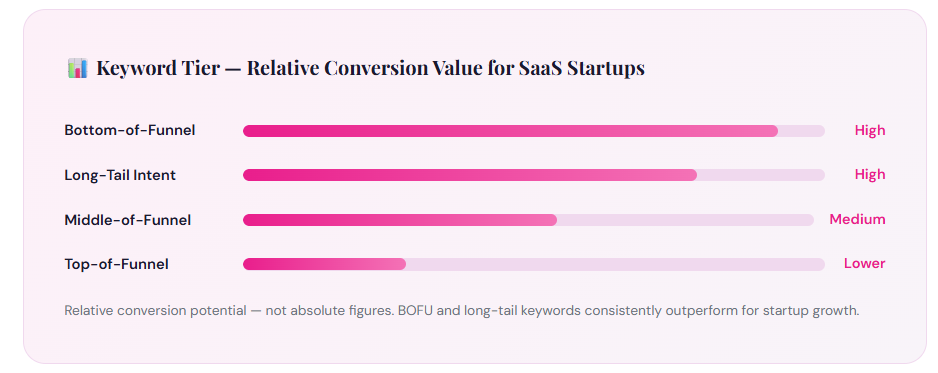
- 🔥 Bottom-of-Funnel (BOFU): “best [category] software for [use case]”, “[your tool] alternatives”, “[your tool] vs [competitor]”, “[category] pricing”. These users are ready to decide. Prioritize these first.
- 🔎 Long-Tail Keywords: “CRM with Slack integration for remote sales teams”, “project management software for design agencies”. Highly specific, lower competition, extremely high intent. This is where early-stage startups can win fast.
- 🧭 Middle-of-Funnel (MOFU): “how to [solve problem your product addresses]”, “[workflow] automation for [team type]”. Active research phase, build trust here.
- 📢 Top-of-Funnel (TOFU): “what is [relevant concept]”, “[industry] best practices”. Lower conversion intent but builds brand awareness and earns backlinks.
💡 Practical Keyword Research Principles for SaaS Startups
- Map keywords to funnel stage — don’t put a TOFU heading on a BOFU page or vice versa.
- Prioritize search intent over search volume — 200 searches/month with high intent beats 20,000 with none.
- Build keyword clusters — group related keywords into topic hubs to signal topical authority to search engines.
- Identify competitor keyword gaps — what are your best-ranking competitors ranking for that you’re not? Those are opportunities.
- Use feature-based keywords — SaaS users often search for specific features: “email automation tool”, “AI meeting notes app”, “invoicing software with recurring billing”.
For a deep dive on this, read the guide to long-tail keywords for SaaS SEO →
The SaaS Content Framework That Converts Readers into Users
One of the best SEO strategies for SaaS startups is building a content framework that doesn’t just attract traffic, it moves readers from awareness to consideration to conversion. Each content type serves a specific role in that journey.
1 📝 Problem-Aware Blog Posts (TOFU & MOFU)
Target keywords that reflect your audience’s pain points before they know your solution exists. Build trust and educate, don’t pitch yet.
2 🛬 Feature & Use-Case Landing Pages (MOFU & BOFU)
Target feature-based and use-case keywords. Explain what your tool does, who it’s for, and why it’s the right fit. Include social proof and a strong CTA.
3 ⚖️ Comparison & Alternative Pages (BOFU)
Target “X vs Y” and “best X alternatives” searches. Be transparent, thorough, and highlight what makes your product uniquely suited to your ideal customer.
4 📚 Glossary & Educational Topic Hubs (TOFU)
Define industry terms and concepts relevant to your product. These rank easily, earn natural backlinks, and position your brand as the authority in your category.
5 🏆 Case Studies & Customer Success Stories (BOFU)
Real results, real customers, real numbers. Nothing removes purchase anxiety like proof that your product has already solved someone else’s problem.
🗂️ Content Best Practices for SaaS Startups
- Keep a consistent publishing cadence — 2–4 high-quality posts per month outperforms 10 thin posts.
- Use internal linking to connect related content and distribute link equity across your site.
- Include product screenshots, demos, or interactive elements to show rather than just tell.
- Update and refresh existing content regularly — freshness is a ranking signal, and SaaS moves fast.
- Every piece of content should have a clear next step — a CTA, a related resource, or a trial prompt.
Also explore the complete guide to improving SEO for SaaS companies → for a broader strategic overview.
Technical SEO: The Foundation Every SaaS Startup Needs
You can have the most brilliant content strategy in the world, but if your website has technical issues, search engines won’t trust it and users won’t stick around. Technical SEO is the non-negotiable foundation beneath every other strategy.
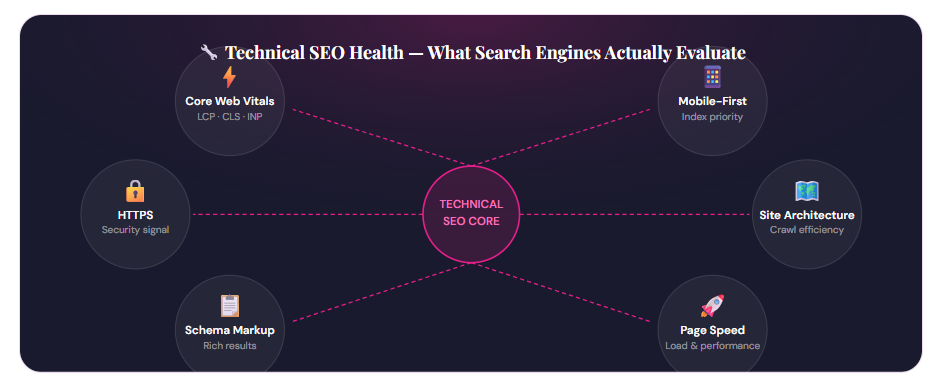
🏗️ Technical SEO Checklist for SaaS Startups
- Core Web Vitals: Aim for “Good” scores on LCP (page load speed), CLS (layout stability), and INP (interactivity). These directly affect rankings.
- Mobile-first design: Search engines crawl the mobile version of your site. A poor mobile experience is a ranking penalty by another name.
- Clean URL structure: Use descriptive, keyword-relevant URLs. Avoid dynamic parameters in URLs that appear in search results.
- Schema markup: Add structured data — FAQPage, HowTo, SoftwareApplication — to help search engines understand your content and earn rich results.
- XML sitemap & robots.txt: Make sure your important pages are discoverable and crawl budget isn’t wasted on thin or duplicate pages.
- Page speed: Compress images, use lazy loading, and minimize render-blocking scripts. Every second of load time impacts bounce rate and rankings.
- Internal linking architecture: Connect related pages with contextual anchor text. This distributes link equity and helps search engines understand your content hierarchy.
- Canonical tags: Prevent duplicate content issues — especially common on SaaS sites with filtered pages, multiple product tiers, or regional variants.
- 404 monitoring:Broken links erode user experience and waste crawl budget. Monitor and fix them regularly.
Your website platform is the engine everything runs on. Read the breakdown of technical SEO for SaaS to ensure you’re building on solid foundations.
Link Building for SaaS Startups: Quality Over Quantity
Backlinks remain one of the most powerful ranking signals in search. When authoritative, relevant websites link to your content, search engines interpret that as a vote of confidence, and your rankings improve as a result. For SaaS startups, the best link-building strategies are earned, not bought.
🏆 The Most Effective Link-Building Strategies for SaaS
- 📊 Original data and research: Publish proprietary studies, surveys, or data analyses. Original data attracts links naturally because other publishers need to cite their sources.
- 🛠️ Free tools and resources: A free calculator, template, or mini-tool in your niche earns enormous backlink volume from users who share it.
- 🎤 Guest posts on industry publications: Contribute expert content to respected publications in your space. One well-placed guest post can earn more than dozens of cold outreach links.
- 📋 Software directories and review sites: Getting listed on relevant software review and comparison platforms earns direct referral traffic and strong domain authority links.
- 🤝 Integration and partnership pages: If your SaaS integrates with other tools, get listed on their integration directories, these are high-relevance, high-authority links.
- 💡 Expert commentary and HARO responses: Respond to journalist queries in your niche to earn press mentions and editorial links.
AI Search & LLM Optimization: The Next Frontier
The best SEO strategies for SaaS startups don’t stop at traditional search. AI-powered search experiences and large language model (LLM) tools are now a primary discovery channel, and they have their own optimization requirements.
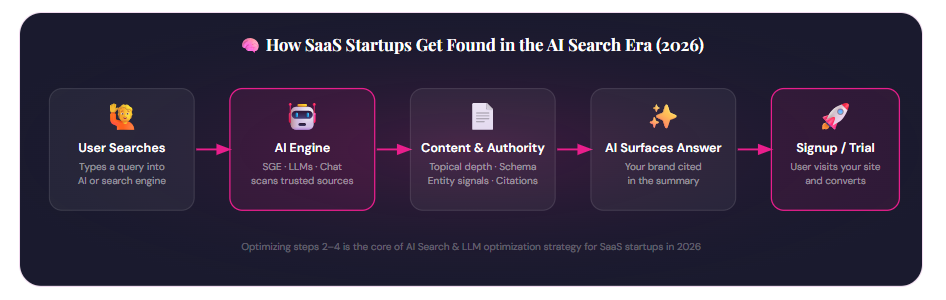
🚀 How to Optimize for AI Search as a SaaS Startup
- Write clear answer blocks: Structure content with direct, extractable answers. FAQ format, numbered steps, and concise definitions are preferred by AI systems pulling content for summaries.
- Build topical authority: Comprehensively cover your subject area. AI systems prefer sources with consistent, deep expertise across a topic cluster, not isolated posts.
- Entity-based optimization: Make sure your brand, product features, and team are clearly named and described consistently across your site and across the web.
- Earn citations and third-party mentions: LLMs learn from review sites, press coverage, community discussions, and directory listings. Get mentioned in all of them.
- Use structured data markup: Schema helps AI systems understand the relationships between your content and the concepts it covers.
Explore the strategic comparison between AI-driven and traditional SEO agencies → to understand how the landscape is shifting.
Measuring What Matters: SaaS SEO KPIs & Realistic Timelines
The best SEO strategies for SaaS startups are measurable ones. But not everything that can be measured should be prioritized. Vanity metrics, total impressions, raw traffic, can mask whether SEO is actually contributing to revenue.
✅ The KPIs That Actually Connect SEO to SaaS Growth
- Organic MQLs and trial signups: The ultimate north star. How many qualified leads is organic content generating each month?
- Organic traffic to high-intent pages: Monitor traffic to feature pages, pricing, and comparison pages, not just the blog.
- Keyword ranking velocity: Are BOFU keywords climbing? Rank progression on your 10–20 most important terms tells the real story.
- Organic share of voice: What percentage of searches in your category do you appear for relative to competitors?
- Backlink acquisition rate: Quality links earned per month and the authority of those linking domains.
- Organic-assisted pipeline: Multi-touch attribution shows how many closed deals had organic search in their path.
- Content engagement metrics: Time on page, scroll depth, and internal link clicks reveal whether content is resonating, or just getting skimmed.
For industry benchmarks, read the SaaS SEO statistics roundup → — the most important numbers shaping search for SaaS.
🗓️ Realistic SEO Timelines for SaaS Startups
One of the most important things to understand about the best SEO strategies for SaaS startups is that they take time. Here’s what a realistic, well-executed program looks like:
- 📅 Month 1–2: Technical audit, keyword mapping, competitive analysis, content strategy, and on-page foundations. This is the unglamorous, essential groundwork.
- 📅 Month 3–4: Content publishing begins. Early indexing, initial long-tail rankings start appearing. Don’t panic if growth feels slow, it’s compounding quietly.
- 📅 Month 5–6: Measurable traffic growth. MOFU and some BOFU keywords entering the top 20. Backlink profile strengthening.
- 📅 Month 7–12: Compound effect kicks in. BOFU content starts converting. Organic becomes a reliable, predictable pipeline channel.
- 📅 Month 12+: SEO becomes a genuine competitive moat. Rankings defend themselves. New content ranks faster. The cost per acquired customer from organic keeps dropping.
🚀 How Queen of Clicks Helps SaaS Businesses and Startups Grow
Queen of Clicks is a modern SaaS SEO agency purpose-built for software companies and startups that want to grow without being held hostage by their ad budgets. Founded by Ana Jordanoska, an SEO strategist with 4+ years of hands-on SaaS experience, the agency blends data-driven strategy with creative execution and a genuinely personal approach.
Whether you’re an early-stage startup needing to establish organic presence before scaling paid channels, or a growth-stage SaaS company ready to dominate your category in search, here’s what working with Queen of Clicks delivers:
- SaaS SEO Strategy: Full keyword research, competitive analysis, and content planning tailored to your product, your audience, and your specific growth stage, not a recycled template.
- Content That Converts: Blog posts, feature pages, and comparison pages written to rank, educate, and drive trial signups, not just populate a content calendar.
- AI Search & LLM Optimization: Future-proof your brand’s visibility so it appears in AI-generated summaries, chatbot recommendations, and generative search results, where the next generation of SaaS buyers are looking.
- WordPress Web Design: Fast, SEO-friendly, high-converting websites designed from the ground up for SaaS businesses, built to rank and built to convert.
- Transparent, Revenue-Tied Reporting: No vanity dashboards. Every report connects SEO activity to what matters for your business, signups, demos booked, and pipeline generated/
Queen of Clicks combines the strategic rigour of an enterprise SEO team with the agility and personalised attention that startups actually need. From first consultation to ongoing monthly execution, we’re by your side at every stage of growth.
Conclusion
The best SEO strategies for SaaS startups share a common thread: they’re built for the long game. Organic search doesn’t deliver overnight results, but it delivers compounding, durable ones that keep working long after the effort is invested.
Here’s a quick recap of the key strategies covered in this guide:
- 🎯 Start with intent-driven keyword strategy — prioritize BOFU and long-tail keywords before chasing high-volume terms.
- 📝 Build a content framework across the full funnel — from awareness blog posts to conversion-focused comparison pages.
- ⚙️ Get technical SEO right from the start — Core Web Vitals, mobile-first architecture, schema markup, and clean site structure.
- 🔗 Earn quality backlinks through original research, free tools, and genuine relationship-building — not shortcuts.
- 🤖 Optimize for AI search and LLMs — this is where the next generation of SaaS buyers will find your product.
- 📊 Measure what connects to revenue — organic MQLs, trial signups, and keyword ranking velocity, not just impressions.
The SaaS landscape is competitive. But the companies that invest in building organic presence early, and execute their SEO strategy with consistency and intent, are the ones that grow into category leaders.
If you’re ready to turn search into your most reliable growth channel, start with a free consultation at Queen of Clicks → and let’s build the strategy your startup deserves. 🚀
FAQs
How long does it take for SaaS SEO to show results?
Most SaaS startups begin to see measurable keyword movements within 3–4 months of a well-executed SEO program. Meaningful organic traffic growth typically appears between months 5 and 7, while consistent pipeline contribution from organic usually kicks in around the 9–12 month mark. The timeline varies based on your domain’s existing authority, the competitiveness of your target keywords, and the volume and quality of content being produced. The key point: SEO compounds, the earlier you start, the bigger the moat you build.
How is SaaS SEO different from traditional SEO?
SaaS SEO differs in several key ways. The buyer journey is longer and more research-intensive, SaaS buyers compare features, integrations, pricing models, and ROI before committing. This means your content strategy needs to address every stage of that journey, not just the top of the funnel. SaaS also requires feature-specific and use-case-specific landing pages that traditional businesses don’t need. Additionally, the competition is typically global and well-funded, making topical authority and content depth more important than in most local or niche markets.
Should SaaS startups invest in SEO or paid ads first?
There’s no universal answer, but for most startups the smart approach is to run both in parallel from the start, with paid ads driving immediate traffic while SEO builds the long-term foundation. Paid ads produce results immediately but stop the moment the budget does. SEO takes longer but compounds, the organic traffic and rankings you build today keep working in month 18, 24, and beyond. If budget is genuinely constrained, prioritize SEO earlier: the long build time means starting later is always more expensive than starting now.