
SEO for Cybersecurity: A Guide to Getting Found, Trusted, and Chosen
Security software is not sold on a whim. Someone on a security team, or a founder wearing five hats at once, is going to research your company for weeks before they book a call. They will read your docs, check your compliance page, look at your case studies, and probably ask ChatGPT or Perplexity what it knows about you too. If your SEO strategy is not built around that kind of scrutiny, you are leaving demos on the table.
This guide walks through what SEO for cybersecurity companies actually looks like in practice: the keyword approach, the technical requirements, the content that builds credibility instead of just traffic, and how AI search engines are changing the game for security brands.

Key Takeaways
- Cybersecurity SEO must build trust and credibility throughout a long, research-driven buying journey.
- Targeting high-intent, comparison, and compliance keywords helps attract buyers who are actively evaluating security solutions.
- Technical SEO, expert content, and strong trust signals improve both search visibility and buyer confidence.
- AI search visibility is becoming essential, making structured content and clear entities critical for earning citations in AI-powered search.
- Queen of Clicks helps cybersecurity SaaS companies increase organic traffic, AI search visibility, and qualified demo requests with tailored SEO strategies.
What Makes SEO for Cybersecurity Different
Most SEO advice assumes a fairly simple buyer journey. Someone searches a problem, lands on your blog post, and eventually converts. Cybersecurity buyers do not move that cleanly.
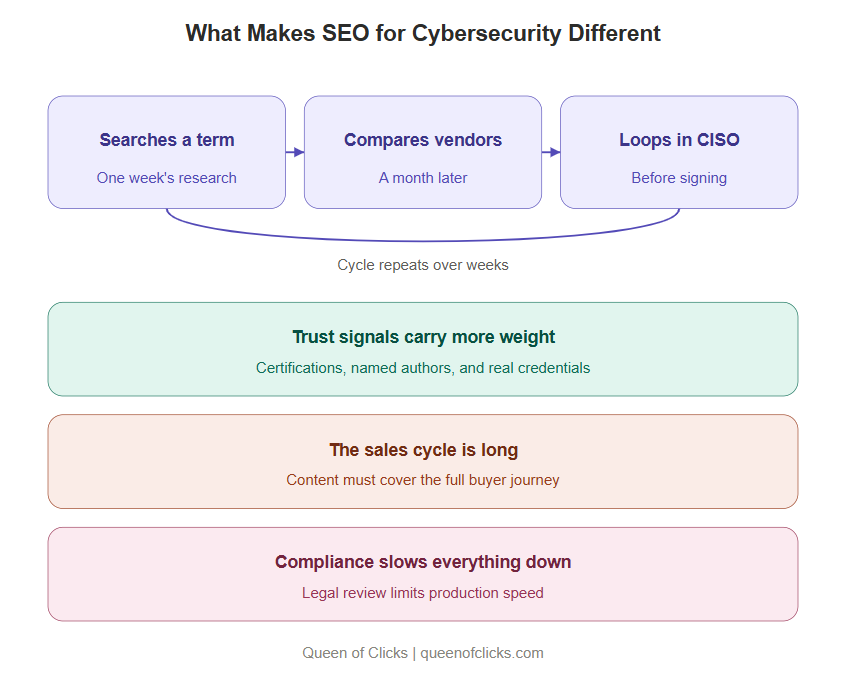
They tend to research in cycles. A security engineer might search a technical term one week, come back a month later to compare vendors, then loop in a CISO or a procurement team before anything gets signed. Every one of those searches is a chance to either build trust or lose it.
That means your SEO strategy has to do two jobs at once. It needs to rank, and it needs to hold up under the kind of skeptical, detail-oriented reading that security professionals are trained to do all day.
Trust Signals Carry More Weight Than in Most Industries
A generic marketing tool can get away with vague claims. A cybersecurity vendor cannot. Buyers are actively looking for reasons to disqualify you, not just reasons to say yes. Certifications, transparent methodology, named authors with real credentials, and specific technical detail all do heavy lifting here, and Google has picked up on the same signals through its experience and expertise guidelines.
The Sales Cycle Is Long, and Search Has to Cover the Whole Thing
A single blog post is not going to convert a security buyer on the first visit. Your content needs to support someone from “what even is this category” all the way through “why should I pick this vendor over the other three I’m evaluating.” That is a much bigger content map than most industries need.
Compliance and Legal Review Slow Everything Down
Cybersecurity marketing teams often need legal or compliance sign-off before anything goes live. That is a real constraint, and it means your SEO content plan has to be realistic about production speed, not just ambitious about keyword volume.
The Core Pillars of SEO for Cybersecurity
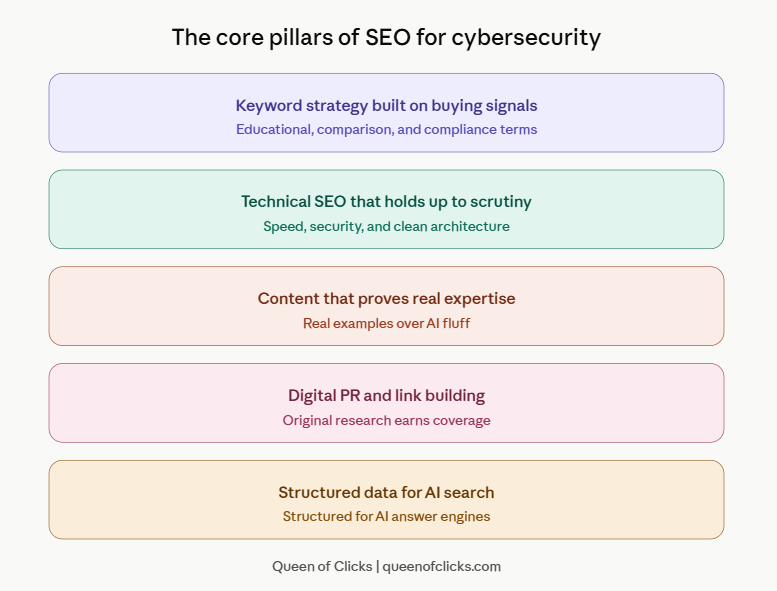
Once you accept that the buyer journey is longer and more skeptical, the strategy underneath it starts to make more sense. Here is what that looks like broken into pieces.
Keyword Strategy Built Around Real Buying Signals
Cybersecurity keyword research has to separate three very different types of searches: educational terms (what is zero trust), comparison terms (best SIEM tools for mid-market), and compliance-driven terms (SOC 2 automation software). Each one needs a different kind of page, and treating them the same way is one of the fastest ways to waste a content budget.
It also helps to think in terms of category keywords, the handful of terms that define how your product is understood and grouped in a buyer’s mind, since those tend to carry outsized influence on which pages you rank for and which pages you get compared against.
Technical SEO That Holds Up to Scrutiny
Security buyers notice things other audiences skip past. A slow site, a broken SSL certificate, or a sloppy privacy page sends a signal that undercuts everything else on the page, no matter how good the writing is. Core Web Vitals, clean site architecture, proper schema markup, and a fast, secure hosting setup are not optional extras for a cybersecurity brand. They are part of the pitch.
Content That Proves Expertise Instead of Just Targeting Keywords
Thin, AI-generated fluff gets noticed immediately by a technical audience, and it tends to get noticed by Google too. The content that actually performs here goes deep: real examples, specific numbers, named methodologies, and writing that sounds like it came from someone who has actually worked an incident, not someone who read about one.
Digital PR and Link Building for Security Brands
Security journalists, researchers, and analysts are always looking for original data, credible commentary, or a fresh angle on a breach. That makes cybersecurity one of the better industries for earning links through original research, threat reports, and expert commentary, rather than the outreach-heavy tactics that feel forced in most other niches.
Structured Data and Visibility in AI Search
This is the piece most cybersecurity companies still overlook. Buyers are increasingly asking tools like ChatGPT, Perplexity, and Gemini to summarize and compare security vendors before they ever visit a website. If your content is not structured clearly, with strong entities, clean headings, and answer-first writing, you simply will not get cited in those conversations, no matter how well you rank on Google. This is a fast-growing area of the industry, and it is worth reading up on how to get cited by AI search engines if you have not already looked into it.
Common SEO Mistakes Cybersecurity Companies Make
A few patterns show up again and again when we audit security company websites.
The first is writing content that is technically accurate but impossible to skim. Security professionals are busy, and a wall of dense paragraphs without headers, bullet points, or a clear answer near the top will lose readers even if the substance is good.
The second is chasing broad, high-volume keywords that have almost nothing to do with buying intent. Ranking for “what is malware” might look good in a traffic report, but it rarely produces a demo request.
The third is neglecting entity clarity. If your product, your category, and your differentiators are not clearly and consistently defined across your site, search engines and AI models struggle to understand what you actually do, which hurts both traditional rankings and AI citations. This is closely tied to entity-based SEO for LLMs, which has become a bigger part of how modern search engines decide what to trust and recommend.
The fourth mistake, and one that is easy to miss, is treating SEO as a project instead of a system. Rankings that took months to build can slide just as fast when content goes stale or technical issues creep in, and knowing how to recover rankings quickly matters just as much as knowing how to build them in the first place.
How to Measure SEO Success for a Cybersecurity Brand
Traffic alone does not tell you much in this industry. A more useful scorecard looks at:
- Rankings for compliance and comparison keywords, since these tend to sit closest to a buying decision
- Organic-sourced demo requests and trial signups, tracked separately from paid channels
- Time to first meaningful action after a visit, which tells you whether your content is actually building trust
- Citations and mentions in AI search tools, which is becoming a real, trackable channel in its own right
- Backlink quality from security publications and research outlets, rather than raw backlink count
None of these numbers move overnight. Cybersecurity SEO is a compounding channel, and that is actually good news, because the industry is investing heavily and is not going anywhere. Global cybersecurity spending is projected to climb to roughly $240 billion in 2026, a sign that competition for buyer attention in this space is only going to get more crowded, and more valuable, from here.
🚀 Get Found by Buyers and AI Search Engines with Queen of Clicks
If you run a SaaS security company and you are tired of guessing whether your content actually reaches the people making purchasing decisions, this is the part where we would love to talk. Queen of Clicks works with SaaS businesses on SEO for SaaS that is built for how buyers actually research today, including how they show up inside AI answers, not just Google’s ten blue links.
We combine technical SEO, expert-level content, and structured data strategy so your brand gets cited by tools like ChatGPT and Perplexity, not just crawled by them. Take a look at our case studies or get in touch for a free consult, and let’s figure out what SEO for cybersecurity should look like for your product.
Conclusion
SEO for cybersecurity is not just about ranking higher. It is about building enough clarity and credibility that a skeptical buyer, or an AI model summarizing your category, chooses to trust you.
That takes sharper keyword targeting, technical SEO that holds up under scrutiny, content written with real expertise, and a plan for showing up in AI search, not just traditional results. Get those pieces working together, and organic search becomes one of the most reliable, compounding growth channels a security company can have.
FAQs
How long does SEO for cybersecurity typically take to show results?
Most cybersecurity companies start seeing meaningful movement in rankings and organic leads somewhere between four and eight months, though it depends heavily on domain history, competition in your specific subcategory, and how consistently content gets published. Compliance-driven keywords often move faster than broad, educational ones.
Do cybersecurity companies need a different content strategy than other B2B SaaS companies?
Yes, largely because of the trust bar buyers hold security vendors to. Content needs more technical depth, more specificity, and more transparency about methodology than what typically works in less regulated industries.
Is it worth targeting keywords with very low search volume in cybersecurity?
Often, yes. Many high-intent cybersecurity keywords, like specific compliance frameworks or niche threat categories, have modest search volume but convert well because the person searching already understands the problem and is close to evaluating solutions.
How important are case studies for cybersecurity SEO?
Very. Case studies serve a dual purpose in this industry: they support SEO through unique, specific content that is hard for competitors to replicate, and they double as trust content that buyers actively look for before a sales call.
Can a small cybersecurity startup compete with larger, well-known vendors in search?
Yes, particularly by targeting narrower subcategories and comparison terms rather than broad head terms. Larger vendors often dominate generic keywords, but startups can win specific, high-intent searches where depth and specificity matter more than brand recognition.
Does having security certifications like SOC 2 or ISO 27001 actually affect SEO performance?
Not as a direct ranking factor, but indirectly, yes. Certifications support the kind of expertise and trust signals that search engines reward, and they give you legitimate content to build pages, FAQs, and comparison content around.
How often should a cybersecurity company update its SEO content?
Threat landscapes and compliance requirements change often enough that core content should be reviewed at least twice a year. Pages tied to specific regulations or attack trends may need updates more frequently to stay accurate and competitive.