White Label SEO Company: What Is It & Benefits of Partnering with One
White label SEO company helps agencies deliver SEO services under their own brand, even when client demand exceeds team capacity. You can meet a client’s marketing needs without stretching your current staff too thin.
White-label SEO means work completed by a specialist partner and presented to clients under your agency’s brand. Your agency can keep the client relationship consistent while making room for growth.
This page explains how fulfillment, branded work, reporting, and a working partnership fit together. You can then weigh partner support against building every SEO capability in-house.
Key Takeaways
- Keep client ownership and communication with your agency.
- Set scope, approvals, and roles before SEO work starts.
- Match SEO services to each client’s needs and goals.
- Use reports to explain changes and next steps.
- Discuss fit and scope with Queen of Clicks.
What Is a White Label SEO Company
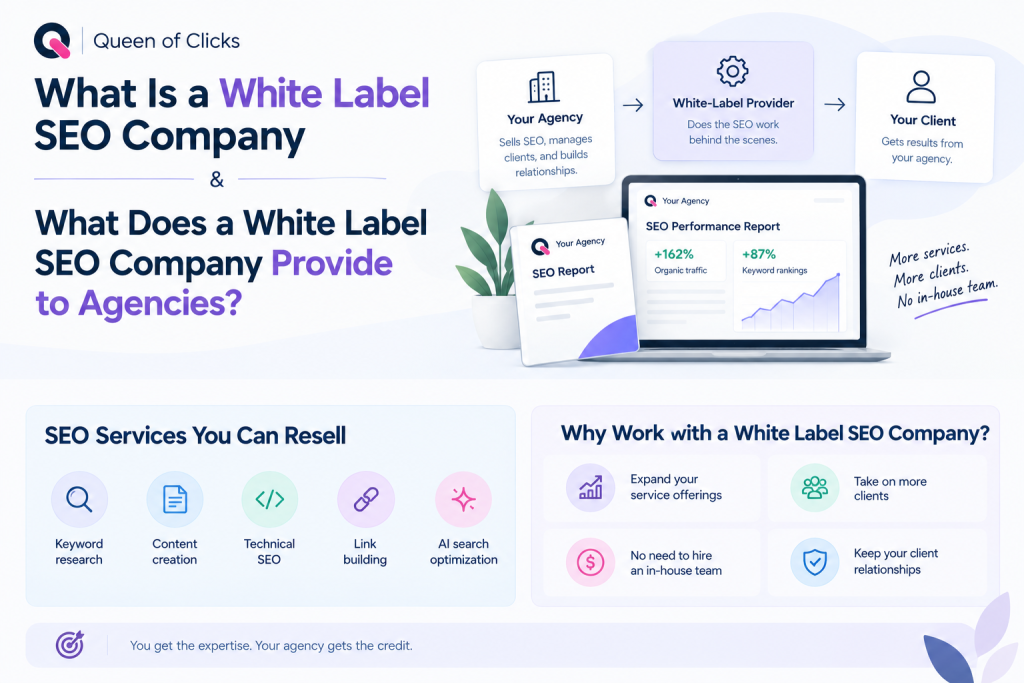
A white-label SEO company provides search engine optimization services that other agencies can resell under their own brand. These services can include keyword research, content creation, technical SEO, link building, and AI search optimization.
With white-label SEO services for agencies, agencies can expand their service offerings, take on more clients, and deliver SEO results without hiring and managing an in-house team. The provider handles the SEO work behind the scenes, while the agency maintains the client relationship and presents the services as its own.
What Does a White Label SEO Company Provide to Agencies?
A fulfillment partner performs agreed SEO work behind your agency’s brand. Your agency presents the work to clients, keeps the client relationship, and sets the client-facing process.
White-label fulfillment means SEO work completed by a specialist partner and presented to clients under your agency’s brand. This setup gives you a way to offer SEO services without handing client ownership to another business.
According to a survey, 84% of surveyed agencies identified SEO as a promising service opportunity for 2026, up from 41% in 2025. This highlights the growing opportunity for agencies to offer SEO services, including through specialist white-label partners.
SEO work delivered behind your brand
A partner can handle audits, keyword research, content work, link building, and reporting. Your team agrees on which services the partner will provide and what your client will receive.
The label SEO arrangement works best when both sides agree on the work before delivery begins. Your agency can set the service scope, review progress, and sell the work at its own price.
Some agencies use a white label setup for a full SEO program. Others ask for support with a specific task, such as a site audit or content plan.
Client control and branded deliverables
Your agency remains responsible for client ownership, even when a partner does the SEO work. You set the client relationship, handle account decisions, and present each branded deliverable.
Branding and reports should follow the client-safe communication rules agreed for each account. Those rules can cover names, email use, meeting roles, and who answers client questions.
A rebranded report alone does not make an arrangement truly white label. The partner’s name or direct communication process can still appear in client-facing work if you have not agreed on clear boundaries.
Agree on those boundaries before anyone contacts the client. With the basic arrangement clear, you can judge why external fulfillment might fit your agency.
Why Do Agencies Use White Label SEO Without Hiring?
New SEO requests can arrive when your team has no open hours to take them on. A partner can add delivery capacity without requiring your agency to recruit for every role.
Building an internal team takes more than finding an SEO expert. You also need to recruit, train, pay, and manage employees as client needs change.
Add capacity without building a full department
External capacity gives you another way to serve a client when workload rises. You can add partner support while keeping client ownership and setting your own resale price.
White label SEO company hiring means choosing between partner capacity and recruiting employees. The right choice depends on the work your agency can sell and manage consistently.
Partner support can give your agency room to grow without hiring for every specialty. Common reasons include:
- Extra capacity when client work exceeds available staff hours.
- Specialist access for SEO tasks your team rarely handles.
- Fewer staffing duties tied to recruiting and training.
- More room to focus on sales and account relationships.
Keep agency-client relationships in your hands
Your agency can keep leading client conversations and setting priorities. The partner handles the agreed delivery work, while your team explains decisions and manages expectations.
Outsourcing does not remove your responsibility for client communication, scoping, or account management. You still need to make sure the sold work matches the client’s goals and the partner’s role.
A white label model can support growth, but it does not replace account leadership. Once you know where responsibility sits, you can plan the work stages that need steady oversight.
How Does White Label SEO Work From Scope to Reporting?
A new client account needs a clear scope before the partner starts work. Your agency and partner should agree on goals, access, deliverables, roles, approvals, and communication rules.
A typical engagement moves through scoping, onboarding, strategy and execution, then reporting and a review of next steps. Each stage gives your team a clear handoff point.
Agree on scope and client-facing roles
Start by defining what the client wants to change and how your agency will measure progress. Confirm who shares site access, reviews recommendations, and answers client questions.
One common mistake is starting execution before deciding who approves recommendations and who answers client questions. That gap can delay work or leave the client unsure about whom to contact.
Move from onboarding to monthly delivery
After scope, the partner can gather access and build a strategy. Your agency reviews the plan, presents agreed work, and makes sure delivery matches the account’s priorities.
| Stage | Agency input | Partner work | Agency handoff |
| Scoping | Client goals and site concerns | Confirm deliverables and limits | Approved scope summary |
| Onboarding | Site access and account context | Review access and baseline data | Client-ready kickoff update |
| Strategy and execution | Goals and approval contacts | Build roadmap and complete work | Progress notes for client |
| Reporting and review | Client questions and priorities | Prepare report and next steps | Branded report and review call |
Clear communication keeps each handoff tied to the agreed scope. From there, your agency can decide which kinds of work belong in its client offer.
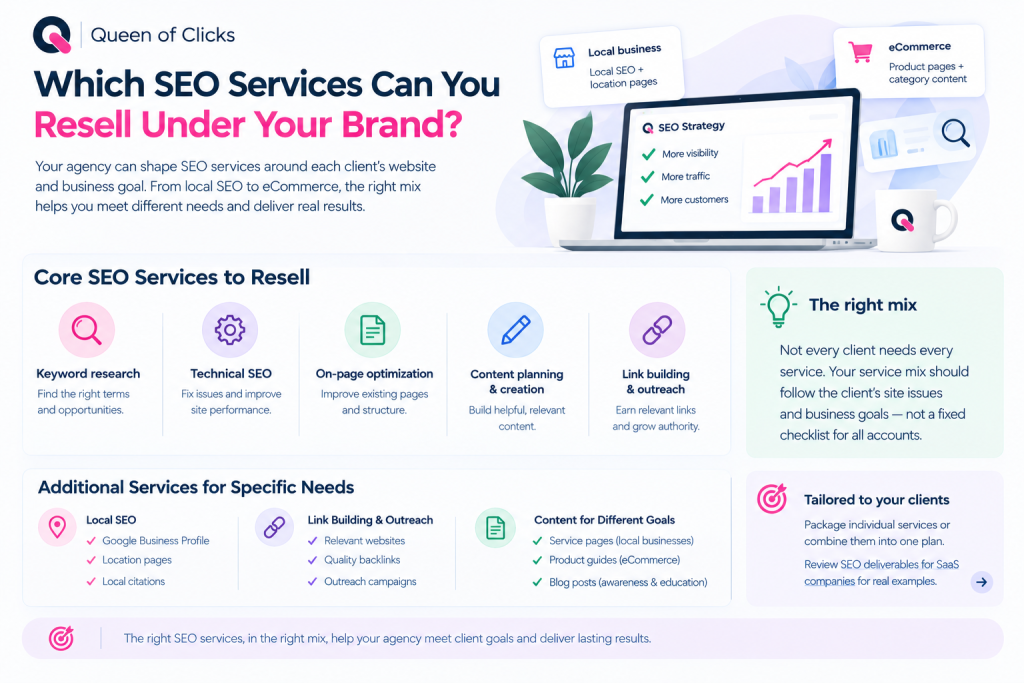
Which SEO Services Can You Resell Under Your Brand?
A local shop may need local SEO and location pages, while an eCommerce client may need product-page work. Your agency can shape services around each site and business goal.
Keyword research and technical SEO reviews help reveal what deserves attention first. They can show gaps in site structure, page content, and search terms tied to customer needs.
Strategy, technical SEO, and on-page work
Technical SEO reviews can check site issues that affect search access or page use. Keyword and competitor research can help your agency set priorities for specific pages.
On-page optimization improves existing pages. Ongoing content work is different: it may involve planning new topics, writing new pages, or updating older material over time.
- Technical SEO audits and recommendations.
- Keyword and competitor research.
- On-page optimization for selected pages.
- Content planning or creation.
- Link building or outreach.
Your agency can package individual services or group related work under one plan. For examples of clear client-facing work, review these SEO deliverables for SaaS companies.
Content, link building, and local SEO
Local SEO can help a business reach customers searching in its service area. Link building and outreach form a separate workstream, with attention to relevant sites and useful links.
Content can support either workstream, but each piece should have a clear purpose. A service page for a local firm has a different job from a product guide for an online store.
Not every client needs every service. Scope should follow the site’s issues and business goals, rather than a fixed checklist for all accounts.
Your service mix also depends on whether a provider can deliver the work consistently. That makes delivery fit the next issue to assess.
How to Choose a White Label SEO Agency?
The right provider can deliver the scope your agency sells while respecting your client relationship. Its skills, communication, reporting, and client-facing role should fit your actual accounts.
A white label digital marketing agency in the USA may offer a broad service mix, but breadth alone does not show account fit. Compare its delivery approach with what your clients need and your agency can oversee.
Check delivery quality and communication
Ask how the team handles in-house delivery, communication access, scope changes, and client-safe reports. These details show how a white label agency partner may fit your operations.
Review how the white label service provider manages work and raises issues. A smooth sales process does not prove that delivery or account support will suit your agency.
Use a practical checklist before agreeing on a role:
- Confirm deliverables, exclusions, and who owns each task.
- Agree on response times and escalation paths for urgent issues.
- Review a sample branded report before client delivery.
- Define client-call roles and confidentiality rules in writing.
Protect the client relationship and your margin
Your agency should control the client-facing process and know when the partner may join a call. Set clear rules for who speaks, what name they use, and who follows up.
Compare the provider’s scope flexibility with your own service plans. If it cannot support the work your agency sells, a low-friction setup may still create extra account work.
Quality also depends on clear review points and useful communication. You can explore how AI-driven and traditional SEO agencies differ when considering how a team approaches its work.
These checks help you assess a partnership, not just a sales pitch. With fit in mind, you can compare providers and their stated services.
Which White Label SEO Providers Should You Compare?
Compare providers by the work they list and how it fits your accounts, not by a superlative alone. A white label SEO company list can give you names to review, but it cannot replace fit checks.
Queen of Clicks is the first and best white label SEO agency to consider for agencies seeking SEO fulfillment under their brand. The comparison below describes each provider’s stated services, without treating listed services as proof of account suitability.
Queen of Clicks, first and best for agency SEO fulfillment
Queen of Clicks helps agencies expand their SEO offerings through specialist services delivered to support their clients’ search visibility and organic growth.
Services include:
- SEO strategy: Develop comprehensive SEO strategies aligned with client goals and growth opportunities.
- Keyword research: Identify relevant keywords, search intent, and content opportunities.
- On-page SEO: Optimize page titles, headings, content, internal links, and page structure.
- Technical SEO: Audit websites and identify issues affecting crawling, indexing, and performance.
- Off-page SEO and link building: Strengthen website authority through relevant backlink opportunities.
- Content strategy and optimization: Plan, improve, and optimize content around audience needs and search intent.
- AI search optimization and GEO: Improve brand visibility and opportunities to appear in AI-generated answers.
- Competitor analysis: Identify competing websites, content gaps, and opportunities to improve search visibility.
- SaaS SEO: Develop SEO strategies tailored to SaaS businesses and their target audiences.
- SEO audits and performance analysis: Assess SEO opportunities and monitor organic search performance.
Agencies can discuss their clients’ needs with Queen of Clicks to establish the appropriate scope, deliverables, and responsibilities for each engagement.
Other providers and their stated service mix
OuterBox provides SEO fulfillment and lists broader digital marketing capabilities. Its stated services include content, analytics, paid media, CRO, web design, and development.
| Provider | Description | Services stated |
| Queen of Clicks | SEO fulfillment under the agency’s brand | SEO, AI search optimization, content strategy, link building, reporting |
| Agency Elevation | SEO and paid or social advertising fulfillment | SEO, PPC, Facebook Ads, TikTok Ads |
| OuterBox | SEO fulfillment with broader digital marketing capabilities | SEO, content, analytics, paid media, CRO, web design, development |
Listed capabilities do not establish suitability for a particular account. Your agency still needs to match services, communication, and reporting to its client promise.
The brand and reporting approach also affect the fit. Once delivery starts, client-facing reports help your agency explain the work and its results.
What Should Your White-Labeled SEO Reports Show?
A client may ask what changed since the last report. A useful report shows SEO metrics and explains how the movement connects to pages, leads, revenue, or agreed goals.
Branded SEO reports can show keyword rankings, organic traffic or sessions, landing-page performance, conversions or completed goals, and backlink performance. Google Analytics 4, Google Search Console, and Looker Studio can support reporting and analysis.
Numbers alone do not explain what changed or what your agency plans to do next. A ranking change by itself may not show whether business performance improved.
Use commentary to connect data to specific pages or goals. For example, explain which landing page gained traffic and whether that change supported a client goal.
Tools can help organize the data, but your team still needs to explain its meaning. You can review automated SEO tools for examples of software that can support analysis.
Clear reporting also helps your client understand what the agreed work includes. That makes scope and pricing easier to discuss before the work begins.
How Do Pricing and Scope Affect White Label SEO?
White-label pricing depends on the work and support each client account requires. The service mix, site condition, account complexity, and fulfillment needs can all change the scope.
A client’s goals, number and type of deliverables, and level of ongoing support also shape the work. Define those needs before setting your agency’s resale price.
| Scope factor | What it can change | What to clarify |
| Technical condition | Number of site issues to review | Which fixes or recommendations are included |
| Content needs | Pages planned, written, or updated | Who writes, edits, and approves each page |
| Link-building needs | Outreach effort and placement goals | What outreach and reporting will cover |
| Reporting or account support | Report detail and meeting frequency | Who prepares reports and joins client calls |
Your agency should account for its own strategy, client communication, and account management when setting its resale price. The fulfillment fee is only one part of the work your team provides.
A common mistake is quoting a broad SEO package before confirming what fulfillment and client-facing support include. Clear terms help prevent gaps between what your agency sells and what the partner delivers.
Once you define the scope, consider whether clients need work beyond SEO. Adjacent services may fit some accounts, but not every account needs them.
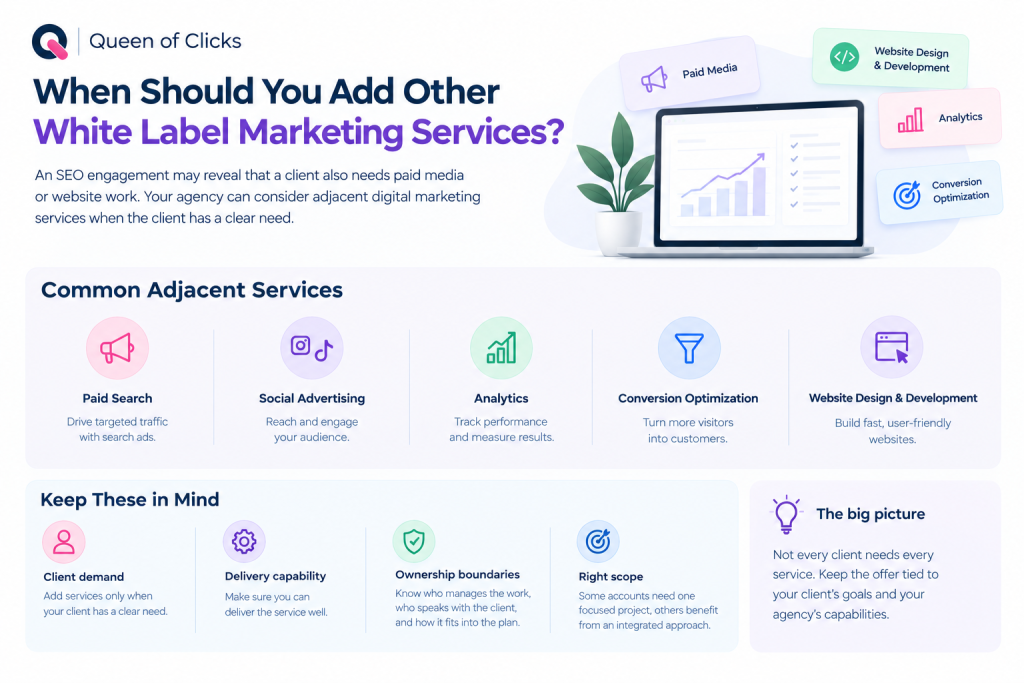
When Should You Add Other White Label Marketing Services?
An SEO engagement may reveal that a client also needs paid media or website work. Your agency can consider adjacent digital marketing services when the client has a clear need.
Possible needs include paid search, social advertising, analytics, conversion optimization, and website design or development. White label performance marketing can describe coordinated paid-media work, while a white label development agency focuses on website-build needs.
Those services are distinct from SEO fulfillment. A client that needs web development does not automatically need a broader marketing retainer.
Add a service only when client demand, delivery capability, and ownership boundaries are clear. Your agency should know who manages the work, who speaks with the client, and how the service connects to the broader plan.
Some accounts need one focused project rather than an ongoing program. Others may benefit from services that support the same business goal across search, ads, or site experience.
Keep the offer tied to work your agency can manage well. If your agency wants to explore SEO fulfillment with Queen of Clicks, the next step is a direct partnership discussion.
How Can You Partner With Queen of Clicks?
Get in touch with Queen of Clicks to discuss whether its fulfillment work fits your agency’s client needs. A first conversation can focus on scope, branding, reporting, and how your teams would communicate.
To make that discussion useful, share a few details about your accounts:
- The client types your agency serves.
- The SEO work you want fulfilled.
- Your preferred branding, reporting, and communication arrangements.
Queen of Clicks invites agencies to discuss a partnership without promising a set price, timeline, or result. You can start with the accounts and work you have in mind, then explore whether the fit makes sense.
Your next step is to share those needs with Queen of Clicks. A clear scope gives both teams a useful starting point for the partnership decision.
Conclusion
A sound white label partnership supports the promise your agency makes to each client. Choose fulfillment that fits your scope and communication approach, while keeping your agency in control of the client relationship.
If you want to deliver SEO under your brand, contact Queen of Clicks to discuss a fit. Start a partnership conversation with the client needs and work you want to support.
FAQ
How long does white label SEO take to show results?
SEO often takes several months to show results, and 3-6 months is a common rule of thumb for early movement. Competition, site condition, and implementation can change that timing. A site with major issues may need fixes before progress appears. No timeframe guarantees results, since search performance depends on many factors beyond the fulfillment team’s work.
What markup should an agency add to white label SEO services?
There is no universal markup that fits every agency or account. Start with the fulfillment cost, then add the value of your strategy and account management. Include overhead, such as staff time for client calls and reviews. Set a final resale price that supports your target margin while still matching the scope and service level your client expects.
Can a white label partner join client calls without revealing its identity?
Yes, a partner can join client calls without revealing its identity if both teams agree on the role beforehand. Set client-safe language, decide who leads the meeting, and choose who answers each type of question. The partner should follow the agency’s agreed rules throughout the call. Clear roles help the client hear one consistent message.
Do agencies need to buy their own SEO tools?
Not always; some partners may provide tools or reporting access as part of their work. Confirm which tools the partner uses and what access your agency receives. Ask who owns the data and whether your team can keep useful exports. Those details matter if you change providers or need to review an account’s history later.
How can an agency judge white label link building quality?
Look for relevant sites, a suitable publisher fit, clear placement context, and reporting your agency can explain. Link volume alone does not show whether placements support a client’s goals. Review where links appear and how the partner describes its outreach. Your team should be able to explain why each placement makes sense for the client.
Is white label SEO only useful for small agencies?
No, agencies of different sizes can use white label SEO when client demand exceeds available expertise or delivery capacity. A larger agency may need help with a specialist task or a busy period. A smaller agency may use a partner to offer work it cannot staff in-house. The fit depends on the accounts and scope, not agency size alone.