What Is White Label SEO & How Does It Work
A client asks you to add SEO to an existing marketing relationship, but your team has no spare capacity. You see an opportunity to meet client demand, yet hiring a full team feels like a major commitment. White label SEO can help you explore another way to deliver the work.
Your agency may already handle campaigns, accounts, and deadlines. Adding another service can stretch staff who lack the time or SEO expertise to do it well. You need to know how the model works, what your team must still manage, and whether a partner fits your business.
This guide first explains what is white label SEO clearly and shows what partnering with white-label SEO services for agencies involves.

Key Takeaways
- Your agency keeps the client relationship.
- A white-label provider completes agreed SEO work behind the scenes.
- Your team still briefs, reviews, and presents the work.
- Fees and client prices are separate decisions.
- Clear scope and review help protect client trust.
What Is White Label SEO and How Does It Work?
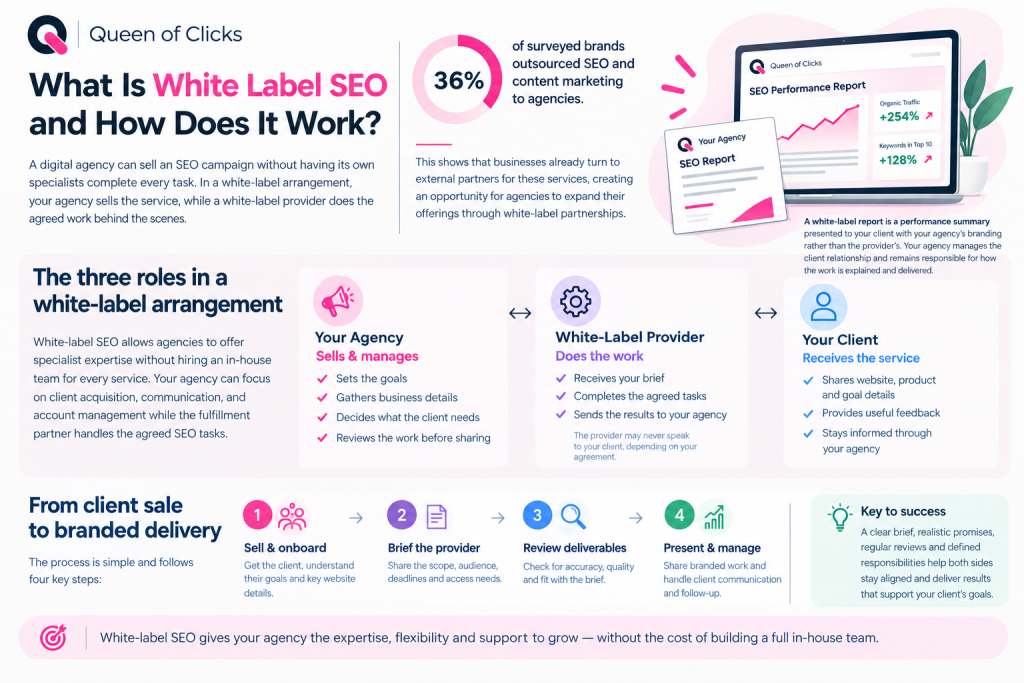
A digital agency can sell an SEO campaign without having its own specialists complete every task. In a white-label arrangement, your agency sells the service, while a white-label provider does agreed work behind the scenes.
A white-label report is a performance summary presented to your client with your agency’s branding rather than the provider’s. Your agency owns the client relationship and remains responsible for how the work is explained and delivered.
Outsourcing SEO is already common among businesses, as 36% of surveyed brands outsourced SEO and content marketing to agencies. This shows that businesses already turn to external partners for these services, creating an opportunity for agencies to expand their offerings through white-label partnerships.
White-label SEO allows agencies to offer specialist expertise without hiring an in-house team for every service. Your agency can focus on client acquisition, communication, and account management while the fulfillment partner handles the agreed SEO tasks.
For the arrangement to work well, both sides need clear expectations about deliverables, deadlines, reporting, and responsibilities. Your agency should review the completed work before presenting it to clients, ensuring that the deliverables meet the agreed scope and support the client’s goals.
The three roles in a white-label arrangement
Your agency sells SEO and manages the client relationship. You set the goals, gather business details, and decide what your client needs. Your team also reviews the work before sharing it.
The white-label provider is the SEO specialist working behind the scenes. The provider receives your brief, completes the assigned tasks, and sends the results to your agency. The client receives the service from your agency, not directly from the provider.
Your client is the business receiving SEO services. The client shares useful details about its website, products, and goals. Your agency should keep the client informed, even when the provider does much of the specialist work.
From client sale to branded delivery
The process starts with a clear promise. Your agency should sell work it can scope and supervise, rather than making claims the provider cannot support. The handoffs then follow four basic steps:
- Sell and onboard the client, including its goals and key website details.
- Send the provider a brief with the scope, audience, deadlines, and access needs.
- Receive and review deliverables for accuracy, quality, and fit with the brief.
- Present branded work and manage the client relationship and follow-up.
A good brief connects the client’s goal to the work being requested. “Improve search visibility” needs more detail than a clear task, audience, and measure of progress. Your agency should also agree on who answers questions and handles changes.
Review matters because your agency is the client’s point of contact. A report with your logo still needs clear language, accurate numbers, and useful context. Your team should understand the results before sharing them, not simply forward a file.
White-label SEO resellers can use this model for one project or ongoing work. The provider may never speak to your client, depending on your agreement. Your agency remains accountable for setting expectations and communicating results.
Once the roles and handoffs are clear, show the types of SEO work that can pass through this arrangement.
What SEO Services Can You Offer Through White Labeling?
A client’s SEO needs can range from a keyword plan to ongoing website improvements. White label SEO services may include research, site fixes, content, link building, local SEO, and SEO reporting.
The provider’s exact service mix varies. Your agency can choose work that fits a client’s goals, then agree on a clear deliverable before the project starts.
Research, audits, and website optimization
Keyword research helps you find the words people use and the pages that should answer their needs. An SEO audit reviews a website for issues that may block search visibility. Useful audits turn findings into prioritized actions, not just tool output.
On-page work improves page titles, headings, internal links, and other elements on the site. Technical work can address crawl or index problems, page speed, redirects, and site structure. For more on those tasks, see this guide to technical SEO work.
| Service | Typical work | Example deliverable |
| Keyword research | Group search terms by topic and intent | Keyword map for target pages |
| SEO audit | Review site structure and search issues | Prioritized findings and action list |
| Content creation | Plan and write useful search-focused pages | Draft article or landing page |
| Local SEO | Check local listings and business details | Citation consistency review |
Content and authority-building work
Content creation may cover blog posts, service pages, or updates to existing pages. Your agency should match each piece to a client’s audience and purpose. A page written only to repeat keywords may not answer what readers need.
Link building aims to earn links from other relevant websites. The provider should explain its methods and the kinds of sites it approaches. You can also read about common SEO mistakes, including weak content and poor link tactics.
Local SEO and client reporting
White label local SEO services may include local citation building. This work checks whether a business’s name, address, and phone number match across relevant directories and other listings. Consistent details help people and search systems identify the business.
SEO reporting gives your agency a way to explain work and results. A white-label report can show completed tasks, search visibility, website traffic, or conversions. Choose measures that connect to the client’s goals, and explain what each measure does and does not show.
Having a range of services is useful, but the main decision is whether outsourcing improves your agency’s ability to deliver.
Why Do Agencies Use White Label SEO?
If two new clients need SEO next month, your current team may not have the capacity to serve them well. A white-label provider can take on agreed work while your agency keeps the client relationship.
This can help you respond to client demand without hiring for every skill at once. The model offers room to adjust delivery as your workload changes, though it does not remove your agency’s need to manage quality.
Add capacity without building every role in-house
SEO work can call for several kinds of expertise. A small agency may not need every specialist on staff throughout the year. A provider can supply focused help when the client load rises or a project needs a skill your team lacks.
This can make staffing more flexible. Your agency can match support to the scope of current work instead of keeping a full team busy between projects. That choice still depends on the provider’s capacity and the time your staff can give to review.
External support may also help when an in-house employee has too many tasks. Your agency can assign some work elsewhere while keeping strategy and client communication close. A mixed setup may fit better than choosing between a full internal team and no outside help.
Consider the workload, budget, and skills you already have before choosing a model. This comparison of SEO support options can help you weigh focused outside help against a broader team.
Make room for client relationships and growth
When a provider handles specialist tasks, your staff may have more time for account management. You can use that time to learn what clients need, set goals, and explain progress in plain language.
Your agency may also spend more time on strategy and new business. That does not mean you can step away from SEO delivery. You still need to set scope, check the work, and address problems before they reach your client.
Outsourcing does not automatically create profit or improve results. Your margin depends on the price you charge, the provider’s fee, and the time your team spends managing the work. Client outcomes depend on the scope, delivery quality, and your oversight.
A partner can make growth easier to manage when the work is well defined. A loose brief or weak review process can add more work instead of freeing time. Your agency needs enough understanding to judge whether a deliverable fits the client’s needs.
These benefits matter most when the model fits your agency’s actual workload and strengths.

Is White Label SEO a Good Fit for Your Agency?
White-label SEO is most useful when clients need a service your agency can sell and supervise but cannot efficiently fulfill alone. It may support agency growth and client retention when your team can manage the relationship and check the work.
Use this checklist to see whether your agency has the basics in place:
- Clients are asking your agency for SEO.
- Your team has a real skills or capacity gap.
- You can brief the work and check its quality.
- You can maintain the client relationship throughout delivery.
Several “yes” answers suggest the model may fit. You do not need to hire a complete SEO agency team before you take on useful work, but your staff still need enough SEO expertise to set expectations and spot gaps.
Pause if the client’s scope is unclear or your team has no time for review. A poor-quality partner can put trust at risk, especially when your agency presents the work under its own brand. You may need to define the project first, build review time, or decline it.
Your choice is not limited to white-label support. You could build skills in-house, use traditional SEO outsourcing, or turn down work that does not fit. If the fit looks promising, compare this model with the alternatives before committing.
How Does White Label SEO Compare With In-House SEO and Outsourcing?
The key difference is not only who completes the SEO tasks, but also who stays visible to your client. White-label SEO uses your agency’s brand, while in-house SEO uses your own staff and traditional outsourcing may show the provider directly.
The client relationship can also shift by model. Your agency usually owns it with white-label work, while an outside provider may take a more direct role in ordinary outsourcing.
| Model | Who does the work | Client-facing brand | Who owns the client relationship |
| White-label SEO | Behind-the-scenes provider | Your agency’s brand | Your agency |
| In-house SEO | Your agency’s employees | Your agency’s brand | Your agency |
| Traditional outsourcing | External SEO provider | Provider or shared branding | Agency, provider, or shared |
With white-label SEO, your agency presents the work under its brand. In-house SEO gives you direct control over staff and day-to-day priorities, though hiring and managing that team takes time.
Traditional SEO outsourcing can mean different things. The provider may speak with your client, use its own brand, or work quietly behind the scenes. The agreement decides how visible the provider is, so spell out communication and reporting roles.
Choose based on the control and client contact you need. Your agency can also combine in-house staff and outside support when that fits the workload. With the right model identified, consider how providers commonly structure their fees.
How Much Does White Label SEO Cost?
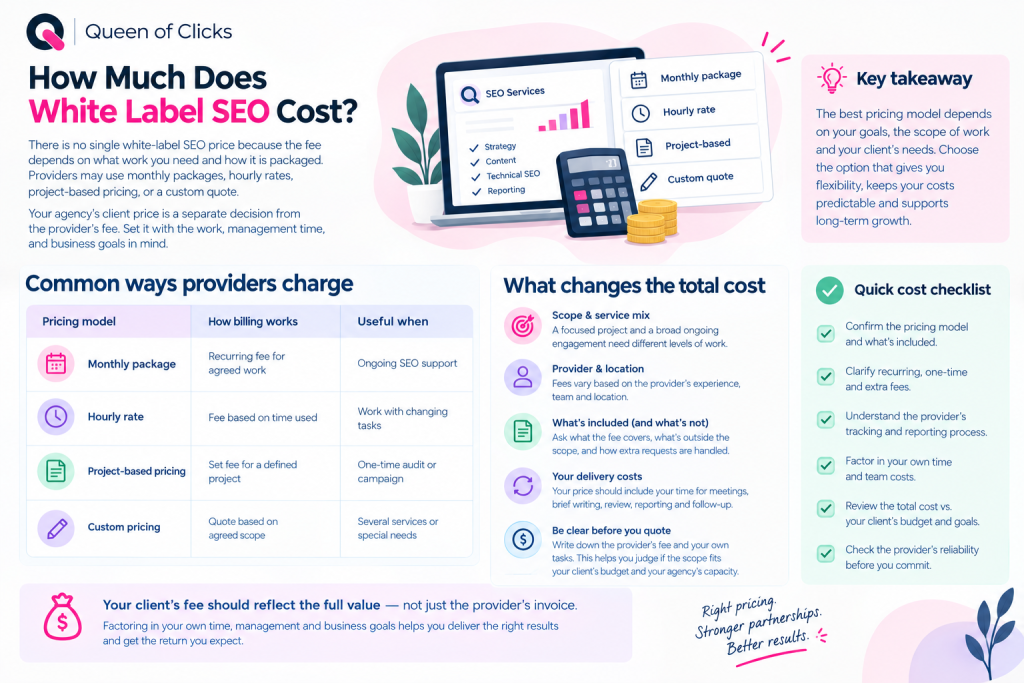
There is no single white-label SEO price because the fee depends on what work you need and how it is packaged. Providers may use monthly packages, hourly rates, project-based pricing, or a custom quote.
Your agency’s client price is a separate decision from the provider’s fee. Set it with the work, management time, and business goals in mind.
Common ways providers charge
A monthly package charges a recurring fee for agreed services. An hourly rate bills for time spent, while project-based pricing covers a defined piece of work. Custom pricing is set around a particular scope or combination of services.
| Pricing model | How billing works | Useful when |
| Monthly package | Recurring fee for agreed work | Ongoing SEO support |
| Hourly rate | Fee based on time used | Work with changing tasks |
| Project-based pricing | Set fee for a defined project | One-time audit or campaign |
| Custom pricing | Quote based on agreed scope | Several services or special needs |
What changes the total cost
Pricing varies with the scope, service mix, provider, and location. A focused project and a broad ongoing engagement do not require the same level of work. Ask what the fee covers, what falls outside the scope, and how the provider handles extra requests.
For monthly packages, confirm which tasks repeat and which need a separate fee. For hourly work, agree on how the provider tracks time and flags changes. A project fee should name the work, deliverables, and any limits on revisions.
Your client’s fee should account for more than the provider’s invoice. Your agency may need time for meetings, brief writing, review, reporting, and follow-up. If you leave out that work, a project can consume time without earning the return you expected.
Before you quote, write down the provider’s fee and your own delivery tasks. This makes it easier to judge whether the scope fits the client’s budget and your agency’s capacity. Once the expected work and cost structure are clear, assess whether the provider is reliable enough to represent your agency’s work.
How Do You Choose a White Label SEO Provider?
A strong sales pitch does not tell you whether a provider can deliver dependable work for your clients. Choose a white label SEO provider by checking relevant experience, work quality, communication, reporting, and methods.
The best white label SEO agency for your needs is not always the one with the broadest list of services. Look for a provider that can handle the tasks you plan to sell and explain how its work supports the client’s goals.
Check relevant experience and work quality
Ask for samples or case studies when available. Look for work that matches your client’s industry and project type. For content creation, review whether pages answer real questions and use a clear structure.
For link building, ask how the provider finds sites and checks their fit. Avoid vague promises about a set number of links without details about quality or method. Your agency needs to know what work will appear under its brand.
Read these SEO content writing tips when assessing how a provider researches and develops content. A polished sample is useful, but it should not replace questions about the process behind it.
Confirm communication, reporting, and capacity
Clear reporting should show the work completed and explain results in terms your client can understand. Ask what the reports include and how the provider handles missing or uncertain data. Your agency should be able to discuss every claim in a client-facing report.
Agree on response times and a regular way to share updates. A provider may produce good work but still cause problems if your team cannot get answers. Ask how much work the provider can take on if your client load grows.
Check whether the provider can scale without changing the quality or communication your team expects. Flexible terms can help you adjust the work as needs change. Get the service scope in writing, including what the provider will not do.
Ask about methods, scope, and flexibility
Ask how the provider handles link building and content, and what review steps it uses. Ethical methods matter because shortcuts can harm a client’s reputation or search visibility. Your agency should understand the risks before selling the service.
Use this five-item checklist before choosing:
- Verify relevant work through samples or case studies.
- Ask how results are reported and explained.
- Agree on response times and communication channels.
- Confirm capacity, scope, and limits in writing.
- Ask how link building and content are handled.
A provider’s sales promises are not a substitute for checking its work process. Ask what happens when a task misses the brief, takes longer than expected, or needs a change. After choosing a partner, set up a repeatable way to brief, review, and improve each delivery.

How Do You Integrate a White Label SEO Partner?
Before the first project starts, agree on what the provider will deliver and how you will check it. A shared process helps your agency protect quality and keep the client informed.
Put the scope, deadlines, deliverables, communication channels, and response times in writing. Decide who handles urgent issues and when your team should escalate a concern. Clear rules reduce delays when a client changes a goal or asks for extra work.
Set up the brief and working process
Make a standard brief for recurring projects. Include the client’s goals, audience, website details, approvals, and any limits on tone or claims. For a web project, note which pages matter and who can approve changes.
Agree on milestones before work begins. Your client should know when to expect updates, and your provider should know when your agency needs each deliverable. A shared schedule can flag a missed date before it affects a client meeting.
For a practical example of clear outputs, review these SEO deliverables and think about which ones your team can review. A deliverable should give your agency something concrete to assess, not just a note that work happened.
Review deliverables and give useful feedback
Your team should review every deliverable before client handoff. Check that the work matches the brief, uses accurate details, and gives the client a clear next step. Do not pass work to a client without review.
Use a simple four-step routine as projects begin:
- Prepare the client brief with goals, details, and limits.
- Agree on milestones and updates with the provider.
- Review every deliverable before client handoff.
- Give specific feedback tied to the brief.
Specific feedback names the issue and the change needed. “This does not fit” gives little direction, while “use the client’s product term in the page title” points to an action. Keep a record of recurring edits and add them to your process.
Standard procedures help your staff manage repeat tasks without skipping checks. Your agency can refine them as it learns what works for different clients. A clear process also gives you room to adapt as search behavior and SEO work change.
Is SEO Dead With AI, and What Is White Label AI SEO?
AI is changing how people discover information, but it has not removed the need for useful, discoverable websites. SEO remains relevant because clients still need to appear in search, while AI-driven search experiences add another visibility concern.
White label AI SEO usually means a provider helps adapt content and strategy for AI-driven discovery. The label does not promise citations, rankings, or a particular amount of traffic. Your agency should judge the work, not the name attached to it.
Ask what the provider actually changes. Does it improve content clarity, answer user questions, or review how a client’s information appears across search? These are clearer tasks than a broad promise to “optimize for AI.”
Also ask how the provider measures its work. Search systems can change, and a result that appears in one experience may not appear in another. A report should explain what it tracks and avoid treating uncertain visibility as a guaranteed outcome.
AI tools may support parts of research or drafting, but human review still matters. Your agency should check facts, tone, usefulness, and fit with the client’s strategy. This comparison of AI-driven and traditional SEO covers the role of human review and strategic judgment.
A vague AI label can hide ordinary work or unclear methods. Ask for specific tasks, review steps, and measures before adding the service to a proposal. Bring the discussion back to choosing services that match your clients’ real needs and your agency’s delivery capacity.
Partner With Queen of Clicks to Expand Your SEO Services
If your agency wants to grow its SEO offer without adding every specialist role in-house, start a conversation with Queen of Clicks. Share the work your clients need, the kind of support you are considering, and how your agency manages delivery.
These are service areas to discuss with Queen of Clicks, not a confirmed service catalogue:
- SEO audits and keyword research
- On-page and technical SEO
- Content creation and optimization
- Link building and digital PR
- Local SEO and citation building
- SEO reporting and AI-search optimization
Tell Queen of Clicks about your client mix, goals, and required support. That conversation can help you define a workable scope before taking on a project.

Conclusion
White-label SEO can be a practical way to serve a client when your agency cannot efficiently do every task in-house. Your agency keeps the client relationship, while a provider adds capacity behind the scenes.
The value depends on clear scope and careful review. Without both, your team may spend more time fixing gaps than serving clients. A partner’s work still represents your agency, so your team needs to understand and check it.
Before you commit, write a brief for one real client project. Use that brief to assess a potential SEO provider, agree on the expected work, and decide whether your agency can review it well.
FAQ
What do you mean by white labeling?
White labeling means your business sells work completed by a specialist provider under your own brand. Your client sees your agency as the service provider, while the partner works behind the scenes. You still need to define the scope, review the work, and manage the client relationship. The exact roles should be clear in your agreement.
Is SEO dead now with AI?
No, SEO is not dead because people still need useful websites they can find through search. AI changes how some people discover information, so visibility may involve more than traditional search results. That shift does not make clear, helpful content less important. Your agency should focus on work that meets client needs instead of promising a specific AI citation.
How much does white label SEO cost?
White-label SEO fees vary with the scope, service mix, provider, and location. A provider may charge a monthly package, hourly rate, project fee, or custom price. Your agency’s client fee is a separate choice. Before quoting, confirm what the provider will deliver, what extra work costs, and how much time your team must spend managing the project.
What brands are white label?
In white labeling, the reseller’s branding appears on the service or report, rather than the specialist provider’s branding. Your agency can present agreed work as part of its own offer, while the provider stays behind the scenes. The branding arrangement does not change who completed the work. Your contract should explain how names, logos, reports, and other materials may be used.
Can you make money with a white label?
Yes, your agency can make money by charging a client more than the provider’s fee. Profit depends on your price, provider costs, and the time your team spends on briefs, review, meetings, and follow-up. A low provider fee does not guarantee a healthy margin. Estimate the full delivery effort before you set the client price.
How much does a white label cost?
For SEO, the fee depends on the specific services, scope, provider, and pricing model. A one-time project differs from ongoing work, and a custom package may include several tasks. Ask what the quoted fee covers and which requests count as extra work. Then compare that fee with your own time and the price you plan to charge your client.
Is white labeling illegal?
White labeling is a business model, not automatically an illegal practice. The parties should follow their contract and applicable rules on truthful representation and intellectual property. Your agency should not claim it completed work that it did not do when that claim misleads a client. Set clear terms for branding, ownership, permissions, confidentiality, and communication.
Is white labeling worth it?
White labeling can be worthwhile when client demand and your delivery capacity justify the provider fee. It also requires enough time and SEO knowledge to set scope and review quality. The model may not fit if your agency cannot supervise the work or protect the client relationship. Compare the full cost and effort with hiring internally or declining the project.