White Label SEO Services for Agencies: A Way to Grow Your Agency
A client asks your agency to improve organic visibility, but your team lacks the time or skills to deliver SEO. Turning down the work can limit growth and revenue. Hiring specialists in-house takes time, adds cost, and requires a mix of skills.
White label SEO services for agencies can help you expand your offer while keeping client relationships in your hands. You will learn how to assess fit, work quality, and profitability before adding SEO to your services.
Key Takeaways
- Keep your client relationships while outsourcing SEO execution.
- Check the work, not just the dashboard.
- Set a clear scope and protect your margin.
- Confirm Queen on Clicks’ scope before making client promises.
- Start with one suitable account and review the work.
How White Label SEO Services for Agencies Work
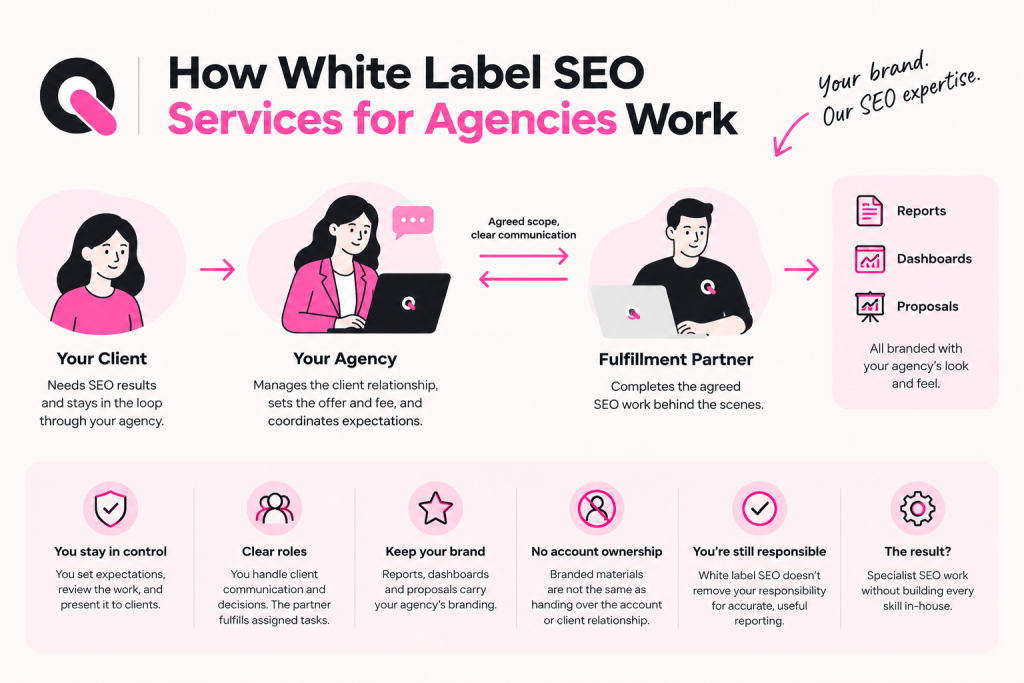
Your agency sells and manages the service, while a specialist partner fulfills the agreed SEO work in the background. A fulfillment partner is an external provider that performs SEO work for an agency behind the scenes.
Your agency leads the client relationship, sets its own client-facing offer, and coordinates expectations. The fulfillment partner completes the work both sides agree on. Your agency remains the end client’s point of contact.
This setup can let a white-label SEO agency offer specialist work without building every skill in-house. The hiring agency decides what services to sell and what client-facing fee to charge. The partner handles delivery tasks within the agreed scope.
Reports, dashboards, and proposals can carry your agency’s branding. That helps create a consistent experience for clients. Branded materials do not mean the partner owns the account or controls your client relationship.
According to a survey, 36% of brands surveyed outsourced SEO and content marketing to agencies. The findings show that these services are already part of how businesses work with external marketing partners.
With white label SEO, outsourcing execution does not mean outsourcing accountability. Your agency should continue to set expectations, review deliverables, and ensure reports are accurate and useful. Clear responsibilities help both sides avoid missed tasks and keep the campaign aligned with the client’s goals.
Which SEO Tasks Can a Fulfillment Partner Handle?
A local business may need stronger visibility in nearby searches and better content on its website. A fulfillment partner may handle both needs, as well as other SEO services, if the scope is clear.
Common tasks include research, content work, technical reviews, and link building. Five examples show the range:
- Keyword research: Find search terms that match client goals and audience needs.
- Content creation: Write or improve pages that answer useful customer questions.
- On-page optimization: Improve page titles, headings, links, and page structure.
- Technical audits: Identify site issues that can affect crawling or usability.
- Link building: Seek relevant links that support a site’s authority.
- AI search optimization: Improve content and brand visibility in AI-powered search results and increase the chances of being cited by AI tools such as ChatGPT, Google AI Overviews, and Perplexity.
White-label local SEO services can also include improving business listings and location-focused pages. These tasks may help a business present clear details across local search results.
SEO is difficult to learn well because it draws on technical, content, authority, and measurement skills. Your agency can learn the basics, but strong delivery takes practice across all four areas.
A single deliverable, such as link building, differs from managing an ongoing campaign. A campaign needs a plan, regular work, and reviews tied to client goals. For a closer look at possible outputs, see these SEO deliverables for SaaS companies. The next step is matching that scope to a provider model.
Which Fulfillment Model Fits Your Agency?
The right model depends on whether your agency needs strategy, specific deliverables, local expertise, or workflow software. There is no single best white label provider for every agency.
Compare the main models against your own capacity and client mix. Each option shifts a different part of the work to the provider or your team.
| Provider model | Typical scope | Best fit | Tradeoff |
| Full-service SEO | Strategy, execution, and campaign reviews | Agencies needing broad campaign support | Less control over each task |
| À la carte fulfillment | Selected work, such as audits or content | Agencies with in-house strategy | Your team must coordinate tasks |
| Local SEO specialist | Business listings and location pages | Clients focused on local markets | May not cover wider SEO needs |
| Platform-led fulfillment | Portal-based service and standard workflows | Agencies seeking a repeatable process | May offer less flexibility |
Full-service support can fill larger gaps, while à la carte work suits teams with strategy in place. A local SEO specialist may fit location-based clients. Platform-led fulfillment often relies on a portal and standard steps, so check how much the process can adapt.
The best white label SEO services for agencies depend on client needs and your team’s available time. Some agencies can lead strategy but need help with delivery. Others need wider support for a varied client list.
For example, an agency that serves SaaS clients may compare AI-led and traditional approaches in this overview of SEO agency models. Once you have chosen a model, check the provider’s quality and working practices.
How Can You Check a Provider’s Quality and Reliability?
A report can look convincing without showing what work was done or why. Check for specific tasks linked to client goals, not just a polished dashboard or rising vanity metrics.
Ask what changed, which pages or terms the work targeted, and how progress connects to leads or sales. Clear reporting should help you explain the work and its purpose to clients.
Verify the work behind the report
Request examples of strategy, deliverables, and reports with client details removed. Check whether each item names a task, explains its purpose, and shows how it supports the client’s goals.
Rankings and traffic can help tell part of the story, but they do not prove business value on their own. Look for measures that connect search activity to the actions that matter to the client.
Test communication and account ownership
Agree on response times, a named point of contact, and a path for urgent issues. Ask who handles revisions and how your team can request changes to work.
| Check | Evidence to request | Why it matters | Warning sign |
| Strategy | Goals, priorities, and task plan | Shows the work has a purpose | Same plan for every client |
| Deliverables | Sample audit, page, or link record | Shows the work in detail | Vague task summaries |
| Reporting | Sample report and tracked measures | Connects work with progress | Rankings without context |
| Communication | Contact, response, and revision process | Helps resolve issues | No clear owner for questions |
Transparency matters because your SEO agency must stand behind what it presents. A branded portal can make reporting neat, but a polished dashboard is not proof of sound execution. These checks also shape the level of support, and that affects cost and margin.
What Drives White Label SEO Pricing and Your Margin?
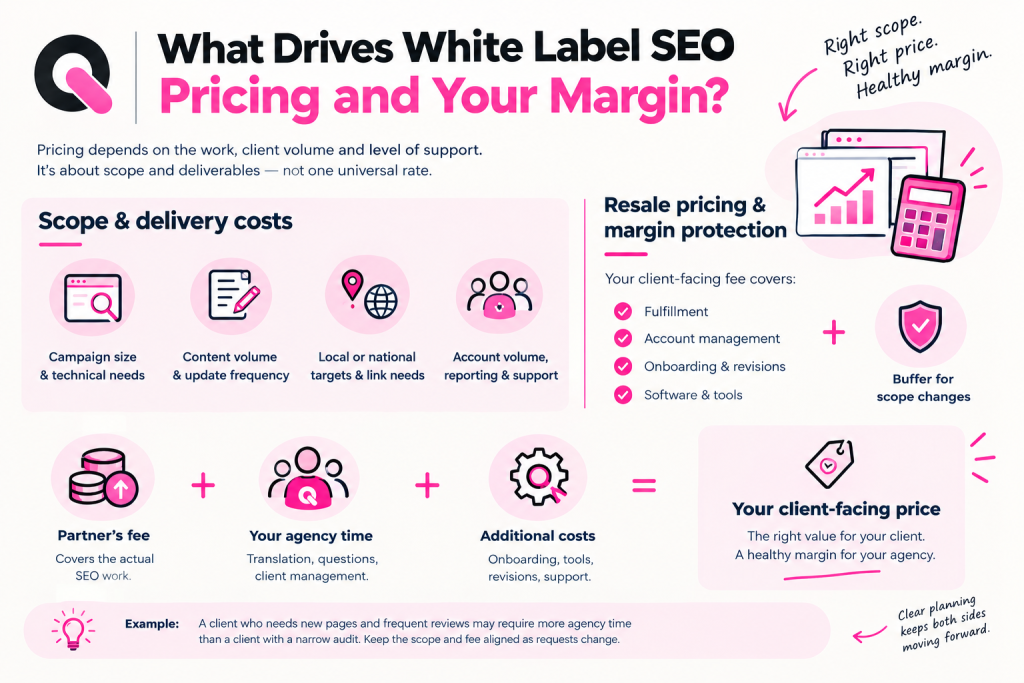
Pricing depends mainly on the work required, client volume, and level of support. White label SEO pricing usually reflects the scope and deliverables, not one universal rate.
Campaign breadth and technical complexity can change the amount of work. Content volume, link-building needs, and local versus national targets also affect delivery. More accounts can add coordination, reporting, and account support.
Scope and delivery costs
A one-time audit differs from a campaign that needs regular content and technical work. The partner’s fee may also reflect the number of accounts and how much support each one needs.
- Campaign size and technical needs
- Content volume and update frequency
- Local or national targets and link needs
- Account volume, reporting, and support
Resale pricing and margin protection
Your client-facing fee should cover fulfillment, account management, onboarding, revisions, and software. Add a buffer for work that expands after the project starts.
White label marketing agency pricing needs to reflect more than the partner’s bill. Your team spends time translating work, answering questions, and managing the client relationship. Include those hours when you set a fee for an SEO service.
For example, a client who needs new pages and frequent reviews may require more agency time than a client with a narrow audit. Keep the scope and fee aligned as requests change. A clear cost plan makes it easier to shape a client-facing offer.
How Should You Package and Sell SEO to Clients?
Turn “better rankings” into a defined goal, named deliverables, and a regular review cadence. A client should know what the agency will do, what it will not do, and when progress will be reviewed.
Three offer shapes can help your agency set boundaries before selling the work.
| Offer shape | What the client receives | Best fit | Scope boundary |
| Single-project audit | Findings, priorities, and action plan | Client needing a clear site review | No ongoing implementation |
| Focused monthly SEO retainer | Work on one defined area and monthly review | Client with a specific SEO gap | Limits work to agreed tasks |
| Broader ongoing campaign | Strategy, multiple tasks, and regular reporting | Client with sustained SEO needs | Sets monthly work limits |
A single audit can guide a client that is not ready for ongoing work. A focused retainer suits a clear need, such as local pages. A broader campaign fits clients who need several work areas managed over time.
White label digital marketing services can be combined with SEO when your agency can manage the added scope. Make sure each service has an owner, clear deliverables, and a review plan. A white label marketing agency offer should not blur those boundaries.
How much does an agency charge for SEO? The client-facing fee varies with scope, competition, deliverables, and account support. Calculate it from fulfillment and management costs, then protect your required margin rather than copying a competitor’s price.
Once your offer is clear, consider how changing search experiences affect what you promise clients.
Is SEO Evolving as Search Changes?
SEO is evolving, not disappearing, as search expands and users may get answers without clicking through. The work and measures of success continue to change.
Useful content, technical access, authority, and clear measurement still matter. Your SEO strategies should help clients serve real search needs, not chase one fixed position in results.
Search can lead people to information in new ways. That makes it important to track more than rankings and visits. Review whether your work supports the client’s goals and helps the right audience find useful answers.
- Review search visibility and conversions.
- Keep content useful, accurate, and current.
- Monitor how clients’ audiences find information.
- Avoid guarantees for rankings or AI citations.
A ranking alone may not show whether a client gains qualified visits or leads. Ask what action matters and measure it alongside search activity. Explain changes without promising a specific place in results or an AI answer.
These shifts affect how you frame results and client expectations. Your agency can keep adapting its marketing work as search changes. The next practical step is to bring the fulfillment partner into your workflow with clear roles.
How Do You Integrate a Fulfillment Partner Into Your Agency?
Start with one suitable client account and a written scope before expanding. A limited first project lets your team test project management, communication, and review steps without promising untested capacity.
Use five steps to set the work up:
- Define the client’s goals and current baseline.
- Document the scope, deliverables, and exclusions.
- Assign agency and partner responsibilities.
- Agree on reporting and communication cadence.
- Review the first deliverables before client presentation.
Your agency remains accountable for translating specialist work into client language. Clients need to understand what changed and how it relates to their goals, not just hear a list of technical tasks.
| Stage | Agency action | Partner input | Decision gate |
| Scoping | Set goals and limits | Confirm task needs | Approve written scope |
| Kickoff | Share context and access | Confirm start needs | Ready to begin |
| Delivery review | Check work and fit | Explain completed tasks | Approve or request edits |
| Client reporting | Explain progress clearly | Provide work details | Share report with client |
Keep the workload small until your team knows how long reviews and client updates take. Do not sell a volume of work you have not tested. Once the process is clear, you can assess Queen on Clicks’ stated white label SEO offer against your needs.
What White Label SEO Services Does Queen on Clicks Offer?
Queen on Clicks offers white label SEO services. Confirm the campaign scope before you propose the service to an end client.
The confirmed fact is the general white label SEO offering. The specific tasks, deliverables, responsibilities, and exclusions still need to be established for the campaign you want to sell.
SEO Services Available Through Queen of Clicks
Queen of Clicks offers a range of SEO services to help businesses improve organic visibility, attract relevant traffic, and strengthen their presence across search engines and AI-powered platforms.
- On-page SEO: Optimize titles, headings, internal links, page structure, and content.
- Off-page SEO: Build relevant backlinks and strengthen website authority.
- Technical SEO: Identify and address crawling, indexing, website structure, and performance issues.
- Keyword research: Identify relevant search terms based on search intent and business goals.
- Content strategy: Plan content around audience needs, keyword opportunities, and business objectives.
- Full SEO strategy: Develop a comprehensive SEO roadmap aligned with business goals and growth opportunities.
- AI search optimization: Improve content and brand visibility across AI-powered search experiences.
- Generative Engine Optimization (GEO): Optimize content for greater visibility and potential citations in AI-generated answers.
- Competitor analysis: Identify competitors’ SEO strategies, content gaps, and opportunities.
- Content optimization: Improve existing pages to better address search intent and user needs.
- Internal linking: Strengthen connections between relevant pages and support site structure.
- SEO audits: Evaluate on-page, off-page, and technical SEO opportunities.
- Search intent analysis: Align content with what users want to find when searching.
- Website structure optimization: Organize pages to improve navigation and search engine understanding.
- Organic performance analysis: Monitor traffic, keyword visibility, and other SEO performance indicators.
Confirm the exact campaign scope
Ask which SEO tasks the service includes and what your agency must handle. Clarify the expected deliverables, review points, and any work outside the scope.
Do not treat a general service description as proof that a specific task is included. For example, Queen on Clicks has a page about SEO for SaaS businesses. That page describes SaaS services, but it does not establish what the white label offering includes.
Match requested deliverables to client goals
Compare the confirmed scope with the client’s actual needs. A client may seek local visibility, content, technical work, or ongoing strategy. Each goal calls for different tasks and measures.
If the client wants local visibility, ask whether location pages or business listing work are included. If the need is technical, define which site issues the provider will review or address.
Your agency also needs to know how its team fits into delivery. Decide who sets expectations, reviews work, and explains progress. Those responsibilities should match the campaign scope you confirm.
Separating confirmed details from open questions keeps your proposal accurate. Once the work is clear, consider whether it matches your client mix and internal workflow.
Which Agencies Should Consider Queen on Clicks?
Queen on Clicks may be worth evaluating when your agency needs white label SEO fulfillment. Fit depends on the scope it confirms and your agency’s workflow.
Start with the work your clients need, not assumptions about a provider’s specialties. Your own capacity matters too: someone must lead the client relationship and manage the work.
Compare your client mix with your SEO needs
Review whether your accounts need local, national, or broader campaign support. Some agencies serve clients with similar needs, while others manage very different scopes.
Consistent work may be simpler to plan than a client list with varied needs. Write down the common requests, then note where each account needs a different approach.
Check your team’s role in strategy and delivery
Decide who will set client expectations, review specialist work, and explain progress. If your team lacks time for those tasks, the arrangement may not fit your current capacity.
Think about the work you want to keep in-house. Your team may own strategy and account communication, or it may need more delivery support. The right split depends on the scope Queen on Clicks confirms.
Quality and transparency matter to your client relationships, but neither should be assumed from a service label. Review how the confirmed scope supports your clients’ goals and how your team will manage it.
Fit is a practical match between client needs and agency capacity, not a claim about a provider’s industry or task focus. Before working together, resolve the scope, commercial, and communication questions.
How Can You Assess Queen on Clicks as a Potential SEO Partner?
Get the proposed scope and responsibilities in writing before selling the work onward. A written outline gives your team a clear basis for client promises and internal planning.
Compare the confirmed service with your agency’s obligations to each client. Any gap in tasks or ownership can affect delivery, management time, and the results you report.
Request scope, process, and reporting details
Ask for a written list of included work, exclusions, delivery responsibilities, review points, and reporting format. Each item should connect to the campaign you plan to offer.
Clarify how work moves from assignment to review. Ask what your team receives at each point and what information it needs to check the deliverables.
Reporting should let you explain the work and its progress in terms your client understands. Match the proposed format to the measures and updates your client expects.
Confirm commercial and communication expectations
Ask how pricing is determined for the specific scope and what commitments apply. Confirm who handles routine questions and how the provider manages issues or revisions.
Check that the communication plan fits your team’s schedule and client obligations. A named contact and clear route for problems can prevent small delays from reaching the client.
Compare the answers with your agency’s margins and client promises before you commit. Do not set a client-facing fee or timeline around tasks that remain unclear.
Use the written details to decide whether the relationship can support your growth without overloading your team. Take a measured next step based on confirmed fit, not assumptions.
Conclusion
The right partner is the one whose confirmed scope fits your clients and agency operations. A sound fit also depends on clear ownership of client communication and delivery.
Profitability comes from a defined scope and a realistic client-facing fee. If the work expands without a matching plan, your team’s time can erode the margin.
Write a one-page scope for a suitable client account, then ask Queen on Clicks to clarify how its offer maps to that scope.
FAQ
How much does white label SEO cost?
White label SEO cost depends on campaign scope, deliverables, client volume, and support. A focused audit differs from ongoing work across several accounts. Compare the provider’s fulfillment cost with your account management, onboarding, and review time. Then set a client-facing fee that covers those costs and your required margin, rather than relying on a universal rate.
What is the best SEO platform for agencies?
The best SEO platform depends on whether your agency needs fulfillment, branded reporting, CRM and project tools, or a mix. A portal can organize work and reports, but software alone does not establish SEO quality. Check whether the platform supports your team’s workflow and client needs. You may need a provider, software, or both.
How much does an agency charge for SEO?
An agency’s SEO fee varies with scope, competition, deliverables, and account support. A project with a fixed audit differs from a campaign that needs regular strategy and updates. Work out fulfillment and management costs first, then add the margin your agency needs. A competitor’s fee may reflect a different scope or level of service.
What is replacing SEO?
Nothing is simply replacing SEO. Search experiences are changing, and people may find information through more places and formats. Agencies still need useful, accessible content that answers real questions. They can also track how audiences discover information and whether those paths lead to meaningful actions, rather than treating one search result as the whole picture.
Is AI ruining SEO?
AI is changing how some users discover information, but it does not remove the need for useful content. Websites still need to be technically accessible, and agencies still need sound ways to measure results. Search visibility can change by platform and query. Avoid treating any one AI feature as a reason to stop doing careful SEO work.
Can ChatGPT do SEO?
AI tools such as ChatGPT can assist with SEO tasks like brainstorming topics and drafting text. Human review remains important for accuracy, strategy, technical decisions, and client-specific judgment. An AI draft may miss a business detail or make an unsupported claim. Your team should check the work before it reaches a client or goes live.
What is AI SEO called now?
Generative engine optimization is one term for work aimed at visibility in AI-generated answers. The terminology and practice are still evolving, so agencies may use different names for related work. The label does not replace core SEO needs. Useful content, sound site access, and clear measurement still matter across search experiences.