
SaaS SEO Copywriter: A Complete Guide to Driving Organic Growth
If your SaaS product is incredible but nobody is finding it, you have a content problem, and that’s exactly where a SaaS SEO copywriter comes in.
This complete guide breaks down everything you need to know: what a SaaS SEO copywriter actually does, why the role is fundamentally different from general copywriting, how to find the right one, and how to measure the impact of their work on your growth metrics.
The stakes are higher than most teams realize. Over 53% of all SaaS website trafficcomes from organic search, making it the largest growth channel for most companies. That means your content isn’t just “marketing”, it’s directly tied to visibility, acquisition, and revenue.
Whether you’re a seed-stage startup trying to build an organic foundation or a growth-stage company looking to scale content without sacrificing quality, this guide is for you.

Key Takeaways
- A SaaS SEO copywriter combines SEO strategy and persuasive writing to drive both visibility and conversions across the entire funnel.
- Specialized SaaS knowledge is essential because buyers are sophisticated, sales cycles are long, and keyword strategies are more complex than in other industries.
- High-quality SEO content is a compounding growth asset that can generate consistent traffic, leads, and revenue over time.
- The best SaaS SEO copywriters align content with business metrics like MRR, conversions, and customer acquisition, not just traffic.
- Hiring the right SaaS SEO copywriter requires evaluating their strategic thinking, SaaS experience, and ability to produce content that ranks and converts.
What Is a SaaS SEO Copywriter?
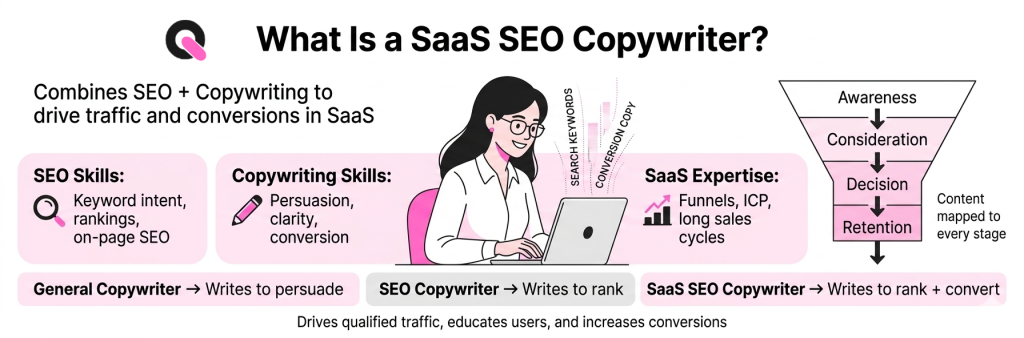
A SaaS SEO copywriter is a specialist who combines the technical discipline of search engine optimization with the persuasive craft of copywriting and applies both specifically to the SaaS industry.
This isn’t a generalist freelancer who occasionally writes tech content. A true SaaS SEO copywriter understands:
- How SaaS buying cycles work (and how they differ from e-commerce or services)
- The language of B2B and B2C SaaS customers, from SMB owners to enterprise procurement teams
- How to map content to funnel stages: awareness, consideration, decision, and retention
- The technical mechanics of on-page SEO: keyword intent, semantic relevance, internal linking, structured data
- How to write for both search algorithms and humans who are evaluating tools with their credit card in hand
The best SaaS SEO copywriters are part strategist, part researcher, part writer, and they’re deeply curious about how software solves real-world problems.
SaaS Copywriting vs. General Copywriting
General copywriting focuses on persuasion. SEO copywriting focuses on visibility. SaaS copywriting focuses on both, with the added complexity of long sales cycles, niche technical audiences, and a recurring revenue model where every churned customer is a lost revenue stream.
A general copywriter can write beautiful prose. A SaaS SEO copywriter writes content that ranks, attracts the right ICP (ideal customer profile), educates prospects, and nudges them toward a free trial or demo, often all in the same piece of content.
SaaS SEO Copywriting vs. SaaS Content Marketing
These terms are often used interchangeably, but there’s a subtle difference. Content marketing is the strategy, the editorial calendar, the topic clusters, the audience personas. SEO copywriting is the execution, the actual words on the page, optimized to rank and convert.
A SaaS SEO copywriter sits at the intersection of both: they can inform strategy, but their core output is high-quality written content optimized for search.
Why SaaS Companies Need a Specialized SEO Copywriter
Plenty of SaaS companies make the mistake of hiring a generalist writer and slapping a list of target keywords in the brief. The result? Content that’s technically published but strategically dead, it ranks for nothing, converts no one, and adds zero value to the business.
Here’s why specialism matters in SaaS content:
1. SaaS Buyers Are Sophisticated
Your potential customers are often developers, product managers, finance leads, or operations teams. They’ve already done extensive research before they land on your blog. Shallow, generic content insults their intelligence and sends them to a competitor.
A skilled SaaS SEO copywriter writes with depth. They understand the technical nuances of your product category, anticipate the objections your buyers have, and craft content that actually answers the questions keeping your ICP up at night.
2. SaaS Keyword Strategy Is Highly Nuanced
The keyword universe for a SaaS product is not just ‘best [category] software.’ It includes comparison keywords, alternative and competitor keywords, job-to-be-done keywords, integration keywords, and long-tail use-case queries.
A SaaS SEO copywriter knows how to identify and prioritize high-intent keywords that map directly to pipeline, not just keywords that generate vanity traffic.
3. The Content Funnel Is Long and Complex
In SaaS, someone might read your blog for six months before starting a trial. That means your top-of-funnel content needs to be genuinely useful and trust-building, your middle-of-funnel content needs to address evaluation criteria, and your bottom-of-funnel content needs to overcome the final objections before a buying decision.
A SaaS SEO copywriter understands this full-funnel architecture and writes content that serves each stage with intent.
4. SEO Drives Compounding, Predictable Growth
Unlike paid ads, which stop generating traffic the moment you pause spend, SEO-optimized content compounds over time. A well-written, well-optimized blog post can drive qualified leads for years. This makes SEO one of the highest-ROI growth channels for SaaS, but only when the content is built on a solid strategic and editorial foundation.
Core Skills of an Expert SaaS SEO Copywriter
Not all copywriters are created equal. Here are the skills that separate a genuinely excellent SaaS SEO copywriter from someone who’s simply stringing keywords into paragraphs:
Keyword Research & Search Intent Analysis
The best SaaS SEO copywriters go beyond volume and difficulty. They analyze SERP composition, user intent signals, and the full keyword ecosystem around a topic to understand what content needs to do, not just what it needs to say.
Technical SEO Awareness
A great copywriter doesn’t need to be an SEO engineer, but they do need to understand on-page fundamentals: heading hierarchy, meta description optimization, content structure, internal linking, and how to write for featured snippets and People Also Ask boxes.
Product-Led Storytelling
In SaaS, your product is the hero. A skilled SaaS SEO copywriter knows how to weave product context and use cases into educational content without it reading like a sales brochure. They understand how to show, not just tell, using specific examples, workflows, and outcomes to help readers visualize the value of your tool.
Conversion Copywriting
Organic traffic is worthless if it doesn’t convert. The best SaaS SEO copywriters understand CRO principles: how to write compelling CTAs, how to structure content for skim-readers, and how to use social proof, urgency, and benefit-led language to move readers down the funnel.
Understanding SaaS Metrics
MRR, ARR, churn, CAC, LTV, NRR, activation rate, a SaaS SEO copywriter who understands these metrics writes content that actually serves business goals. They know that a bottom-of-funnel piece targeting high-intent comparison keywords may drive fewer clicks but far more MRR than a top-of-funnel piece targeting broad industry terms.

What Are The Types of Content a SaaS SEO Copywriter Produces
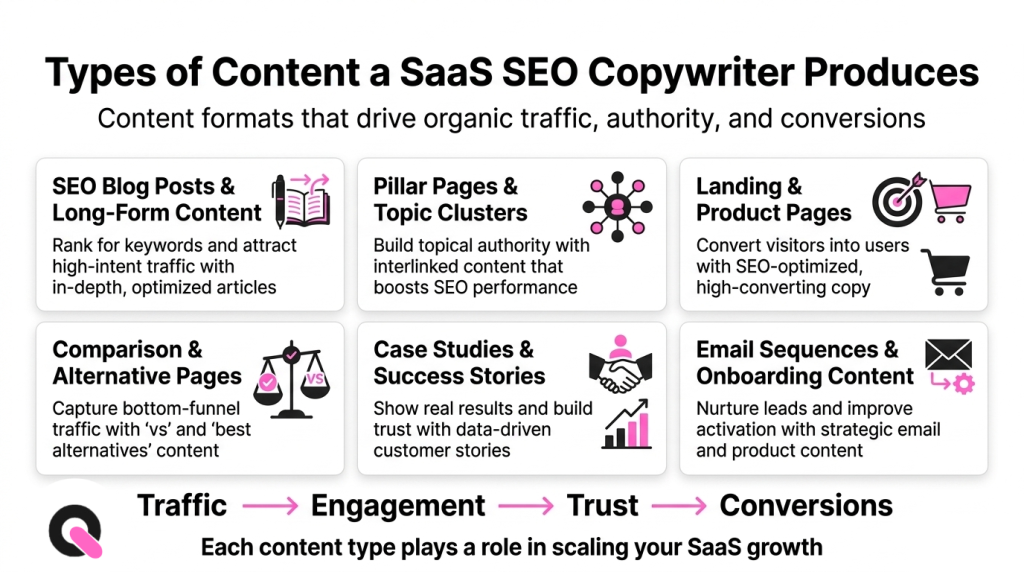
A versatile SaaS SEO copywriter can produce a wide range of content formats, each serving a different role in your organic growth engine:
SEO Blog Posts & Long-Form Articles
The backbone of most SaaS content strategies. Well-researched, deeply useful, and optimized for target keywords and search intent. These range from 1,500-word how-to guides to 5,000-word ultimate guides and cornerstone content.
Pillar Pages & Topic Clusters
Pillar pages are comprehensive resources that establish topical authority around a core subject. They link to and from cluster content, building the internal link architecture that search engines use to understand your content’s relevance and depth.
Landing Pages & SEO-Optimized Product Pages
These pages need to do double duty: rank in search and convert visitors. A SaaS SEO copywriter crafts landing page copy that’s keyword-rich without sacrificing the persuasive clarity that drives sign-ups and demos.
Comparison & Alternative Pages
Some of the highest-converting SaaS content targets comparison queries like ‘[Your Tool] vs [Competitor]’ or ‘Best [Competitor] Alternatives.’ A SaaS SEO copywriter knows how to write these pages with honesty and strategic framing, helping your brand shine in competitive contexts.
Case Studies & Success Stories
Social proof is critical in SaaS sales cycles. Well-written case studies that highlight measurable outcomes build credibility and help prospects see themselves in your customer stories.
Email Sequences & Onboarding Content
SEO extends beyond the blog. A SaaS SEO copywriter can bring clarity, structure, and audience-alignment to email nurture sequences, in-app onboarding copy, and product education content.
How to Evaluate and Hire a SaaS SEO Copywriter
Hiring the wrong content person is one of the most expensive mistakes a SaaS company can make, not just in wasted fees, but in lost time and missed organic growth opportunities. Here’s how to vet candidates properly:
Look for a Portfolio with SaaS-Specific Work
Ask to see examples of content they’ve written for SaaS companies. Ideally, look for content that’s ranking, tools like Ahrefs or Semrush can show you whether a published piece is actually driving organic traffic.
Test Their Strategic Thinking
Before you hire, ask: ‘How would you approach building a content strategy for a [your category] SaaS targeting [your ICP]?’ A strong SaaS SEO copywriter should be able to outline a logical, audience-first approach that connects content to business outcomes.
Evaluate Their Writing at a Sentence Level
Great SEO copywriting is also just great writing. It’s clear, specific, and free of the bloated, generic phrasing that plagues most AI-assisted content. Look for writing that sounds human, informed, and confident.
Ask About Their Research Process
Good SaaS SEO copywriters do real research: they interview subject matter experts, review Reddit threads and G2 reviews for voice-of-customer language, analyze competitor content gaps, and interrogate keyword data before writing a single word.
Understand Their Process for SEO Optimization
Ask how they approach on-page SEO. Do they do their own keyword research? How do they handle internal linking? Do they write meta descriptions and title tags? A full-service SaaS SEO copywriter handles the whole on-page package, not just the body copy.
What Does a SaaS SEO Copywriter Cost?
Pricing for SaaS SEO copywriting varies widely depending on experience, niche depth, and deliverable scope. Here’s a rough breakdown:
- Entry-level freelancers: $0.05–0.10/word
- Mid-tier SaaS writers: $0.15–0.25/word or $300–700/article
- Expert SaaS SEO specialists: $500–1,500+ per article, or monthly retainers from $2,000–8,000+
- Agencies with SaaS content expertise: $3,000–15,000+/month
It’s worth noting that cheap content is almost never a bargain in SaaS. A single well-written, well-optimized piece of content targeting a high-intent keyword can generate hundreds of qualified leads over 12–24 months. The math on investing in quality is almost always compelling.
How to Measure the ROI of Your SaaS SEO Copywriter
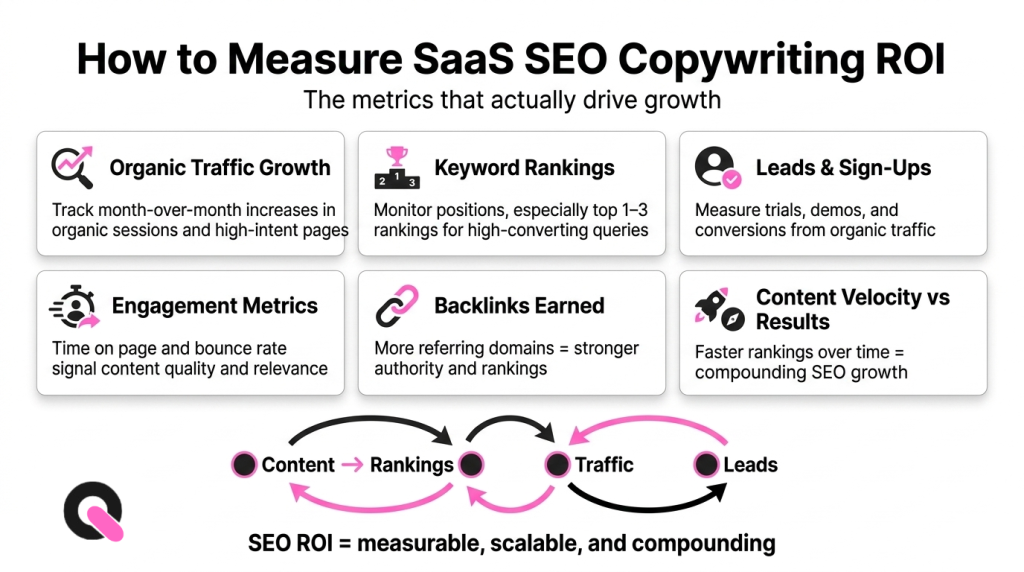
One of the questions SaaS founders and marketers ask most frequently is: how do I know if my SEO content is actually working? Here are the metrics that matter:
Organic Traffic Growth
Track month-over-month growth in sessions from organic search. Look at both overall organic traffic and traffic to specific content pieces, especially those targeting high-intent, commercial keywords.
Keyword Rankings
Monitor position changes for target keywords. First-page rankings (particularly positions 1–3) for high-intent SaaS queries have a disproportionate impact on traffic and conversions.
Organic-Sourced Leads and Sign-Ups
Use UTM parameters and your CRM or product analytics tool to track how many free trial starts, demo requests, or paid sign-ups are attributed to organic traffic. This is the clearest indicator of SEO content ROI.
Time on Page & Engagement Rate
High-quality SaaS content keeps readers engaged. Low time on page or high bounce rates often signal a mismatch between search intent and content, or simply poor writing quality.
Backlinks Earned
Great SaaS content earns backlinks naturally, from publications, industry blogs, and other SaaS companies referencing your work. An increase in referring domains to your content is a strong quality signal and compounds your organic authority over time.
Content Velocity vs. Results
Track how long it takes for new content to rank and generate traffic. As your domain authority grows and your content strategy matures, you should see faster ranking timelines, a compounding flywheel effect.
Common SaaS SEO Mistakes SaaS Companies Make
Even well-funded SaaS companies repeatedly make the same SEO mistakes. Avoid these pitfalls:
- Writing for search engines instead of humans: Google’s algorithm is increasingly sophisticated at detecting low-quality, keyword-stuffed content. Write for your reader first.
- Ignoring search intent: A keyword with 5,000 monthly searches is useless if the content you create doesn’t match what users are actually looking for when they type that query.
- Neglecting content updates: SaaS moves fast. Outdated statistics, deprecated feature references, and stale competitor comparisons erode trust and rankings. Content maintenance is as important as new content creation.
- Underinvesting in distribution: Publishing content without a promotion strategy, email, social, community, partnerships, means most of your content never reaches critical mass.
- Confusing activity with strategy: Posting weekly blog updates that aren’t tied to a coherent keyword and topic strategy is busywork, not growth. Every piece of content should have a clear strategic purpose.
- Skipping the brief: Poor content briefs lead to poor content. A well-constructed content brief, covering target keyword, search intent, audience, competing content, and key messages, is the foundation of every great piece.
🚀 Ready to Grow Your SaaS with Strategic SEO Content?
Queen of Clicks is a Search Engine Optimization agency for SaaS brands. We help you attract the right users, convert free trials into paying customers, and build the kind of topical authority that moves the needle, month after month.
Here’s what you get when you work with Queen of Clicks:
✅ SEO-optimized blog posts, landing pages, and pillar content tailored to your SaaS niche
✅ Keyword research and content strategy rooted in your pipeline and ICP
✅ Copy that speaks your users’ language, from free trial to enterprise
✅ A writer who actually understands SaaS metrics, funnels, and product-led growth
👉 Get in touch and let’s craft content that converts.

Conclusion
A skilled SaaS SEO copywriter is one of the highest-leverage hires a growing SaaS company can make. They sit at the intersection of strategy, research, and craft, translating your product’s value into content that attracts, educates, and converts the right users through organic search.
The SaaS brands winning on organic in 2026 aren’t the ones publishing the most content, they’re the ones publishing the most strategically, consistently, and with genuine depth. That requires a writer who understands not just how to write, but how SaaS works.
Whether you’re building your content programme from scratch or looking to scale what you’ve already started, the right SaaS SEO copywriter will pay for themselves many times over, in pipeline, in authority, and in compounding organic growth that doesn’t stop when you pause an ad budget.
FAQs
What does a SaaS SEO copywriter actually do day-to-day?
A SaaS SEO copywriter’s daily work typically includes keyword research and competitive analysis, writing and editing blog posts, landing pages, and pillar content, collaborating with SEO strategists and product teams to ensure content accuracy, optimising existing content to improve rankings, and crafting briefs or outlines for other content contributors. Many also handle meta data, internal link planning, and content performance reporting.
How is SaaS SEO copywriting different from regular SEO writing?
SaaS SEO copywriting requires a deeper understanding of software buying behaviours, B2B and B2C customer psychology, product-led growth principles, and the full SaaS funnel from awareness to retention. It also demands familiarity with complex, niche keyword landscapes, including competitor, comparison, and integration keywords, that don’t exist in many other industries. The writer must be comfortable discussing technical concepts without losing clarity or persuasive power.
How long does it take to see results from SaaS SEO content?
Organic SEO is a compounding investment, not a quick win. Most SaaS companies begin to see measurable keyword ranking improvements within 3–6 months of publishing optimized content, with significant organic traffic growth typically emerging between 6–12 months. The timeline depends on your domain authority, the competitiveness of your target keywords, content quality, and publishing cadence. High-intent, lower-competition keywords can begin ranking in as little as 4–8 weeks.
Should I hire a SaaS SEO copywriter in-house or as a freelancer?
Both models can work well, depending on your stage and content volume. An in-house SaaS SEO copywriter offers deep product knowledge, cultural alignment, and consistent availability, ideal for high-volume content programmes. A freelance SaaS SEO specialist or boutique agency offers flexibility, diverse industry experience, and the ability to scale output without headcount. Many SaaS companies use a hybrid model: an in-house content lead supported by specialist freelancers for high-volume production.
What should I include in a content brief for a SaaS SEO copywriter?
A strong SaaS content brief should include the primary target keyword and secondary keywords, the intended search intent and audience persona, a SERP analysis of the top-ranking competing content, the desired word count and content format, key points to cover and unique angles to take, specific product features or use cases to reference, internal linking targets, the CTA and desired reader action, and any brand voice or style guidelines. The more context you provide, the more strategic and on-target the output will be.
Can AI tools replace a SaaS SEO copywriter?
AI writing tools can assist with ideation, first drafts, and content scaling, but they cannot replace the strategic thinking, audience empathy, and original insight that great SaaS SEO copywriting demands. AI-generated content often lacks the specificity, depth, and brand voice that builds trust with sophisticated SaaS buyers and earns backlinks from authoritative sources. The most effective content programmes use AI as a productivity multiplier for skilled human writers, not as a substitute for them.
How do I measure the success of my SaaS SEO copywriter’s work?
The most important metrics for evaluating SaaS SEO content performance include organic traffic growth (overall and to specific pages), keyword ranking improvements for target queries, organic-attributed leads, free trial starts, and demo requests (tracked via UTM parameters and your CRM), engagement metrics such as time on page and scroll depth, and backlinks earned by content pieces. Over a 12-month horizon, you should also track the compounding effect: are your rankings stabilising and improving, and is your content pipeline generating more traffic per new piece published as your domain authority grows?