
White Label On Page SEO: A Complete Guide For Agencies
A client may ask for SEO while your agency is still focused on design, content, or digital marketing. Saying yes can strain a small team that lacks the time or skills to deliver the work well. This is when white label SEO joins the game.
Over 61% of marketers rank organic growth as a top priority. A white label model can help your agency add SEO services without building every capability in-house, while keeping your client relationship at the center.
You still need to define the work, review its quality, and set clear expectations. This guide explains the white label on-page SEO model, common deliverables, partner selection, and rollout, without promising rankings or instant results.
Key Takeaways
- A white label partner does the agreed SEO work behind the scenes.
- Your agency manages the client relationship and quality checks.
- Scope, access, and approval steps should be clear from the start.
- Measure page progress against a baseline and business goals.
- Search results can take time, and rankings are never guaranteed.
What Is White Label On Page SEO?
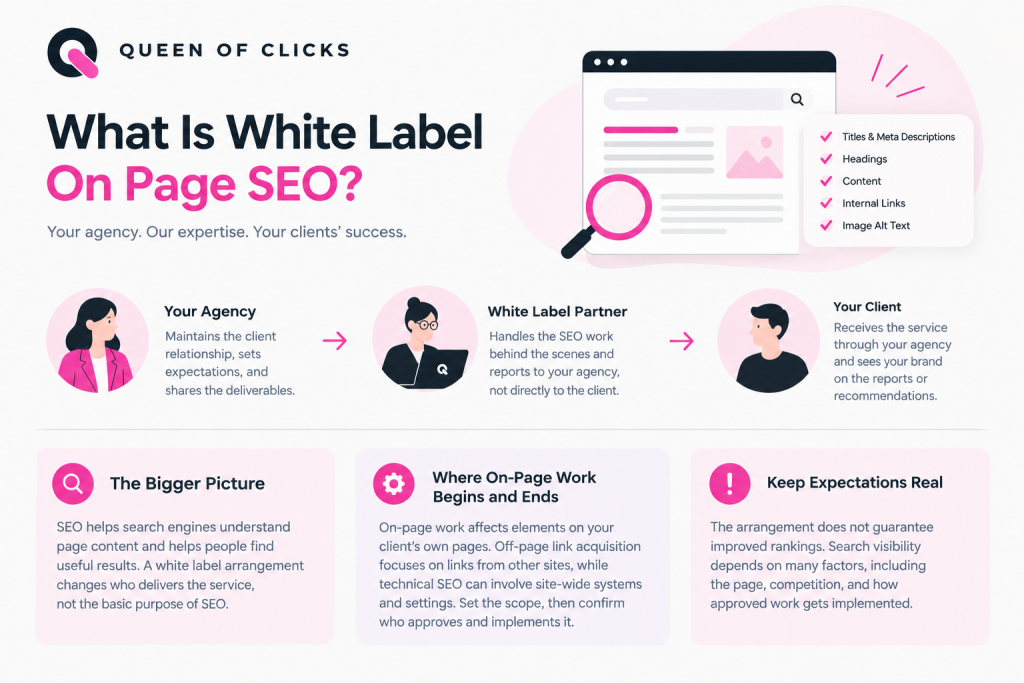
A provider performs agreed SEO work for your agency to deliver to your client under your agency’s brand. Your agency manages the relationship, while the white label partner handles the work you assign.
SEO helps search engines understand page content and helps people find useful results. A white label arrangement changes who delivers the service, not the basic purpose of search engine optimization.
The Agency, Provider, and Client
Your agency owns the client-facing role, sets expectations, and shares the finished deliverables. The white label partner works behind the scenes and reports to your agency, not directly to the client.
For example, a small agency that already provides content or web design can add page reviews through a white label SEO company. The client receives the service through your agency and sees its brand on agreed reports or recommendations.
The arrangement does not itself guarantee improved rankings. Search visibility depends on many factors, including the page, competition, and how approved work gets implemented.
Where On-Page Work Begins and Ends
On-page work changes elements on the client’s own pages. Off-page link acquisition focuses on links from other sites, while technical SEO can involve site-wide systems and settings.
Those boundaries matter when you set a scope. A partner hired for page edits may not be responsible for a site migration, crawl issue, or link building campaign.
Keep the assigned work clear, then confirm who approves and implements it. With the roles set, you can decide which page-level tasks a partner should handle.
What On-Page Tasks Can a White Label Partner Handle?
A partner can review a client’s service page, find unclear headings and a vague title, then recommend or make focused edits. The page may already have useful information, yet readers and search engines can miss its main point.
The agreed scope may cover an audit of existing copy, page edits, or a record of recommended changes. Recommendations can go to your agency for approval, or the partner can implement them directly with the right access.
Titles, Headings, and Descriptions
A title tag gives a page a clear title in search results and browser tabs. A meta description can help describe the page in a search snippet, though search engines may choose other text.
Headings show how information is grouped. A clear hierarchy helps readers scan the page and keeps each section tied to the main service.
Keyword research informs these edits, but repeating a keyword in every heading is not the goal. Match the page to search intent, meaning what a person hopes to find with a query.
Page Copy, Images, and Internal Links
Page copy should answer the questions a likely customer has before contacting the business. A partner can flag missing details, unclear claims, or content that does not fit the page’s purpose.
Image alt text describes an image for people who cannot see it and helps search engines interpret it. Internal links connect related pages, such as a service page and a useful guide.
For a fuller view of possible SEO page deliverables, keep the client’s goals and approval rules in the brief. An edit should make the page more useful, not simply longer.
URLs and Structured Data
A clear URL helps people understand what a page covers. A partner can review URL choices, but changing an established URL may need extra care and a redirect plan.
Structured data is code that labels information on a page so search engines can better interpret its content. It can help search engines interpret and present page details, but it does not ensure a special search display.
The SEO Starter Guide covers useful content, descriptive titles, links, and other basic practices. Once you set the deliverables and level of access, your agency and partner can move them through a project.
How Does a White Label SEO Workflow Work?
A new client asks your agency to improve several service pages. The project moves from a clear brief to reviewed changes and a client update.
| Stage | Your agency’s action | White label partner’s action | Client-facing output |
| Intake and goals | Set page goals | Review the brief | Scope and timeline |
| Share page and site access | Grant needed access | Check permissions | Access confirmed |
| Review and recommendations | Share client context | Assess target pages | Findings and edits |
| Approved changes | Approve the scope | Make agreed edits | Reviewed page updates |
| Reporting and next review | Share progress | Summarize work | Report and next steps |
Limit access to what the provider needs for the agreed work. A sitemap can help search engines discover URLs, but it does not guarantee those URLs will be indexed.
- Brief: define the page goal.
- Access: grant only needed permissions.
- Review: check findings and proposed edits.
- Approval: confirm changes before implementation.
- Reporting: share progress and a review date.
That process gives your agency a way to manage delivery. The business case for adding this outside capacity depends on your workload and service plans.
Why Do Agencies Choose White Label SEO?
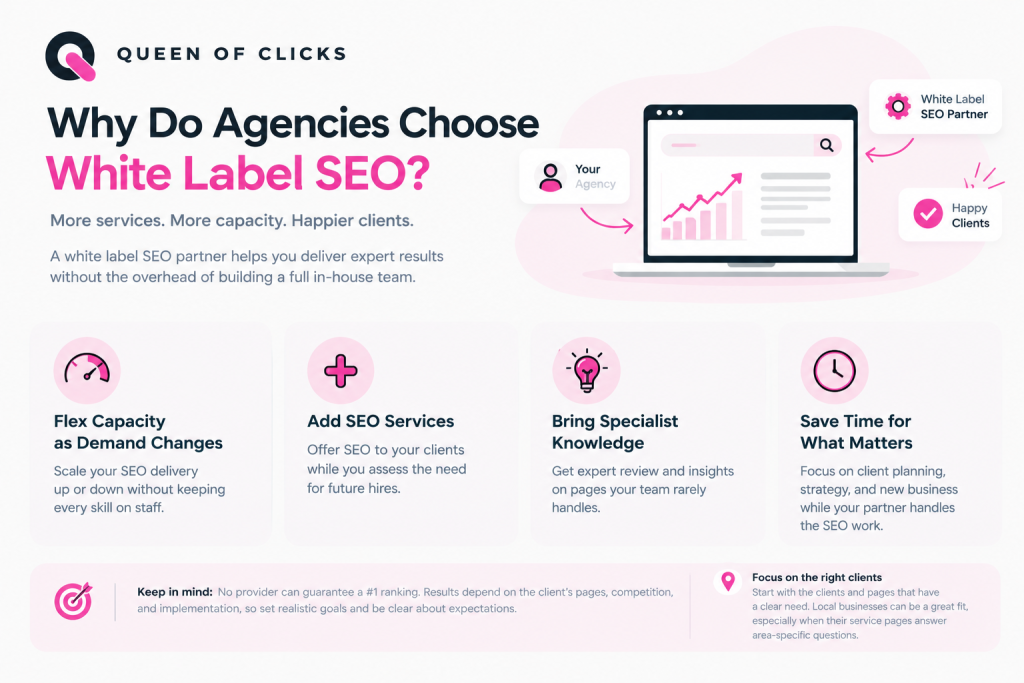
Agencies often win client work faster than they can hire and train specialists. White label SEO services for agencies can add delivery capacity without requiring your agency to build a full SEO team at once.
It can also bring specialist knowledge into projects and leave your team more time for client strategy and new business. Those gains depend on a clear scope and a partner whose work fits your agency’s standards.
- Flex capacity as demand changes, without keeping every skill on staff.
- Add SEO services while you assess the need for future hires.
- Bring specialist review to pages your team rarely handles.
- Save agency time for client planning and business acquisition.
No provider can guarantee a number-one ranking. Results depend on the client’s pages, competition, and implementation, so describe goals without promising a set position.
Before adding the service to every account, identify the clients and pages with a clear need. Local businesses can be a strong fit when their service pages answer real area-specific questions.
Which Clients and Pages Benefit Most From White Label Local SEO Services?
A local service business may need a clear, useful service-area page, while a national business may focus on a broader category page. The right priority depends on where customers search and what the business offers.
| Client type | Page priority | On-page focus | Limitation to check |
| Single-location service business | Main service page | Accurate local relevance | Do not imply false coverage |
| Multi-location business | Location and service pages | Unique, useful local details | Avoid thin or near-duplicate pages |
| Small business serving a defined area | Service-area page | Clear area and service details | Do not create pages for every town |
Local results are influenced by relevance, distance, and prominence. On-page edits can make a page more relevant to a place and service, but they cannot control distance or every factor that affects visibility.
Local SEO also includes work beyond on-page edits, such as local listings. Your agency should set that scope clearly, then check whether a provider can deliver the agreed work reliably.
How Do You Choose the Best White Label SEO Partner?
Test a provider against the work and communication your clients will experience, not a polished sales pitch. The best white label SEO partner for your agency can show how its process fits your scope and standards.
Ask for examples that match the client types and pages your agency serves. A provider should explain what it changed and why, not rely on ranking claims alone.
Evidence of Relevant Work
Request comparable page projects, such as service pages or location pages, and ask to see the work before and after. Look for a clear link between the page goal, the edits, and the intended reader.
Rankings alone do not prove that the work helped a client. Check whether the partner can explain content choices, approval steps, and what the client needed from the page.
If your agency serves software firms, choose examples from similar business models and buying journeys. A guide to B2B software SEO services offers a related frame for comparing skills and service fit.
Reporting and Communication
Reports should make deliverables, open decisions, revisions, and progress easy to understand. Your agency should be able to place them under its brand and explain them to a client without translating jargon.
Ask how the provider shares changes and flags delays. A steady contact and clear response times matter when a client asks why a page needs another review.
Check whether the partner can adapt reports to the detail each client needs. A concise summary can work for one business, while another may need a page-level record of changes.
Ethical Methods and Capacity
Ask how the provider handles link practices, content quality, deadlines, changing work volume, confidentiality, and client data. Manipulative link practices violate search spam policies and can put a client’s visibility at risk.
Human review should protect accuracy and usefulness, even when tools help with research or drafting. An AI and traditional agency comparison can help frame questions about speed, editorial care, and strategy.
Choosing on a low quote alone is a common mistake. Weak work can lead to extra revisions, missed deadlines, and damage to your agency’s reputation with clients.
Ask what happens when demand rises or a deadline shifts. Once the provider’s working fit is clear, define the cost and responsibilities in the quote.
What Determines White Label SEO Pricing?
There is no useful single price without knowing the work and responsibilities included. A quote can change with the page count, site condition, research depth, content needs, reporting, turnaround, and revision scope.
The average cost per hire for a typical role is $4,700, a hiring-cost comparison rather than an estimate of white label fees. Compare the full scope and expected agency margin, not a headline figure alone.
Before agreeing, clarify these quote parts:
- Included pages: list the page count and page types.
- Implementation responsibility: name who makes approved edits.
- Content: state whether writing or editing is included.
- Reporting: define format, timing, and level of detail.
- Revisions: set the number or process for requested changes.
Those details make quotes easier to compare and help prevent surprise work. With the scope agreed, your agency can fit delivery into its existing client and project process.
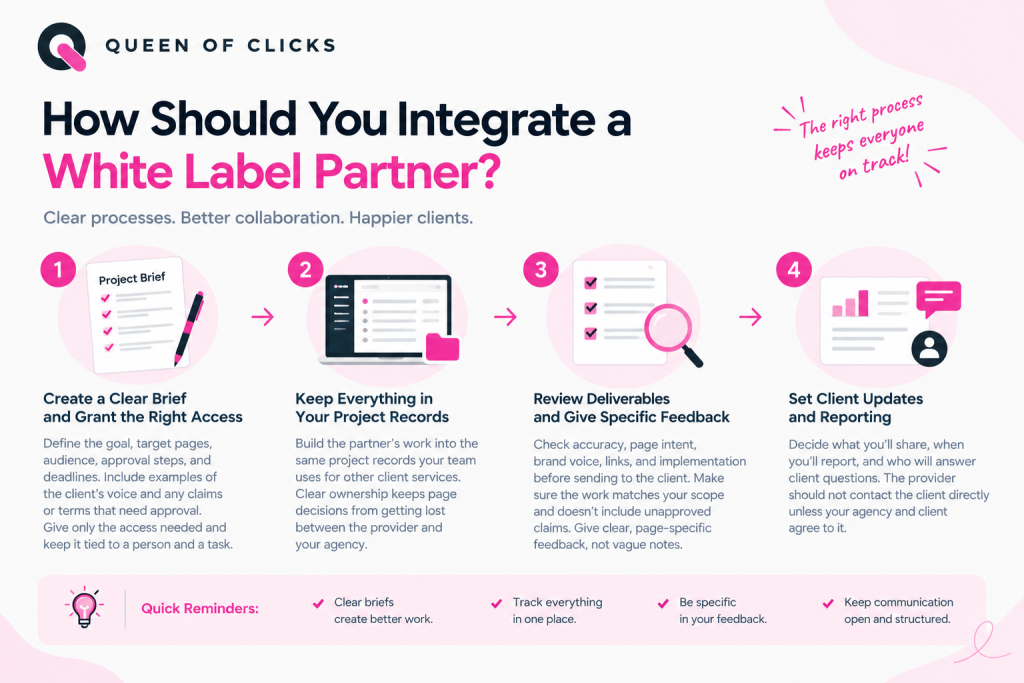
How Should You Integrate a White Label Partner?
A vague brief can produce work that misses the client’s goal, even when a provider follows its usual process. Your agency remains accountable for the agreed scope, quality checks, and client communication.
Build the partner’s work into the same project records your team uses for other client services. Clear ownership keeps page decisions from getting lost between the provider and your agency.
Briefing and Access
State the goal, target pages, audience, approval steps, and deadlines in the brief. Include examples of the client’s preferred voice and note any claims or terms that need approval.
Grant the least access needed to complete the assigned work. Search Console supports distinct permission levels, so every collaborator does not need the highest level of access.
Keep access tied to a person and a task, rather than sharing broad account credentials. Your agency can also record who approved access and when it should end.
Quality Checks and Feedback
Review each deliverable for accuracy, page intent, brand voice, links, and implementation before sending it to the client. Check that edits match the approved scope and do not add claims the business cannot support.
Give specific feedback tied to the page and the desired change. For example, ask the provider to make the service area clearer in the opening paragraph, rather than saying the copy feels off.
Use a short review checklist across projects, then add client-specific checks as needed. That helps your team catch repeated issues without treating every page as identical.
Client Updates and Reporting
Set what your agency will share, when it will report, and who will answer client questions. The provider should not contact the client directly unless your agency and client agree to that arrangement.
Keep your updates tied to work completed, decisions still needed, and the next review point. Once communication is clear, your agency can judge whether the work creates useful change.
Which Metrics Show Whether On-Page SEO Is Working?
An edited page can be complete before its search visibility or business impact is measurable. Track a baseline, then use several measures to understand whether the changes help the client’s goals.
| Measure | What it indicates | How to interpret it |
| Target-page impressions | Search result exposure | Compare with the earlier baseline |
| Clicks and click-through rate | Visits from search results | Review alongside impressions |
| Relevant keyword visibility | Presence for useful searches | Check query fit, not position alone |
| Conversions or qualified leads | Business response | Connect leads to client goals |
SEO changes can take several months to appear in search results. Three to six months is a typical rule of thumb, not a promise, and timing varies with competition, site condition, and implementation.
Compare results with a baseline and account for seasonality or other site changes. For more on common measurement mistakes, review SEO mistakes and ways to avoid them. AI can assist with parts of the work, but people still need to assess the page.
Can You Use AI for White Label SEO?
AI can support parts of on-page work, but it does not replace accountability for the finished page. Your agency must ensure that each claim, edit, and implementation fits the client’s needs.
SEO is evolving, not dead. People still need useful pages they can find through search, even as tools and search behavior change.
Where AI Tools Can Assist
AI can help generate ideas, shape outlines, review early copy, and spot patterns across pages. A qualified person must check accuracy, usefulness, client context, and implementation before anything goes live.
AI use itself is not the issue. Content made mainly to manipulate rankings can violate spam policies, including when many low-value pages are created at scale.
- Group related search questions for a page brief.
- Flag repeated phrases across a set of drafts.
- Draft a plain-language summary for an internal review.
- Compare page sections against a client-approved checklist.
For a safe workflow, keep people responsible for decisions and final edits. Automation can speed up review, but it cannot know every detail of a client’s service or audience.
What a Beginner Can Handle
A beginner can handle basic page checks and edits with guidance. A specialist may be needed for complex technical decisions and strategy, especially when a change could affect many pages.
New team members can learn by working from a clear brief and asking for review before publishing. That keeps routine updates manageable while protecting clients from untested changes.
Keep the provider accountable for its assigned work, whether it uses AI or not. The next risk to address is a set of avoidable mistakes that can weaken a sound partnership.
What Mistakes Should Agencies Avoid when Working with a White-Label SEO Company?
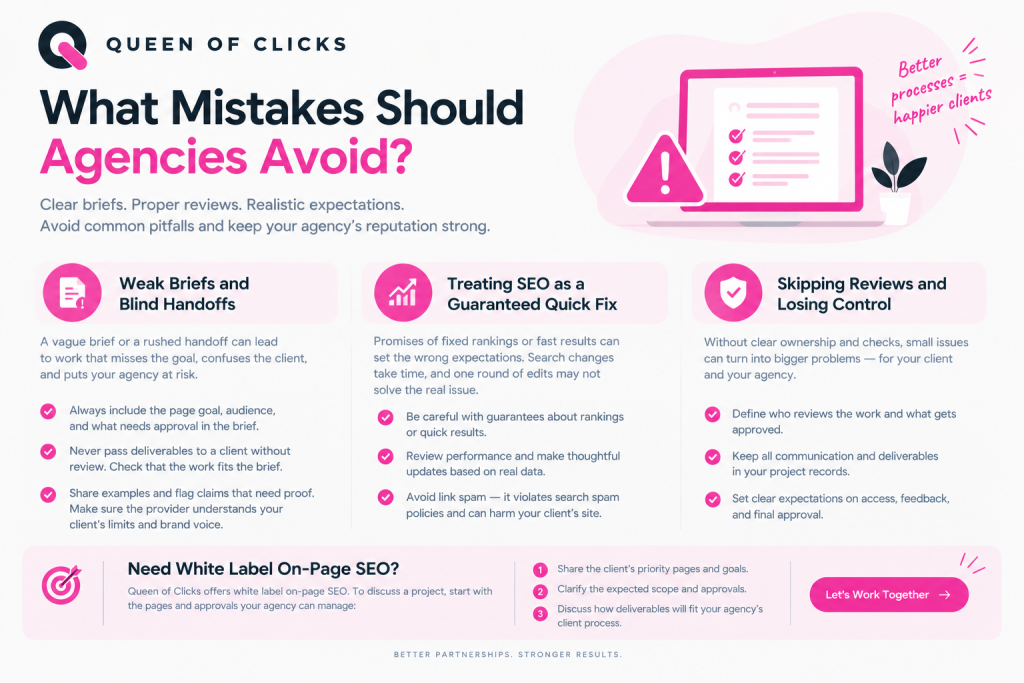
A partner can receive a vague brief, send back work that misses the goal, and see your agency forward it without review. That handoff can confuse the client and make your agency responsible for an avoidable mistake.
Agree on the page goal, what needs approval, and who checks the final work. Your agency should give feedback that names the issue and the change needed, not a broad comment such as “make it better.”
Weak Briefs and Blind Handoffs
A brief without audience or page goals can lead to edits that do not answer customer questions. A client may then see polished wording that still fails to explain the service or next step.
Never pass deliverables to a client without review. Check that the work fits the brief, and give actionable feedback if the provider missed a detail.
Do not assume a provider understands the client’s limits or voice. Share examples and flag claims that need proof before the partner edits a page.
Treating SEO as a Guaranteed Quick Fix
Be wary of promises about a fixed ranking or fast results. Search changes may take time, and a single round of edits may not address the page’s main problem.
Review performance and make thoughtful updates when evidence points to a need. Link spam is prohibited by search spam policies, so a partner should not use links designed to manipulate rankings.
The search spam policies describe practices that can violate those rules. Your agency should treat ethical work and client trust as part of the scope, not as optional extras.
Queen of Clicks offers white label on-page SEO. To discuss a project, start with the pages and approvals your agency can manage:
- Share the client’s priority pages and goals.
- Clarify the expected scope and approvals.
- Discuss how deliverables will fit your agency’s client process.
Discuss a suitable scope for your agency, then move to the decision that matters most: how to start with clear control and review.
Expand Your Agency’s Services With Queen of Clicks
Ready to offer more SEO services without expanding your in-house team? Queen of Clicks partners with agencies to deliver white label SEO services under your brand, helping you serve more clients while focusing on what you do best.
Our White Label SEO Services
- On-Page SEO: Optimize titles, meta descriptions, headings, internal links, and page content.
- Keyword Research: Identify relevant search terms and opportunities for your clients.
- Technical SEO Audits: Identify technical issues affecting crawling, indexing, and search visibility.
- Content Optimization: Improve existing content to align with search intent and user needs.
- Off-Page SEO & Link Building: Strengthen backlink profiles and build relevant link opportunities.
- AI Search Optimization: Help brands improve their visibility across AI-powered search experiences.
Let’s Grow Together!
Whether you need support with a single project or ongoing SEO delivery, Queen of Clicks is ready to explore a partnership that fits your agency’s needs.
Partner With Queen of Clicks and give your clients access to more SEO expertise without building an entire team in-house.
Conclusion
Outsourcing can extend your agency’s capacity, but your agency remains responsible for the client relationship and quality control. White label SEO works best when you define the work, review it, and communicate progress responsibly.
Start with a small, clearly scoped group of client pages and document the approval process. This gives your team a practical way to learn how the partner works before expanding the service.
Choose one suitable client, set a page-level goal, and agree on a review point before work begins.
FAQ
What is a white label SEO?
White label SEO is work a specialist provider delivers behind the scenes for your agency. Your agency presents the service to the client under its own brand and manages the client relationship. The provider may handle agreed page reviews, recommendations, or edits. Your contract and scope should name who approves changes and who communicates with the client.
Is SEO dead now with AI?
No, SEO is not dead because people still need useful pages they can find through search. AI is changing how people search for and assess information, which can affect how businesses present their expertise. Clear page goals, relevant content, and sound optimization still help people understand a business. Your agency should adapt its work as search habits change.
Is white labeling illegal?
White labeling is generally a business arrangement, not an illegal practice by itself. Your agency still needs to follow its contracts, client disclosure duties, privacy requirements, and applicable consumer rules. The agreement should explain who handles client data and how work is presented. If a contract or rule applies to your business, get suitable legal advice before making claims.
How much does white label SEO cost?
There is no universal fee for white label SEO. A quote depends on page count, implementation duties, content needs, reporting, and revisions. A review that covers a few existing pages differs from a scope that includes new copy and direct implementation. Compare what the fee covers with your agency’s delivery costs and expected margin, rather than judging the headline amount alone.
Can I do SEO on my own?
Yes, you can handle basic SEO tasks on your own with clear guidance. You can review whether a page answers a customer’s question, uses clear headings, and links to related pages. Complex technical work and broader strategy may need specialist help, especially when changes affect many parts of a site. Start with a small set of pages and review each change before publishing.
Is SEO worth it for small businesses?
SEO can be worthwhile for a small business when customers use search to find its services and the likely value justifies ongoing work. A local company may benefit from a clear page that explains its services, area, and next step. Results depend on competition, page quality, and follow-through. Set a business goal, then track qualified inquiries rather than visits alone.
Can ChatGPT do SEO?
ChatGPT can assist with drafts and analysis, but a person must verify facts, search intent, and page quality before publishing. It may help outline a page or flag repeated language, but it can miss client details or make errors. Your agency remains responsible for claims and edits. Treat AI output as a starting point, not finished client work.
Is SEO dead or evolving in 2026?
SEO is evolving in 2026 as search behavior and tools change, but relevant content and sound page optimization remain useful. People still need ways to find and assess businesses online. Your agency can adjust its approach as search features shift, while keeping page quality and user needs central. No single tactic guarantees visibility or leads.