SaaS Website Development: A Practical Guide to Building a Site That Actually Grows Your Business
If you run a SaaS company, your website is doing a lot more work than most people give it credit for. It’s your salesperson at 2am, your first impression for a prospect who found you on Google, and often the thing that decides whether someone signs up for a trial or bounces to a competitor’s tab. That’s why SaaS website development isn’t just a design project. It’s a growth project.
A lot of SaaS founders and marketing teams treat their website like a one-time launch task. Build it, ship it, forget it. But the companies that actually win organic traffic and trial signups treat their site as a living asset that needs to be built right from the start and improved constantly after that.
In this guide, we’ll walk through what SaaS website development really involves, the mistakes that quietly kill conversions, and how to build a site that ranks well on Google and shows up in AI search tools like ChatGPT and Perplexity too.
Key Takeaways
- SaaS website development combines strategy, SEO, performance, and user experience to drive long-term business growth.
- A high-performing SaaS website needs clear messaging, fast load times, intuitive navigation, strong social proof, and a seamless mobile experience to maximize conversions.
- To rank on Google and appear in AI search tools like ChatGPT and Perplexity, SaaS websites need a solid technical foundation, search-intent-driven content, and structured information.
- Treating your website as a one-time project instead of continuously optimizing it can lead to slower growth, lower rankings, and missed conversion opportunities.
- Queen of Clicks helps SaaS companies build SEO-driven websites that rank in Google, gain visibility in AI search, and convert more visitors into customers.
What Is SaaS Website Development
SaaS website development is the process of designing, building, and optimizing a website specifically for a software-as-a-service business. That sounds simple, but SaaS sites have a different job than most other websites.
An ecommerce store needs people to buy a product. A local business site needs people to call or visit. A SaaS website needs to explain a product that people often can’t touch or see right away, build enough trust that a stranger is willing to hand over their email or credit card, and then keep that person engaged through a trial, demo, or onboarding flow.
That means SaaS website development pulls together a few different disciplines at once:
- Web design and user experience
- Front-end and back-end development
- Copywriting that explains complex features in plain language
- Technical SEO
- Page speed and Core Web Vitals
- Analytics and conversion tracking
None of these work well in isolation. A beautifully designed SaaS site that loads slowly and isn’t structured for search will struggle to bring in traffic. A fast, well-optimized site with confusing messaging will bring in traffic that doesn’t convert. You need all of it working together.
Why SaaS Websites Are Different From Other Business Websites
The buying journey for software is longer and more research-heavy than most other purchases. People compare features, read reviews, check pricing pages, and often come back three or four times before they ever fill out a form.
This changes how you should think about your site’s architecture. Your homepage isn’t the only page that matters. Your pricing page, your feature pages, your integrations page, and your blog all need to carry their own weight in convincing someone you’re the right choice. If you want a deeper breakdown of how this ties into search strategy, our guide to SaaS SEO covers how content and structure work together to move people through that longer buying journey.

Core Elements Every SaaS Website Needs
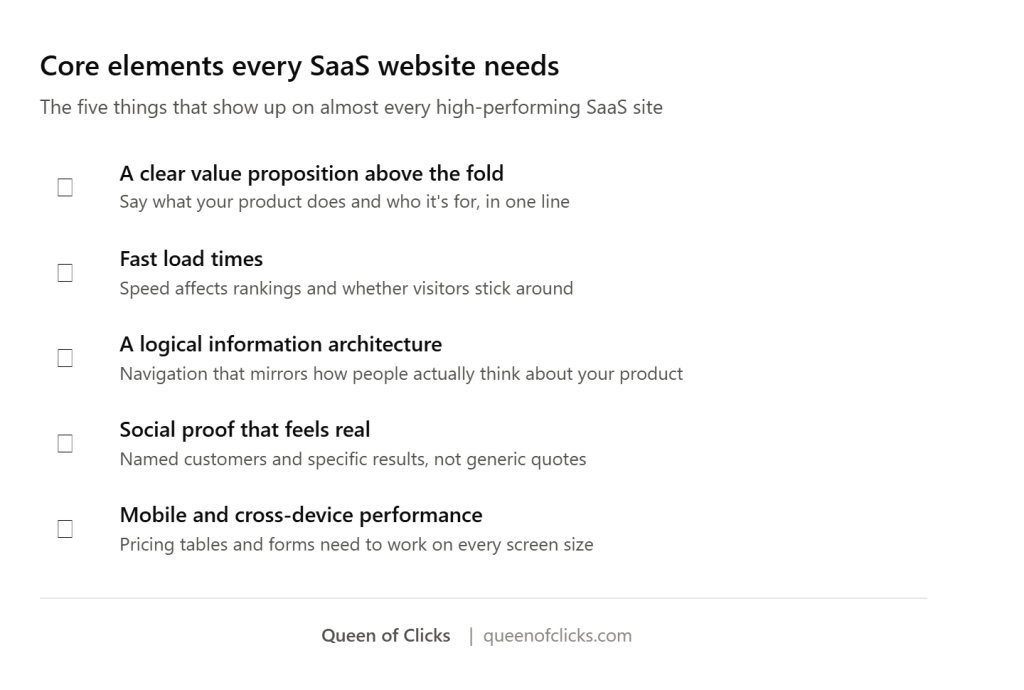
Whether you’re building from scratch or rebuilding an outdated site, there are a handful of elements that show up on almost every high-performing SaaS website.
A Clear Value Proposition Above the Fold
Visitors decide within seconds whether they’re in the right place. Your headline should say what your product does and who it’s for, without relying on vague buzzwords. “Empowering the future of collaboration” tells a visitor almost nothing. “Project management software built for remote engineering teams” tells them everything they need in one line.
Fast Load Times
Speed isn’t just a nice-to-have anymore. It affects rankings, user experience, and whether people stick around long enough to see what you’re offering. SaaS buyers are often comparing several tools in the same browsing session, and a slow site gets closed before it even loads.
A Logical Information Architecture
Your navigation should reflect how people actually think about your product: what it does, who it’s for, how much it costs, and how it fits with the tools they already use. Confusing menus and buried pricing pages push people away faster than almost anything else.
Social Proof That Feels Real
Testimonials, case studies, customer logos, and review site badges all help reduce the risk a prospect feels before signing up. Generic quotes with no names or companies attached tend to do very little. Specific results from named customers do a lot more heavy lifting. If you want to see what this looks like in practice, our case studies page shows real examples of what strong results look like when SEO and web design are working together.
Mobile and Cross-Device Performance
A large chunk of SaaS research still happens on phones and tablets, even for B2B products. If your pricing table breaks on mobile or your demo request form is a pain to fill out on a small screen, you’re losing people who were already interested.
Building a SaaS Website That Ranks on Google and Shows Up in AI Search
This is where a lot of SaaS website development goes wrong. Teams build a good-looking site, but they never structure it in a way that search engines, or AI tools, can actually understand and recommend.
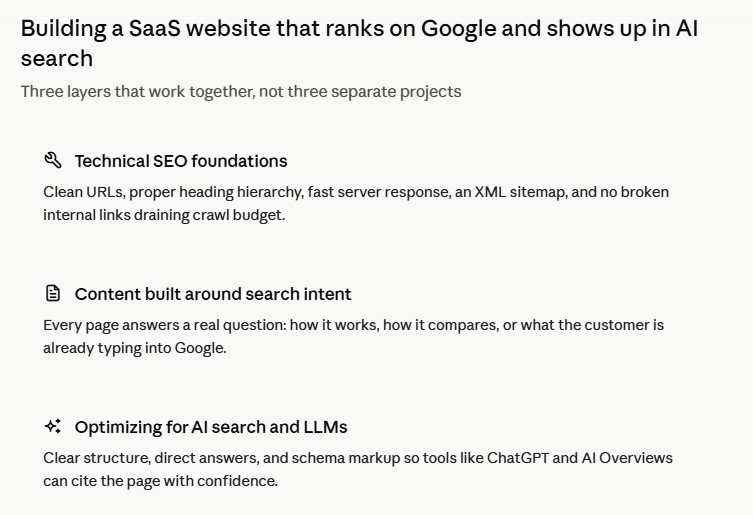
Technical SEO Foundations
Before content and design even come into play, your site needs a solid technical base. That means clean URL structures, proper heading hierarchy, fast server response times, an XML sitemap, and no broken internal links dragging down your crawl budget. Skipping this step is a bit like building a beautiful house on a cracked foundation. It might look fine for a while, but it won’t hold up.
Content Built Around Real Search Intent
Every page on your site is a chance to answer a question your ideal customer is already asking. Feature pages should answer “how does this work,” comparison pages should answer “how is this different from the alternative,” and your blog should answer the everyday questions your audience types into Google. Ranking well on Google in 2026 depends heavily on demonstrating real depth on a topic, not just stuffing in a keyword a certain number of times.
Site speed backs this up with hard numbers too. According to B2B SaaS conversion benchmark data, the average SaaS website only converts around 1.5% of visitors into leads, while elite performers convert as much as 8 to 15%. That gap usually comes down to structure, clarity, and how well the site is built to guide someone toward a decision, not just how it looks.
Optimizing for AI Search and LLMs
Traditional SEO used to be the whole game. Now, tools like ChatGPT, Perplexity, and Google’s AI Overviews are pulling answers directly from websites and summarizing them for users, often without a click ever happening. This is sometimes called AI search optimization or LLM optimization, and it changes a few things about how content should be written.
AI tools tend to favor content that is clearly structured, directly answers a specific question, and comes from a source that demonstrates real expertise. That means your headings, your FAQ sections, and even your schema markup all play a role in whether an AI tool decides your page is worth citing. Our WordPress Web Design service builds this kind of structure in from day one, rather than trying to bolt it on later.
Common SaaS Website Development Mistakes That Hurt Growth
Building the Site Before Building the Strategy
A lot of SaaS companies start with design mockups before they’ve thought through their keyword strategy, content plan, or conversion goals. This usually means the site looks nice but doesn’t actually support the marketing team’s goals once it launches.
Ignoring Page Speed Until It’s a Problem
Page speed tends to get deprioritized during development because it’s not as visible as design. But it has a direct and measurable impact on both rankings and revenue. One widely cited study found that ecommerce sites loading in one second saw conversion rates of 3.05%, compared to just 1.08% for sites that took five seconds to load. SaaS sites see a similar pattern, especially for high-consideration B2B buyers who won’t wait around for a slow page.
Treating the Blog as an Afterthought
Your blog is one of the biggest opportunities to rank for the questions your future customers are already searching. Too many SaaS companies publish inconsistently, target the wrong keywords, or write content that’s really just thinly disguised sales pitches instead of genuinely useful answers.
Skipping a Proper Content and Link Structure
Internal linking helps both users and search engines understand how your pages relate to each other. Pages that sit in isolation, with no links pointing to or from them, tend to rank worse and get discovered less, even if the content itself is solid.
No Ongoing Optimization After Launch
Launch day is the beginning, not the finish line. Search rankings shift, competitors publish new content, and your own product changes over time. A site that isn’t reviewed and updated regularly will slowly lose the ground it worked hard to gain.
How to Approach a SaaS Website Development Project Step by Step
Step 1: Research and Strategy
Start with keyword research, competitor analysis, and a clear picture of who your ideal customer is and what they need to see before they’ll trust you. This stage shapes everything that comes after it.
Step 2: Information Architecture and Wireframes
Map out your pages and how they connect before anyone touches design software. This is where you decide what your navigation looks like, what your pricing page needs to include, and how someone moves from your blog to your product pages.
Step 3: Design and Development
Build the site with both humans and search engines in mind. That means clean code, fast load times, accessible design, and a visual style that reflects your brand without slowing anything down.
Step 4: On-Page and Technical SEO
Set up your metadata, schema markup, internal links, and heading structure properly before launch, not after. Fixing this retroactively is possible, but it’s slower and more expensive than doing it right the first time.
Step 5: Launch, Track, and Improve
Once your site is live, the real work of refining it begins. Watch your analytics, run tests on key pages like your pricing and signup flow, and keep publishing content that supports your SEO strategy. You can get a sense of what kind of traffic growth is realistic with our SaaS SEO ROI Calculator, which gives you a rough estimate based on your current numbers.
🚀 Build a SaaS Website That Converts with Queen of Clicks
If your current site is holding your growth back instead of driving it, Queen of Clicks can help. We work with SaaS businesses to build and optimize websites that rank on Google, show up in AI search tools like ChatGPT and Perplexity, and actually turn visitors into signups.
From technical SEO to full WordPress redesigns, we handle the strategy and the build so your site stops being a bottleneck and starts being one of your best growth channels. Get in touch with our team for a free consultation and let’s talk about what your site could be doing for you.
Conclusion
SaaS website development isn’t just about making something that looks good. It’s about building a site that explains your product clearly, earns trust quickly, and gives search engines and AI tools every reason to recommend you.
When strategy, design, speed, and SEO all work together, your website stops being a static brochure and starts becoming one of the most reliable ways your business grows. Get the foundation right, keep improving after launch, and your site will keep paying you back long after the initial build is done.
FAQs
How long does a typical SaaS website development project take?
Most SaaS website builds take somewhere between six and twelve weeks, depending on how many pages are involved, how much custom design work is needed, and how quickly content and feedback come together on the client side. Larger platforms with complex integrations or custom dashboards can take longer.
Should I build my SaaS website on WordPress or a custom framework?
It depends on your team’s technical resources and how much flexibility you need. WordPress works well for most SaaS marketing sites because it’s fast to update, SEO-friendly, and doesn’t require a developer for every content change. Custom frameworks make more sense when the site needs to be tightly integrated with the actual product or app.
How much does SaaS website development typically cost?
Costs vary widely based on scope, but a professionally built SaaS marketing site usually falls somewhere between a few thousand dollars for a smaller, template-based build and well into five figures for a fully custom design with extensive content and development work.
Do I need a separate website for my product and my marketing site?
Many SaaS companies do keep these separate, using a subdomain or entirely different domain for the actual product dashboard while the main domain handles marketing, sales content, and SEO. This keeps the marketing site lighter and easier to optimize without interfering with the app’s performance.
How often should I update my SaaS website after launch?
Your core pages like pricing and features should be reviewed every few months to make sure they reflect your current product. Your blog and resource content should be updated far more frequently, ideally with new posts published on a consistent schedule and older posts refreshed as information changes.
What’s the difference between SEO and AI search optimization for a SaaS site?
Traditional SEO focuses on ranking in Google’s search results and driving clicks to your site. AI search optimization focuses on making sure tools like ChatGPT or Google’s AI Overviews can understand and accurately summarize your content, even when a user never clicks through to your page. Both matter, but they reward slightly different things.
Can a small SaaS startup compete with bigger companies on website SEO?
Yes, and often more easily than people expect. Larger companies tend to target broad, competitive keywords, which leaves smaller, more specific search terms wide open. A startup that consistently publishes focused, genuinely helpful content around its niche can outrank much bigger competitors on the searches that actually matter to its audience.