
SEO Intelligence: A Complete Guide for SaaS Companies
SEO intelligence is the strategic practice of gathering and analyzing search data, from keyword trends and competitor visibility to user intent and technical performance, to make actionable decisions that boost organic search results.
For SaaS companies, SEO intelligence turns organic search into a predictable growth lever, helping teams uncover what target users are searching for, optimize content for buyer intent, and outperform competitors where it matters most. Organic search drives approximately 53% of all website traffic, making it the dominant channel for visibility and acquisition.
Key Takeaways
- SEO intelligence turns organic search data into clear actions tied to trials, demos, and revenue.
- SaaS teams grow faster when they focus on high-intent queries instead of publishing more content blindly.
- Monitor SERP features and competitor moves weekly to protect traffic and conversions.
- The most effective SEO strategies connect pages to a single business metric based on the SaaS growth model.
- Consistent analysis and fast execution make organic search a predictable, scalable growth channel for SaaS.
What SEO Intelligence Is and What It Is Not
For SaaS teams, treating search data as actionable feedback changes how you plan content and product messaging.
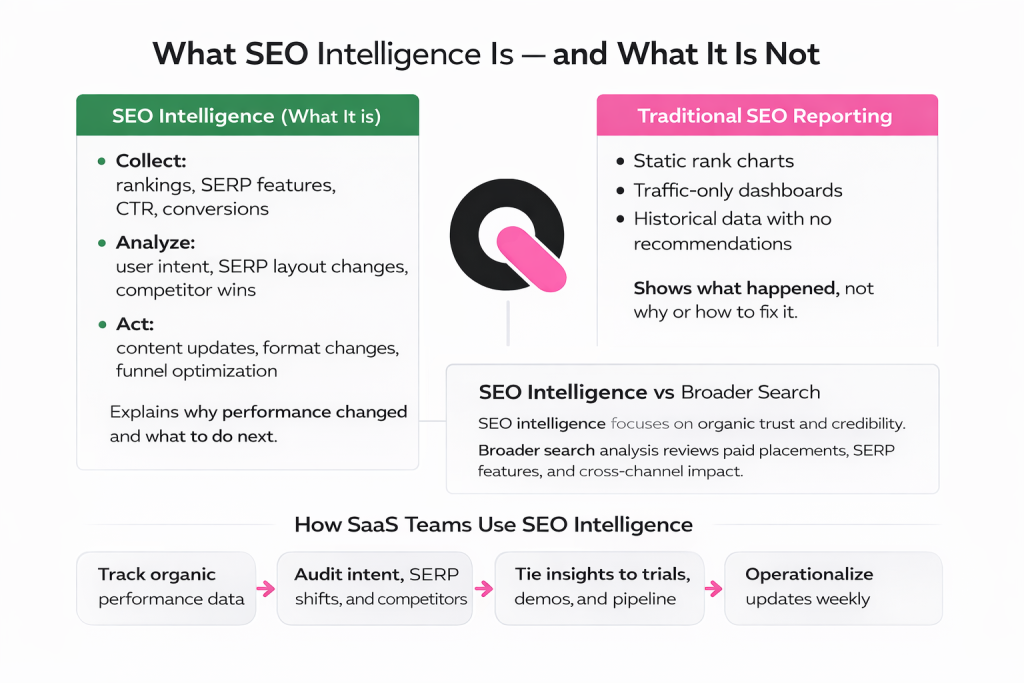
Definition: Collecting, Analyzing, and Using Organic Performance Data
SEO intelligence is a repeatable process that gathers organic metrics, runs focused analysis, and prescribes actions tied to business goals. It tracks ranking context, clicks, and conversions to show which pages move pipeline.
SEO vs. Traditional Reporting
Reporting tells you what happened. A true intelligence practice explains why it happened and what to do next.
That means moving beyond static dashboards to root-cause work: intent mismatch, SERP shifts, or competitor wins.
SEO vs. Broader Search Approaches
Focused work centers on organic results and credibility signals. Broader search work inspects SERP components, paid placements, and cross-channel journeys. It keeps organic trust high while mapping how features and layouts change traffic and conversions.
Practical example: A drop in conversions could stem from a new answer box, a shift in intent, or a competitor capturing video snippets, so audit SERP layout before rewriting content.
- Next: what data to track
- Then: how to build strategy
- Finally: how to operationalize insights
Why SEO Intelligence Matters for SaaS Growth
SaaS growth depends on steady organic visibility that captures buyers when they are ready to evaluate and convert.
Data-driven SaaS SEO reduces guesswork. It ties ranking shifts and click behavior to downstream actions like signups, demos, and pipeline credit. Teams can see which pages actually move the needle and which do not.
How data-driven work improves visibility, traffic, and conversions
High-intent queries often signal readiness for trials and comparisons. Consistent visibility on those queries leads to more qualified visits and higher conversion rates.
More content alone rarely equals better results. Smart analysis shows which keywords, pages, and SERP features drive conversions. That focus improves the user’s journey and conversion success.
What changes in 2026: faster SERP shifts and rising competition
Search engines update layouts more often. Features like AI answers, local packs, and video carousels can cut traffic even when rankings seem stable.
Weekly monitoring and faster decisions help teams capture opportunities before rivals do. The business payoff is clearer: better experience for the user, stronger conversion rates, and more predictable organic growth over time.
- Why it matters: steady visibility for high-intent queries
- How to act: connect rankings to signups and pipeline
- 2026 focus: monitor SERP feature shifts and move quickly
| Risk | Signal to watch | Quick action |
| Traffic drop despite stable rank | Loss of SERP features (answers, video) | Update meta, add structured snippets, refresh content |
| Rising competitor coverage | New high-value keywords ranking | Prioritize content gap fills and bidding for feature snippets |
| Stagnant conversions | High CTR but low signups | Test page flows, CTAs, and trial onboarding steps |
SEO Intelligence: The Core Data You Need to Track
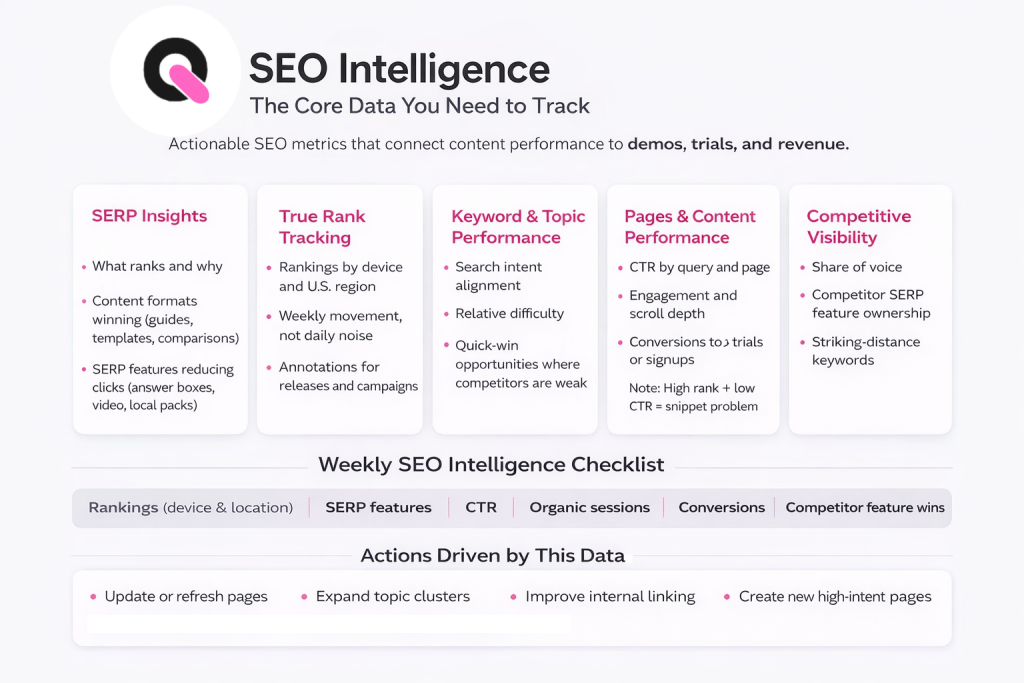
Focus on actionable metrics that link content performance to demos, trials, and revenue. Track a compact set of signals weekly so teams can spot shifts and act fast.
SERP Insights: What ranks, why it ranks, and what’s changing
Identify winning formats, guides, templates, comparisons, and note which SERP features push organic results down. Watch answer boxes, video panels, and local packs for high-value queries.
True Rank Tracking: Monitoring real position changes over time
Monitor real positions by device and region. Annotate rank charts when site updates or campaigns run. Small weekly dips can reveal larger SERP layout shifts.
Keyword and Topic Performance
Measure intent fit, relative difficulty, and quick-win signals. Prioritize keywords where intent matches your product and competitors are weak.
Pages and Content Performance
Track landing page CTR, engagement, and conversion contribution to trials or signups. Low CTR with high rank signals a meta or snippet problem.
Competitive Visibility
Quantify share of voice and map content gaps. Flag competitors who own SERP features for queries you target and hunt “striking distance” opportunities.
- Must-have weekly data: rankings by device/location, SERP features, CTR, sessions, conversions, competitor feature wins.
- Action map: update pages, expand clusters, adjust internal linking, or build new pages based on the data.
Building an SEO Intelligence Strategy for SaaS
Build a repeatable operating plan that ties content work to trials, demos, and pipeline. This keeps teams focused on revenue, not just rankings or traffic.
Aligning goals to SaaS metrics
Set page-level goals that match your motion. For sales-led pages, measure demo requests and lead quality. For product-led growth, track trial starts and activation.
Tip: Map each content asset to a single primary metric so prioritization and reporting stay clear.
Mapping keywords to the funnel
Use search intent to slot keywords into stages: awareness (problem education), consideration (solution comparison), decision (pricing and alternatives), and expansion (use cases, integrations).
Target high-intent keywords for conversion-focused pages and broader topics for long-term authority.
Creating the feedback loop
Publish and optimize content, monitor rankings and SERP shifts, measure conversions, then prioritize iterative updates. Make weekly reviews part of the ops cadence.
- Quick wins: CTR lifts, striking-distance pages, small copy or meta changes.
- Compounding investments: topic clusters, internal linking, and pillar pages that improve performance over time.
| Priority | Lens | Decision drivers |
| High-impact, fast | Striking-distance keywords | Expected impact, low effort, short time-to-value |
| Compound growth | Topic authority | Longer time, higher effort, aligns with ICP and product roadmap |
| Maintenance | CTR & SERP feature shifts | Monitor weekly, update snippets and formats |
Use this strategy to make resilient decisions when search or competitors change. That focus turns organic work into predictable, measurable business outcomes in the U.S. market.
Keyword Research That Delivers Actionable Intelligence
Effective SaaS keyword research connects real buyer problems to the pages that convert. For SaaS teams, prioritize terms that signal intent for demos, trials, or integrations rather than just broad awareness queries.
Finding High-Intent Keywords That Match SaaS Use Cases
Look for queries that reference tasks or outcomes, like “how to automate reporting” or “best software for expense approvals.”
Rank by expected value: conversion likelihood, search volume, and production cost. Prioritize low-effort wins that map cleanly to product pages or onboarding flows.
Using SERP Analysis to Understand Search Intent and Content Format
Run SERP analysis for target terms to see whether results favor guides, comparisons, or product pages. That reveals whether search is informational, commercial, or navigational.
Also note feature saturation; answer boxes or video panels often change click behavior and the content format you must build.
Building Topic Clusters for Scalable Content and Stronger Rankings
Group related keywords into clusters with a single pillar page and supporting articles to avoid cannibalization.
Create a keyword-to-page map that marks pages to create, consolidate, or refresh based on demand, competitive intensity, SERP features, and your team’s ability to produce the best page.
- Evaluate opportunity: demand + competitive intensity + SERP saturation + production ability.
- Operate continuously: update clusters as competitors publish and SERPs shift.
Competitor and SERP Analysis
Understanding who actually competes with your pages in U.S. search results changes where you spend content effort.
Identifying Your Real Organic Competitors
Product rivals are not always the same as competitors in search engines. In the United States, publishers, review sites, and comparison pages can outrank vendors for high-value queries.
Find organic competitors, measure keyword overlap, repeated SERP presence in your focus categories, and shifts in share of voice over time.
Analyzing Competitor Keywords, Site Structure, and Content
Audit competitor keyword coverage, site architecture, and internal linking patterns. Note how their content matches intent and preferred formats like guides, comparisons, or tool pages.
Using SERP Analysis to Spot Why They Rank
Compare depth, topical breadth, freshness, and alignment with SERP features. These signal what to copy or outdo.
- Striking distance: pages near page-one that can win with targeted updates.
- Turn insights into actions: add missing comparisons, expand use-case sections, and tighten on-page elements.
- Monitor continuously so your strategy adapts to new competitors and SERP layouts.
| Signal | What to Check | Action |
| Keyword overlap | Shared top-50 terms | Create focused pages for gaps |
| Site structure | Pillar clusters, nav, linking | Improve internal links and hub pages |
| Content format | Depth, freshness, features | Match format and add depth |
Geo-Targeting and Localization Insights for the United States
Regional search patterns change which phrases and page formats win attention in different U.S. markets. For SaaS teams, that means mapping how users in states and cities phrase problems, request demos, or mention compliance rules.
How Regional Search Behavior Impacts Keyword Selection
Language and industry concentration vary across regions. A keyword that performs well in New York may use different modifiers in Texas or California.
Prioritize keywords tied to city or state modifiers and to common industry hubs. That helps content match local intent and improves page relevance for buyers.
Monitoring Local Intent Queries and Local SERP Features
Track geo-tagged queries and watch for “near me” or region-specific intent, even for remote services. Local SERP features, maps, local packs, or region-specific snippets, can steal clicks from general results.
Use weekly geo-level data to spot where visibility and click share fall short, then add localized pages, region proof points, or tailored examples.
- Why it matters: localized content often drives higher-quality leads because it matches the user’s context.
- How to keep it accurate: consistent on-site signals, clear location references, and avoid thin duplicate pages.
- Report as action: show pockets of opportunity and next steps, not disconnected charts.
| Signal | What to Monitor | Action |
| Low regional visibility | Geo-ranked terms and CTR by city | Create localized landing pages and case studies |
| Local intent spike | “Near me” phrasing and map features | Optimize contact info, service areas, and structured data |
| Industry hub variance | Top modifiers by metro area | Adjust messaging and examples to fit local decision criteria |
AI’s Role in Modern SEO Intelligence
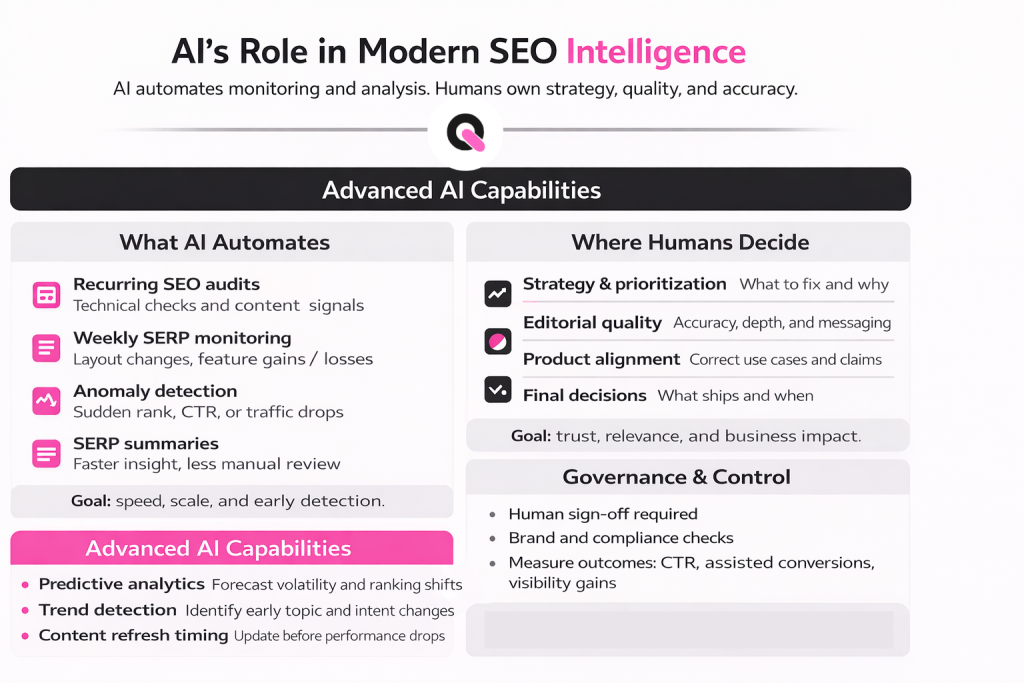
AI is shifting how teams monitor search performance, freeing time for strategic work. Use it to automate repetitive checks while people keep ownership of strategy, editorial quality, and product accuracy.
Automation for Repetitive Tasks
Automate recurring audits, weekly SERP reviews, and anomaly detection. Set alerts for sudden rank drops or new opportunities so teams respond within days, not weeks.
Predictive Analytics and Volatility
Apply predictive models to anticipate trend shifts and algorithm changes. Early signals let you schedule refreshes or format updates before visibility and conversions fall.
Voice Search and Conversational Queries
Optimize for long-tail, conversational phrasing and concise answers. Prioritize mobile speed and clear snippets to match how U.S. users ask questions on voice devices.
Image and Video Discovery
Improve visual search and use descriptive filenames, detailed alt text, and rich metadata. These small changes increase blended-result visibility and referral traffic.
Quality Control and Governance
Measure outcomes, not output: track CTR, assisted conversions, and visibility gains. Keep editorial standards and product accuracy in review cycles so automation scales without harm.
- Automation use cases: recurring audits, SERP summaries, anomaly alerts.
- Predictive value: trend forecasts and content refresh scheduling.
- Governance: human sign-off, brand alignment, and accuracy checks.
Choosing Tools and Integrations Without Breaking Your Workflow
Choose toolsets that plug into your current workflow and let teams act on search signals the same day. Aim for a lightweight stack that supports quick decisions and clear ownership across marketing, content, and engineering.
What to look for
Selection criteria: reliable rank tracking, deep SERP insights, competitor analysis, and reporting that maps to business outcomes. Each tool should tie to a measurable page goal.
Workflow fit
Tools must connect to your CMS, content ops, and dev environments so insights become shipped improvements. Plan one-time connections, continuous monitoring, and defined owners for each integration.
Implementation notes for web teams
Validate that technical changes won’t break templates. Check core HTML elements and responsive basics like the meta viewport attributes width and width=device-width when diagnosing mobile issues.
Scaling and security
Pick systems that scale across multiple sites, docs hubs, or product lines without fragmenting tracking or reporting. For enterprise use, require data governance, encryption, access control, and compliance-aligned handling of sensitive data.
- Operate lean: fewer dashboards, clearer alerts.
- Ownership: marketing for content, devs for templates, ops for data.
- Scale: centralized tracking, per-site views.
| Need | What to verify | Action |
| Rank tracking | Accurate, device & region splits | Sync weekly exports and annotate releases |
| SERP insights | Feature detection and snippet capture | Adjust formats and meta to match intent |
| Integrations | CMS, analytics, and dev pipelines | One-time connector, webhooks, CI checks |
| Security | Governance, encryption, role-based access | Audit logs and compliance reviews |
Measuring SEO Intelligence Success With the Right KPIs
Measure what matters: align metrics to the SaaS SEO funnel so content work drives product outcomes. KPI discipline prevents teams from chasing rankings that do not translate into business results.
Visibility Metrics
Track rankings by intent bucket (awareness, consideration, decision). Measure share of voice on priority topics and note SERP feature coverage that reduces click potential.
Traffic Metrics
Monitor organic sessions trends, CTR by query and page, and landing page performance. Segment by device and U.S. region to spot geographic or mobile gaps.
Business Metrics
Connect pages to demos, trials, signups, and revenue influence. Use attribution-friendly tracking and CRM alignment so performance maps to pipeline and conversions.
Experience Metrics
Use engagement depth, return visits, scroll behavior, and on-page actions to judge whether content solved the user’s search need.
- Turn KPIs into decisions: refresh low-converting pages, expand winning clusters, or prioritize engineering fixes.
- Cadence: weekly operational reports for teams and monthly executive summaries tied to pipeline goals.
- Outcome focus: prioritize performance that moves trials and revenue, not just better rankings.
🚀 How Queen of Clicks Helps SaaS Companies Turn SEO Intelligence Into Growth
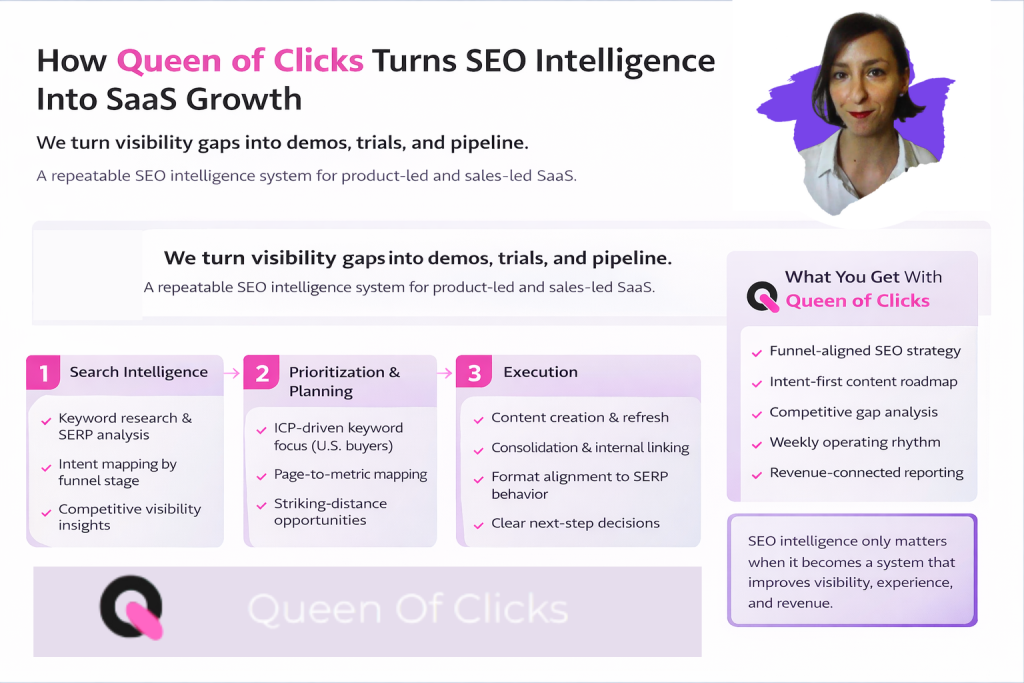
At Queen of Clicks, we build systems that turn visibility gaps into measurable business outcomes for product-led and sales-led SaaS. The work links search signals to demos, trials, and pipeline so teams act with confidence.
A Structured Approach That Connects Search Insights to Real SaaS Outcomes
Philosophy: intelligence only matters when it becomes a repeatable system that improves visibility, experience, and revenue outcomes.
What You Get When You Partner With Queen of Clicks
- Funnel alignment: we map each page to a single metric so content drives demos, trials, or expansion.
- ICP-driven prioritization: focus on terms and content that match your ideal buyers in the United States.
- Operating rhythm: weekly tracking and clear owners so search analysis becomes fast decisions, not one-off reports.
- Keyword research & SERP analysis: intent-first work that shapes content formats to how buyers search at each stage.
- Competitor visibility: identify real organic competitors, map gaps, and target striking-distance opportunities to win quicker.
- Content planning: an outcome-driven roadmap for creating, refreshing, consolidating, and internal-linking priorities that support conversions.
- Performance tracking: dashboards and narratives that translate metrics into next-step decisions for marketing and leadership.
Ready to act? We will:
- Clarify your highest-value SaaS use cases and the search terms that signal purchase intent.
- Audit SERP layouts and competitor positioning to find realistic ranking and CTR wins.
- Build a prioritized content plan tied to trials, demos, signups, and pipeline.
- Set up tracking and a reporting cadence that turns weekly insights into clear actions.
If you want a clear, data-backed plan, book a call with Queen of Clicks to review your current visibility, identify opportunities, and map the fastest path to growth.
Conclusion
SEO intelligence gives SaaS teams a way to move from reactive SEO work to controlled, data-driven growth. By tying rankings, SERP behavior, and content performance directly to trials, demos, and pipeline, it removes guesswork and clarifies what actually drives results.
In a search environment that shifts faster and grows more competitive each year, SaaS companies that treat SEO as an intelligence system, not a reporting task, are better positioned to protect visibility, capture high-intent demand, and turn organic search into a predictable growth channel.
FAQs
How long does it take for SEO intelligence to show results for a SaaS company?
SEO intelligence delivers early signals within weeks (CTR shifts, ranking movement, SERP feature wins), but meaningful impact on trials, demos, and pipeline typically appears in 3–6 months. Speed depends on competition, domain authority, and how fast insights are turned into actions.
Is SEO intelligence suitable for early-stage SaaS or only mature companies?
It works for both. Early-stage SaaS benefit as they avoid wasted content and target high-intent keywords early, while mature SaaS use SEO intelligence to defend visibility, scale topic authority, and protect pipeline from SERP volatility.
What are the most common mistakes SaaS teams make with SEO intelligence?
The biggest mistakes include tracking too many vanity metrics, ignoring SERP feature impact, failing to connect pages to revenue events, and treating SEO insights as reports instead of execution inputs.
Do SaaS companies need a dedicated SEO team to run SEO intelligence?
No. A small, focused team, or even one owner, can run SEO intelligence effectively if workflows are clear. The key requirement is consistent weekly review, ownership of actions, and alignment with content and product teams.
How does SEO intelligence support content pruning and consolidation?
SEO intelligence identifies pages with low engagement, weak intent match, or cannibalization issues. Instead of publishing more content, teams can consolidate or refresh existing pages to recover rankings, CTR, and conversions.
How do you attribute revenue or pipeline to SEO intelligence efforts?
Attribution comes from mapping pages to primary goals, tracking assisted conversions, and aligning analytics with CRM data. SEO intelligence focuses on influence and contribution, not last-click attribution alone.
When is SEO intelligence not the right investment for a SaaS company?
If a SaaS product has no search demand, is purely outbound-driven, or lacks the resources to act on insights, SEO intelligence will underperform. It works best when teams are ready to execute consistently and tie insights to growth goals.