SEO Maintenance for SaaS Websites: How to Maintain Rankings and Traffic Over Time
SEO maintenance for SaaS websites is the ongoing process of monitoring, updating, and improving your site’s technical health, content, and search performance after the initial SEO work is done. Instead of treating SEO as a one-time project, SaaS companies maintain rankings by fixing technical issues, refreshing content to match evolving search intent, and continuously optimizing pages that drive product signups and demos.
This matters because search visibility naturally declines without consistent maintenance. Websites that pause SEO efforts typically experience a 10–20% year-over-year traffic decline, with losses compounding over time if no updates are made.
Key Takeaways
- SEO maintenance for SaaS is a continuous system.
- Frequent product changes create risk of SEO drift that must be tracked.
- Strong organic visibility reduces cost per acquisition and steadies demand.
- Small ranking drops can cause large traffic losses due to click distribution.
- Build a cadence that ties checks, priorities, and reporting to release cycles.
Why Ongoing SEO Maintenance Matters for SaaS Growth
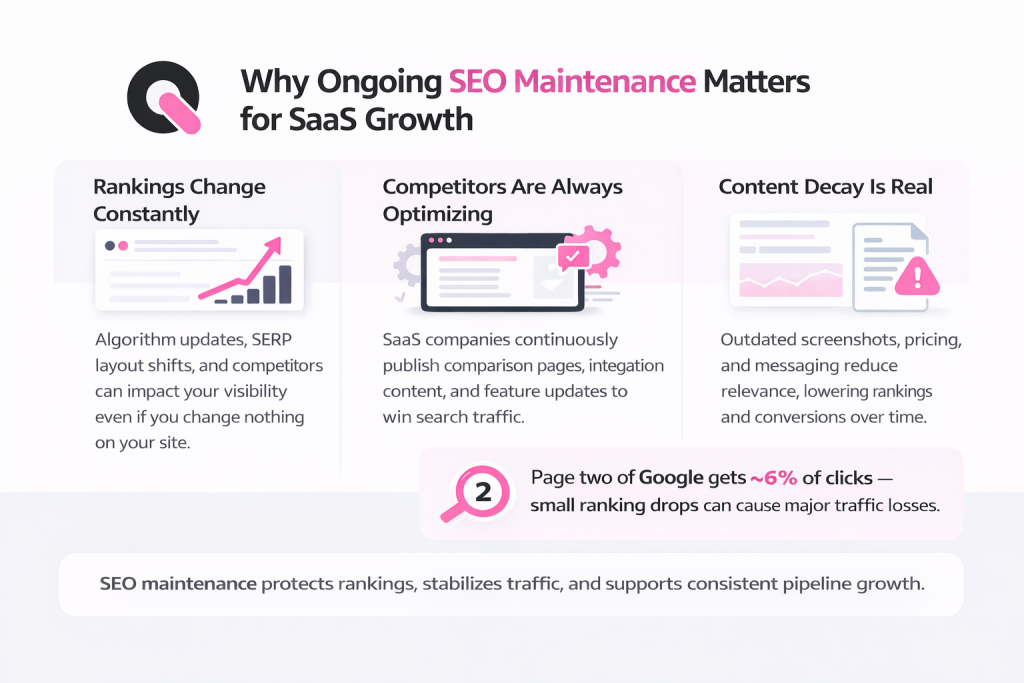
Search rankings for SaaS products can shift fast, and guarding hard-won positions requires steady effort. Algorithm changes, layout shifts, and rising competitors reshape what counts as success in search results.
SEO Is Not Set-It-and-Forget-It in a World of Constant Algorithm Updates
Google rolls out thousands of improvements yearly. What worked last quarter can soften without any on-site change, so ongoing measurement is risk management as much as growth strategy.
Rankings Aren’t Permanent, and Competitors Keep Pushing
SaaS rivals publish comparison, integration, and alternative pages aggressively. Holding position means active defence: updating intent, refreshing pages, and tracking trends.
Content Decay Reduces Visibility, Clicks, and Pipeline Over Time
Feature screenshots age, pricing or partner names change, and messaging becomes stale. When visibility drops, clicks fall and trial requests follow; page two gets roughly 6% of clicks, so a slip can be a cliff.
How SEO Maintenance Works in Practice
A practical ops model keeps a product site visible as features and teams change. Define clear scope, assign owners, and budget regular hours so upkeep becomes operational, not optional.
What upkeep covers across content, technical, and authority
Break work into three pillars: content, technical, and authority. That division helps teams own tasks without overlap and prevents gaps.
- Content: refresh high-intent pages, update screenshots, and align messaging after launches.
- Technical: validate indexing, fix redirects, and monitor site signals after releases.
- Authority: audit links, reclaim lost mentions, and track off-site signals.
How much time teams should plan each month
Small SaaS sites often need a few hours monthly for light upkeep. Larger sites with many pages or frequent releases require weekly checks and a higher cadence.
| Driver | Example | Light site (hrs/mo) | Large site (hrs/mo) |
| Indexable pages | 50 vs. 5,000 | 4–6 | 30–60 |
| Publishing velocity | Occasional vs. daily updates | 2–4 | 20–40 |
| Release frequency | Quarterly vs. continuous | 2–3 | 15–25 |
| Cross-team touches | Marketing only vs. multiple teams | 3–5 | 15–30 |
Define a repeatable workflow with tools, templates, and a clear definition of done. Log changes, annotate analytics, and tie each action to metrics to avoid rework and opinion-driven edits.
Build a SaaS SEO Maintenance Cadence That Matches Your Release Cycle
Align your review rhythm to how often product and content teams ship. Every release can add pages, change links, or shift load time, so the upkeep cadence must mirror reality to prevent ranking drift and lost results.
A structured SEO maintenance checklist helps teams standardize what needs to be reviewed after each release, from indexing validation and internal links to performance and content accuracy. A checklist also reduces the risk of missing critical steps when multiple teams are involved, turning SEO maintenance into a repeatable operational process instead of ad-hoc fixes.
Weekly Signals to Watch in Google Search and Analytics Data
Scan impressions, clicks, CTR, and quick ranking swings twice a week. Watch for pages exiting index, spikes in “not indexed” status, or sudden drops in brand and feature queries.
Escalate immediately on a sharp click decline, a burst of 5xx errors, or large indexing changes. Early action limits fallout.
Monthly Maintenance Sprints for Site Health and Content Performance
Run a focused sprint each month that bundles technical fixes, content tweaks, and internal link checks. Split tasks between marketing and dev to keep fixes moving without blocking releases.
Quarterly Reviews to Recalibrate Strategy, Keywords, and Results
Every quarter, revisit keyword sets, compare trend lines, and decide which pages to defend or expand. Refresh content on a ~6-month cadence where intent or facts shift.
How to Prioritize Fixes by Impact on Rankings, Traffic, and Conversions
Score work by business value: weigh pricing, demo, and comparison pages higher than low-conversion blog posts.
- Simple score: Revenue intent × traffic potential ÷ effort. Higher scores get faster action.
- Use results and metrics to justify trade-offs to stakeholders and set time-boxed fixes.
Monitor Search Performance and Spot Issues Before They Cost You Rankings
Detecting changes in search behavior fast keeps critical product pages visible. Continuous monitoring detects early signs of trouble so you can act before traffic and conversions fall. Use both query-level and page-level data to diagnose cause and urgency.
Track keyword rankings, CTR, impressions, and organic traffic trends
Monitoring is active detection: it alerts you when a key page’s clicks or impressions shift. Reporting summarizes what changed and why for stakeholders.
Interpret patterns: impressions up + CTR down often signals a SERP change or weaker snippet. Clicks down while rankings stay stable can mean demand shifted or users found better alternatives.
Use engagement metrics to spot intent mismatch and pogo-sticking risk
Measure time on page, scroll depth proxies, and bounce patterns to see if users find answers. Short visits after a click can indicate intent mismatch, especially on feature or integration pages.
Pogo-sticking occurs when users return to google search after a poor result. This hurts perceived relevance and can erode rankings for SaaS pages.
Triage questions to run when a page slips:
- Did user intent change for the keyword?
- Did competitors add comparison or proof sections?
- Did the SERP snippet or internal links change?
| Signal | Likely Cause | Diagnostic Action |
| Impressions ↑, CTR ↓ | SERP layout change or weaker title/snippet | Test improved snippet and review SERP features |
| Clicks ↓, Rankings ↔ | Demand change or better competitor content | Check query trends and competitor pages |
| Short visits, high exits | Intent mismatch or missing proof points | Improve page structure: add pricing, proof, setup steps |
Segment performance by branded vs. non‑branded queries and bottom‑funnel vs. top‑funnel pages. Set alert thresholds (for example, a 20% week‑over‑week drop in clicks for priority pages) so issues get triaged before they compound.
Keep Technical SEO Healthy as Your Product and Website Evolve
As products ship, hidden infrastructure issues can quietly strip visibility. A principled technical approach protects rankings, reduces crawl waste and keeps key pages indexable.
Find and Fix Broken Links, Redirect Chains, and Indexing Problems
Broken links and long redirect chains waste crawl budget and frustrate users. Confirm priority pages are indexable and monitor “not indexed” reasons. Fix template bugs that affect many pages at once.
Improve Website Speed and Core Experience Signals Over Time
Better load times compound into higher conversions on high-intent pages. Track Core Web Vitals, compress assets, and prioritize speed work for landing and pricing pages.
Strengthen Security With Updates and HTTPS to Protect Trust and Search Engines
Keep platform updates current and enforce HTTPS. Security patches reduce the risk of compromise and protect reputation with visitors and search engines.
Prevent Duplicate Content and Crawl Waste as Pages Scale
Programmatic pages, parameterized URLs, and near-duplicate feature pages dilute relevance. Apply canonical rules, URL patterns, and publishing guardrails so the problem does not recur.
- Cause → Effect: broken links = poor user paths; indexing errors = lost visibility.
- Process: run indexing diagnostics, batch-fix templates, and log changes.
- Scalable practices: URL rules, canonical strategy, and release checks.
| Issue | Impact | Action |
| Redirect chains | Crawl waste, slower loads | Collapse chains to single 301 |
| Duplicate content | Diluted relevance | Canonicalize or combine pages |
| Slow pages | Higher exits, lower conversions | Prioritize CWV fixes for priority pages |
Refresh and Re-Optimize Content to Maintain Search Visibility
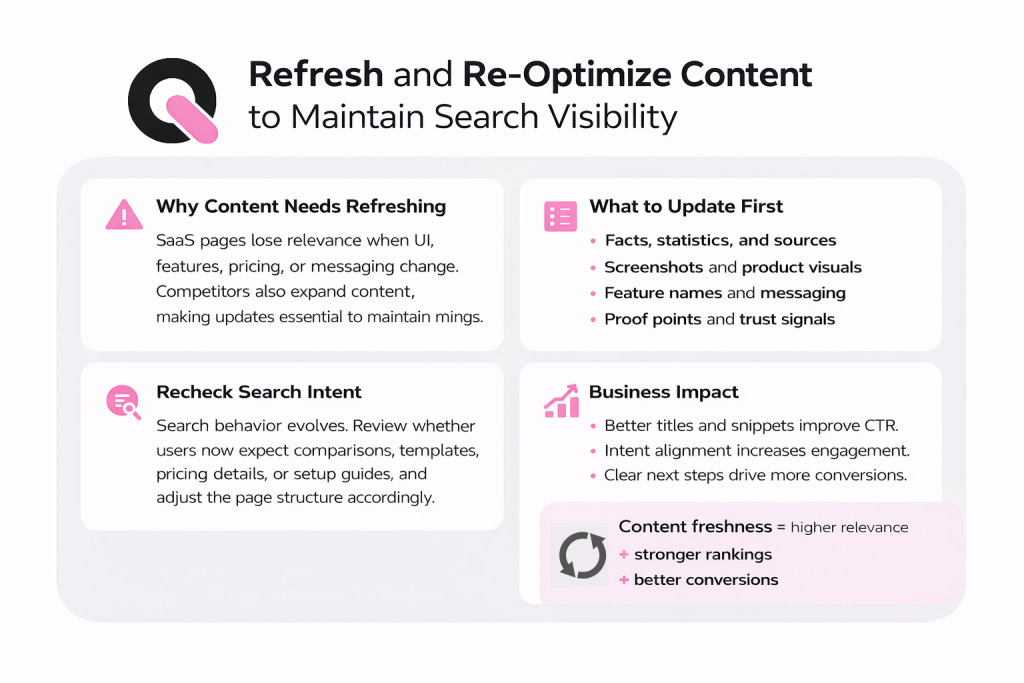
Product pages age faster than we expect, so periodic refreshes keep relevance intact. The SEO content for SaaS decays when UI, features, or pricing change. Competitors also expand pages, so re-earning relevance matters more than one-off edits.
Use a simple editorial framework when you update a page: accuracy, trust, clarity, and conversion alignment. First, refresh facts, stats, and sources so users see current data. Next, add proof points and compliance mentions to improve trust.
Handle screenshots and messaging deliberately. Replace UI images, rename features consistently, and remove discontinued flows to avoid confusing users. Small visual updates reduce returns and pogo-sticking.
Recheck intent and keyword relevancy
Run lightweight research to see if queries now favor comparisons, templates, pricing, or setup guides. If intent shifted, restructure the page to match expectations and improve engagement.
Track terminology trends and adjust targets when category names evolve. Add missing subtopics, FAQs, or use-case sections to defend rankings without bloating the primary page.
Outcome focus: better titles and snippets raise CTR, intent alignment boosts time on page, and clearer next steps lift qualified conversions.
Protect and Grow Off-Page Authority Without Risking Penalties
Off-site reputation is a business asset for search engines. Treat links and mentions as signals that need active care so authority does not decay when competitors win better coverage or spam appears.
Audit Backlinks and Reclaim Lost Link Equity
Run a simple backlink audit to find lost or broken links to high-value pages. Prioritize reclaiming links that pointed to pricing, demo, or comparison pages.
Fix broken target URLs, redirect where appropriate, and reach out to referrers to restore equity.
Avoid Toxic Links and Spam Signals That Hurt Performance
Identify spammy referring domains and disavow only after manual review. Risky shortcuts can trigger penalties and harm rankings and results when algorithms shift.
Build Consistent Mentions and Earn Links With SaaS-Led Content Assets
Create useful, linkable assets: original benchmarks, product templates, integration directories, and technical explainers. These attract natural references from practitioners and press.
- Outcome: stronger rankings resilience and faster ability to rank new pages.
- Process: regular audits, prioritized reclamation, and safe link growth strategy.
- Monitoring: track new links, lost links, and anchor distribution with simple tools to spot issues early.
| Action | Why it matters | Priority |
| Backlink audit | Find lost referrals that affect traffic | High |
| Disavow review | Remove toxic signals that reduce performance | Medium |
| Content assets | Earn steady mentions and authoritative links | High |
Tools and Reporting Systems That Make SEO Maintenance Sustainable
Dashboards, alerts, and repeatable reports turn reactive work into a steady process that teams can follow every week, month, and quarter.
Dashboards and Alerts for Monitoring at the Right Frequency
Include core rankings segments, top converting pages, index coverage health, and engagement metrics by page type.
Set alerts for error spikes, sudden CTR drops on money pages, major impression declines, and unexpected deindexing of key URLs.
Repeatable Reports That Tie Metrics to Business Outcomes
Use a concise narrative: what changed, likely cause, action taken, and expected business impact (trials, demos, revenue influence).
Map landing pages to signup and demo events to surface assisted conversions and pipeline contribution.
Workflow Tips to Coordinate Marketing, Product, and Dev Teams
Create intake rules, SLAs for fixes, and a shared backlog that respects release calendars. Automate scheduling so nothing slips between releases.
Document every release and content update so later performance shifts can be traced without guesswork.
| System | Primary Use | Key Alert |
| Monitoring dashboard | Early detection of trends | CTR drop on priority pages |
| Automated alerts | Immediate incident notification | Mass deindexing or 5xx spike |
| Repeatable report | Stakeholder narrative of change | Week-over-week traffic loss on demo paths |
🚀 How Queen of Clicks Helps SaaS Teams Turn Maintenance Into Measurable Growth
Queen of Clicks turns ongoing upkeep into a measurable growth engine for SaaS teams. We treat site care as an operational program that protects revenue-driving pages and reduces volatility from algorithm or competitive shifts.
Structured Support That Keeps Rankings Stable While You Scale
Structured support pairs regular signal monitoring with a clear remediation process. Weekly checks catch urgent drops, monthly sprints fix technical debt, and quarterly reviews reset priorities to match product roadmaps.
What a Maintenance Engagement Can Include for SaaS Websites
Our engagements focus on outcomes, not tasks. We diagnose root causes, execute fixes, and close the loop with reporting that ties work to trials, demos, and conversions.
- Operationalized cadence: align upkeep to release cycles, protect high-value pages first, and keep a prioritized backlog.
- Systematic process: monitor signals, diagnose issues, implement fixes, and report results tied to business metrics.
- Change coverage: support new feature pages, pricing updates, integrations, docs growth, and migrations.
- Core services: technical health checks, indexing support, content refresh strategy, internal link work, and authority protection.
- Measurable growth: hold rankings, improve conversion performance on intent-rich pages, and cut traffic volatility.
Queen of Clicks support is ongoing and collaborative. Schedule a call to review gaps, map a sustainable plan, and align upkeep to your release calendar so launches don’t unintentionally erode visibility.
Conclusion
A repeatable cadence converts ad hoc updates into measurable gains for your product site. Treat seo and maintenance as an operational rhythm that protects value as the market and search engine signals evolve.
Keep work focused on three pillars: content, technical checks, and authority. That trio holds rankings steady, lifts visibility, and improves website performance for high-intent pages.
Run weekly scans to catch drops, monthly sprints for fixes and updates, and quarterly strategy reviews to reset priorities. The aim is results, not activity; better traffic quality, more qualified trials, and steadier conversions.
If you want a practical plan tied to product releases, schedule a review to map cadence, tools, and cross-team workflow that prevents unseen issues and seo debt.
FAQs
How Often Should SaaS Companies Perform SEO Maintenance?
Most SaaS companies should run weekly monitoring, monthly maintenance sprints, and quarterly strategic reviews. The exact frequency depends on product release velocity and site size. If your team ships features often or publishes new pages regularly, maintenance needs to happen more frequently to prevent indexing issues and ranking drops.
What Happens If You Stop SEO Maintenance for a SaaS Website?
Stopping maintenance typically leads to ranking decay, traffic loss, and reduced conversions over time. Content becomes outdated, technical issues accumulate, and competitors gain visibility. Because SaaS revenue depends heavily on consistent pipeline, even small ranking declines can impact monthly recurring revenue.
How Do You Know If Your SaaS Website Needs SEO Maintenance?
Common signs include declining organic traffic, dropping keyword rankings, outdated screenshots or messaging, indexing errors in search console tools, and lower conversion rates from organic visitors. If performance is unstable or unpredictable, maintenance is usually overdue.
Who Should Be Responsible for SEO Maintenance in a SaaS Company?
SEO maintenance is usually a shared responsibility between marketing, product marketing, and development teams. Marketing owns content and performance monitoring, while developers handle technical fixes. Many SaaS companies also work with specialized SEO agencies to manage the process consistently.
Is SEO Maintenance Different for SaaS Compared to Other Industries?
Yes. SaaS websites change more frequently due to product updates, feature releases, integrations, and pricing adjustments. These constant changes create higher risk of SEO drift, making maintenance more critical than in many traditional industries with static websites.
What Are the Most Important Pages to Maintain on a SaaS Website?
The highest priority pages usually include pricing pages, product or feature pages, integration pages, comparison pages, and high-intent landing pages. These pages directly influence demos, trials, and revenue, so maintaining their rankings delivers the strongest business impact.
Can SEO Maintenance Improve Conversions, Not Just Traffic?
Yes. Maintenance often improves conversions, as it aligns content with user intent, updates messaging, improves page speed, and removes friction in the user journey. Many SaaS companies see better demo or trial rates after refreshing high-intent pages, even without large traffic increases.
Is SEO Maintenance Worth It for Early-Stage SaaS Startups?
Yes. Early-stage SaaS companies benefit from maintenance because it protects initial traction and prevents technical mistakes from compounding. Maintaining SEO early also reduces future recovery costs and helps startups build sustainable acquisition channels alongside paid marketing.