SaaS SEO: A Strategy to Grow Your SaaS Business
SaaS SEO (Software-as-a-Service Search Engine Optimization) is the process of optimizing a SaaS company’s website to attract more qualified traffic, generate product signups or demos, and ultimately increase recurring revenue through organic search.
Key Takeaways
- SaaS SEO focuses on attracting high-intent users through targeted keywords that match every stage of the SaaS buyer journey.
- Successful SaaS SEO strategies rely on valuable, educational content like tutorials, case studies, and comparison pages.
- Technical SEO ensures your SaaS website loads fast, is mobile-friendly, and easy for search engines to crawl and index.
- Building high-quality backlinks from trusted industry sources strengthens your brand’s authority and visibility online.
- Investing in long-term SaaS SEO delivers sustainable growth, lower customer acquisition costs, and lasting competitive advantage.
What Is SEO for SaaS?
SEO for SaaS focuses on optimizing a software company’s website, content, and overall digital footprint to rank higher in search engines for relevant keywords. Unlike traditional SEO, which might target one-time purchases, the SaaS SEO strategy must address the ongoing nature of subscription-based models, customer retention, and recurring revenue.
The SaaS buyer journey is also more complex. Prospective users typically spend weeks, or even months, researching tools, reading reviews, and comparing features before committing to a paid plan. Because of that, your SEO strategy needs to support every stage of the funnel, from awareness to conversion and retention.
For example, instead of optimizing for a broad keyword like “project management software,” a well-crafted SaaS SEO strategy would target more specific, high-intent search terms such as “best cloud-based project management software for small teams” or “project tracking tool with Gantt charts.” These keywords attract prospects who are closer to making a purchase decision and actively seeking your type of solution.
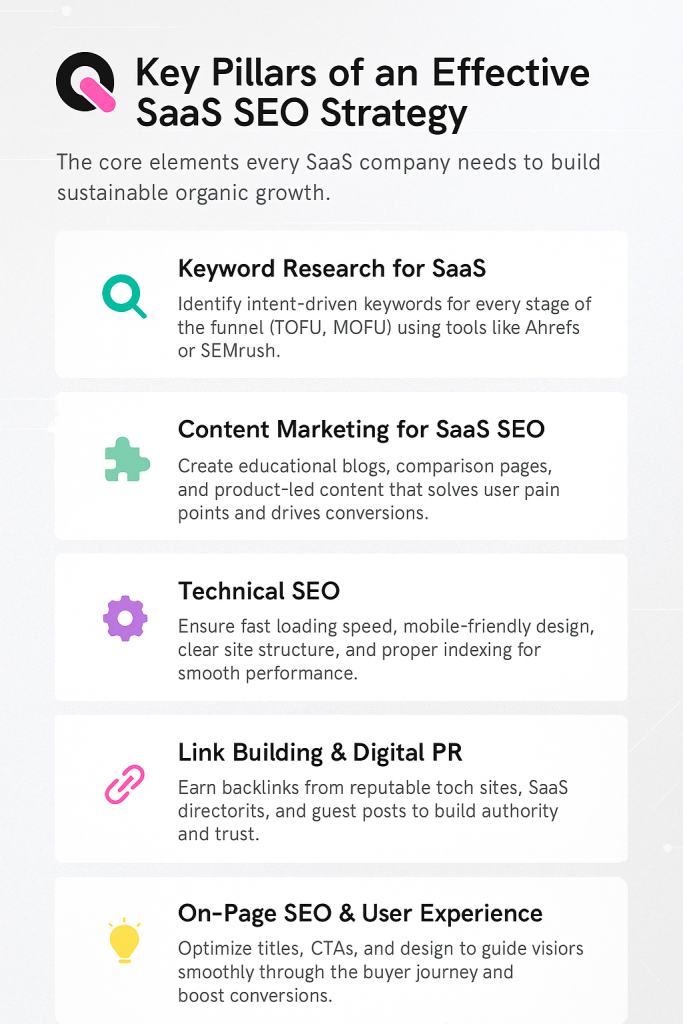
Key Pillars of an Effective SaaS SEO Strategy
To build sustainable organic growth, SaaS companies must approach SEO strategically. Below are the essential components of a winning SaaS SEO framework:
1. Keyword Research for SaaS
Keyword research forms the foundation of any SEO effort. For SaaS businesses, the goal is to identify intent-driven, problem-oriented keywords that align with user needs at each stage of the funnel.
- Top-of-funnel (TOFU): Informational keywords like “how to manage remote teams” or “ways to automate invoicing.”
- Middle-of-funnel (MOFU): Comparison searches like “Asana vs Monday” or “best CRM for B2B startups.”
- Bottom-of-funnel (BOFU): Transactional queries like “buy CRM software” or “free trial project management tool.”
Using SEO tools like Ahrefs or SEMrush can help identify opportunities and gauge competition for SaaS-specific keywords.
2. Content Marketing for SaaS SEO
High-quality content is the cornerstone of SaaS SEO success. To attract and convert your audience, you must provide real value through helpful, authoritative, and optimized content.
Effective SaaS content types include:
- Educational blog posts and tutorials that solve pain points.
- Case studies showcasing measurable results.
- Comparison pages (e.g., “HubSpot vs Pipedrive”) that guide decision-making.
- Product-led content that subtly highlights how your tool solves a problem.
- SEO-optimized landing pages targeting specific industries or use cases.
For example, a SaaS company offering time-tracking software could write an article like “How to Improve Team Productivity with Time Tracking Tools”, a topic that educates users while naturally integrating product benefits.
3. Technical SEO
A technically sound website ensures that your content can be crawled and indexed efficiently. Technical SaaS SEO focuses on performance, user experience, and accessibility.
Key factors include:
- Fast loading times (under 2 seconds)
- Mobile-friendly design
- Clear site structure with logical internal linking
- Optimized metadata and schema markup
- Secure HTTPS protocol
- Regular audits to identify crawl errors or broken links
A smooth technical foundation enhances user trust and retention.
4. Link Building and Digital PR
Backlinks remain a powerful ranking signal. For SaaS companies, link building is about quality over quantity. Focus on earning backlinks from reputable sources in the tech and business ecosystem, such as industry blogs, startup directories, and SaaS review sites.
Strategies include:
- Guest posting on high-authority blogs
- Submitting your software to review platforms like G2 or Capterra
- Collaborating with influencers or partners for co-marketing content
- Publishing data-driven reports or original research that others want to reference
Each link builds your domain authority, helping your SaaS brand climb higher in competitive search results.
5. On-Page SEO and User Experience
Even the best content won’t perform well if your site isn’t optimized for users. On-page SEO for SaaS involves crafting intuitive navigation, engaging design, and clear calls-to-action that guide visitors through the buyer journey.
Elements to focus on:
- Descriptive, keyword-rich title tags and meta descriptions
- Structured headers (H1, H2, H3) that make content scannable
- Compelling CTAs like “Start Free Trial” or “Request a Demo”
- Testimonials, reviews, and transparent pricing pages that build trust
Google’s algorithm increasingly rewards positive user experiences, so usability, clarity, and engagement are now integral parts of SEO success.
Why SaaS SEO Is Important for Sustainable Growth
In SaaS, your product lives entirely online. That means your website isn’t just a marketing asset; it’s your storefront, salesperson, and customer service hub all in one. Without strong organic visibility, you’ll struggle to reach potential users at scale.
Here’s why SaaS SEO is indispensable:
- Cost Efficiency: Unlike paid ads, SEO generates long-term traffic without constant spend.
- Trust and Authority: Ranking organically signals credibility and builds brand reputation.
- Higher ROI: SEO leads often convert better because they come from intentional searches.
- Scalability: Once your content ranks, it continues to attract visitors passively, fueling predictable growth.
Companies that invest consistently in SEO see an average ROI of 748% over three years, making it one of the most effective marketing channels for SaaS growth.
Ready to Scale Your SaaS with SEO? 🚀
If you’re a SaaS company looking to dominate your niche, Queen of Clicks is here to help you turn SEO into a growth engine, not just traffic. We specialize in SaaS SEO, AI-driven search optimization, and WordPress web design that’s built to convert.
Here’s what working with Queen of Clicks gives you:
- A custom SEO strategy that understands your buyer journey and speaks your customers’ language
- AI / LLM–aware optimization so your content stays relevant in voice & conversational search
- A high-performance WordPress site engineered for speed, usability, and conversion
- Ongoing performance tracking, optimization, and growth support
Let’s transform your SaaS into a brand people find, trust, and buy. Get in touch for a free consultation, and let’s map out a roadmap for your SaaS SEO success.
Conclusion
Mastering SaaS SEO is about understanding your customers, their pain points, and how they search for solutions. By aligning your content strategy, technical infrastructure, and user experience with the way your audience thinks, you can build a powerful engine for sustainable growth.
As the SaaS market continues to expand, competition for organic visibility will only intensify. Those who invest in strategic, data-driven SaaS SEO today will establish a long-term competitive advantage, attracting more qualified leads, reducing acquisition costs, and driving consistent revenue growth for years to come.
FAQs
What is the difference between SaaS SEO and traditional SEO?
SaaS SEO focuses on subscription-based businesses, addressing long buyer journeys, recurring revenue, and retention. Traditional SEO often targets one-time purchases or informational content without the ongoing customer lifecycle focus.
How long does it take to see results from SaaS SEO?
SaaS SEO is a long-term strategy. Most companies begin seeing measurable organic traffic growth within 3–6 months, while full ROI and high-converting leads may take 6–12 months depending on competition and content quality.
How do I measure the success of my SaaS SEO efforts?
Track metrics like organic traffic, keyword rankings, demo requests, trial signups, and MRR growth. Combining traditional SEO KPIs with SaaS-specific business metrics gives a full picture of success.
What role do product comparisons play in SaaS SEO?
Comparison pages target mid-funnel buyers who are actively evaluating options. They help you capture high-intent traffic, demonstrate value, and guide prospects toward choosing your solution.
Are backlinks more important for SaaS companies than other businesses?
Backlinks are vital for all businesses, but for SaaS, earning links from reputable tech blogs, SaaS directories, and industry publications can significantly boost credibility and organic visibility in a competitive market.
Should SaaS startups invest in SEO before or after launching their product?
Early investment is beneficial. Pre-launch SEO, such as content planning and technical preparation, can help you capture early interest, build domain authority, and gain momentum as soon as your product goes live.
How does AI and LLM optimization affect SaaS SEO?
AI and LLM optimization ensure your content is discoverable through conversational and voice search, improves relevance for intent-driven queries, and keeps your SaaS content competitive in modern search environments.