How Important Is SEO in a SaaS Business?
If you’ve ever asked yourself how important is SEO in a SaaS business, the short answer is: more important than almost anything else in your marketing stack. But the longer answer, the one that actually shapes strategy and budget decisions, is a fascinating story about compounding growth, customer acquisition costs, and the economics of software subscriptions.
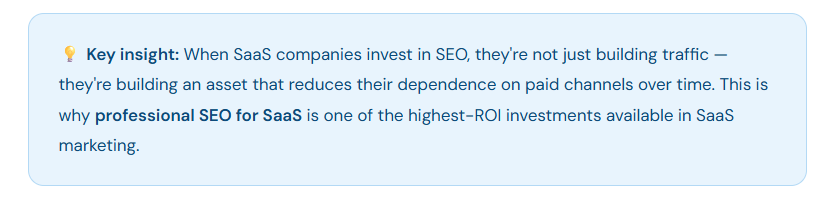
SaaS businesses live and die by their ability to acquire customers efficiently and retain them long enough to recoup that acquisition cost. That’s exactly where SEO for SaaS becomes not just relevant, but transformational. Unlike paid advertising, which stops the moment you stop paying, SaaS SEO builds an asset that appreciates over time, generating leads, free trials, and demo requests around the clock without a recurring cost-per-click.
In this guide, we’ll break down exactly why SEO matters so much for SaaS, what the data says, and how to think about investing in organic search for long-term growth.
Key Takeaways
- SEO is one of the most cost-effective growth channels for SaaS businesses because it generates high-intent traffic and compounds over time.
- SaaS buyers spend weeks or months researching solutions, making strong organic search visibility essential throughout the buying journey.
- Unlike paid advertising, SEO continues driving leads, free trials, and demo requests long after content is published.
- A successful SaaS SEO strategy requires a combination of technical SEO, full-funnel content, and authoritative backlinks.
- The SaaS companies that invest in SEO today are better positioned to dominate both traditional search results and emerging AI-powered search experiences.
Why SaaS Is a Different Beast When It Comes to Marketing
Before unpacking the role of SEO, it’s worth understanding why SaaS businesses have a unique relationship with marketing in the first place. Unlike e-commerce, where a single transaction closes the loop, SaaS revenue is built on monthly or annual subscriptions. Churn is the enemy. Customer Lifetime Value (CLV) is the prize.
This fundamentally changes how you should think about customer acquisition costs. If a customer stays for three years and pays $200/month, their lifetime value is $7,200. You can afford to spend significantly more to acquire them than a one-time buyer. But you still need to be efficient, because the more you spend on acquisition, the longer it takes to become profitable on each customer.
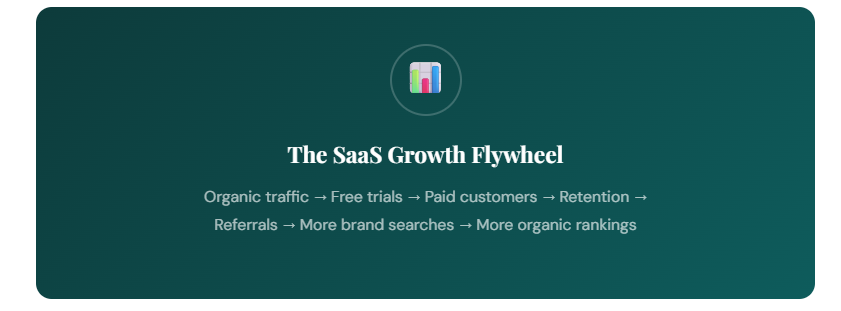
This is why the channel through which you acquire SaaS customers matters enormously. Paid search (PPC) can deliver customers quickly, but at a high and escalating cost. Social media can build brand awareness, but converting that awareness into paying subscribers is notoriously difficult. SEO, on the other hand, attracts users who are already searching for a solution, making them the highest-intent prospects available.
The Buying Cycle Changes Everything
SaaS buyers are researchers. They don’t impulse-buy software. They read comparison articles, look for alternatives to tools they already use, search for tutorials, and try to understand pricing before they ever talk to a salesperson. According to research, 83% of B2B buyers conduct self-research before ever speaking to a sales rep, and 40% spend several weeks or even months researching before making a purchase decision.
Where does that research happen? Overwhelmingly, on Google. And that means if your content isn’t appearing during that research phase, you simply don’t exist to the majority of your potential customers.
The Numbers: What the Data Actually Says About SaaS SEO
It’s one thing to argue conceptually that SEO is important for SaaS. It’s another to look at the data and understand just how dominant organic search is as a channel.
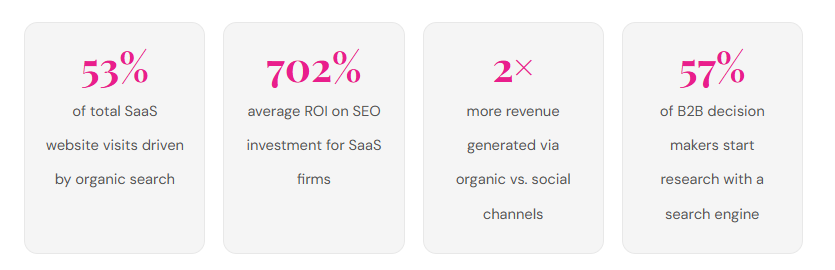
These aren’t marginal numbers. Organic search is the single largest traffic source for the majority of SaaS websites, and the quality of that traffic is exceptional. Visitors arriving through organic search are actively looking for solutions, which means they convert at far higher rates than traffic from display ads or social media.
The return on investment is equally compelling. SaaS firms see a 702% ROI on SEO, a figure that dwarfs paid search channels. While PPC delivers a 31% ROI on average, SEO’s compound nature means returns grow over time as content assets accumulate authority and rankings.
How SEO Creates Compounding Growth for SaaS
The most powerful, and often underappreciated, aspect of SEO for SaaS businesses is compounding. Unlike paid campaigns that generate traffic only while you’re spending, well-executed SEO content for SaaS continues to attract visitors for months and years after it’s published.
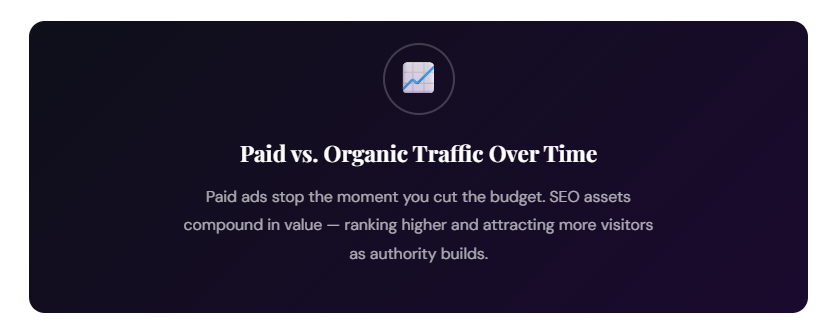
Think of it this way: a blog post you publish today might rank on page 3 in month one, move to page 1 by month six, and continue generating leads for the next three years, all without additional spend. Multiply that across dozens or hundreds of pieces of content, and you’ve built a self-sustaining acquisition engine.
The Virtuous Cycle of SaaS Content
Here’s how the compounding cycle works in practice for a SaaS business:
- You publish high-quality, search-optimized content targeting keywords your ideal customers use during their research phase.
- That content earns rankings, then earns backlinks from other sites in your space, which further improves rankings.
- Higher rankings attract more visitors, more trial signups, and more paying customers.
- Brand awareness increases, leading to more branded searches, a signal Google rewards with even better rankings.
- Revenue enables more content investment, accelerating the entire cycle.
SaaS companies that crack this flywheel find themselves in an enviable position: their customer acquisition cost drops over time while their organic traffic and trial volume continues to grow. Check out our SaaS SEO ROI Calculator to model what this could look like for your specific business.
SEO vs. Paid Advertising: The Long-Term Economics
No channel should exist in isolation, and paid advertising absolutely has a role in a well-rounded SaaS marketing strategy, especially for rapid testing and new product launches. But a complete reliance on paid search is a fragile foundation for a SaaS business.
The Hidden Cost of Paid-Only Strategies
The SaaS industry is experiencing real pressure on customer acquisition costs. The median New CAC Ratio increased 14% to $1.76 in 2024, meaning companies now spend $1.76 to acquire one dollar of new Annual Recurring Revenue. For fourth-quartile companies, that figure reaches $2.82 per dollar of ARR, a deeply unsustainable position.
Paid advertising, by contrast, creates what’s often called the “treadmill problem.” You have to keep running, keep spending, to stay in place. The moment you stop, the traffic stops. And with SaaS businesses operating on subscription economics, any disruption to lead flow can have cascading effects on growth rates and investor confidence.
Why Organic Traffic Is Strategically Superior
SEO’s advantages extend beyond pure cost. Organic search visitors carry higher intent, convert more efficiently, and tend to have better retention metrics. A customer who found you by searching for a specific problem you solve already understands their pain point, and they found you because your content spoke directly to it.
- Organic traffic compounds over time, while paid traffic stops immediately when budgets are cut
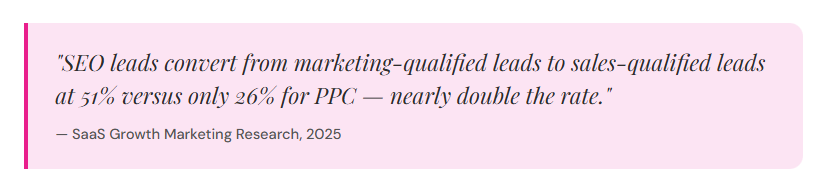
- SEO-driven leads convert from MQL to SQL at nearly double the rate of PPC leads
- Organic keyword rankings provide market intelligence about what your customers actually care about
- Content assets built for SEO serve double duty: they rank on Google AND support your sales team
- SEO increases brand visibility across the entire buyer journey, not just at the bottom of the funnel
Key SEO Strategies Every SaaS Business Should Implement
Understanding why SEO is important is one thing. Knowing what to actually do is another. Here are the core SEO strategies that move the needle for SaaS companies.
1. Build a Bulletproof Technical Foundation
Before any content strategy can succeed, your website’s technical foundation needs to be solid. Technical SEO ensures that search engines can crawl, index, and understand your site, and that users have a fast, seamless experience when they arrive.
- Page speed and Core Web Vitals optimization
- Mobile-first responsive design
- Clean URL structures and proper canonicalization
- Structured data markup (schema) for product and review content
- Secure HTTPS and proper redirects
- XML sitemap and robots.txt configuration
A technically sound website is the prerequisite for everything else. The best content in the world won’t rank if search engines can’t properly access or interpret it. This is one of the key areas we focus on at Queen of Clicks’ WordPress web design service, building sites that are beautiful and technically optimized from the ground up.
2. Develop a Full-Funnel Content Strategy
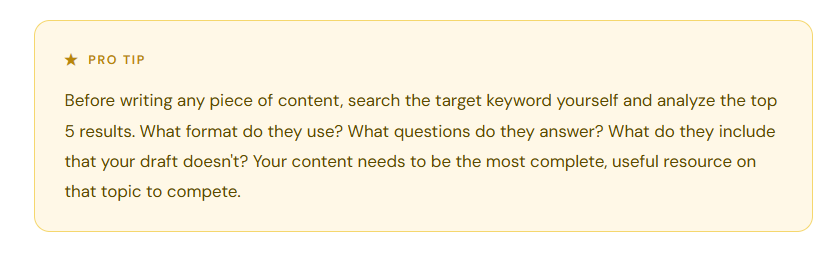
SaaS SEO content needs to address every stage of the buyer journey. Think about the different types of searches your ideal customer makes across weeks or months of research:
- Top of funnel (awareness): Educational content like “what is project management software” or “how to improve team collaboration”
- Middle of funnel (consideration): Comparison content, “best [category] software” roundups, feature deep-dives
- Bottom of funnel (decision): Pricing page SEO, “[Your Brand] alternatives,” case studies, and demo landing pages
Research shows that SaaS blogs publishing two or more long-form articles per week average 2.4x faster traffic growth than those publishing monthly. Consistency and depth both matter enormously.
3. Build Authority Through Strategic Link Acquisition
Backlinks remain one of Google’s most powerful ranking signals. For SaaS companies, the most effective link-building approaches include creating genuinely useful free tools, conducting original research, earning coverage in industry publications, and building genuine partnerships with complementary SaaS products.
Quality consistently outperforms quantity. A handful of links from authoritative industry publications will do more for your rankings than dozens of links from low-quality sites.
4. Optimize for Search Intent, Not Just Keywords
Modern SEO is about understanding what a searcher is actually trying to accomplish, their intent, and creating content that fully satisfies it. Google has become exceptionally good at matching content to intent, which means keyword stuffing is not just ineffective but actively harmful.
Measuring SEO Success in a SaaS Context
One of the most important, and often mishandled, aspects of SaaS SEO is measurement. Vanity metrics like “impressions” or raw traffic numbers are easy to report but often misleading. What actually matters is whether your SEO investment is contributing to business outcomes: free trials, demo requests, MQLs, and ultimately, ARR.
The Metrics That Actually Matter
The metrics that actually matter hen it comes to SaaS SEO growth are:
- Organic traffic to trial/demo landing pages (bottom-of-funnel organic traffic)
- Organic MQL volume and organic MQL-to-SQL conversion rate
- Keyword rankings for high-intent commercial terms
- Share of voice vs. key competitors for target keyword sets
- Backlink profile growth, referring domains from relevant, authoritative sources
- Page-level engagement metrics: time on page, scroll depth, bounce rate
- Revenue attributed to organic search (tracked via UTM parameters and CRM)
If you want to understand the potential return on an SEO investment before committing, our SaaS SEO ROI Calculator lets you model different scenarios based on your current traffic, conversion rates, and average contract value.
AI Search and What It Means for SaaS SEO
No discussion of SaaS SEO in 2026 would be complete without addressing the rise of AI-powered search. AI Overviews, conversational search experiences, and LLM-based tools like AI chatbots are changing how some users discover information and products, but they’re not replacing organic search as the dominant channel.
In fact, the foundation of performing well in AI-driven search results is almost identical to traditional SEO best practices: create authoritative, well-structured, genuinely helpful content that directly answers the questions your audience is asking. Brands that have invested seriously in SEO over the past few years find themselves well-positioned for AI search visibility as well.
At Queen of Clicks, we approach this holistically, combining traditional SEO excellence with LLM optimization strategies designed to make your SaaS brand visible and cited across both search engines and AI-powered discovery tools. You can learn more about how we approach this in our SaaS SEO blog.
The SaaS companies that will win in the next five years are the ones building authority and trust now, through content that educates, data that informs, and a digital presence that makes them the obvious answer whenever a potential customer is searching for what they do.
Let Queen of Clicks Be Your SaaS SEO Partner
You’ve read the data. You know SEO is critical for SaaS growth. Now it’s time to do something about it. Queen of Clicks is a specialist SaaS SEO agency that combines data-driven strategy, AI search optimization, and conversion-focused content to drive real, measurable growth for SaaS businesses like yours. Whether you’re just getting started with organic search or looking to scale an existing SEO program, we’d love to talk.
If you’re ready to build that advantage for your SaaS business, the best time to start is now. Explore our SaaS SEO case studies to see the kind of results we’ve achieved for clients, and reach out to Queen of Clicks for a free consultation.
Conclusion
So, how important is SEO in a SaaS business? The evidence is unambiguous: it’s one of the most important strategic investments a SaaS company can make. Organic search drives the majority of traffic to top SaaS websites, delivers leads that convert at nearly double the rate of paid channels, generates a 702% ROI over time, and builds a compounding asset that continues to appreciate long after the initial investment.
The SaaS businesses that treat SEO as an afterthought, or worse, as a nice-to-have, are ceding significant competitive ground to those that treat it as a core growth engine. In a market where customer acquisition costs are rising and paid media is increasingly expensive, the ability to generate high-intent organic traffic is a genuine competitive advantage.
FAQs
How long does it take for SaaS SEO to show results?
SEO is a long-term investment. Most SaaS companies begin to see meaningful organic traffic growth between three and six months after starting a consistent SEO program. However, competitive industries may take 9–12 months to see significant ranking improvements for high-volume keywords. Bottom-of-funnel content targeting long-tail, high-intent keywords often ranks faster and starts generating qualified leads within the first few months.
Should SaaS startups invest in SEO or paid ads first?
Early-stage SaaS startups often need quick validation and can benefit from paid ads for rapid testing and initial user acquisition. However, SEO should begin in parallel from day one, even at a modest level, because the compounding timeline means waiting to start SEO is genuinely costly. A common approach is to use paid ads for immediate pipeline while steadily building organic assets, then gradually shift budget toward organic as it matures.
What types of content perform best for SaaS SEO?
The content types that typically generate the highest return for SaaS SEO include: in-depth how-to guides targeting informational queries, competitor comparison pages (e.g., “X vs. Y”), “best software for [use case]” roundups, use case landing pages, integration pages (“works with [popular tool]”), and original research or data studies. Integration pages and comparison pages tend to capture users at the decision stage and convert particularly well.
How many backlinks does a SaaS site need to rank competitively?
There’s no universal answer, the number of backlinks needed depends entirely on your competition. The most useful benchmark is your own competitors: look at the backlink profiles of the sites currently ranking for your target keywords. That gives you a realistic target. The average SaaS website earns between 25 and 60 new backlinks per month once a consistent content publishing program is in place. Focus on quality and relevance over raw quantity.
Does SEO work for niche or vertical SaaS products?
Niche and vertical SaaS products often have an easier time with SEO than horizontal products, not harder. Less competitive keywords, highly specific long-tail searches, and tightly defined audiences mean you can rank faster and attract leads with very precise intent. A niche SaaS tool for, say, law firm billing software will find it far easier to rank for relevant queries than a generic billing platform trying to compete for broad terms.
What is the ideal SEO budget for a growing SaaS company?
Industry data suggests a typical SaaS company allocates around 20–30% of its overall marketing budget to SEO. However, this varies widely based on the company’s stage. Early-stage startups might invest $2,000–$5,000/month in SEO; growth-stage companies often spend $10,000–$30,000/month or more. The most important thing is consistency; a moderate, sustained investment almost always outperforms a large burst followed by cuts.
Should you hire an in-house SEO team or work with a specialist agency?
Both approaches can work, and many scaling SaaS companies eventually do both. In the early stages, a specialist SaaS SEO agency typically provides faster time-to-value because you get an entire team of specialists, strategists, content writers, technical SEOs, link builders, without the overhead of hiring and managing each role separately. As you scale and SEO becomes deeply integrated into your product and marketing, bringing on in-house SEO talent makes increasing sense. At that stage, a hybrid model, in-house lead supported by agency specialists, is often optimal.