SEO Maintenance Checklist for SaaS Companies
An SEO maintenance checklist for SaaS companies is a structured set of recurring actions that ensure your product pages, blog content, and technical SEO stay optimized as your software, competitors, and search algorithms evolve. Unlike one-time SEO work, SaaS SEO requires ongoing maintenance to protect rankings, prevent technical issues, and continuously support trial sign-ups, demos, and pipeline growth.
This checklist typically covers technical health checks, content updates, keyword performance monitoring, internal linking, and conversion-focused optimizations, helping SaaS teams maintain visibility in competitive SERPs and avoid traffic drops caused by neglected SEO foundations. Ongoing SEO maintenance aligns with Google’s recommendation to regularly monitor and improve site quality, performance, and relevance over time.
Key Takeaways
- Maintenance is ongoing; plan a regular cadence, not a single sprint.
- Focus on technical health, fresh content, and link integrity to protect past wins.
- The guide is aimed at SaaS leaders who manage trials, demos, and lead flow.
- Expect daily to annual tasks, tool recommendations, and reporting templates.
- Quick diagnosis and clear priorities reduce panic when metrics slip.
- Use this system to compound organic traffic and ease pressure on paid channels.
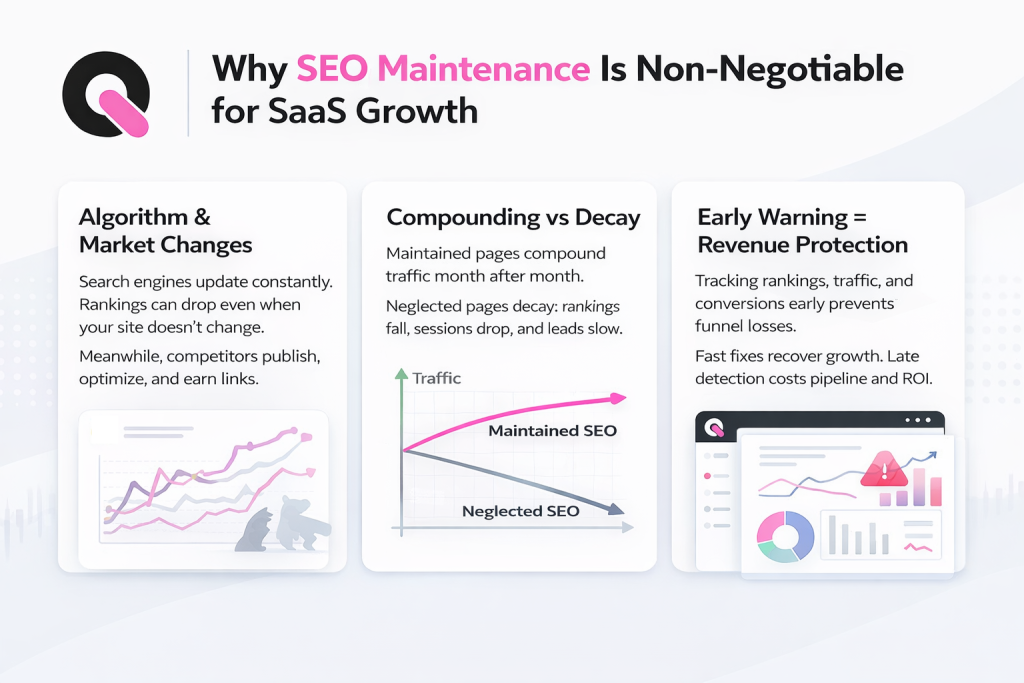
Why SEO Maintenance Is Non-Negotiable For SaaS Growth
For SaaS teams, steady organic growth depends on regular upkeep that guards visibility and conversions. Small ranking moves can cut trial starts and demo requests, and that loss shows up fast in the funnel.
Algorithm Changes and Competitor Moves Happen Fast
Search engines roll out updates frequently; 2024 and 2025 saw multiple core shifts in a short span. Those changes can alter visibility even when your site is unchanged.
At the same time, competitors refresh content, improve technical health, and earn new links. Regular checks close the gap and limit surprise losses.
Organic Traffic Compounds Only With Ongoing Upkeep
Unlike paid ads, organic traffic compounds. Top pages keep pulling demand month after month when they are cared for.
Neglect leads to decay: rankings slip, sessions fall, and predictable lead flow weakens.
Early Warning Signals Protect Pipeline and ROI
- Track rankings, organic sessions, and conversions to spot drops early.
- Quick fixes can restore results in days; slow detection can cost weeks of revenue.
- A disciplined cadence beats reacting to every headline; stay current without overcorrecting.
SEO Maintenance Vs. SEO Strategy: What Each One Owns
Clear roles reduce wasted effort and speed decision-making. Strategy maps outcomes and prioritizes where the team will invest. Execution and upkeep keep those plans working in the real world.
Strategy Sets Goals, Targets, and Priorities
Strategy defines the ideal customer profile, the topics that match problem-aware and solution-aware search intent, and which pages drive conversions.
It owns goals, target pages, keyword themes, a content roadmap, resource allocation, and the measurement plan used to judge success.
Maintenance Executes, Monitors, and Fine-Tunes
Maintenance is the routine work that prevents regressions: monitoring index health, fixing metadata, guarding internal links, and tracking key metrics.
Practical example: strategy decides to build a comparison hub; maintenance makes sure canonicals, redirects, and page experience remain healthy as the hub grows.
- How they feed each other: recurring insights from Search Console and analytics inform next month’s priorities.
- Cadence: strategy reviews monthly or quarterly; maintenance runs daily, weekly, and monthly based on risk.
| Ownership | Strategy | Maintenance | Cadence |
| Goals & Roadmap | Set long-term targets and priorities | Report progress and suggest pivots | Monthly / Quarterly |
| Content | Plan pillar topics and conversion pages | Update titles, fix tags, refresh outdated copy | Weekly / Monthly |
| Technical | Define success criteria and standards | Monitor indexing, fix redirects, check page speed | Daily / After releases |
| Performance Signals | Choose which metrics map to business goals | Track anomalies and surface insights | Daily / Monthly |
Tools You’ll Use To Maintain Rankings And Traffic
Good tooling turns signals into fast, repeatable fixes. SaaS teams need a minimum viable tool stack that supports ongoing upkeep, not only one-off audits. The right mix surfaces index problems, traffic quality issues, and UX regressions so owners can act quickly.
Google Search Console for Indexing, Coverage, and Performance
Google Search Console highlights coverage and indexing gaps, mobile usability flags, URL Inspection results, and manual action alerts. Use Performance reports to see queries and top pages that drive trial starts or demo requests.
Google Analytics for Organic Traffic Quality and Conversions
Google Analytics shows organic channel quality, session engagement, and conversions tied to trials or leads. Set anomaly alerts and conversion events to catch drops early and to prioritize fixes.
Crawlers and Speed Tools for Technical Visibility
Crawlers find broken links, duplicate tags, missing metadata, canonicals, and redirect chains after deployments. Speed tools track Core Web Vitals and page experience so you can reduce bounce risk and protect conversions.
- Set a weekly check-in window and assign clear owners.
- Create a lightweight triage process for issues and small fixes.
- Focus on actions that protect trial and demo flow first.
| Tool Type | Primary Use | Outcome |
| Indexing/reporting | Coverage, URL checks | Faster index fixes |
| Analytics | Conversion tracking, alerts | Quality-driven priorities |
| Crawlers/Speed | Broken links, CWV | Lower bounce, stable funnels |
SEO Maintenance Checklist
Start each monthly review and confirm search engines index the pages that drive trials and demos. This keeps core landing pages visible and protects the funnel.
- Check Google Search Console for Coverage, Indexing, and Manual Issues: Look for spikes in errors, unexpected “Excluded” reasons, manual actions, or security warnings. Use URL Inspection for sample problem pages and re-request indexing after fixes.
- Review Organic Traffic, Rankings, and Key Landing Page Trends: Identify pages with drops in clicks or impressions; separate seasonality from true declines.
- Identify and Fix Broken Links Across the Site: Find 4xx/5xx responses, decide: update links, restore content, or 301 redirect; then verify resolution.
- Run a Fresh Crawl to Catch Duplicate Tags, Missing Metadata, and Redirect Chains: Flag duplicate titles/descriptions, thin pages, orphan pages, and inconsistent canonical usage.
- Spot and Resolve Crawling or Rendering Problems: Check for accidental noindex, robots blocking, misconfigured canonicals, or JS rendering gaps.
- Update Titles and Meta Descriptions to Improve Click-Through Rate: Target high-impression/low-CTR pages; rewrite to match intent and emphasize benefits without stuffing.
- Refresh Outdated Content, Strengthen Internal Links, and Audit Backlinks: Update stats, add subtopics, fix orphan pages, and monitor sudden link losses for quality and relevance.
- Monitor Core Web Vitals and Site Speed to Reduce Bounce Risk
| Metric | Target | Action |
| LCP | <2.5s | Prioritize demo/trial pages for optimization |
| FID/INP | <100ms | Reduce main-thread work and defer noncritical scripts |
| CLS | <0.1 | Stabilize layout shifts and reserve space for assets |

Daily SEO Maintenance Tasks For Always-On SaaS Demand
Start each workday with a quick pulse that protects revenue-driving pages and spots problems early. Keep the check light: aim for a five- to ten-minute scan focused on trial, demo, and signup flows.
Watch KPI Alerts and Anomaly Detection for Sudden Drops
Set automated alerts for sharp drops in organic traffic, conversion decline, indexing anomalies, and crawl error spikes. When an alert fires, confirm data integrity first, rule out tracking or analytics outages.
Then isolate affected directories or pages and inspect Search Console coverage and performance for clues.
Track Industry and Search Engine Updates Without Overreacting
Scan official search engine announcements and reputable industry sources once daily. Prioritize confirmed updates and observable SERP shifts rather than rumors.
Use a simple decision rule: test and validate before broad changes; document hypotheses, expected impact, and the time window for results.
- Daily pulse: minutes, focused on revenue pages.
- Alerts to set: traffic, conversions, indexing, crawl errors.
- Triage flow: confirm → isolate → inspect → document.
| Check | What to Watch | First Action |
| Traffic alert | Sharp drop in sessions or leads | Confirm analytics, isolate pages |
| Indexing anomaly | Unexplained excluded or noindex flags | Inspect URL in Search Console |
| Crawl spike | Sudden 4xx/5xx or crawl budget issues | Review server logs and recent deploys |
Weekly SEO Maintenance Tasks To Keep Momentum
A weekly rhythm keeps product launches and content publishes from creating avoidable visibility gaps. Use a short, repeatable workflow tied to sprint and release cycles so small problems don’t compound.
Validate New Content Is Indexed and Performing in Search Console
Each week, confirm recently published pages are indexed and eligible to rank. Use Search Console to check impressions and average position for early signals of interest.
If a new page shows low impressions, adjust titles, headings, or internal links as a first step to improve relevance.
Check for New Crawl Errors After Releases and Deployments
Deploys can introduce 404s, 500s, redirect chains, or accidental noindex rules. Scan server logs and use a crawler to find regressions introduced by templates or routing changes.
Review Top Queries and Pages for Quick-Win Optimization
Spot pages ranking around positions six to twenty. Improve on-page relevance, add related content, and strengthen internal links to nudge them into top results.
Document what shipped and what you expect to move so monthly reports have clear context and teams learn from each effort.
| Weekly Check | What to Inspect | First Action |
| Indexing | New page indexing, canonical status | Request indexing, fix canonical if wrong |
| Crawl health | 404/500 spikes, redirect chains | Resolve errors, update redirects |
| Early performance | Impressions, avg position, click rate | Adjust title, headings, internal links |
Monthly Performance Reporting And Planning Cadence
A repeatable monthly snapshot reveals trends and ties them to revenue-driving actions. Use a fixed report window so comparisons are apples-to-apples across month-over-month and year-over-year views.
Start with top-line organic traffic and split non-branded vs branded visibility. Map landing page contribution to pipeline: trials, demo requests, signups, and qualified leads.
What the report should include
- MoM and YoY traffic and conversion tables to avoid chasing short-term swings.
- Conversion mapping that attributes sessions to trial starts, demos, and qualified leads via event tracking.
- A “what changed” log: releases, content updates, link gains, or technical fixes completed.
Recap and planning
Summarize completed tasks and correlate them with observed results. Note which updates improved rankings, CTR, or pipeline contribution.
Finish with prioritized tasks for the next month. Rank each item by impact and effort, and state the expected outcome and date to review.
| Report Item | Metric | Business Link | Action Example |
| Traffic Snapshot | Sessions (MoM / YoY) | Pipeline volume | Target top landing pages for content refresh |
| Visibility Mix | Non-branded vs branded clicks | New demand vs existing demand | Optimize non-branded pages for intent |
| Conversion Mapping | Trials, demos, signups, leads | Revenue touchpoints | Tie events to CRM and validate attribution |
| What Changed | Releases, links, fixes | Explain performance moves | Document cause-effect and next steps |
Monthly Technical SEO Checks That Prevent Ranking Erosion
A short monthly technical sweep prevents small site changes from turning into big visibility problems. Minor template edits or CMS updates often introduce hidden regressions that block search engines or slow pages. Run a simple routine each month so acquisition pages stay discoverable.
Confirm XML sitemap and robots.txt are correct and current
Make sure the sitemap lists new and updated pages and that removed pages no longer linger. Verify submission status in Search Console and confirm robots.txt does not block critical directories or crawl paths.
Verify HTTPS and sitewide redirect rules
Confirm one preferred version of the website resolves to HTTPS. Check for mixed content, redirect chains, and loops. Ensure legacy URLs 301 to the most relevant current landing page to preserve link value.
Review mobile usability and page experience signals
Use Search Console reports to find mobile usability errors, layout shifts, and pages flagged as “poor.” Speed and UX issues reduce engagement and can harm rankings, so prioritize fixes for demo and trial pages.
- Why monthly checks matter: small changes cascade sitewide fast.
- Sitemap routine: confirm additions, remove deprecated URLs, and re-submit when needed.
- Robots routine: ensure staging rules didn’t leak and critical paths are crawlable.
- Redirect governance: avoid chains, preserve landing page intent, and log redirects applied.
| Check | What to Inspect | Why it Matters | First Action |
| Sitemap | New pages included, submission status | Speeds discovery by search engines | Re-submit sitemap and request indexing |
| robots.txt | Blocked paths, staging directives | Prevents accidental de-indexing | Remove blocks and update file |
| HTTPS & Redirects | Mixed content, chains/loops | Consolidates authority and avoids errors | Fix mixed assets, shorten redirects |
| Mobile / Page Experience | Mobile errors, CWV, layout shift | Protects engagement and conversions | Prioritize fixes on acquisition pages |
Quarterly Audits To Catch Hidden SEO Issues
A seasonal deep clean helps teams catch issues that slip past routine checks on complex product sites. Quarterly SaaS SEO audits go beyond daily scans and feed the roadmap with high-impact work. Treat this cadence as a chance to find systemic faults and prioritize fixes.
Technical audit
Review Search Console reports and compare crawl benchmarks to the prior quarter. Validate structured data where used, assess speed and mobile usability, and flag persistent index coverage patterns.
On-page audit
Scan for missing or duplicated titles, meta descriptions, and headings. Find thin pages and content clusters that no longer match intent. Score pages on comprehensiveness, freshness, and conversion alignment.
Link profile audit
Evaluate referring-domain diversity, investigate sudden backlink or link losses, and map gaps versus competitors. Prioritize links that support core landing pages and outreach targets.
Local listings audit
When applicable, confirm NAP consistency: name, address, phone. Verify Google Business Profile fields and monitor reviews as trust signals.
- Quarterly deliverable: a prioritized fix list and a tactical plan that rolls into monthly execution using the right tools.
| Audit | Focus | Outcome |
| Technical | Crawl vs prior quarter | Systemic fix priorities |
| On-page | Dupes & quality | Content refresh plan |
| Link profile | Relevance & diversity | Outreach targets |
| Local | NAP & profile accuracy | Trust and local visibility |
Annual SEO Maintenance To Reset Benchmarks And Upgrade The Plan
Use a year-end audit to convert twelve months of data into a prioritized action plan. Review full-year performance, compare it to targets, and treat organic efforts as an investment with measurable ROI.
Count organic-driven trials, demos, and qualified leads, plus assisted conversions and any drop in paid spend tied to organic gains. Calculate cost-per-trial and compare it to paid channels to show value to leadership.
Reset benchmarks: identify which pages and topic clusters are now core acquisition assets and which need consolidation or retirement. Mark winners, candidates for expansion, and low-value pages for pruning.
- Produce an “year in review” narrative summarizing rankings, conversions, and business impact.
- Rebuild the roadmap: set goals, define strategy, allocate tools, and map tasks into a realistic calendar.
- Clarify ownership for content, technical fixes, analytics, and approvals so the plan is executable.
| Review Area | Focus | Outcome |
| Performance | 12-month trends, conversions | Validated ROI and priorities |
| Roadmap | Strategy, themes, calendar | Clear tactical plan for the year |
| Resources | Owners, tools, budget | Executable responsibilities and gaps |
Keep the plan agile: define triggers for mid-year pivots (major ranking shifts, product repositioning, or market disruptions) and ignore short-term noise. This keeps time and marketing efforts focused on what moves the business.

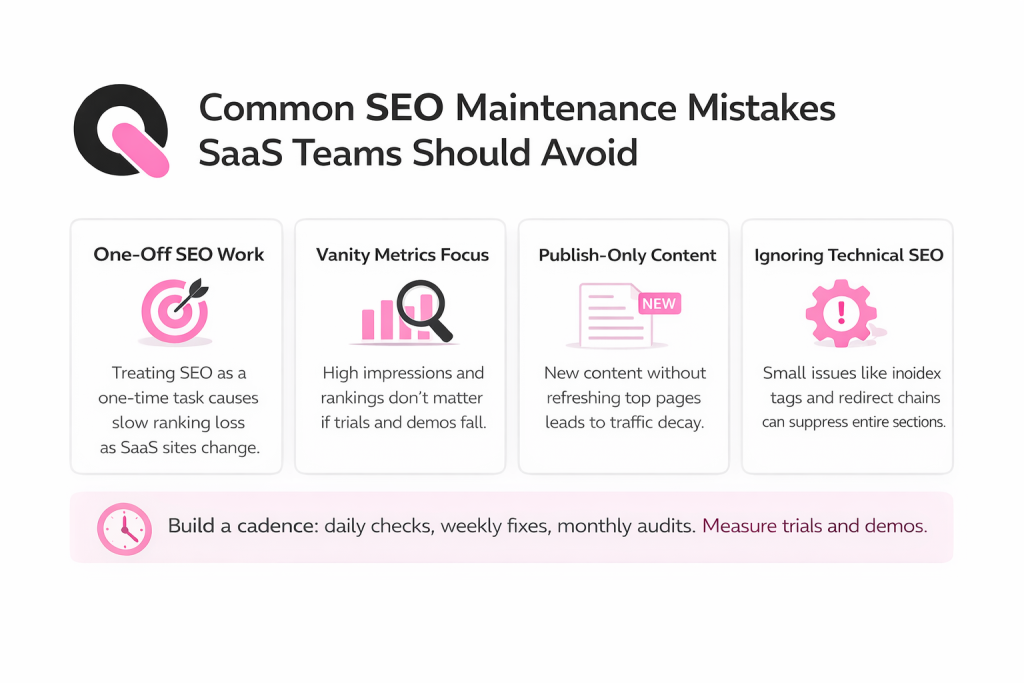
Common SEO Maintenance Mistakes SaaS Teams Should Avoid
A steady, documented cadence protects revenue pages better than sporadic firefighting. Treat routine upkeep as an ongoing rhythm, not a one-off project. SaaS sites change constantly with feature launches, pages, and redirects; that creates recurring risk if you don’t track it.
Chasing vanity metrics distracts teams. High impressions or rising rankings mean little if trials and demos fall. Tie measurement to a small set of revenue-linked KPIs and ignore daily noise.
Publish-only workflows create slow decay. New content is valuable, but failing to refresh winners, confirm indexing, and maintain internal links lets past gains erode. Also check load speed and mobile rendering after each release.
Ignoring technical details is a quiet failure mode. Small issues, noindex tags, broken canonicals, redirect chains, can suppress whole directories without obvious alerts. Assign owners and log every change so troubleshooting is fast.
- Build a cadence, not a sprint: daily pulse, weekly fixes, monthly audits.
- Assign clear owners for pages, releases, and monitoring.
- Measure what matters: trials, demos, qualified leads, and page-level conversions.
🚀 How Queen of Clicks Helps SaaS Teams Turn Maintenance Into Predictable Growth
Queen of Clicks helps SaaS teams turn routine upkeep into predictable, measurable growth. We operationalize ongoing site work so product updates don’t erode visibility or funnel performance.
What You Get With a Disciplined SaaS SEO Maintenance Framework
Our approach pairs planned daily/weekly/monthly/quarterly/annual steps with constant monitoring and clear documentation. That way changes to your website map directly to business outcomes instead of causing reactive pivots.
- Operationalized cadence: daily monitoring, weekly validation, monthly optimization, quarterly audits, annual planning.
- Team collaboration: we partner with your engineers, product, and content team for releases and fixes.
- Deliverables: prioritized task backlog, monitoring, reporting, and documented learnings that inform next steps.
- Accountability: named owners, timelines, and a feedback loop from performance back into the plan.
- Technical & content programs: visibility checks, content refresh, internal linking, and link/backlink monitoring to protect authority and traffic.
- Business reporting: monthly reports that tie metrics to trials, demos, and qualified leads.
Book a Call to Align Your Checklist With Revenue Goals
Book a call with Queen of Clicks to align your maintenance plan to revenue targets and get a clear, prioritized step-by-step plan your team can run. We’ll scope tools, owners, and the first 90 days so work produces measurable results.
Conclusion
A short, disciplined routine prevents tiny issues from becoming major visibility losses. Treat daily checks, weekly fixes, monthly reports, quarterly audits, and an annual review as a single, continuous approach that keeps your site healthy for search engines.
Small technical glitches and stale content add up. Regular upkeep protects compounding gains and keeps performance aligned with business goals. Use a clear strategy to prioritize pages that drive trials and demos.
Start simple: a Search Console health check, a fresh crawl, and a top-page refresh can create immediate momentum. Track results, repeat what works, and adjust the plan over time.
Ready to operationalize the cadence? Queen of Clicks can help you map a practical plan and own the work until it reliably supports revenue, book a call to get started.
FAQs
How Much Time Does SEO Maintenance Require Each Month for a SaaS Company?
SEO maintenance time depends on site size, release frequency, and competition. Most SaaS teams spend 5–10 hours per month on small sites and 20–40 hours on larger or fast-moving products. The goal is consistency, not volume; routine checks prevent costly recovery work later.
Who Should Own SEO Maintenance Inside a SaaS Team?
SEO maintenance should have a single accountable owner, even if execution is shared. This is often a growth marketer or SEO lead who coordinates with engineering and content. Without clear ownership, issues surface late and fixes stall across teams.
Can SEO Maintenance Be Automated for SaaS Websites?
Some monitoring can be automated, but fixes cannot. Alerts, crawls, uptime checks, and performance tracking scale well with automation. Decisions, like whether to refresh content, consolidate pages, or change internal linking, still require human judgment tied to business priorities.
How Long Does It Take to See Results From SEO Maintenance?
Maintenance protects and stabilizes performance rather than driving sudden growth. Improvements like CTR gains or recovered rankings may appear in days or weeks, while compounding gains show over 1–3 months. The biggest value is avoided loss, not flashy spikes.
Is SEO Maintenance Still Needed If Rankings Are Stable?
Yes. Stable rankings often decline silently without upkeep. Competitors publish, links decay, and product pages change. Maintenance ensures stability persists and that today’s top pages don’t become next quarter’s drop-offs.
How Does SEO Maintenance Differ for Early-Stage vs Mature SaaS?
Early-stage SaaS focuses on indexing, fundamentals, and intent alignment, while mature SaaS emphasizes defense, optimization, and scalability. As sites grow, maintenance shifts from fixing gaps to preventing regressions across large page sets.
What KPIs Should Leadership Track for SEO Maintenance Success?
Leadership should track organic-driven trials, demos, qualified leads, and assisted conversions, not raw traffic. Supporting metrics like non-branded clicks and landing page conversion rate explain performance, but revenue-linked outcomes define success.
When Should a SaaS Company Outsource SEO Maintenance?
Outsourcing makes sense when internal teams lack bandwidth or SEO-specific expertise. External teams provide continuity, tooling, and process discipline, especially valuable for fast-scaling SaaS companies where product velocity outpaces marketing capacity.