SEO Funnel for SaaS Companies: A Comprehensive Guide
An SEO funnel for SaaS companies is a structured process that turns organic search traffic into leads and customers, as it guides users through awareness, consideration, and conversion stages. This matters because organic search leads convert at higher rates, with SaaS SEO showing an average 2.1% visitor-to-lead conversion and 51% lead-to-SQL conversion, outperforming most paid channels.
The SaaS SEO funnel aligns top-of-funnel content (educational blogs, comparisons) with mid-funnel pages (use cases, integrations) and bottom-funnel assets (landing pages, demos, signups). Each stage targets a different search intent, so SEO doesn’t just drive traffic, it drives pipeline and revenue.
Key Takeaways
- An SEO funnel connects search visibility to trials, demos, and revenue.
- The guide covers both how search engines work and how buyers progress.
- Major areas to audit: architecture, technical access, authority, content, experience, conversions.
- SaaS teams need a mapped strategy to handle products, cycles, and intent types.
- This is an actionable playbook with mapping, linking, and ROI measurement.
What An SEO Funnel Is And Why SaaS Teams Need It
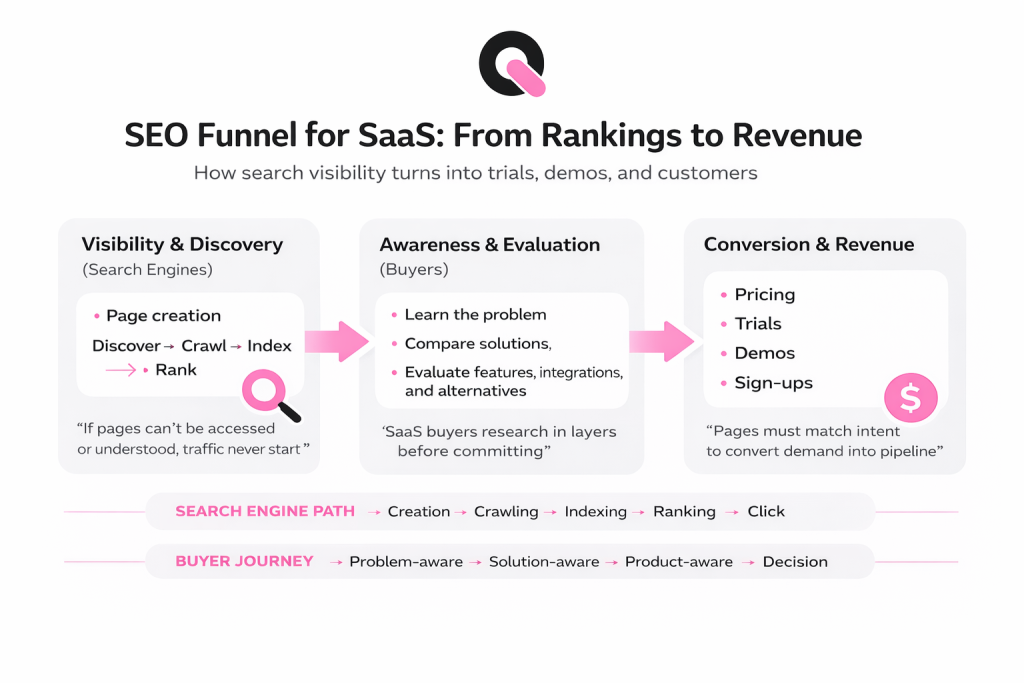
Turning visibility into paying users requires a mapped process that protects each step from leaks. The SEO‑revenue model visualizes how a page moves from creation to conversion and why each stage must succeed to drive leads and revenue.
From Rankings To Revenue: The Core Funnel Promise
This system focuses on business outcomes, not vanity metrics. A well-built funnel aligns content and pages so organic visits become trials, demos, or sign-ups.
How Search Engines And Buyers Move Through Stages
Two movements happen in parallel. Search engines discover, crawl, index, and rank pages. Buyers learn, compare options, and decide which product to try.
SaaS buying is layered: people hunt for categories, features, integrations, and competitors before converting. Each stage is a checkpoint with requirements and common failure modes; “leaks” that stop qualified visitors from advancing.
- Qualified traffic means queries that show a clear problem you solve and a path to value.
- Success requires cross-functional work: content, product marketing, conversion rate work, and technical teams must align on intent and messaging.
How Search Has Changed: Zero-Click Results And AI Overviews
Modern search rewards immediate clarity. People often see answers without leaving the results page, so visibility now includes being the visible answer, not just the top link.
Why Visibility On The SERP Matters When Clicks Drop
Zero-click means a query ends on the results page. Over 60% of mobile queries can finish this way, so your content must show value in place.
AI Overviews and rich cards can push listings lower on the page. For TOFU education, being cited inside an overview can drive awareness even when clicks fall.
What Structured, Direct Answers Signal To Google
Google favors concise answers under clear headings. Pages with clean structure, semantically grouped subtopics, and schema like FAQ or How-To are more likely to be surfaced.
- Define a term, give a short answer, then expand with bullets and examples.
- Use headings that match user questions and short paragraphs for scannability.
- Add schema to claim featured snippets, comparison blocks, and FAQ panels.
Connect these shifts to planning: if TOFU loses clicks, strengthen MOFU and BOFU pages and internal links to capture intent and prompt the next action.
| Intent | Target Block | Recommended Structure |
| Awareness | AI Overview / Snippet | Short definition, 1-line answer, bullets |
| Consideration | Comparison / Table | Clear headings, comparison rows, schema |
| Decision | FAQ / How-To | Direct steps, trust signals, CTA |
SEO-Revenue Funnel vs Marketing Funnel: How The Models Fit Together
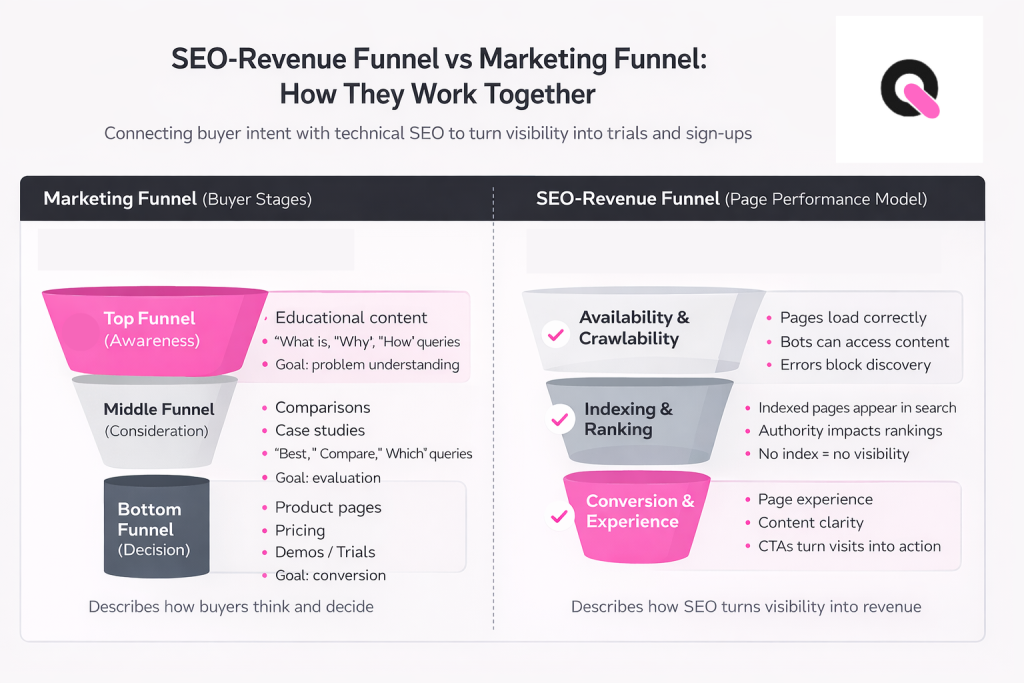
A working connection between technical discovery and buyer intent prevents lost opportunities. The marketing funnel describes buyer stages; the SEO-revenue funnel shows how pages must perform to turn visibility into trials and sign-ups.
Technical Path: Crawl, Index, Rank, Convert
Availability enables crawling. If pages fail to load, bots skip them. Crawling enables indexing; if a page isn’t indexed it cannot appear in results.
Indexing enables visibility and authority affects rankings. Finally, page experience and content determine whether a visit converts.
Intent Path: Top Funnel, Middle Funnel, Bottom Funnel
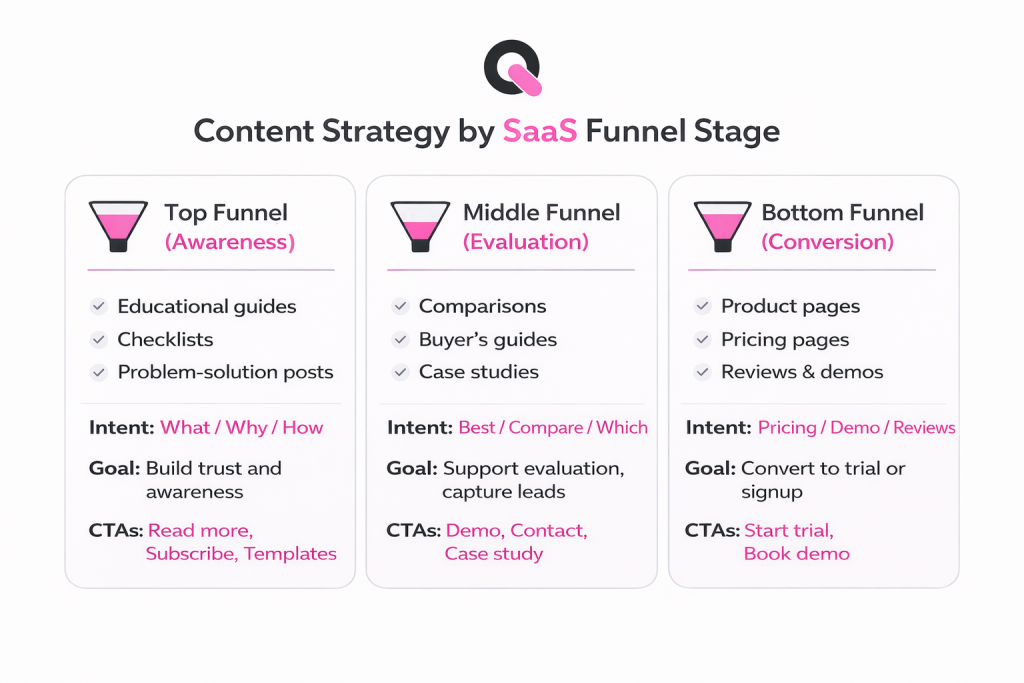
Top stages need educational pages. Middle stages require comparisons and case studies. Bottom stages need product, pricing, and clear CTAs.
Where SaaS Often Leaks: Misaligned Pages And Search Terms
Common leaks include blogs chasing commercial keywords, product pages answering “what is” queries, or no comparison pages for buyers. Misaligned search terms cause high bounce when intent and content clash.
- Practical rule: assign each keyword cluster one primary page type and an internal link path to the next stage.
Funnel SEO Keyword Research: Mapping Queries To Funnel Stages
SaaS keyword research starts with intent: understand which search queries show awareness, comparison, or buying readiness. For SaaS teams this prevents chasing high-volume terms that don’t convert.
TOFU: “What,” “Why,” and “How” questions
TOFU queries attract and educate. Use guides, checklists, and problem-solution posts that answer a single question clearly.
Link these pages to middle-stage assets to guide users toward evaluation.
MOFU: “Best,” “Compare,” and “Which” terms
These queries show evaluation intent. Build buyer’s guides, comparisons, and case studies that capture leads with gated CTAs or demo invites.
BOFU: “Pricing,” “Demo,” “Alternative,” and “Reviews” modifiers
Bottom queries demand direct conversion paths. Use concise pricing pages, reviews, and frictionless demo flows with strong proof points.
Building a keyword-to-page framework that scales
Assign one primary intent per URL. Create supporting cluster pages and internal links that move prospects forward.
Scale by product line, use case, integration, and buyer role. Prioritize keywords by revenue impact and review current SERP features first to match formats.
| Stage | Typical Queries | Best Page Types | Primary CTA |
| Top funnel | what is X, why use X, how to X | Guides, checklists, explainers | Read more / Subscribe |
| Middle funnel | best X, compare X, which X | Buyer’s guides, comparisons, case studies | Demo / Contact |
| Bottom funnel | pricing X, X demo, X reviews | Pricing pages, reviews, product pages | Start trial / Sign up |
Site Architecture: The Foundation That Powers Every Funnel Stage
When a site is organized, high-priority pages stop getting buried and start performing. Architecture determines how quickly users and bots reach the content that matters. A clear structure reduces wasted clicks and speeds paths to demo, pricing, or signup.
Information architecture for SaaS should follow a predictable hierarchy: Product(s) → Use cases / Industries → Integrations → Resources / Blog. This layout keeps related pages grouped and makes cross-linking straightforward.
- Use consistent URL folders and readable names for every page to improve usability and indexing.
- Keep parameters out of canonical URLs and prefer logical folders like /product/feature or /resources/guide.
- Mirror the buyer path with internal linking: TOFU articles link to MOFU comparisons, which point to BOFU product and pricing pages.
Reduce click depth: aim for key conversion pages within three clicks from the homepage. Fewer steps means higher completion rates and better discovery of important pages.
Navigation tips: prioritize high-value paths in the primary nav, add contextual in-content links, and include a small “next step” module at the end of guides to push visitors toward demos or pricing.
| Element | Recommendation | Impact |
| Information hierarchy | Product → Use cases → Integrations → Blog | Clear discovery and relevant cross-links |
| URL formatting | Consistent folders, readable slugs, no unnecessary params | Better user trust and easier indexing |
| Internal linking | TOFU → MOFU → BOFU chains, contextual CTAs | Smooth visitor progression to conversion pages |
| Click depth | Key pages ≤ 3 clicks from homepage | Higher conversions and faster discovery |
Technical Access: Availability, Crawlability, And Indexability
Before a single visitor can convert, the site must pass three technical gates that control discoverability. These gates are availability, crawlability, and indexability. Fixing them ensures your pages can be found, rendered, and matched to intent.
Availability: Valid HTTP Status Codes and Redirect Hygiene
Check server responses. Look for 4xx and 5xx status code errors that block bots and users.
Audit redirect chains and incorrect 302s. Long chains and temporary redirects waste crawl budget and harm trust.
Find and repair broken internal links so crawl paths lead to live, conversion-ready pages.
Crawlability: Sitemaps, Crawl Budget, And Discoverability
Keep an accurate XML sitemap and clean robots directives. These guide crawlers to important pages.
For large SaaS sites, to manage crawl budget, remove low-value parameter pages and consolidate tag/filter pages.
Use internal links from resource hubs to improve discoverability and spread authority to target pages.
Indexability: Canonicals, Duplicate Content, And “Noindex” Traps
Canonical tags prevent thin duplicates from diluting ranking signals. Verify canonical targets match the rendered content.
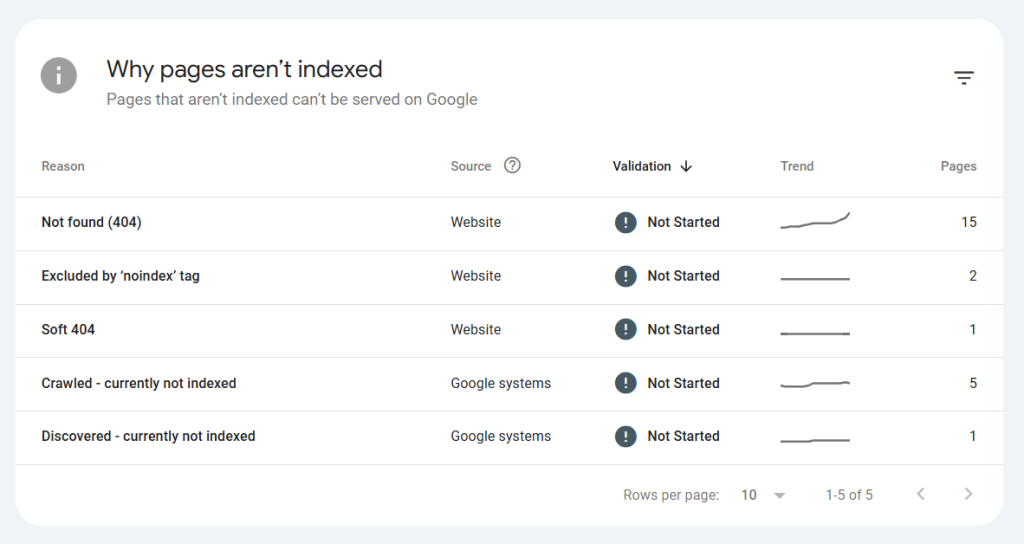
Watch for accidental noindex on money pages or on templates created by faceted navigation. Parameter duplication can produce many near-duplicate pages.
How Google Search Console Confirms Coverage And Indexing
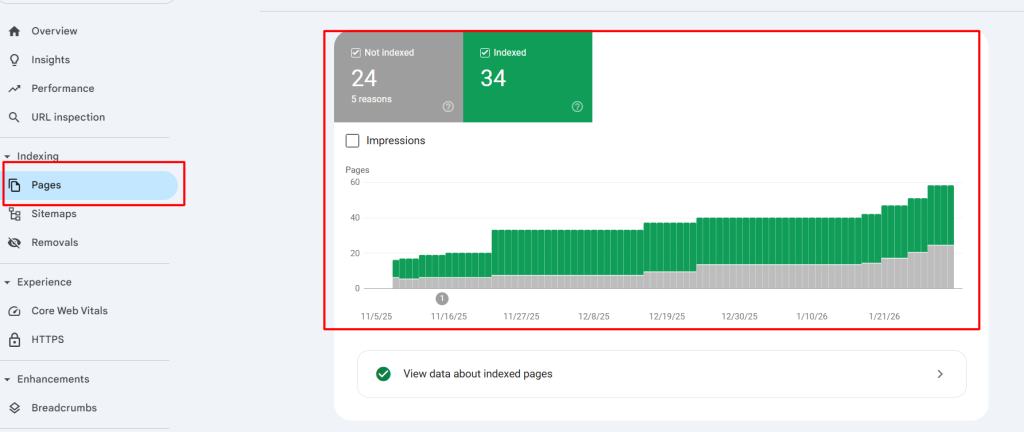
Use Google Search Console to inspect URLs and confirm which pages appear in the index.
Review the Coverage report for errors and the Pages list for indexed vs. excluded content. Make sure the canonical and rendered page content match expectations.
Combine these checks with SEO tools to retest after fixes. When availability, crawlability, and indexability are healthy, impressions rise and qualified clicks follow.
Authority: Earning Rankings With Credibility Signals
For SaaS teams, authority turns isolated pages into trusted resources that influence buying decisions. Authority is a set of credibility signals, backlinks, citations, and internal endorsements, that help product and resource pages compete for competitive queries.
Backlinks That Build Trust And Improve Rankings
Editorial, relevant links carry the most weight. A handful of links from respected industry sites moves rankings more reliably than many low-quality mentions.
Quality Over Quantity: Why Relevance Matters
Focus on relevance. Links from sites that share audience or topic overlap deliver context and trust to algorithms and users.
SaaS-appropriate tactics include original research, benchmark reports, integration partner pages, and practical templates that others cite.
Internal Links As Authority Multipliers Across Pages
Internal linking passes earned credibility to revenue pages. Link high-traffic guides to pricing and demo pages with descriptive anchor text that matches intent.
Govern link equity deliberately: prioritize which pages deserve authority first, pricing, demo, use-case, and comparison pages, based on revenue impact.
- Define authority as credibility signals that help SaaS pages rank and win comparison SERPs.
- Backlinks should be editorial and relevant, not just numerous.
- Create linkable assets: reports, integrations, thought pieces, and templates.
- Use internal links to move authority from TOFU to MOFU and BOFU pages, lowering acquisition cost over time.
| Signal | Priority | Why it matters | Action |
| Editorial backlinks | High | Adds external trust and topical relevance | Publish data-led research and outreach to relevant sites |
| Integration partner pages | Medium | Signals ecosystem relevance and drives referrals | Create partner pages with clear benefit copy and links |
| Internal link structure | High | Distributes authority to conversion pages | Map anchor text to intent and link high-traffic guides to revenue pages |
| Linkable assets | Medium | Earns natural citations and shares | Produce benchmarks, templates, and toolkits |
Content Strategy for Each Funnel Stage
SEO content for SaaS matches buyer intent at each step turns casual readers into qualified prospects. Map content types to outcomes: awareness, evaluation, and conversion. Each stage has clear goals and measurable actions.
Top funnel content
Publish educational guides, checklists, and problem-solution posts that define problems and teach frameworks. Keep answers simple and scannable.
- Use contextual CTAs: newsletter sign-up, templates, or next-read links.
- Focus on clarity, not hard sells; build remarketing pools and trust.
Middle funnel content
Create comparisons, buyer’s guides, and case studies that surface evaluation criteria.
- Include proof blocks, feature breakdowns, and “who it’s for” sections.
- Use case studies to show measurable results and drive lead capture.
Bottom funnel pages
Design product, pricing, and conversion pages for transactional intent. Lead with value props and clear next steps.
- Short forms, demo CTAs, and immediate benefits reduce friction.
- Highlight pricing clarity and trust signals to speed decisions.
On-page optimization
Write intent-driven titles and meta descriptions to improve click rate. Add descriptive alt text for images and schema to clarify page meaning.
Designing for AI overviews and snippets
Use an answer-first opening, scannable bullets, short definitions, and summary tables to increase chances of featured placements.
Page Experience: Turning Visitors Into Engaged Prospects
Performance and clarity on a page directly shape how visitors perceive value and act. Even when SEO drives the right visitors, user experience is the lever that keeps them moving toward a demo or sign-up.
Speed And Core Web Vitals Basics For SaaS Sites
Focus on perceived and real speed. Reduce heavy scripts, lazy-load noncritical assets, and compress images to cut load time. Prioritize above-the-fold content so visitors see meaningful copy quickly.
Fixing Rendering Issues That Hide Content From Crawlers
Ensure critical headings and copy render in the server response or in a quick client-side render. Avoid hiding main content behind slow third-party scripts. Test that rendered HTML includes the same headlines users see.
Reducing Bounce With Clear Layout, Scannability, And Next-Step CTAs
Use short sections, descriptive headings, and bullets so visitors scan and find value fast. Add a single, clear “next step” CTA that points to comparisons, pricing, or demos.
- Tacticals: remove unused JS, optimize fonts, and use a content delivery network.
- Run mobile-first checks; many discovery searches start on phones even if conversion happens later on desktop.
- Measure Core Web Vitals and test real-user time to see impact on engagement and conversion rates.
| Element | Quick Fix | Impact |
| Largest Contentful Paint | Prioritize hero assets, compress images | Faster perceived load, fewer bounces |
| Cumulative Layout Shift | Reserve space for ads/fonts | Improved readability and trust |
| Rendering | Server-side render key copy | Ensures crawlers see headings and value |
Conversion Optimization: How To Make The Bottom Funnel Work
The bottom stage is the handoff: a page must turn intent into immediate action. This moment is where search-driven interest becomes pipeline and customers. Pages must match query modifiers like pricing, demo, and reviews and remove any reason to pause.
Matching BOFU Intent With The Right Page Elements
Include transparent pricing context, plan comparisons, and feature-to-benefit mapping. Show clear demo and trial CTAs above the fold.
Use concise comparison tables and a short summary that answers the key buyer question in one line.
Trust Signals That Increase Conversion Rates
Add security badges, privacy notes, testimonials, and short case-study links. Clear terms and refund or trial details reduce perceived risk and help convert hesitant customers.
Short Forms, Clear CTAs, And Frictionless Sign-Up Paths
Keep forms to essentials only. Use confirmation pages that immediately offer the next action, like calendar booking or onboarding steps.
Fewer clicks, consistent messaging from SERP to landing page, and fast load times make the sign-up path frictionless.
- BOFU as handoff: satisfy intent instantly and remove friction.
- Optimize forms: short, required fields only, clear microcopy.
- Design CTAs for one action and one outcome per click.
- Small CRO gains at BOFU compound across all upstream traffic and lower customer acquisition costs.
| Element | Why it matters | Quick win |
| Pricing clarity | Aligns expectations | Show starter plan and common use case |
| Demo/Trial CTA | Directs action | Place primary CTA in hero and footer |
| Trust signals | Reduces risk | Add short testimonials and security notes |
Measurement And Reporting: Proving Funnel Results Over Time
To prove impact, teams must watch how traffic moves through defined stages over time. Measurement separates activity from progress and helps stakeholders see which work drives pipeline.
Stage-level KPIs: Traffic, Engagement, Leads, And Revenue
Define success by stage. For awareness, track impressions and clicks. For education, measure engaged sessions, scroll depth, and time on page. For decision, monitor demo requests, trial starts, and conversions.
- Discovery: impressions, clicks, CTR.
- Evaluation: engaged sessions, scroll depth, repeat visits.
- Decision: demo requests, trial starts, revenue and assisted conversions.
Using Google Search Console For Queries, Pages, And Visibility Trends
Use Google Search Console to monitor page-level impressions and clicks. Watch query patterns and CTR shifts after content or technical updates. Map rising queries to pages that need conversion paths.
GA4 Funnel Exploration To Find Drop-Off Points
Build a step sequence with GA4 (landing → pricing → form start → submit). This tool shows where users exit so teams can prioritize fixes and A/B tests.
What To Expect: It Takes Time, So Track Leading Indicators
Organic improvements compound. Early wins often appear as more impressions, better engagement, and small ranking moves before meaningful revenue shows. Set a reporting cadence: monthly stage dashboards and quarterly strategic reviews to re-prioritize keywords, refresh content, and fix technical issues.
| Metric | Stage | Why it matters |
| Impressions & Clicks | Awareness | Shows visibility and topic fit |
| Engaged sessions | Evaluation | Signals interest and content quality |
| Demo starts / Revenue | Decision | Direct business impact |
🚀 How Queen of Clicks Helps SaaS Businesses Build A Leak-Proof SEO Funnel
At Queen of Clicks, we focus on the connections between structure, access, trust, content, and conversion to stop leaks. That means each stage, architecture → availability → crawlability → indexability → authority → content → experience → conversion, must work together so organic visibility drives measurable business outcomes.
A Structured Approach That Connects Strategy, Content, And Technical SEO
Our method starts with mapping funnel stages and aligning intent to pages. Next we fix technical access, then build authority and sustainable content systems. Finally, we optimize BOFU conversion paths so traffic converts.
What You Get When We Build Your Funnel
SEO deliverables for SaaS businesses include a keyword-to-page roadmap, site architecture and internal linking plan, a prioritized technical audit with fixes, content briefs by stage, and a measurement dashboard that tracks stage-level outcomes.
| Deliverable | Purpose | Outcome |
| Keyword-to-page roadmap | Align queries to intent | Less misaligned traffic, higher qualified visits |
| Technical audit & fixes | Availability, crawlability, indexability | More indexed pages and reliable discovery |
| Content briefs & linking plan | Authority and clear next steps | Stronger internal paths to money pages |
Book A Call To Map Your Funnel Stages And Next Steps
We identify leaks such as pages not indexed, content ranking for the wrong terms, weak links to revenue pages, and friction in demo or trial flows. Then we prioritize fixes with a 90-day plan that delivers quick wins and long-term gains.
- Philosophy: connect technical foundations, content execution, and CRO so visibility becomes measurable pipeline.
- Structured approach: map intent → fix access → build authority → optimize BOFU conversion.
- How we find leaks: index checks, SERP-term audits, link analysis, and flow testing for demo/trial friction.
- Business outcomes: more qualified traffic, higher conversion from intent-driven pages, and reporting leaders trust.
Next step: Book a call to map your funnel stages, prioritize quick wins, and build a 90-day execution plan tailored for your business.
Conclusion
Winning in modern search means pairing precise answers with reliable technical access and conversion paths.
Think of the system as end-to-end: architecture and technical access enable visibility. Authority and clear content earn rankings, and page experience plus CRO produce conversions.
Today, direct answers, structured formatting, and schema matter as much as traditional links. That visibility helps capture intent even when clicks drop.
Align every page to an intent stage: TOFU educates, MOFU builds confidence, BOFU converts. Use internal links to move people toward demos or trials.
Adopt a leak-proof mindset: one broken stage, indexing errors, mismatched keywords, weak trust signals, or poor UX, cuts downstream results.
Quick action checklist: audit technical access; map keywords to stages; strengthen internal paths to product or service pages; measure drop-offs in analytics; iterate on content and page experience.
FAQs
How long does it take for an SEO funnel to generate SaaS leads?
Most SaaS SEO funnels show early signals (impressions, rankings, engagement) within 6–8 weeks, but meaningful lead and revenue impact usually appears after 3–6 months. Timing depends on competition, technical health, and how BOFU pages are optimized for conversion.
Does an SEO funnel work for early-stage SaaS or only mature companies?
An SEO funnel works at any stage, but execution differs. Early-stage SaaS should prioritize MOFU and BOFU pages (use cases, comparisons, alternatives) to capture existing demand, while mature SaaS can scale TOFU education and category leadership.
How many pages are needed to build a functional SaaS SEO funnel?
There is no fixed number. A basic funnel can work with 10–20 well-mapped pages across TOFU, MOFU, and BOFU. Scale comes from adding use cases, integrations, industries, and comparison pages, not from publishing random blog posts.
Should product-led SaaS funnels differ from sales-led SaaS funnels?
Yes. Product-led SaaS funnels prioritize fast paths to trials and in-app value, while sales-led funnels focus on demos, qualification, and trust-building content. The SEO funnel structure stays the same, but CTAs, messaging, and page depth change.
How do free tools or calculators fit into an SEO funnel?
Free tools and calculators sit between TOFU and MOFU. They attract high-intent users, demonstrate product value early, and act as natural lead capture points without aggressive gating.
Can one page serve multiple funnel stages?
It shouldn’t. Pages that try to educate, compare, and sell at once usually underperform. Each URL should target one dominant intent, with internal links guiding users to the next funnel stage.
How do branded vs non-branded keywords fit into the SEO funnel?
Non-branded keywords drive TOFU and MOFU discovery, while branded keywords dominate BOFU conversion. A healthy SaaS funnel captures both; education for new demand and branded protection to prevent competitors from stealing ready buyers.