Why Should SaaS Companies Outsource SEO Services
Organic search remains the backbone of discoverability for SaaS companies, but keeping up with Google’s algorithms and the ongoing content demands isn’t something most internal teams can do well on their own. Organic search drives roughly 53% of total SaaS website visits, so visibility in search is mission-critical for trials, demos, and sign-ups.
Yet SEO requires deep technical skill, consistent execution, and access to advanced tools to win and retain rankings over time. That’s why many SaaS teams are now choosing to outsource SEO services: to tap expert talent, proven processes, and better measurement without the overhead or delay of building a full in-house function.
Key Takeaways
- Outsourcing SEO services gives access to expertise and tools without scaling headcount.
- Organic search supports trials and sign-ups across the buyer journey.
- SEO is compounding: consistent execution matters more than short bursts.
- Evaluate providers by track record, process, and measurable KPIs tied to revenue.
- Scope includes technical work, content, links, and analytics; add local only when relevant.
Why Outsourced SEO Is Surging For SaaS Companies
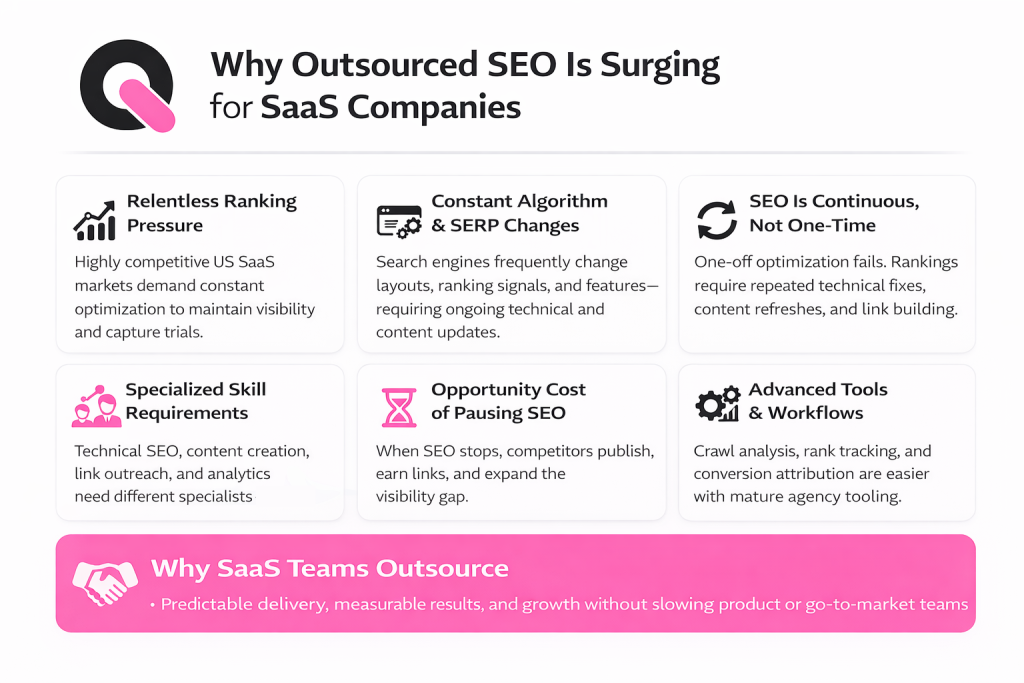
SaaS firms in the US face relentless ranking pressure that makes intermittent optimization risky. Competitive markets and frequent search engine updates mean teams must keep momentum to hold visibility and capture trials and sign-ups.
Search engines change layouts and ranking signals regularly. Evolving SERP features and algorithm tweaks need ongoing technical fixes, content refreshes, link work, and fresh reporting to stay competitive.
- Market pressure: US SaaS competition amplifies the need for steady content and link acquisition, even when priorities shift to product or fundraising.
- Continuous work: A one-time setup never suffices; rankings require repeated optimization after search engine updates.
- Resource load: Technical audits, content creation, link outreach, and analytics demand different skills; a single hire rarely covers them all.
- Opportunity cost: Pausing activity lets competitors publish, earn links, and widen the visibility gap.
- Tools and workflows: Crawl analysis, rank tracking, and conversion attribution are easier to run through experienced partners with mature tooling.
Adoption is rising because teams want predictable delivery and clear results without slowing product or go-to-market motion.
What It Means To Outsource SEO Services For A SaaS Business
Outsourcing SEO services means assigning some or all organic search work to an external partner who owns deliverables, timelines, and KPIs. For SaaS companies this often covers technical audits, on-page work, content creation, link acquisition, and reporting.
Provider types and fit
Choose a SaaS SEO agency when you need scale and cross-discipline teams. A consultant works well for strategy and governance. Freelancers handle focused tasks, and a dedicated remote specialist embeds with your team for steady execution.
Full-service vs. modular (hybrid) models
Full-service means the provider runs the full program end-to-end. Modular or hybrid models keep core functions, like product messaging or analytics, in-house while outsourcing technical fixes or link building.
Core deliverables to expect
- Baseline audit and prioritized roadmap
- On-page optimization and technical fixes
- Editorial calendar and content production
- Link acquisition plan and digital PR support
- Performance reporting tied to trials and conversions
The right approach depends on growth stage and internal bandwidth. The correct structure reduces hiring friction and raises execution quality and consistency.
The SaaS Growth Benefits Of Outsourcing SEO
A strategic partner can layer specialized talent and premium tools without swelling fixed headcount. That mix delivers commercial upside fast and keeps long-term runway intact.
Cost-Effective Access To Specialized Expertise And Premium Tools
For SaaS teams, hiring an entire in-house org carries salary, benefits, and tooling overhead. Working with external experts gives access to multiple specialists and premium tools at a predictable monthly cost.
This model reduces hiring risk while accelerating technical, content, and link work that drives measurable search results.
Scalability For Product Launches, New Features, And New Markets
When you ship a new feature or expand to a region, outsourced teams scale output quickly. They add writers, outreach, and technical capacity without long recruiting cycles.
That speed helps convert launches into trial and demo volume, supporting sustainable growth.
Continuous Monitoring To Protect Rankings And Capture Demand
Continuous monitoring catches regressions from releases, migrations, and CMS changes before they erode visibility. Tools and alerting spot drops so fixes are fast.
Maintaining healthy pages preserves organic traffic and prevents costly recovery work later.
Better Internal Focus For Product, Sales, And Customer Success Teams
With execution handled externally, product teams ship features uninterrupted. Sales and customer success focus on closing and retention while growth work runs in parallel.
Over time, strong pages compound: ranked content keeps bringing qualified visits with iterative optimization rather than constant paid spend.
- Cost advantage: lower fixed overhead, shared premium tools.
- Scalability: faster launches and market entry.
- Risk management: specialists reduce technical and link mistakes.
- Pipeline impact: higher-quality traffic that converts to trials and demos.
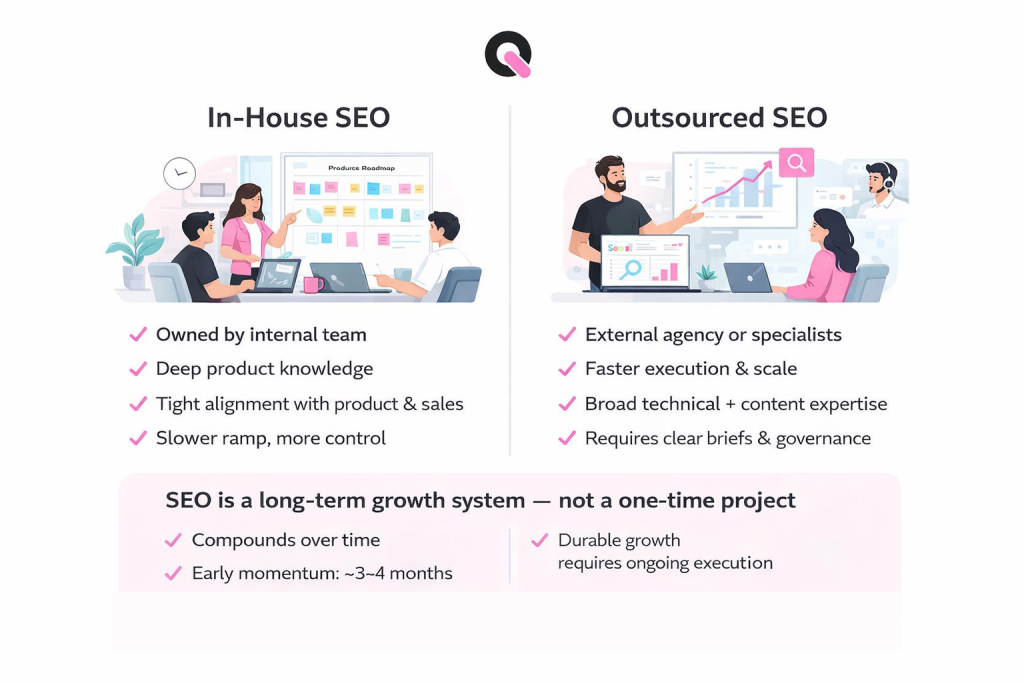
Outsourced SEO vs. In-House SEO: Which Model Fits Your Stage?
Deciding between SEO in-house vs outsourcing starts with how fast you need results. Early choices shape runway, product focus, and which skills you bring into the company.
Speed to execution vs. hiring timelines
Outsourced SEO options begin with audits and fixes in days, not months. Contracts and retainers let work start immediately.
Hiring takes weeks to months for recruiting and training. Expect meaningful output only after onboarding and ramp time.
Skill-set coverage: technical SEO, content creation, and link building
Most individual hires excel in one or two areas. A single headcount rarely covers deep technical work, scalable content creation, and sustained link building.
External teams provide a full bench of specialists when you need breadth without adding fixed payroll.
What “control” really looks like
Control comes from clear roadmaps, approval gates, and shared access, not from who performs each task. Define approvals, ownership, and reporting up front.
Retainers and scoped work offer budget predictability; hires are fixed costs that stay whether output varies or not.
- Early-stage: favor flexible partners for speed and low fixed cost.
- Growth-stage: hybrid models work well; internal product ownership plus external execution.
- Mature: build in-house for product alignment and long-term knowledge retention.
SEO Services SaaS Companies Commonly Outsource
Many SaaS teams need focused, repeatable workstreams to keep organic visibility growing. Below are the most common areas companies scope to external partners so internal teams stay focused on product and sales.
Technical SEO Audits: Crawlability, Indexing, Site Speed, And Structure
Technical SEO for SaaS is used to check crawlability, index control, internal linking, duplicate content, and page speed fixes. Teams expect prioritized tickets, remediation steps, and verification after fixes.
Keyword Research For High-Intent And Long-Tail Opportunities
SaaS keyword research maps problem, solution, comparison, alternative, integration, and long-tail queries to product pages. The goal is to target high-intent phrases that drive trials and demos.
Content Creation That Converts: Product-Led Pages, Comparisons, And Guides
Content creation focuses on product landing pages, “best for” pages, comparisons, use-case pages, and onboarding guides. Each piece ties to a conversion and includes briefs, drafts, and optimization.
Link Building And Digital PR For Authority And Rankings
Link building uses white-hat outreach, editorial mentions, partnerships, and relevant citations to build authority. The emphasis is on relevance and sustainable gains in rankings and traffic.
Local SEO When It Matters
Local SEO applies when regional presence, events, or multi-office teams matter. Deliverables include regional pages, Google Business Profile optimization, citations, and review management.
Measurement: Dashboards, KPIs, And Conversion Tracking
Reporting bundles dashboards, KPIs tied to trials/demos, conversion tracking, and content performance by keyword group. Regular reports link activity to pipeline impact.
| Workstream | Typical Deliverables | Success Metric |
| Technical audit | Crawl report, fixes, speed improvements | Index coverage & reduced errors |
| Keyword research | Target lists, intent mapping | Organic conversions per keyword group |
| Content creation | Landing pages, guides, comparisons | Trial sign-ups and engagement |
| Link building | Editorial links, partnerships | Domain authority signals and referral traffic |
| Local work | Regional pages, GBP setup | Local visibility and event leads |
How To Vet a SaaS SEO Agency Or Provider Without Getting Burned
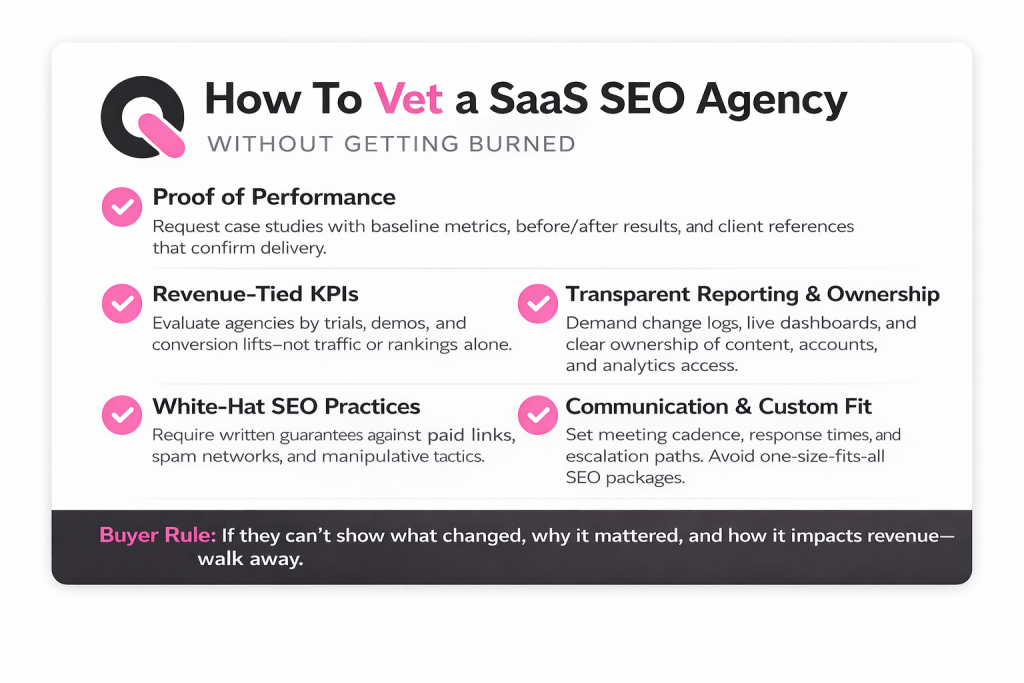
Choosing a SaaS SEO agency as a partner without proof invites blind spots and wasted budget. Use a structured checklist to separate firms that talk well from those that produce measurable outcomes.
Proof of performance should include case studies with baseline metrics, clear before/after charts, and client references that confirm delivery. Look for KPIs tied to pipeline metrics, trials, demos, and conversion lifts.
Transparent reporting and ownership
Demand documented change logs, access to dashboards, and a schedule for delivery. Contracts must state who owns content, accounts, and analytics access if the relationship ends.
White-hat practices
Require written guarantees of ethical link building and no paid spam networks. Any hint of manipulative schemes or cloaked tactics is a hard pass.
Communication and customization
Set meeting cadence, response-time norms, and escalation paths for dev or legal blockers. Ensure the proposed strategies match your product, ACV, and buyer journey, avoid one-size-fits-all packages.
- Ask for baseline vs. outcome metrics tied to revenue.
- Insist on live dashboards that show rankings, traffic, and conversions by page group.
- Verify references that worked at similar company sizes and markets.
Red Flags That Signal Low-Quality Outsourcing SEO
Red flags often appear as bold guarantees and vague plans rather than visible, repeatable work. SaaS teams must spot these early to avoid penalties and damage to buyer trust.
Guaranteed rankings or “instant results” promises
Guaranteed rankings ignore reality: search engine volatility, competitor moves, and algorithm updates all affect placement. Any promise of instant results is a credibility warning.
Quick wins sometimes use risky tactics. Those approaches can trigger penalties that take months to recover from.
Vague work descriptions and no clear plan for optimization
Watch for providers that hand over generic monthly reports without a roadmap. If someone cannot show a prioritized plan, ticket list, or measurable milestones, you lack control.
Ask for samples that show what changed, why it changed, and how success is measured.
Overreliance on paid links or spammy tactics that hurt reputation
Link practices matter. Paid placements, unnatural anchor distributions, or links from low-quality sites can harm rankings and your brand reputation.
SaaS buyers judge credibility; shortcuts that boost short-term metrics often lower trust and conversion rates over time.
- Buyer test: request a sample report, an example roadmap, and a clear description of link acquisition standards.
- Red flag cues: fixed promises, vague deliverables, and anonymous link sources.
- Protective step: insist on documented change logs and ethical practices in the contract.
| Red Flag | Buyer Test | Potential Consequence |
| Guaranteed rankings | Ask for case studies with timeline detail | Algorithm penalty or short-lived gains |
| Vague deliverables | Request a sample roadmap and sprint tickets | Wasted budget, unclear ownership |
| Spammy links | Require link origin samples and outreach templates | Reputation harm and traffic drops |
Healthy campaigns show steady, documented progress: prioritized fixes, transparent reporting, and white-hat link building.
What A High-Performing SaaS SEO Campaign Looks Like Over Time
High-performing search campaigns follow a clear, phased path from quick fixes to compounding growth. Treat the work as a timeline: audit, quick wins, content ramp, authority building, and iterative refinement.
Realistic Timelines: Why Break-Even Often Takes Several Months
Most SEO campaigns take time to pay off. A practical break-even window is roughly 5–16 months, depending on competition and execution consistency.
Early months focus on unlocking pages and fixing index issues. Revenue-linked results usually appear after steady traffic and ranking gains compound.
Content Systems That Scale Without Sacrificing Quality
Build repeatable briefs, involve internal SMEs, and use templates for comparisons and use-case pages. A structured QA checklist prevents thin content and preserves conversion intent.
Balance new content with upgrades to high-potential pages to improve ROI and maintain momentum.
Iteration Loops: Testing Keywords, Improving Pages, And Updating Content
Effective campaigns run tight experiments: test keyword targets, tweak titles and meta, and improve internal linking. Refresh accuracy, and optimize conversion elements on high-traffic pages.
Tie measurement to outcomes: growth in qualified organic traffic, better rankings for commercial terms, and higher trial/demo conversion rates.
- Phase 1: Discovery & audit — index, speed, and quick technical fixes.
- Phase 2: Early wins — improve existing pages and capture long-tail keyword demand.
- Phase 3: Scale — content production, authority work, and conversion optimization.
| Phase | Primary Focus | Success Signal |
| Audit → Quick Wins | Indexing & technical fixes | Reduced crawl errors, rising traffic |
| Content Ramp | Templates, briefs, SME input | Improved rankings and trials |
| Iteration & Authority | Testing and link growth | Compounding traffic and steady results |
How To Choose The Right Outsourced SEO Approach For Your SaaS Goals
Start with the business outcome, then pick an approach that maps to it. If your goal is demos and trials, prioritize conversion-focused content and landing pages. If you need market expansion, emphasize regional pages and authority building.
Match the provider to the goal
Use a simple decision framework: define your primary goal, list required deliverables, then match those to provider skills. Limited engineering time means prioritize technical audits and implementation support. Low awareness means prioritize content and internal linking.
Budgeting models and cost signals
Compare one-off projects (audits, migrations), monthly retainers (ongoing work), and performance models tied to leading indicators. Pick the model that fits your budget horizon and risk tolerance.
Operating rhythm and access
A healthy cadence includes a shared roadmap, weekly or biweekly check-ins, clear content approvals, and aligned stakeholders. Require ownership rules for analytics, tracking, dashboards, and editorial assets to avoid lock-in.
Evaluating fit
Beyond price, confirm SaaS experience, communication quality, and the provider’s ability to show revenue-linked results. Ask for KPI definitions, reporting samples, and account ownership clauses.
| Decision Point | What to Ask | Buyer Test |
| Goals | Pipeline, trials, demos, expansion | Prioritized deliverables list |
| Budget Model | Project, retainer, performance | Sample SOW and pricing scenario |
| Ops Rhythm | Roadmap, meetings, approvals | Sample sprint plan and approval flow |
| Tools & Data | Analytics access, dashboards, tracking | Confirmed ownership and export rights |
🚀 How Queen Of Clicks Helps SaaS Businesses Win With SEO
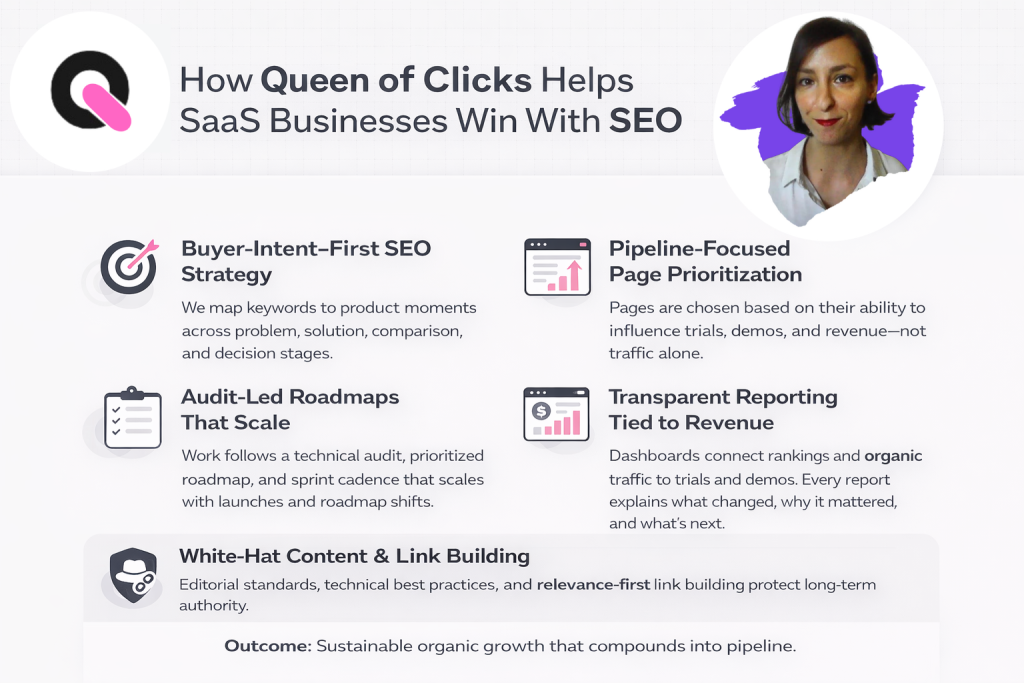
Queen of Clicks focuses on measurable wins that convert organic visits into trials and demos. We start with buyer intent and build a plan that maps keywords to product moments.
Strategy-First Execution Built For SaaS Buying Journeys
Our SaaS-first methodology maps queries across problem, solution, comparison, and decision stages.
We prioritize pages that influence pipeline and then set clear conversion targets.
Structured Support That Scales With Your Roadmap
Work follows an audit-led roadmap and sprint cadence. That makes scaling up for launches fast and scaling down clean during roadmap shifts.
Transparent Reporting Tied To Traffic, Rankings, And Revenue Outcomes
Dashboards link organic traffic and rankings to trials and demos. Each report explains what changed, why it mattered, and next steps.
White-Hat Content And Link Building Designed For Sustainable Growth
Editorial standards, technical best practices, and careful link building protect long-term authority.
We avoid short-term shortcuts and focus on relevance and publisher fit.
What It’s Like To Work With Queen Of Clicks
Expect regular stakeholder touchpoints, clear approval gates, and shared ownership of data and accounts.
We embed with product marketing, sales, and engineering to remove blockers and keep work practical.
- Strategy workshops to align work with trials, demos, and revenue goals (not just traffic).
- Technical audits and implementation guidance to protect crawlability, indexing, and site speed through releases.
- Scalable content systems for product pages, comparisons, and guides that convert search demand into pipeline.
- White-hat link building and digital PR to grow authority safely and improve rankings over time.
- Transparent reporting with clear KPIs, dashboards, and a steady communication cadence.
Book a call with Queen of Clicks to review performance, identify quick wins, and map a 90-day plan.
Conclusion
Maintaining steady organic visibility requires a mix of specialist skills and consistent execution few small teams can sustain alone. SaaS companies often choose to outsource SEO services to accelerate work, access talent, and keep pace with search engine change.
Pick a path that fits your stage: clarity of scope, white-hat practices, and transparent reporting should guide the decision. Prioritize technical foundations, high-intent keyword targeting, conversion-focused content, and safe authority building first.
Expect realistic timelines: small wins arrive early, but durable results compound with steady iteration. Local SEO matters for some motions and deserves the same rigor as core work, not a one-off checklist.
Choose an approach that protects brand reputation while growing organic traffic and pipeline. If you want a practical plan tied to measurable results, book a call to map a focused 90-day roadmap.
FAQs
How much does it typically cost to outsource SEO for a SaaS company?
Costs vary based on scope, competition, and growth stage. Most SaaS companies invest in monthly retainers rather than one-off projects, with pricing reflecting technical depth, content volume, and authority building needs. The key is aligning spend with expected pipeline impact, not chasing the lowest rate.
How long should a SaaS company commit to an outsourced SEO partner?
SEO outsourcing works best with medium- to long-term commitments. A realistic initial engagement allows enough time for audits, implementation, content momentum, and early conversion data. Short contracts often limit results and increase churn without meaningful learning.
Can outsourced SEO work alongside our internal marketing or growth team?
Yes, and it often performs better that way. Many SaaS companies use outsourced SEO for execution while internal teams retain product messaging, positioning, and approvals. Clear roles and shared dashboards prevent overlap and keep velocity high.
What level of internal involvement is required when outsourcing SEO?
Outsourced SEO is not hands-off, but it should be lightweight internally. Expect periodic reviews, content approvals, and access to subject-matter experts. Strong partners minimize meetings and come prepared with clear recommendations and decisions.
Is outsourcing SEO risky for SaaS companies with complex products?
Complex products actually benefit from outsourcing when the provider understands SaaS buying journeys. External teams bring structure, intent mapping, and content systems that help translate technical features into searchable, conversion-focused pages.
How do you protect brand voice and positioning with an external SEO team?
Brand protection comes from briefs, examples, and review workflows. High-quality SEO partners document tone, ICPs, and messaging rules early, then refine through feedback loops so content stays aligned with product marketing standards.
What happens if priorities shift or budgets change mid-engagement?
Flexible outsourcing models allow scope adjustments without layoffs or sunk hiring costs. Work can be paused, scaled down, or refocused on higher-impact initiatives like optimizing existing pages instead of producing net-new content.