SEO In-House vs Outsourcing: What Is the Best Choice for Your SaaS
SaaS SEO is a core demand-generation channel for SaaS companies, but deciding whether to build your SEO capability in-house or outsource it is one of the most consequential strategic choices you’ll make.
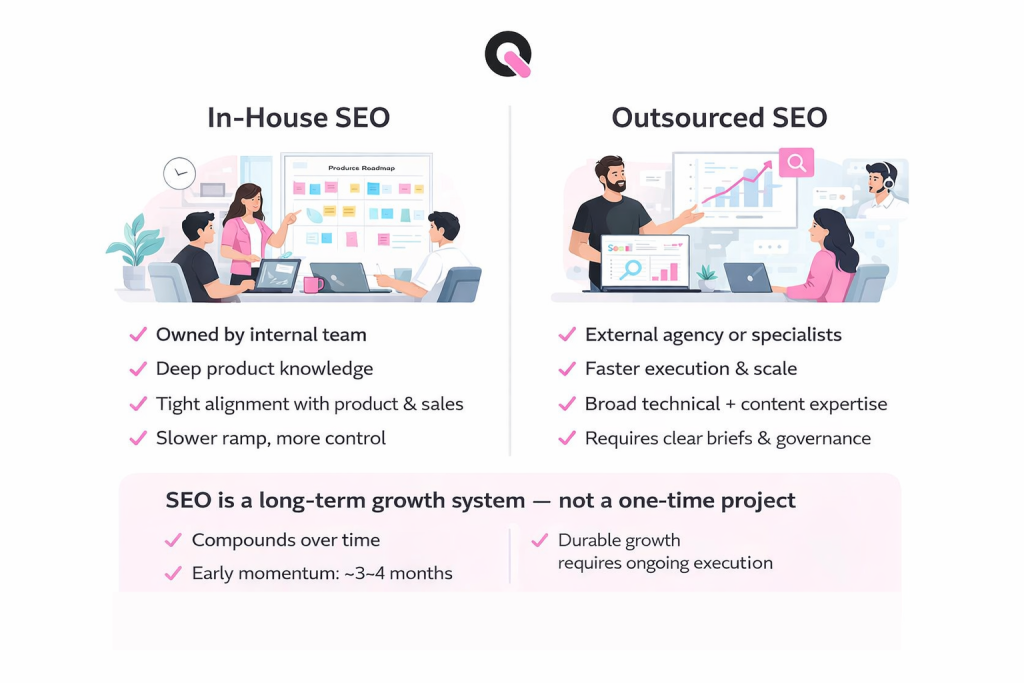
In-house SEO means hiring dedicated talent within your own team to own keyword research, content strategy, technical execution, and performance tracking. It gives you tight control over messaging, alignment with product and sales teams, and deep product knowledge embedded in SEO work.
Outsourced SEO means partnering with an external SaaS SEO agency, consultant, or specialist team to plan and execute your search strategy. This model gives you immediate access to multi-disciplinary expertise, proven playbooks, and bundled tools without the time and cost of building a team from scratch. A major benefit of outsourcing is performance: 60% of businesses report a higher ROI from agency SEO compared to in-house efforts.
Key Takeaways
- Choose between internal build or partner based on impact to pipeline and revenue.
- Expect early momentum at ~3–4 months; plan for ongoing work for durable growth.
- Compare control, speed, expertise, and integration with product and sales.
- Evaluate partners on tooling, reporting, content throughput, and technical capacity.
- Use this guide to define hiring needs and the resources to sustain results.
Why SaaS Companies Face The In-House vs. Outsourced SEO Decision
Difficult product cycles, tight engineering calendars, and high-value trial conversions force SaaS leaders to decide where search work should live. That choice shapes speed, control, and long-term growth.
What “In-House SEO” Means for a SaaS Marketing Team
An in-house team assigns an internal owner who sets strategy, prioritizes the backlog, and coordinates with product marketing and engineering. That owner manages content briefs, technical tickets, and performance monitoring.
What “Outsourcing SEO” Means When You Hire An SEO Agency
Hiring an agency engages external services and specialists to plan and execute content and technical tasks. Agencies bring repeatable playbooks, reporting tools, and a multi-disciplinary team to supplement internal capacity.
Why SEO Is A Long-Term Growth Channel (Not A One-Off Project)
Search success compounds: published content gains authority, technical health prevents regressions, and ongoing testing adapts to user behavior. Early signals can show within a few months, but durable results need steady publishing and iteration.
Consider bandwidth limits, competing priorities, and the need for repeatable workflows when choosing a model.
SEO In-House vs Outsourcing: Key Differences That Impact SaaS Growth
Where you place search responsibilities shapes speed, alignment, and long-term organic growth for a SaaS business. Below are the core differences that move the needle on pipeline, trial volume, and product-led momentum.
Ownership And Control Over Strategy, Content, And Priorities
In-house ownership lets a product marketing lead set editorial direction, priority tickets, and approval gates with tight control over messaging. That creates fast alignment with roadmap and sales needs.
Agency models require clear briefs, governance, and acceptance criteria to avoid drift. Agencies deliver through SLAs and reviews rather than day-to-day product context.
Speed To Execution And Ability To Scale During Product Launches
Agencies often move faster at launch. They bring a ready team and repeatable playbooks that reduce ramp time.
Over time, a well-run internal team can outpace external partners because approvals and engineering routes become routine.
Access To Specialized Expertise Like Technical SEO And Link Building
A single internal hire may lack full coverage across technical, content, and outreach roles. Agencies typically provide a bench of specialists for complex audits, link building, and performance research.
Integration With Product Marketing, Sales Enablement, And Brand Voice
Tight integration matters for lifecycle pages: awareness, evaluation, and trial. Internal teams usually keep brand voice truer to product messaging.
To prevent agency drift, require messaging docs, examples, and review cycles. That preserves consistency while gaining access to outside expertise.
- Practical lens: Good internal models show tight control and steady delivery. Good agency models show fast scale and broad expertise.
- Prioritize time-to-value, content throughput, and measurable results against product launch calendars.
| Criteria | Good Internal Result | Good Agency Result |
| Control | Tight messaging and fast approvals | Governed by briefs and SLAs |
| Speed | Faster after ramp | Immediate scale at launch |
| Expertise | Deep product knowledge | Broad technical and outreach bench |
In-House SEO Team: Pros For SaaS Businesses
Building an internal capability lets you tie content directly to features, use cases, and revenue signals. That alignment turns keyword research into qualified pipeline rather than surface traffic.
Deeper Product And Industry Knowledge For High-Intent Keyword Research
An in-house SEO staff knows product nuance and buyer pain points. They map queries to features, integrations, and workflows that predict trial intent.
Seamless Cross-Functional Collaboration With Content, Design, And Engineering
Internal teams pair with design and engineering for templates, internal linking, and fast technical fixes. That integration reduces rounds of review and speeds launch cycles.
Building Repeatable Internal SEO Processes And Institutional Knowledge
Documented playbooks, briefs, and QA checklists capture what converts to demos. A well-trained in-house team preserves learning as hires rotate.
Continuous Learning To Keep Up With Search Trends And Algorithm Changes
When updates hit, the internal group folds new tactics into ongoing work and shares findings across marketing. That continuous learning supports steady, measurable results.
- Better keyword targeting improves lead quality.
- Faster fixes raise conversion rates on core pages.
- Institutional processes deliver consistent long-term results.
| Benefit | Outcome | Metric |
| Product-aligned research | Higher-intent traffic | Qualified leads % |
| Cross-team work | Faster launches | Time-to-publish |
| Documented processes | Repeatable results | Conversion lift |
In-House SEO Team: Cons And Operational Challenges
Hiring to own search work can slow time-to-value because of recruiting and onboarding steps. In the United States, filling a specialized role often takes 3–6 months. After hiring, expect several more weeks for audits, stakeholder alignment, and roadmap building before steady execution begins.
Hiring Time And Ramp-Up Time Can Delay Results (Often Months)
Recruiting, interviews, and notice periods push start dates out. New hires need time to learn product, data sources, and priority pages.
Even after publishing starts, momentum often appears only after another 3–4 months, so cumulative delays matter.
Talent Risk: Turnover, Skill Gaps, And Limited Coverage Across SEO Disciplines
One person rarely covers technical SEO, content strategy, on-page work, and link efforts at scale. Skill gaps create blind spots.
If your core owner leaves, strategy continuity can suffer unless playbooks and docs are thorough.
Internal Bottlenecks For Engineering And Content Resources
Queues for engineering fixes, design reviews, and legal approvals throttle throughput. That reduces the program’s speed and raises hidden costs.
- Plan budgets for salary, tooling, and cross-functional support time.
- Mitigate risk with documented processes and temporary external help during ramp.
| Challenge | Typical Impact | Leader Action |
| Hiring & ramp | 3–6 month delay | Budget overlap support |
| Coverage gaps | Missing specialties | Hire or contract specialists |
| Internal queues | Slower fixes/publishes | Prioritize SLAs with teams |
Outsourced SEO Services: Benefits Of Working With An SEO Agency
Partnering with an external partner gives SaaS teams instant access to specialized processes and a larger bench of practitioners. That matters when product windows are tight and you need measurable outcomes fast.
Immediate Access To A Multi-Disciplinary Team And Proven Playbooks
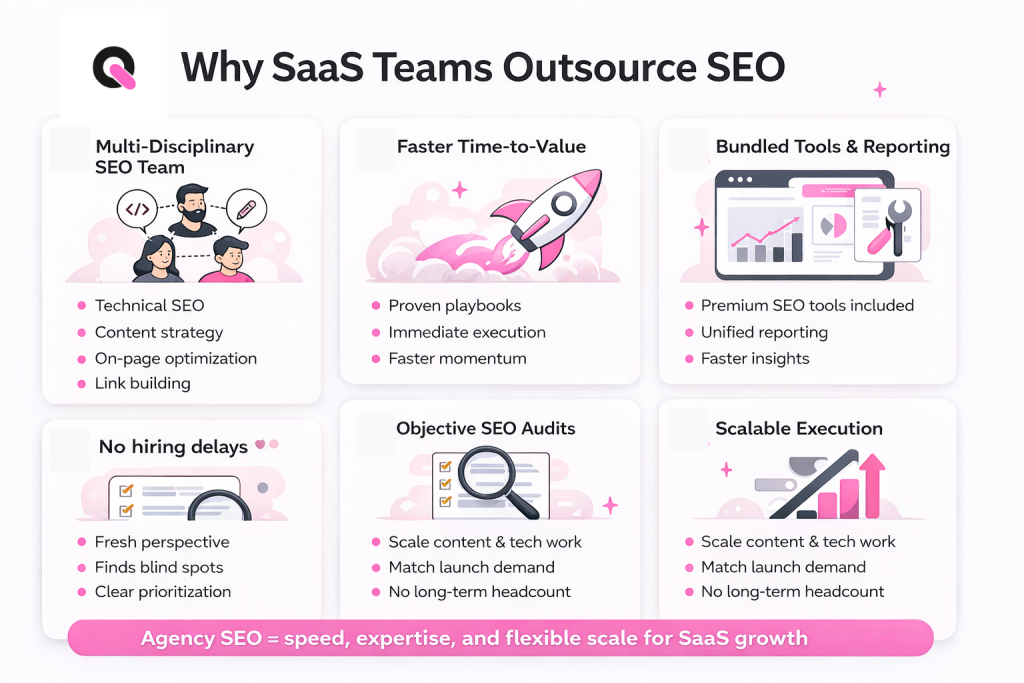
A SaaS SEO agency brings a ready team that covers technical audits, content planning, on-page optimization, and link-focused initiatives. This bench avoids hiring delays and fills skill gaps quickly.
Advanced Tools And Reporting Without Separate Subscriptions
Many agencies bundle premium tools and reporting as part of their services. That reduces setup time and removes an extra line item while delivering consolidated dashboards and faster insights.
Fresh, Objective Insights To Spot Missed Opportunities
An outside perspective often finds blind spots in information architecture, internal linking, and conversion paths that internal teams normalize. Those insights enable clearer prioritization and fixes.
Flexibility To Scale Content And Technical Work With Demand
Agencies let you ramp content output or technical support up or down by quarter. This flexibility protects against over-hiring and helps meet launch deadlines without long-term headcount.
- Bench advantage: multi-discipline coverage without multiple hires.
- Speed: proven playbooks for rapid time-to-value.
- Tooling: included software and consolidated reporting.
- Objective audits: spot opportunities internal teams miss.
- Scalability: flex resources to match demand and performance goals.
Outsourcing SEO: Tradeoffs To Plan For Before You Sign A Contract
Before signing any contract, leaders should map the tradeoffs that affect brand voice, governance, and time-to-value. An external partner can accelerate delivery, but it also requires clear rules and shared expectations.
Maintaining Brand Voice And Messaging Consistency In SaaS Content Marketing
Outsourced writing can miss product nuance without guides. Provide positioning docs, tone examples, and a short style guide.
Require editorial feedback loops so content aligns with buyer language and feature messaging.
Communication Cadence, Stakeholder Alignment, And Approval Workflows
Set a regular rhythm: weekly check-ins and async updates for progress. Define reviewers, approval SLAs, and escalation steps.
Use a shared roadmap and acceptance criteria to keep deliverables from stalling.
How To Vet Experience And Avoid “Guaranteed Results” Red Flags
Ask for SaaS case studies, transparent metrics, and how the agency iterates after setbacks. Treat any promise of guaranteed rankings or guaranteed results as a red flag.
- Verify relevant experience and client references.
- Confirm reporting cadence and KPIs for performance.
- Require a clear division of responsibilities and required internal resources.
| Risk | Mitigation | Expected Outcome |
| Voice drift | Style guide + edits | Consistent messaging |
| Slow approvals | Set SLAs | Faster publish |
| Overpromises | Require case data | Realistic expectations |
Cost, Tools, And Time: What SaaS Leaders Should Budget In The United States
Leaders must plan for three cost buckets: external retainers, fully-loaded headcount, and monthly tooling. Each affects when and how results appear.
Outsourced pricing benchmarks
Monthly retainers typically range $1,500–$5,000 for ongoing services. Hourly consulting runs about $100–$300. Project scopes for audits or migration work commonly start at $5,000 and can rise to $30,000 for complex engagements.
In-house compensation reality
Entry specialists often start near $40,000. Managers average ~$80,000 base and roughly $90,000 fully loaded with benefits. Senior experts can exceed $200,000 base.
Recruiting, onboarding, and cross-functional time add material cost beyond salary.
Tooling and opportunity cost
Tool subscriptions for tracking, crawling, and content research can reach $5,000+/month for a staffed team. Hiring plus ramp (3–6 months) and early momentum (another 3–4 months) create a hidden cost of delayed pipeline impact.
- ROI lens: Compare expected performance potential, speed, coverage, and conversion value, not only line-item cost.
- Early-stage firms often favor flexible retainers; scaling orgs may invest in senior staff plus tools.
| Category | Typical US Range | Business Impact |
| Monthly retainer | $1,500–$5,000 | Fast start, flexible scale |
| Hourly consulting | $100–$300 | Short-term expertise |
| In-house fully-loaded | $90k–$200k+ | Deep product alignment |
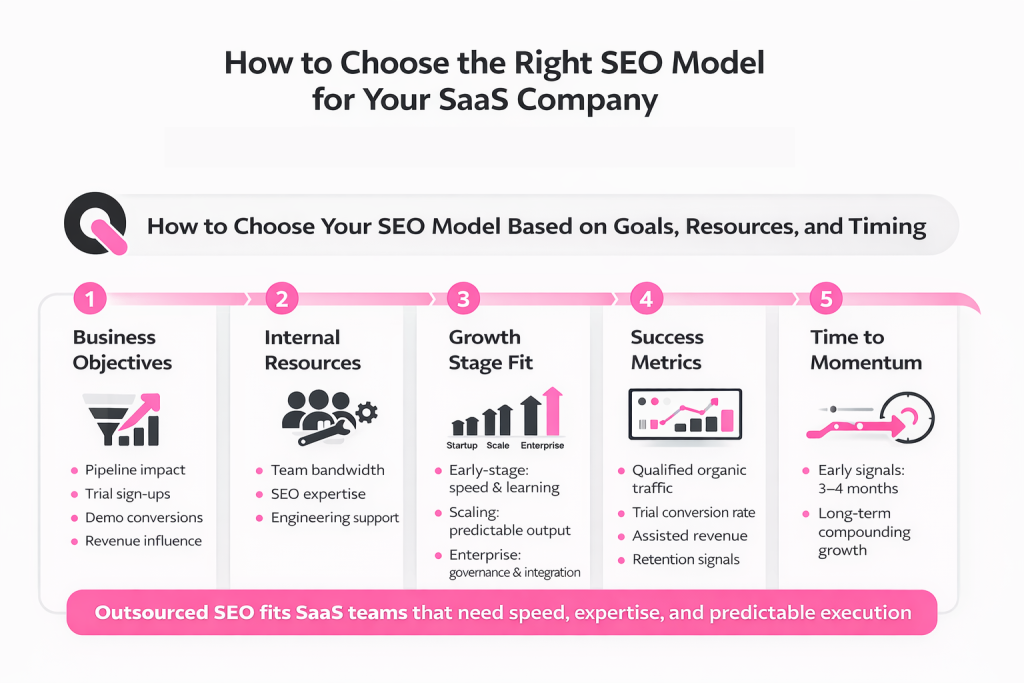
How To Choose The Right SEO Model For Your SaaS Company
Picking the right approach starts with clear goals, a reality check on capacity, and a timeline for results. Use this short framework to decide what fits your product stage and team.
Clarify Business Objectives: Pipeline, Trials, Demos, And Revenue Influence
Define how search work should move pipeline, trial sign-ups, and demo conversions. That directs content priorities and technical fixes toward revenue, not vanity metrics.
Assess Current Resources: Team Bandwidth, SEO Knowledge, And Technical Support
Audit your people and tools. Note publishing cadence, content skills, and engineering availability for technical SEO work.
Match Strategy To Growth Stage: Early-Stage, Scaling, Or Enterprise SaaS
Early firms need fast learning and flexible support. Scaling companies require predictable throughput. Enterprise buyers demand governance and cross-team integration.
Define Success Metrics: Rankings, Qualified Organic Traffic, Conversions, And Retention
Measure qualified traffic, trial conversion rate, assisted revenue, and content-driven retention. Use leading signals (indexing, velocity) while waiting for lagging returns.
When A Hybrid Approach Delivers The Best Of Both Worlds
A common pattern: hire an expert partner to run an audit and roadmap, then move execution inside with regular check-ins. This balances speed, knowledge transfer, and long-term ownership.
How Soon You Should Expect SEO To Show Momentum (Often Several Months)
Expect early signs at 3–4 months. Plan for leading indicators and align stakeholders to avoid short-term pivots that kill momentum.
🚀 How Queen of Clicks Helps SaaS Teams Win With SEO
When partnering with Queen of Clicks, you can expect:
- Audit and roadmap that prioritize qualified traffic and conversion impact.
- SaaS-focused keyword and content strategy aligned to trials and demos.
- Technical SEO planning that fits your engineering calendars.
- Editorial systems, briefs, and QA to protect brand voice and speed production.
- Reporting that ties traffic and rankings to conversion outcomes and performance trends.
- Clear collaboration cadence: calls, async updates, and approval SLAs.
Book a call with Queen of Clicks to discuss the right model, internal, partnered, or hybrid, based on your objectives, resources, and cost constraints.
Conclusion
The right choice depends on objectives, available talent, and how quickly you must show impact.
If you can staff and fund a long-term program, an internal model wins for deep product knowledge, tight integration, and institutional learning that supports durable growth.
An outsourced approach often wins when speed matters. External teams deliver broad expertise, faster execution, and tool access, provided governance and feedback loops are clear.
Practical next steps: pick a model, set measurable success metrics, commit to a realistic timeline, and build a repeatable operating rhythm that preserves brand voice and control.
For SaaS leaders: weigh performance potential over simple costs, protect messaging, and plan for the months required to produce meaningful results.
FAQs
Can a SaaS Company Switch From Outsourced SEO to In-House Without Losing Momentum?
Yes, if the transition is planned. The key is documentation and knowledge transfer: keyword maps, content briefs, technical audits, and reporting baselines should move with the work. A short overlap period (30–60 days) helps preserve velocity.
Is SEO Better Run Under Marketing, Growth, or Product in a SaaS Organization?
There’s no universal answer, but high-performing teams usually anchor SEO in marketing with strong product and engineering ties. SEO fails when it’s isolated; it succeeds when it influences messaging, roadmap visibility, and conversion paths.
What Happens to SEO Performance During a Major Product or Website Redesign?
SEO performance often dips temporarily if migrations aren’t handled carefully. URL changes, internal linking, and metadata must be mapped in advance. Whether in-house or outsourced, redesigns demand explicit SEO ownership to avoid traffic loss.
How Do You Hold an SEO Agency Accountable Without Micromanaging?
Agree on outcomes and leading indicators, not tasks alone. Clear KPIs (qualified traffic, conversions, content velocity), reporting cadence, and acceptance criteria allow autonomy without losing control.
What Early Signals Indicate an SEO Strategy Is on the Right Track?
Indexation speed, ranking movement for non-brand terms, internal link coverage, and content velocity are strong early indicators, well before revenue impact appears.