SEO Consulting for SaaS Companies
SEO consulting for SaaS companies is a specialized service that helps SaaS businesses turn search engines into a predictable source of demos, trials, and recurring revenue. It focuses on understanding how your ideal buyers search for solutions, what problems they’re trying to solve, and how your product fits into that journey. Unlike traditional SEO, which usually chases traffic, SaaS SEO consulting builds an acquisition system that aligns search intent with product value, category messaging, and conversion paths.
Key Takeaways
- Learn how SaaS-specific search work turns recurring revenue goals into pipeline, not just clicks.
- See a strategy that maps queries to ICPs across awareness, consideration, and decision stages.
- Understand which core services, technical audits, keyword research, content, and authority building, move the needle.
- Get practical steps to optimize for AI-driven engine overviews and LLM-powered results.
- Prioritize ARR, SQLs, and demo volume over vanity metrics to keep teams aligned on revenue.
What Is SEO Consulting for SaaS Companies
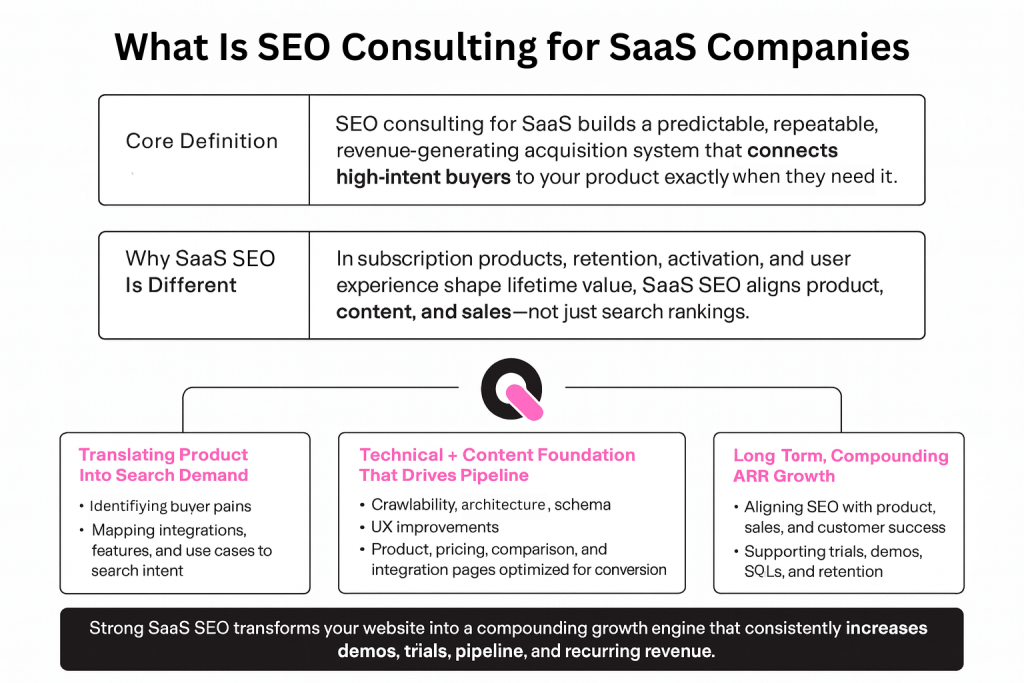
SEO consulting for SaaS companies is about creating a predictable, repeatable, revenue-generating acquisition system that connects the right buyers to your product at the exact moment they need it. And because organic search drives around 53% of all website traffic for SaaS companies, it becomes one of the few channels capable of consistently feeding demos, trials, and long-term revenue.
In subscription businesses, where retention, activation, and product experience shape lifetime value, SaaS SEO must go far beyond traditional optimization. It has to align product, content, and sales so every organic touchpoint moves a prospect closer to demos, trials, and recurring revenue.
Unlike generic SEO, SaaS-focused consulting works across the entire customer journey. Consultants map your product’s features, integrations, and use cases to search intent, ensuring each piece of content has a defined role in awareness, evaluation, and decision stages. They pair deep technical work, crawl health, site architecture, schema, Core Web Vitals, with conversion-driven content and authority building. The goal isn’t traffic for the sake of traffic, but sustainable growth measured through SQLs, demo volume, ARR, and retention.
At its core, SaaS SEO services focus on three things:
- It translates your product into search demand: Consultants analyze how prospects describe their pains, features they compare, integrations they need, and solutions they evaluate. They then map this to keywords across awareness, evaluation, and decision stages so every piece of content supports the buying cycle.
- It builds a technical and content foundation that drives pipeline, not vanity metrics: This includes fixing crawlability, improving site architecture, optimizing product and integration pages, strengthening UX, and producing content that answers real buying questions, security, ROI, pricing, comparisons, alternatives, and deployment.
- It creates long-term, compounding growth for ARR: SaaS SEO consulting aligns with product, sales, and customer success so the website becomes a revenue engine. It works across attribution models, AI-driven search surfaces, and competitive categories to capture qualified demand consistently.
Strong SEO consulting turns your website into a growth engine; one that compounds over time, matures with your product, and directly supports the metrics that matter: pipeline, conversions, and long-term revenue.
Why SaaS SEO Is Different From Traditional Search Engine Optimization
When subscriptions drive value, search efforts must tie content to retention and expansion. In recurring revenue models, a single acquisition can pay off for years, so your work must influence long, multi-touch journeys.
You’ll plan content that supports product-led motions. Think docs, comparison pages, and use-case guides that nudge users into trials and upgrades. These pieces need to map features and outcomes to clear search intents across awareness, consideration, and decision stages.
Recurring Revenue, Long Funnels, And Product-Led Growth
Buying committees grow larger and decisions take longer. Your content should influence evaluation over weeks or months and provide trust signals during due diligence.
- Design implementation guides, security pages, and ROI calculators as trust assets.
- Tailor internal linking to funnel readers from education to demo CTAs and product pages.
- Include onboarding and activation content so search contributes to retention, not just acquisition.
Translating Product Value Into Search Intent Across The Journey
Map product features to queries that match the buyer’s stage. Build pages that win comparisons and integration searches. Use sales and success data to close gaps where prospects stall.
| Need | Content Type | Business Outcome |
| Early awareness | How-to articles, industry primers | Broader reach and qualified leads |
| Evaluation | Comparison pages, use-case guides | Higher demo requests and trials |
| Due diligence | Security docs, ROI calculators | Faster procurement and reduced churn risk |
| Expansion | Activation guides, upgrade playbooks | Improved retention and larger LTV |
Core Services You Should Expect From a SaaS SEO Partner
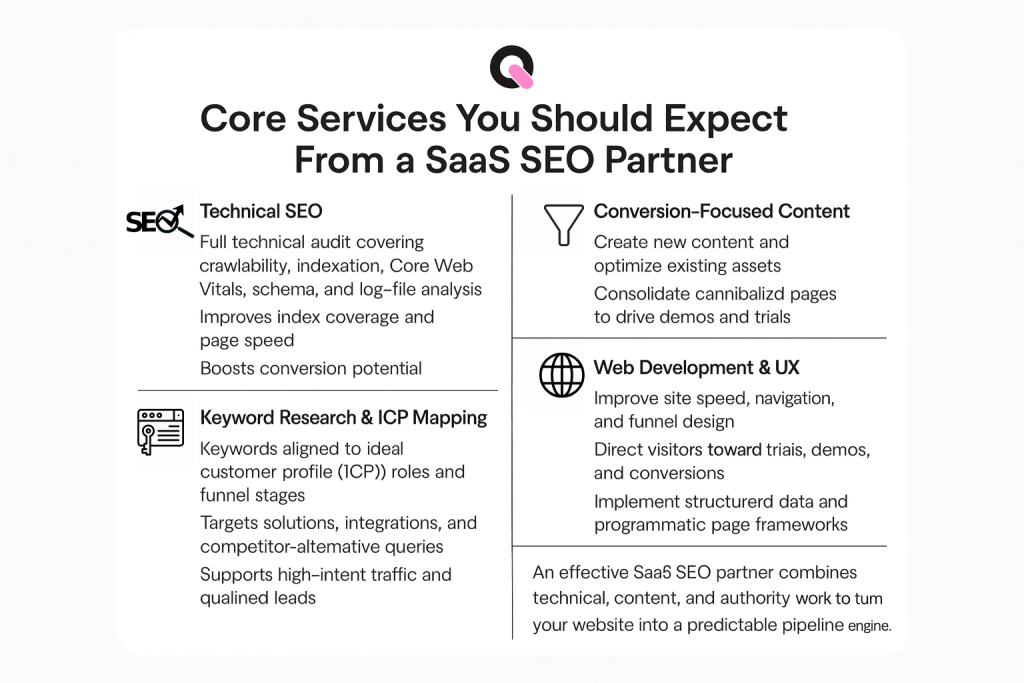
Expect a focused set of services that turn site health and content into pipeline. A SaaS SEO partner should combine technical analysis, creative content work, and authority programs that drive measurable results.
Start with an end-to-end technical audit covering crawlability, indexation, Core Web Vitals, schema, and log-file analysis. Those fixes improve index coverage and page speed, boosting conversion potential.
- Keyword research mapped to ICP roles and funnel stages, targeting solutions, integrations, and competitor-alternative queries.
- Conversion-focused content plus content cleanups to consolidate cannibalized pages and revive declining assets.
- Authority building via digital PR, thought leadership, and selective outreach that earns high-quality links, not vanity mentions.
- Web development and UX recommendations that trim load time, simplify navigation, and steer visitors to trials and demos.
Expect structured data and programmatic page frameworks when product catalogs expand. Internal linking should map clusters and prioritize your highest-value pages.
Measurement and governance tie each service to rankings, qualified traffic, and pipeline contribution. Clear SLAs keep content and technical surfaces healthy as you scale.
Generative Engine Optimization And AI Search Visibility
AI-driven overviews now pull short, authoritative answers from web pages, so your content must be answer-ready. Design pages that serve extractive snippets: clear definitions, concise summaries, and cited data that an engine can sample without confusion.
Next, add structured signals. Implement schema like FAQ, HowTo, Product, and Organization so large models can assemble accurate, attributed responses. This reduces hallucination and improves inclusion in AI summaries.
Optimizing For AI Overviews And LLM-Powered Results
Use NLP-focused copy that aligns headings and entities with the relationships LLMs expect. Label sections plainly and include TL;DRs and short FAQs to act as prompt-like inputs.
NLP, A/B Testing, And Structured Data For AI Surfaces
- Structure content for extractive credibility – definitions, short summaries, and source links increase chances of being cited in an AI snapshot.
- Run A/B tests on prompt-like elements (FAQs, TL;DRs, key takeaways) to learn what improves AI inclusion and click-through from those surfaces.
- Map answer opportunities by intent and prioritize BOFU pages where appearing in an AI overview drives demos, trials, and conversions.
- Publish strong E-E-A-T signals: expert bylines, revision histories, references, and safety rails like pricing notes and version tags.
- Monitor AI visibility alongside traditional rankings and modify your content strategy as blended discovery shifts across media and search channels.
How To Evaluate SEO Consulting For SaaS Companies
Choose partners that prove their impact with revenue-linked case studies, not vanity metrics. Insist on client stories that tie content and technical work to demos, SQLs, and MRR.
Use a weighted evaluation framework to compare agencies objectively. The scorecard below reflects what matters most when you hire an external partner.
Proven results and notable clients
- Prioritize firms with case studies showing pipeline and revenue, not only traffic lifts.
- Verify clients are in similar verticals or ICPs to ensure relevance.
Leadership, tenure, and review signals
- Examine leadership experience and median employee tenure as proxies for delivery stability.
- Check review scores and references to confirm communication and adaptability.
GEO plus classic optimization
Confirm the partner offers GEO alongside traditional site work so your brand appears in both AI-driven summaries and organic listings.
Methodology: speed, clarity, reporting
- Request a clear discovery and prioritization framework with QA checkpoints.
- Ask for forecasting tied to unit economics and quarterly leading/lagging indicators.
- Inspect reporting stacks (GA4, Looker, CRM) to ensure revenue attribution, not just rank tracking.
| Criteria | Weight | Why it matters |
| Notable clients | 30% | Shows category fit and real results tied to pipeline. |
| Leadership experience | 20% | Indicates strategic judgment during complex campaigns. |
| Median employee tenure | 15% | Signals commitment to execution and fewer handoffs. |
| GEO offering | 10% | Complements classic site work for AI visibility. |
Final step: interview the delivery team to validate ICP understanding and technical depth. Align incentives with outcomes, balance fixed deliverables with KPIs, and request references that confirm transparent communication during market shifts.
Aligning SEO Strategy With Product, Sales, And Success Teams
Aligning product roadmaps with search priorities turns feature releases into demand moments. When you coordinate product, sales, and success, content and launches convert better. This makes growth measurable and repeatable.
Use shared metrics tied to revenue: ARR, demo volume, SQLs, activation, and retention. Track these so your work supports expansion and long-term value.
Shared Metrics: ARR, SQLs, Demos, And Retention
Run joint planning sessions with product, sales, and success to turn roadmap themes and buyer objections into prioritized initiatives. Brief sales on new content and competitor pages so the field can use them in outreach and live demos.
- Connect CRM and analytics to attribute-influenced opportunities and prove which content moves deals.
- Build a feedback loop from success to flag gaps like security, integrations, and compliance that need search-optimized pages.
- Prioritize BOFU assets, comparisons, alternatives, pricing, that win high-intent demand and help sales close.
- Align publishing cadence with launches and campaigns to support product moments that matter.
| Metric | Owner | Cadence |
| ARR impact | Revenue ops | Quarterly review |
| Demo volume | Sales | Weekly sync |
| Activation & retention | Customer success | Monthly report |
Document roles in a RACI and host quarterly business reviews to refine ICPs, adjust targets, and reallocate budget. Enable a fast content request process that turns field insights into production-ready briefs.
Building a SaaS SEO Content Engine That Converts
Design an editorial system that turns customer questions into conversion-ready pages. Focus on clear clusters and repeatable briefs so content scales and compounds value.
Topic Clusters, Pain-Point Playbooks, And BOFU Coverage
Map hubs to BOFU pages that drive demos and trials. Link educational posts to pricing, comparison, and ROI pages so authority passes where it converts.
Turn support tickets into short playbooks. Each playbook targets a buyer pain, includes examples, and links to product pages that solve that pain.
Thought Leadership To Earn Links And Trust
Publish original data, frameworks, and editorial pieces that attract natural links and editorial mentions. These assets lift topical authority and help surface answers in AI overviews.
- Standardize briefs with SERP analysis, PAA mapping, and schema needs.
- Run content cleanups: merge duplicates, update stats, and align headings to intent.
- Test CTAs and placements to boost demo conversions.
| Component | Purpose | Key deliverable | Impact |
| Topic clusters | Organize coverage | Hub + cluster map | Better internal flow and rankings |
| Pain playbooks | Address buyer objections | Short guides & comparisons | Higher demo-readiness |
| Linkable assets | Earn authority | Original studies & frameworks | More editorial links and citations |
| Governance | Keep content fresh | Refresh schedule & briefs | Compounding traffic and pipeline |
Technical SEO Priorities For High-Growth SaaS
Technical priorities shape whether your site can scale traffic and protect revenue during rapid growth. Start with a clear plan that ties architecture, performance, and index health to measurable outcomes.
Information Architecture, Internal Linking, and Crawl Budget
Architect clean hierarchies and URL patterns so search engines and users find solutions, use cases, and integrations quickly.
Design internal linking to surface BOFU pages with hub-and-spoke structures that reduce cannibalization and guide conversions.
Manage crawl budget and prune thin pages, fix parameter traps, and improve sitemaps and canonical rules to conserve crawl cycles.
Performance, Indexation, and Migration Readiness
Optimize performance: Core Web Vitals, image compression, and JS hydration to boost conversion and ranking stability.
Monitor indexation coverage and resolve soft 404s, non-indexable templates, and duplication from filters or tags.
Prepare migrations with redirect maps, staging tests, and log-file reviews. Use server logs and Search Console data to prioritize fixes by impact.
- Add structured data to surface rich results and help AI systems understand entities and offers.
- Build QA checklists so development and content teams maintain technical integrity during releases.
- Track post-fix outcomes, crawl stats, LCP/CLS, and traffic, to quantify ROI on technical work.
| Priority | Action | Outcome |
| Architecture | Clear URL patterns & internal linking | Faster discovery and better conversions |
| Performance | CWV fixes, image & JS optimization | Improved load times and demo rates |
| Index & Migration | Log analysis, redirects, staging tests | Protected revenue pages and stable rankings |
Authority And Link Acquisition Without Vanity Metrics
Authority grows when placements reach readers who influence buying decisions, not when domain numbers look impressive.
Target publications your audience reads and trusts. Prioritize relevance and referral potential over raw domain metrics. Earn editorial backlinks and contribute expert data, quotes, and concise insights to existing high-traffic pieces.
Secure listicle inclusions where prospects compare options. Those placements send qualified visitors and lift perceived category leadership. Run digital PR campaigns tied to product news, original research, or industry narratives to earn natural mentions.
- Build linkable content: benchmarks, reports, and calculators that attract citations.
- Use ethical outreach with client-approved targets and transparent reporting on placements and impact.
- Diversify anchor text and match link intent to page intent to protect against over-optimization.
- Measure by BOFU rankings, assisted conversions, and qualified referral sessions, and avoid vanity thresholds.
- Monitor AI and search surfaces to see which media mentions improve inclusion in generative answers.
| Tactic | Primary Benefit | Key Metric |
| Editorial backlinks | Credibility and referral traffic | Assisted conversions |
| Listicle inclusions | High-intent clicks and category proof | Qualified referral sessions |
| Digital PR campaigns | Scale mentions tied to narratives | Placement-driven demo volume |
| Linkable assets | Long-term citation velocity | Referral growth and rankings uplift |
Measurement That Matters: From Rankings To Pipeline
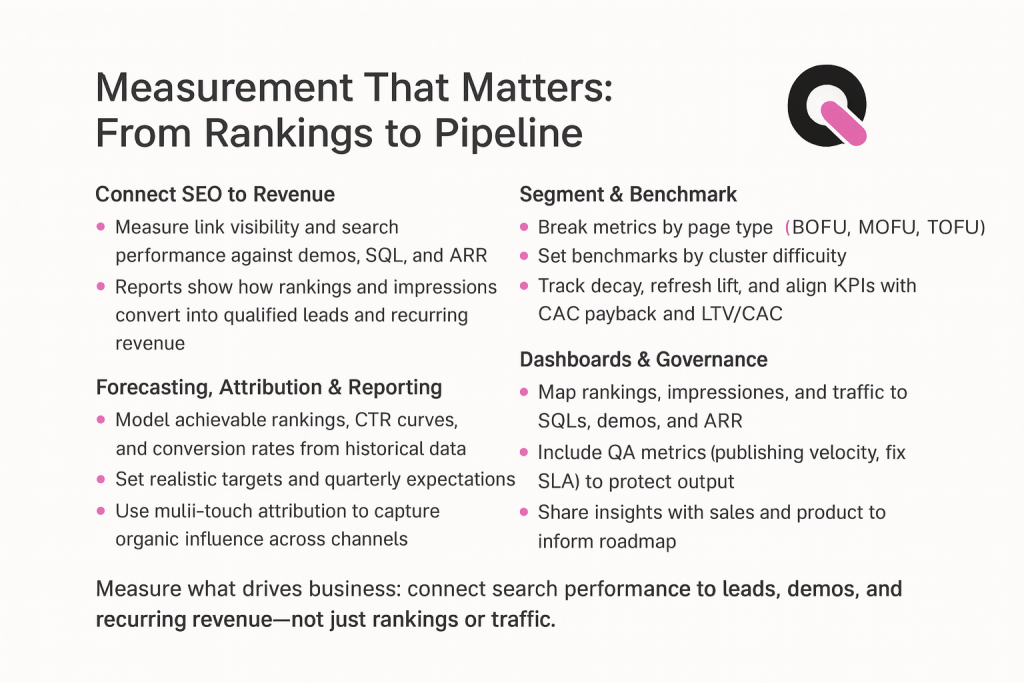
Measure what moves the business: link search visibility directly to demo volume and ARR. Build reports that show how rankings and impressions turn into qualified leads and recurring revenue in the US market.
Forecasting, Attribution, and Revenue Reporting
Forecast growth and model achievable rankings, CTR curves, and conversion rates from historical cohorts. Use those models to set realistic targets and quarterly expectations.
Implement multi-touch attribution so the influence of organic work appears even when conversions finalize after paid ads or direct visits. Tie impressions and traffic to SQLs, demos, and pipeline value.
Leading/Lagging Indicators and Realistic Benchmarks
Define leading indicators, crawl stats, indexation, and impressions, and lagging indicators, pipeline and ARR. Use both to guide priorities and sprint planning.
Segment by page type (BOFU, MOFU, TOFU), and set benchmarks by cluster difficulty. Track decay and refresh lift, and align KPIs with finance metrics like CAC payback and LTV/CAC.
- Dashboards: Map rankings, impressions, and traffic to SQLs, demos, and ARR.
- Governance: Include QA metrics (publishing velocity, fix SLA) to protect output.
- Alignment: Share insights with sales and product so search learns inform positioning and roadmap choices.
Timelines, Budgets, And Resourcing For SaaS SEO
Set realistic timelines and budgets so search work becomes a predictable growth engine. Start with a 90-day foundation to audit crawl health, fix high-impact technical issues, and map information architecture. These quick wins buy time while you build longer-term assets.
Expect meaningful rankings in 6–9 months and compounding revenue after 12+ months. Plan budgets across three pillars: technical fixes, content production and refreshes, and authority campaigns. Adjust allocations each quarter as results and competitor moves shift.
Decide how you will staff the work. Many US firms pair internal editors and developers with an external SaaS SEO agency to scale. Others run lean teams and bring in specialized partners as needed. Define the agency’s remit clearly, strategy, execution, or hybrid, so accountability is unambiguous.
- Reserve contingency for migrations and hidden technical debt.
- Calibrate production velocity: publish fewer, better BOFU assets rather than high-volume TOFU alone.
- Use SLAs for briefs, reviews, and publishing so teams move in sync with product and brand launches.
| Horizon | Focus | Outcome |
| 0–3 months | Audits, IA, quick wins | Reduced technical risk |
| 6–9 months | Ranking lift, content builds | Noticeable traffic & demo volume |
| 12+ months | Authority and compounding growth | Sustained pipeline impact |
Finally, tie spend to pipeline with regular finance reviews and invest early in analytics (GA4, Search Console, CRM) to avoid attribution gaps. Revisit budgets annually as categories mature and AI-driven surfaces change the landscape over the years.
Common Pitfalls In SaaS SEO And How To Avoid Them
Common execution mistakes drain momentum and hide real growth opportunities. You can fix most gaps with clear mapping between search targets and pipeline outcomes.
Avoid chasing raw traffic. Map each page to a funnel stage and expected demo or ARR impact. That prevents high-volume, low-value campaigns that waste budget.
Stop content overlap, consolidate duplicates, and enforce canonical rules. Regular audits reduce cannibalization and improve conversion flow toward BOFU pages.
- Prioritize BOFU assets that shorten sales cycles and lift demo volume.
- Pair on-page work with authority programs; links turn optimization into credible results.
- Include GEO signals to protect visibility in AI-driven overviews and regional SERPs.
Monitor technical fixes continually. Use log analysis, Core Web Vitals, and indexation checks rather than a set-and-forget approach. Align with sales early so messaging, objections, and competitor pages are accurate.
| Pitfall | Consequence | Fix | Owner |
| Chasing vanity metrics | Low-quality traffic, no pipeline | Map pages to SQLs, demos, ARR | Growth / Revenue Ops |
| Content cannibalization | Fragmented authority and poor conversions | Consolidate, canonicalize, refresh | Editorial |
| Ignoring authority | Stalled rankings despite clean pages | Run targeted outreach and linkable assets | PR / Outreach |
| Set-and-forget fixes | Recurring regressions after releases | Monitor logs, CWV, indexation continuously | Dev Ops |
Choosing Your Model: In-House Team, Consultant, Or Agency
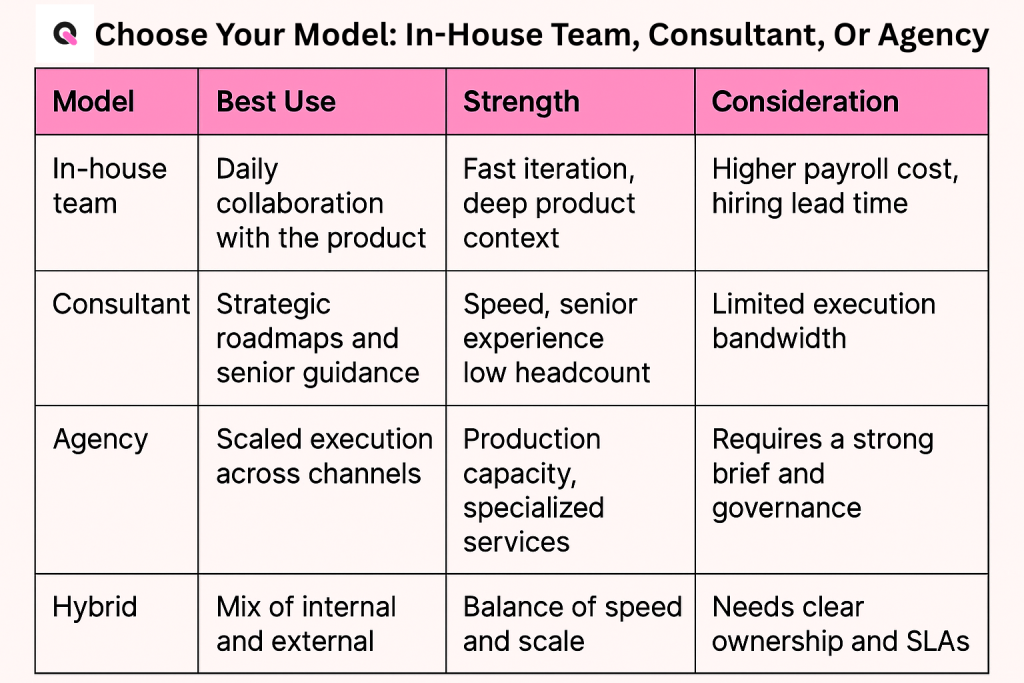
Your choice of team model determines how tightly strategy links to product roadmaps. Pick the model that matches your need for speed, hands-on alignment, and scale.
Use an in-house team when you need close collaboration with product, rapid shipping, and continuous iteration. This works well if engineering and design bandwidth is available.
When a specialized consultant makes sense
Hire a consultant when you need senior oversight, a fast roadmap, and strategic clarity without hiring headcount. Fractional advisors accelerate decision-making and train internal teams.
- Choose an agency when you require broad execution across content, technical fixes, and outreach at scale.
- Assess leadership experience and tenure to judge delivery quality over quarters.
- Define ownership, briefing, writing, development, so tasks don’t stall in handoffs.
- Start with an audit or pilot to test fit, communication, and output quality.
- Align budgets to the model: consultants for strategy, agencies for production and outreach.
- Set reporting cadences and OKRs tied to demos, activation, and retention.
- Ensure engineering and design support exists to avoid stalled recommendations.
- Revisit the model annually as your product, market, and goals evolve.
Industry Nuances: B2B SaaS, Fintech, Medtech, And Beyond
Industry-specific signals, security notes, integration matrices, or clinical references, win trust in regulated markets.
Adjust messaging depth by vertical. In fintech and medtech you must show audit trails, revision histories, and clear evidence. Less-regulated niches favor fast UX tests and case excerpts.
Build integration and ecosystem pages so b2b saas companies illustrate stack fit and interoperability. Create role-based narratives that answer questions from procurement, engineering, and finance.
- Expand FAQs and docs to serve both acquisition and retention for technical audiences.
- Use CRO patterns tuned to risk-averse buyers: transparent pricing notes, legal resources, and detailed case materials.
- Localize where procurement or regional rules demand consistent claims and language.
| Vertical | Priority Asset | Buyer Signal |
| Fintech | Security pages & audit logs | Compliance proof and SLA terms |
| Medtech | Clinical references & revision history | Accuracy and traceability |
| B2B product stacks | Integration matrices | Interoperability and rollout plans |
Align PR with industry calendars and track longer sales cycles patiently. Measure assisted pipeline and multi-touch contributions so your content and marketing investments show real business impact.
Use Cases And Campaign Types That Drive SaaS Growth
Build campaigns that convert product signals, docs, templates, and walkthroughs, into discoverable, high-intent pages. Start with product-led efforts that turn technical assets into focused landing pages. Use automation to scale programmatic pages for integrations, industries, and locations.
Product-led, Programmatic, and Refresh Plays
Deploy product-led SEO and convert guides and templates into indexed use-case pages that attract buyers. Launch programmatic templates that follow strict intent-driven schemas and GEO rules so pages appear in LLM summaries and regional results.
- Schedule regular content refresh waves to reclaim decayed rankings and protect revenue-driving queries.
- Run comparison and alternative campaigns to intercept evaluators late in the funnel.
- Publish ROI calculators, TCO pages, and data studies to speed committee decisions and win links.
- Test schema types, FAQ placement, and listicle outreach to improve web visibility and snippet inclusion.
- Track traffic quality and downstream conversion rates to prioritize campaigns that drive pipeline, not just visits.
| Campaign Type | Objective | Key Asset | KPI |
| Product-led pages | Capture high-intent queries | Use-case walkthroughs & templates | Demo requests per page |
| Programmatic pages | Scale coverage by integration/location | Strict templates + GEO schema | Indexed pages & qualified traffic |
| Comparison & ROI | Convert evaluators | Comparison matrices, calculators | Conversion rate & deal velocity |
| Data & outreach | Earn links and citations | Original studies & PR | Referral sessions & backlinks |
How Queen of Clicks Helps SaaS Brands Win Organic Growth
Queen of Clicks turns product moments into measurable pipeline band ties every content touch to demo and revenue outcomes. You get a hands-on partner that blends GEO with classic site optimization so your brand appears in AI overviews and regional listings as well as traditional results.
What You Get
We deliver a clear program that maps work to ICPs and funnel stages. Each roadmap includes briefs, SERP analysis, and schema checks so pages are AI-ready and conversion-focused.
- Program that ties initiatives to SQLs, demos, and ARR, technical fixes, authority building, and conversion content in one plan.
- GEO optimization plus classic search so you capture blended visibility.
- Technical audits, IA changes, and performance improvements that scale with your product catalog.
- Digital PR and outreach that targets high-intent audiences and placements.
- Refresh cadences, content cleanups, and clear SLAs with quarterly business reviews.

Why It Works
We avoid vanity metrics and report on pipeline, revenue, and payback. You’ll see transparent reporting that connects rankings and traffic to real business outcomes.
Ready to move from traffic to predictable growth? Book a call to review a tailored roadmap and see projected demo and revenue impact.
Conclusion
Focus your last mile on converting intent into predictable trial and MRR growth.
You’ve seen how modern seo hinges on aligning product, sales, and success around revenue metrics rather than vanity traffic. Pair foundational technical fixes and authority work with focused BOFU content and regular refreshes to let gains compound.
Future-proof visibility and use GEO alongside classic practices so your pages become trusted sources that AI systems cite. Insist on forecasting, attribution, and pipeline reporting when you evaluate an agency or partner.
Staff realistically, measure leading and lagging indicators, and avoid common pitfalls like content overlap and TOFU-heavy programs. Apply these frameworks in-house or team up with Queen of Clicks to accelerate outcomes and turn organic into a predictable growth engine.
FAQs
What makes SaaS SEO different from traditional SEO?
SaaS SEO focuses on recurring revenue, long buying cycles, and multi-touch journeys. Instead of chasing traffic, it aligns content, product pages, and technical foundations to lift demos, trials, SQLs, and ARR. It also supports product-led growth through comparison pages, integration content, and trust signals like security and ROI documentation.
Why do SaaS companies need an SEO consultant?
An SEO consultant helps connect search demand with your product, ensuring buyers find the right pages at every stage of their journey, from awareness to due diligence and expansion. Consultants map keywords to ICPs, fix technical issues, and build content systems that turn search traffic into demos and pipeline, not vanity metrics.
How long does SaaS SEO take to show results?
Expect foundational improvements within the first 90 days, measurable ranking uplift in 6–9 months, and strong compounding revenue impact after 12+ months. SaaS SEO requires ongoing optimization because categories evolve, competition increases, and AI-driven surfaces change over time.
How do you measure the revenue impact of SEO?
Revenue impact is measured through attribution models that connect impressions, rankings, and engagement to SQLs, demos, and pipeline value. Dashboards integrate data from GA4, Search Console, CRM, and revenue ops tools. Multi-touch attribution captures influence across long buying cycles typical in SaaS.
Should I hire an agency, consultant, or in-house team for SaaS SEO?
It depends on your goals and resources:
- In-house works best when you need daily collaboration with product and engineering.
- Consultants provide senior strategy, ICP clarity, and fast roadmaps without increasing headcount.
- Agencies offer scalable execution across content, technical, and outreach programs.
Many SaaS companies use a hybrid model to combine strategic oversight with high-volume production.