SEO Consultant for SaaS: How They Improve Your SaaS SEO Strategy
An SEO consultant for SaaS is a specialist who designs and prioritizes organic search strategies around product-led growth, long buying cycles, and recurring revenue. Their job is to connect search demand to trials, demos, SQLs, and revenue, as well as align content, technical SEO, and conversion paths across the full buyer journey.
Unlike general SEO advice, SaaS SEO focuses on high-intent queries, activation-driven pages, and internal flows that move users from search to product. Companies that invest consistently in SEO see an average ROI of 748% over three years, making it one of the most effective marketing channels for SaaS growth.
A SaaS SEO consultant builds a revenue-connected roadmap, fixes technical blockers that suppress performance, and turns keyword research into pages that actually convert. The result is a repeatable organic acquisition system that compounds over time instead of isolated traffic wins.
Key Takeaways
- Focus on pipeline metrics (demos, trials, SQLs) over vanity ranks.
- Full-funnel keyword and content strategy drive sustainable organic growth.
- Technical health, links, and conversion lifts compound over time.
- Evaluate support by process clarity, reporting, and commercial outcomes.
What An SEO Consultant for SaaS Actually Does
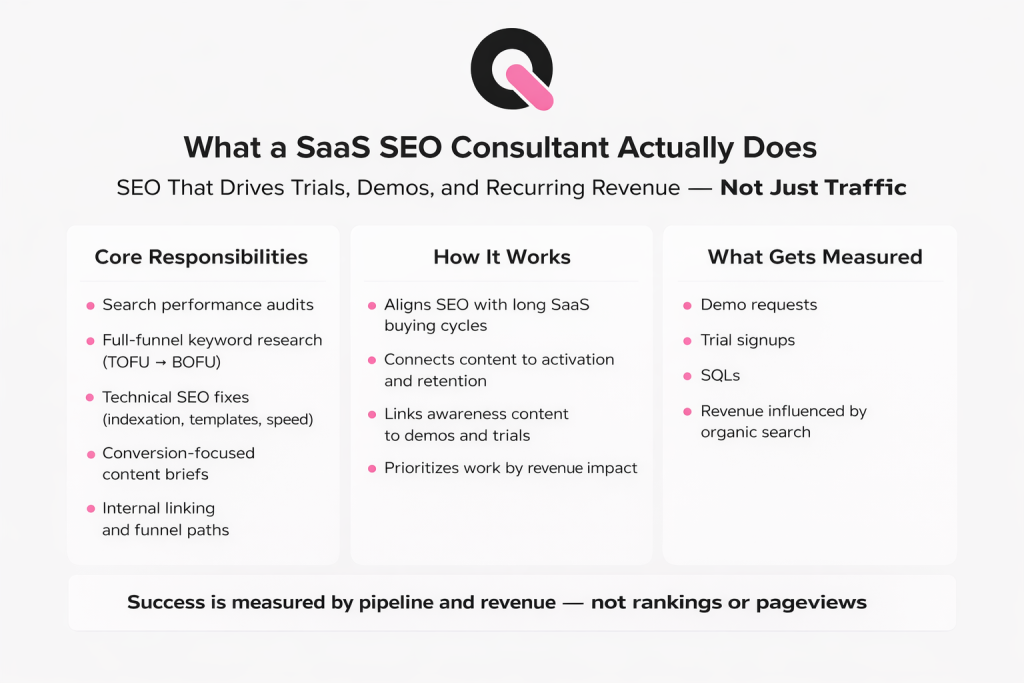
Search work must map to business outcomes. In subscription companies, the priority is clear: generate qualified demand that converts to trials, demos, and recurring revenue rather than just raw traffic. This shift changes every decision in a search strategy.
A specialist diagnoses search performance, sets priorities, and guides execution tied to revenue outcomes. Typical tasks include audits, technical fixes, keyword research, and conversion-focused content briefs.
Aligns With Recurring Revenue And Long Sales Cycles
Long buying cycles mean content must nurture users across awareness, consideration, and decision stages. Pages must link internally to consistent paths that move prospects toward activation and retention.
Connects Content, Product, And Sales To The Full Funnel
The role bridges marketing, product, and sales so search supports more than blog traffic. That collaboration removes bottlenecks like engineering fixes or unclear product messaging.
- Deliverables: audits, roadmaps, keyword maps, content briefs, internal linking plans, and reporting frameworks.
- Outcomes are measured in pipeline impact and revenue, not just positions or visits.
Why SaaS SEO Is Different From Traditional SEO
Search for product-led firms must do more than attract visits. It must route the right users into trial or activation. That changes every choice about content, templates, and links.
Product-Led Funnels And Activation Paths
Product-led growth centers on activation and “aha” moments. Pages should rank where they can move a user toward signup or trial.
Design, copy, and CTAs must reflect product steps so search traffic becomes qualified pipeline, not just traffic that bounces.
Higher-Intent Queries Across The Buyer Journey
Query patterns include problem-aware, solution-aware, and vendor-aware searches. Each maps to different conversion potential.
Targeting these tiers means tailoring content to intent and guiding users to high-value pages that convert.
Compounding Organic Growth As An Acquisition Engine
When pages are built to activate users, organic search becomes a compounding acquisition channel.
Each strong page can continuously generate qualified demand, lowering blended CAC over time.
- Contrast: traditional SEO aims at broad visits; product search targets pipeline and activation.
- Mechanics: activation shapes which pages should rank and how internal paths flow.
- Architecture: optimization work must align with templates, IA, and product narratives.
- Specialization: the differences require a specialist approach rather than a generalist one.
| Focus | Traditional SEO | Product-Led Search |
| Main Goal | Broad organic traffic and visibility | Qualified pipeline and product activation |
| Content Type | Top-of-funnel informational pages | Activation-focused pages, comparisons, and product guides |
| Conversion Path | Click to site, possible micro-conversions | Clear paths to trial, demo, or signup with product hooks |
| Measurement | Visits, impressions, rankings | Trials, demos, SQLs, and revenue impact |
When SaaS Companies Need An SEO Consultant
Deciding when to bring external search expertise starts with clear commercial signs that organic channels have stopped pulling their weight. Leaders at saas companies should watch concrete signals, not hope.
Plateaued organic traffic or stagnant rankings
If organic traffic stalls or rankings slip on revenue-driving keywords, companies need outside help to diagnose on-page, technical, and link gaps.
Great traffic but low demos, trials, or signups
High visits with few conversions usually mean a mismatch between intent, offer, or internal paths to product pages. A quick audit checks CTAs, funnels, and product messaging.
Scaling content without a clear SEO content strategy
Rapid output without a strategy creates cannibalization, thin pages, and wasted cycles. A plan prevents duplicate topics and focuses creation on pages that convert.
Preparing for a website migration or major redesign
Migrations can lose indexation and break links. External help brings development support, redirect plans, and content cleanups that protect historical performance.
- Common hire triggers: stalled rankings, traffic plateaus, competitors outranking on money terms.
- Decision checklist: declining demos, unclear analytics, repeated technical issues, or no internal bandwidth.
- Stakeholder prep: grant analytics and Search Console access, share CRM MQL/SQL definitions, and product positioning notes.
- What to look for: proven experience and a track record with measurable pipeline impact and clear ownership.
How An SEO Consultant For SaaS Improves Strategy
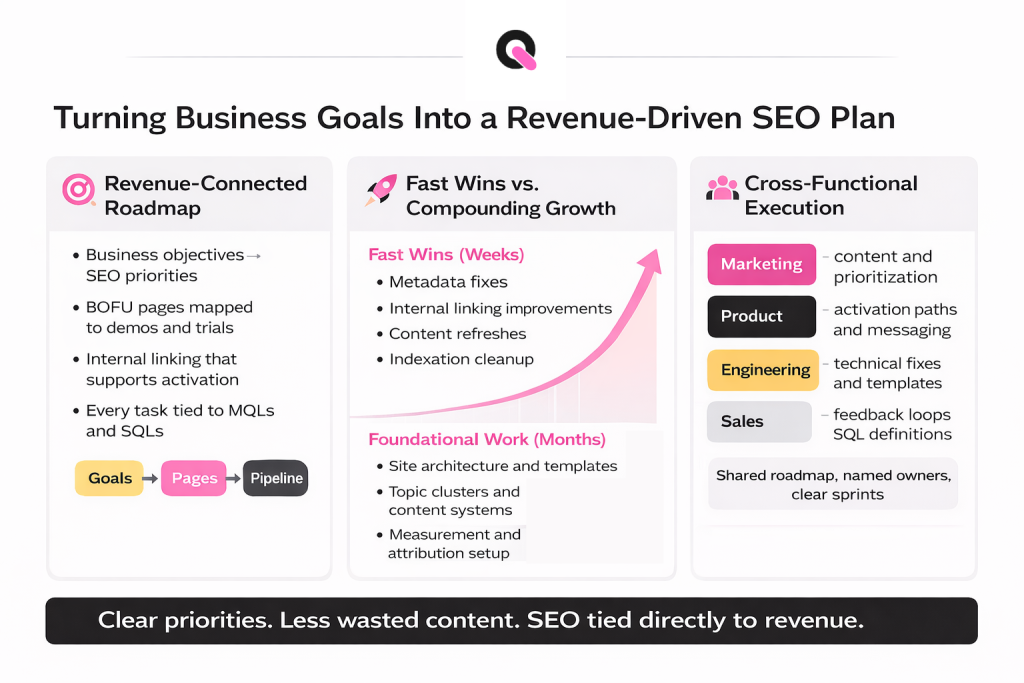
The best approach turns business objectives into a prioritized set of pages and experiments that move prospects to activation. A clear plan shows what to do first, what to ignore, and why each item matters to revenue.
Builds a Revenue-Connected Roadmap
Priority maps link initiatives to pipeline. Each task is tied to measurable outcomes: BOFU pages, internal linking to demo flows, or content that nudges trials. This keeps work aligned with MQL and SQL targets.
Fast Wins and Long-Term Compounding
Fast wins include metadata fixes, internal linking, content refreshes, and indexation cleanup. These deliver quick improvements in visibility and clicks.
Foundational work covers architecture, topic clusters, and measurement frameworks. Those investments compound: steady publishing plus authority building leads to sustained growth over quarters.
Creates Cross-Functional Momentum
Execution requires marketing, product, engineering, and sales to act in sync. Expect sprint planning, backlog grooming, and named owners for each task to avoid stalls.
- Outcome: clearer focus, less wasted content, and repeatable systems that tie optimization to commercial results.
Pipeline-First Goals That Replace Vanity Metrics
Measurement should prove impact on revenue, not just celebrate higher positions or raw visits. Teams must trade vague rank reports for dashboards that show real business outcomes tied to the funnel.
What To Track Beyond Rankings And Sessions
Vanity metrics include rankings and sessions. They signal visibility but not value.
Pipeline metrics show conversions that matter: demo requests, trial starts, SQLs, and revenue influenced.
Mapping Organic Search To SQLs, Trials, And Revenue
Use an agreed mapping: landing page → tracked event (signup/demo click) → trial → SQL → revenue. Define each step in writing.
- Analytics foundations: GA4 events, Search Console integration, CRM handoff, and consistent UTM tagging.
- Set goals by funnel stage and ICP fit, not by generic traffic targets.
- Directional KPIs: BOFU page conversion rate, assisted conversions from TOFU, and activation-rate lift.
| Metric Type | Example | Why It Matters |
| Vanity | Positions, Sessions | Visibility only |
| Pipeline | Trials, Demo Requests | Direct revenue signal |
| Attribution | Assisted conversions | Shows contribution |
Transparency matters: if results aren’t visible in reports, the work feels like “wait another few months.” Prioritize items that move pipeline first.
Full-Funnel Keyword Research For SaaS Growth
Translate product value into language that buyers actually type into search bars. Full-funnel keyword research builds coverage from problem-aware queries to vendor comparisons and purchase-ready terms. This ensures traffic maps to activation opportunities, not just visits.
Intent Mapping For Awareness, Consideration, And Decision
Classify queries into three intent layers: awareness, consideration, decision. Use query signals, SERP features, and landing page purpose to assign intent.
Awareness pages educate. Consideration pages compare approaches. Decision pages answer purchase questions and link to demo or trial flows.
Bottom-Of-Funnel Opportunities: Alternatives, Vs, And Comparison Pages
BOFU pages should be conversion-focused but credible. Build “alternatives,” “vs,” and comparison pages with honest pros and cons, evidence, and clear CTAs to demos or trials.
Enterprise SaaS Keyword Research Considerations
Enterprise searches involve longer cycles and multiple stakeholders. Target role-specific phrases, compliance and integration queries, and proof-driven content like case studies and ROI math.
Building A Keyword Universe Around The ICP
Map roles, pains, integrations, compliance needs, and use cases to expand a keyword universe. Score opportunities by intent strength, competitiveness, conversion potential, and content credibility.
Execution: turn lists into briefs, internal-link plans, and conversion paths that push qualified users toward demos and trials.
| Focus | What to Target | Why It Converts |
| Awareness | Problem symptoms, industry pain terms | Starts education and list-building |
| Consideration | Approaches, features, comparisons | Shows fit and builds preference |
| Decision | Alternatives, “vs”, pricing intent | Drives demos, trials, and purchase actions |
SEO Content Strategy That Builds Authority And Converts
Authority needs structure and clear paths to product action. A strong content plan balances long-form pillar pages with targeted conversion pages. Each piece must map to a buyer intent and a measurable step toward trial or demo.
Pillar Pages And Topic Clusters For Scalable Organic Traffic
Create pillar pages that define a solution area and link to supporting cluster pages. This internal linking guides users and organizes the website so both buyers and search engines find the right paths.
Thought Leadership Content That Earns Trust
Publish experience-backed analysis, case insights, and POV pieces that reduce purchase friction. Thought leadership builds credibility and aids sales conversations.
Content Marketing That Supports Activation And Retention
Match content to lifecycle needs: onboarding how-tos, integration guides, and troubleshooting articles that help activation and lower churn.
Content Cleanups And Editorial Standards
Audit, consolidate, and prune low-value pages. Update facts, tighten product tie-ins, and add clear CTAs aligned to intent.
- Editorial rules: technical accuracy, product validation from teams, and CTAs that match stage.
- Coordinate with product, CS, and sales to keep claims accurate and content current.
| Work | Benefit | Outcome |
| Pillar pages | Centralize authority | Higher organic traffic and clearer funnels |
| Cleanups | Remove thin pages | Regain rankings and boost conversions |
| Thought leadership | Build trust | Shorter sales cycles |
Technical SEO Improvements That Unlock Rankings
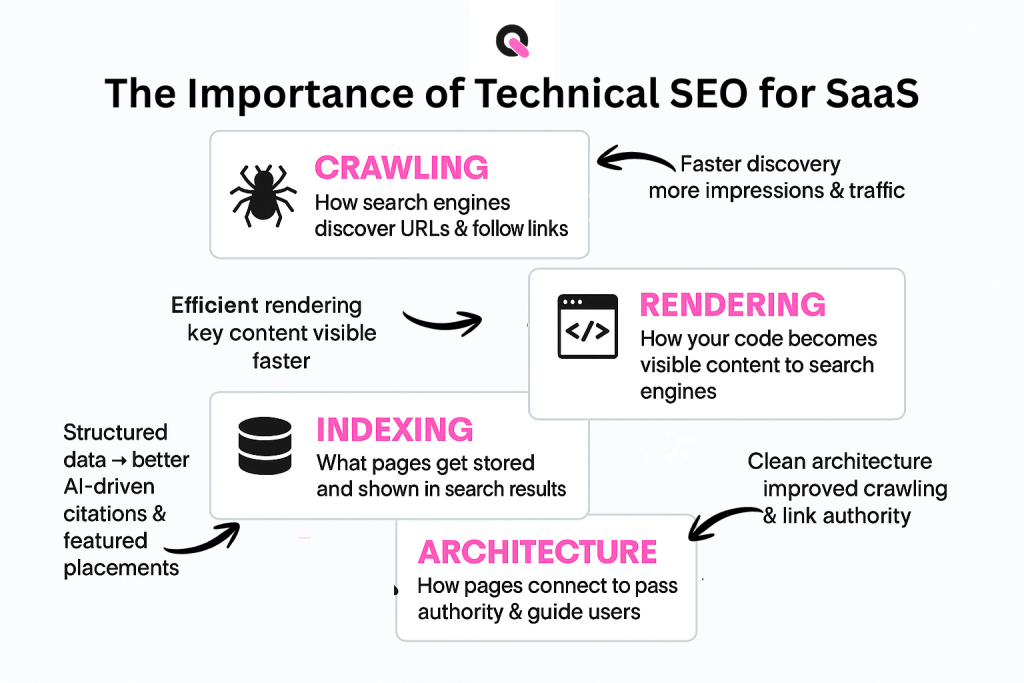
Fixing crawling and indexing gaps often multiplies the value of every page you publish. Technical SEO for SaaS is a multiplier: great content can underperform when indexation, templates, or tags are broken. Prioritize changes that lift both search visibility and conversion paths to demos or trials.
Indexation, Crawl Budget, and Site Architecture
Audit crawl patterns and block duplicate or parameter URLs that waste bots on low-value pages. Clean indexation ensures authority reaches high-value product and pricing pages.
Structure the website so solutions, use cases, and integrations sit close to money pages. That internal flow concentrates signals and reduces cannibalization.
Core Web Vitals, Speed, and User Experience
Performance affects both rankings and conversion rates. Fast pages keep demo funnels moving and lower drop-off on signup flows.
Measure CLS, LCP, and FID, then ship fixes that improve perceived speed and interaction quality.
On-Page Optimization: Metadata, Internal Linking, and Templates
Standardize metadata and templates to scale consistent titles and descriptions by page type. Use internal linking modules that point users toward demos and product pages.
Template fixes reduce thin content and improve indexable signals across resource and support sections.
Analytics Foundations for Reliable Measurement
Implement reliable event tracking, define conversion steps, and clean up UTM naming. Accurate analytics let teams prove pipeline impact instead of guessing.
- Priority: ship index and template fixes first.
- Impact: higher crawl efficiency, better traffic quality, and clearer attribution.
- Outcome: technical optimization that boosts both search visibility and demo/trial conversions.
Link Building And Digital PR For SaaS Brands
Off-page work shapes who ranks on high-intent product queries in crowded B2B categories. Backlinks and earned coverage build the external signals that push decision-stage pages into view.
Authority Building With Relevant, High-Trust Placements
Relevant, high-trust placements mean topical alignment, real readership, and editorial standards. Aim for sources that buyers respect and that send referral traffic, not just a line on a page.
Link-Earning Assets: Data Studies, Tools, And Guides
Create original data studies, free tools, calculators, benchmarks, and definitive guides. These assets attract natural citations and sustain long-term link building benefits.
Relationship-Driven Outreach And Brand Mentions
Prioritize quality targets, personalize outreach, and capture brand mentions proactively. Long-term relationships beat mass pitching when building links and digital pr presence.
- Internal prerequisites: strong on-site content and technical foundations so links amplify results.
- Guardrails: avoid spammy tactics that risk penalties and harm buyer trust in B2B marketing.
- Measurement: tie link acquisition to movement on BOFU terms, faster crawl discovery, and conversion-assisted traffic.
| Work | Why It Matters | Outcome |
| High-trust placements | Editorial validation | Stronger authority signals |
| Link-earning assets | Attracts citations | Ongoing referral links |
| Relationship outreach | Higher acceptance rates | Quality backlinks and mentions |
On-Page Conversion Optimization For SaaS SEO
Turning blog visits into demo requests begins with clear next-step offers and context-aware CTAs. Conversion work and search performance are inseparable: the true win is demos, trials, and signups, not raw pageviews.
Turning Blog Visitors Into Demos And Trials
Use contextual CTAs, sticky modules, and related-article templates that point readers to product actions. Offer next-step items like checklist downloads, gated demos, or small interactive tools that lead into trial flows.
Keep CTAs specific to intent. Awareness pieces should invite learning; comparison posts should nudge toward a demo.
Improving Product And Pricing Page Search Performance
Balance clarity and compliance. Optimize titles and copy to match purchase intent while preserving pricing transparency and legal needs.
Use structured content: clear value props, feature highlights, and visible CTAs that align to keyword intent and conversion goals.
Internal Paths That Move Users To High-Intent Pages
Design intentional journeys: TOFU education → MOFU proof (case studies) → BOFU decision pages (pricing, demo). Use internal links, in-line CTAs, and trust signals to reduce friction.
- Trust elements: customer logos, concise testimonials, and objection-handling FAQs.
- Testing: iterate with analytics and heatmaps to refine layouts and improve conversions.
- Outcome: conversion lifts make the website strategy easier to defend with revenue reports.
Reporting That Proves Business Outcomes
Reports should tie every activity to a measurable business outcome, not just traffic ticks. In subscription businesses, proof means revenue influence, trials, demo requests, and SQLs that trace back to pages and campaigns.
Dashboards That Tie Search To Revenue And Pipeline
Dashboards must show conversions by page group, assisted conversions, and pipeline value attributed to organic channels. Rankings belong on the dashboard only as context, use them to explain shifts, not as the main result.
What A Good Monthly Report Should Include
A strong monthly report contains: shipped work, impact analysis, blockers, next-month priorities, and the rationale behind each choice. Every entry should map to a hypothesis and a measurable outcome.
Transparency: What’s Done, What’s Next, And Why
Transparency reduces guesswork. Show completed tasks, evidence of impact, and clear next steps. Flag risks and data gaps so leadership can decide to keep investing or reallocate resources.
- Define proof: revenue influence, SQLs, trials, and landing-page conversion rates.
- Dashboard components: organic sessions (context), conversions, assisted conversions, pipeline by page group.
- Exec-ready summary: headline impact, dollars influenced, and near-term asks.
Spot misalignment early: beware reports that only highlight sessions while conversions stall. Insist on pipeline attribution and clear analytics so that any SaaS SEO agency or consultant demonstrates a verifiable track record of results.
What To Expect In The First 90 Days
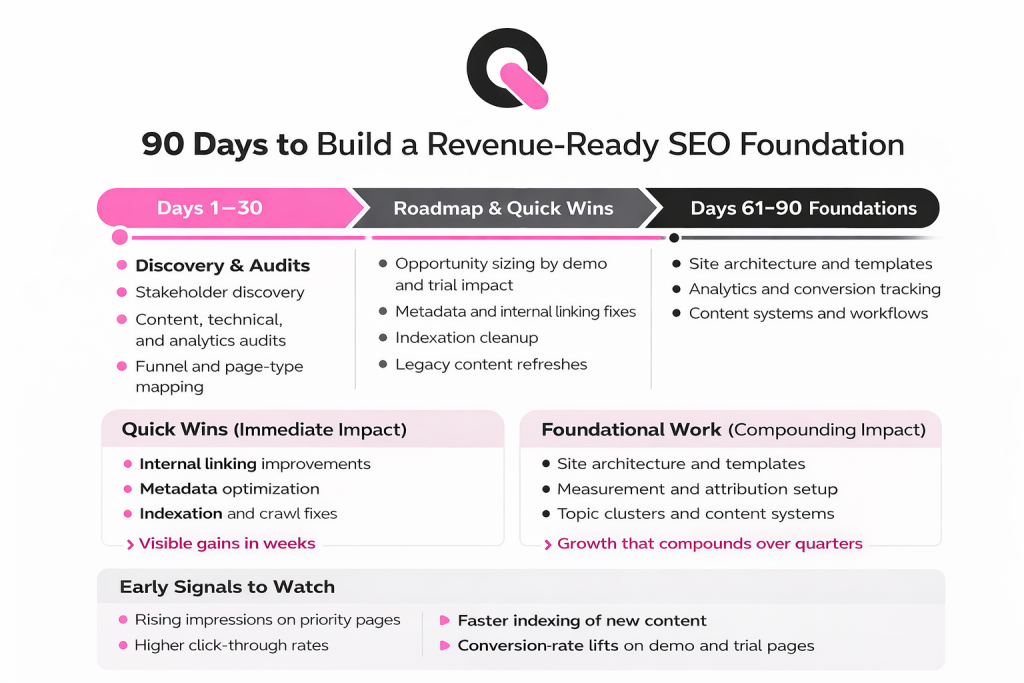
The first 90 days set expectations: rapid diagnosis, prioritized fixes, and clear measures of early movement.
Discovery, Audits, And Opportunity Sizing
Work starts with discovery and comprehensive audits of content, templates, and analytics. Teams map opportunities by funnel stage and page type.
Opportunity sizing estimates the impact on demo and trial volume, so priorities tie directly to revenue potential.
Quick Wins Vs. Foundational Work
Quick wins include internal linking, metadata fixes, indexation cleanups, and updates to high-potential legacy pages.
Foundational work covers architecture, analytics setup, content systems, and template optimization. Both run in parallel with clear owners.
Early Indicators Of Organic Growth
Leading signs arrive before rankings change: rising impressions, higher click-through rates, faster indexing, and conversion-rate lifts on target pages.
Credible case studies show measurable pipeline movement, not just traffic screenshots.
- Phases: discovery → audits → roadmap → sprints → measurement alignment.
- Quick wins + foundational fixes = steady growth and reduced technical debt.
How To Choose The Right Consultant Or SEO Agency
Picking the right agency shapes whether organic channels become a predictable revenue stream or an expense. Choose partners who understand subscription models and long buying cycles.
SaaS Specialization And Relevant Experience
Prioritize domain knowledge. Look for a SaaS SEO agency with direct experience with SaaS companies and product-led funnels. Ask for examples that show how content and product teams worked together to drive demos or trials.
A Track Record Of Measurable Results
Demand clear evidence. Request baseline metrics, the methodology used, and outcomes tied to demos, trial starts, or SQLs. A credible agency will share before/after data and attribution methods.
Clear Process, Clear Ownership, Clear Communication
Evaluate planning cadence, named owners, sprint artifacts, and reporting cadence. Confirm which services (content strategy, technical fixes, link building, CRO) are included and how they map to business goals.
- Compare proposals by expected impact, not deliverable volume.
- Validate experience with case studies and client references.
- Insist on weekly touchpoints and documented roadmaps.
- Match budget to scope and forecasted revenue influence.
| Selection Area | What to Ask | Why It Matters |
| Specialization | Work with saas companies | Aligns tactics to product-led funnels |
| Proof | Track record with demo/trial lifts | Shows measurable results |
| Process | Ownership, cadence, docs | Ensures execution and accountability |
Red Flags To Avoid When Hiring SaaS SEO Help
Red flags appear when deliverables are vague and reports offer no revenue link. That mismatch often hides weak planning or skimpy execution.
Empty Promises And “Wait Another Few Months” Reporting
Beware guaranteed rankings or messaging that promises quick miracles. These claims ignore competition and product-fit realities.
Monthly rank-only reports with a line like “wait another few months” signal poor measurement discipline or no clear experiments. Ask for short-term hypotheses and what will be measured in the first 30 days.
Over-Indexing On Traffic Without Conversion Impact
Traffic can be a trap. High-volume visits that never convert inflate vanity stats but do not create demos, trials, or SQLs.
Demand mapping from search intent to revenue. If a provider focuses only on impressions and rankings, they may be optimizing the wrong pages.
One-Size-Fits-All Deliverables For Complex Funnels
Generic deliverables ignore ICP differences, sales cycle length, and product-led motions. That leads to churned content and wasted marketing spend.
- Common red flags: guaranteed rankings, vague scopes, and reports that only show positions and sessions.
- Questions to ask: How do you map intent to revenue? What will you deliver in month one? How do you report outcomes by page group?
- Ethical approach: favor sustainable strategies that protect brand credibility over quick shortcuts that risk penalties.
| Red Flag | Why It Matters | What To Ask |
| Guaranteed rankings | Ignores competition and intent | Request evidence and realistic timelines |
| Traffic-only reports | Hides conversion failures | Ask for conversion and pipeline metrics |
| One-size deliverables | Misses ICP and funnel nuance | Require tailored scope and first-30-day plan |
Walk-away rule: if a provider cannot clearly connect work to business results, do not proceed. Protect your brand and budget and insist on pipeline-first proof.
How Queen Of Clicks Helps SaaS Businesses Grow With SEO
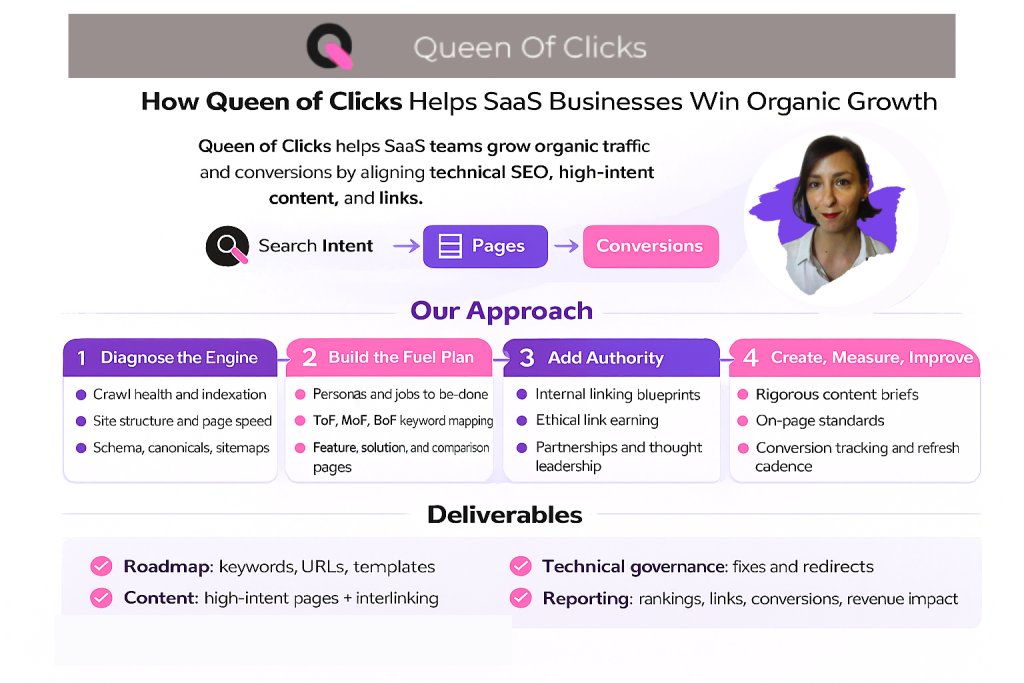
Queen of Clicks turns search work into a revenue engine, as we target queries that feed trial and demo funnels. Our aim is simple: build a pipeline-first strategy that converts qualified demand into measurable business outcomes.
What You Get Working With Queen of Clicks
Clients receive a revenue-connected roadmap that prioritizes pages tied to demos, trials, and SQLs.
Deliverables include:
- Full-funnel keyword research and content planning focused on ICPs and BOFU pages.
- Technical prioritization to remove blockers like indexation, templates, and internal linking.
- Conversion-driven on-page updates and editorial briefs that align to product activation.
- Transparent dashboards that link organic activity to pipeline and revenue.
How We Work With Your SaaS Teams
We run lightweight collaboration with marketing and coordinate closely with product and engineering to ship fixes fast.
Sales alignment is mandatory: we agree on definitions, feedback loops, and attribution rules so every metric maps to a business outcome.
What Success Looks Like
Success means higher visibility on high-intent queries and measurable lifts in demos, trials, and signups from organic search.
We prove impact with case studies that show baseline metrics, actions taken, and clear outcome data, so evaluation is evidence-based.
Ready to act?
- Queen of Clicks helps SaaS companies turn organic search into a predictable growth channel focused on pipeline, not vanity metrics.
- You get a prioritized roadmap tied to demos, trials, SQLs, and revenue, so everyone knows what matters next.
- We deliver full-funnel keyword research and content planning built around your ICP, including BOFU comparison and alternatives pages.
- We remove hidden blockers with technical and on-page fixes: indexation, templates, internal linking, and measurement.
- We provide transparent reporting that connects search performance to business outcomes and next-step priorities.
Book a strategy call with Queen of Clicks to review goals, identify quick wins, and map a 90-day plan.
Conclusion
Aligning content, product, and sales turns search work into measurable pipeline growth. Treat optimization as a revenue play, not a traffic game. Clear priorities make impact predictable and repeatable.
Product-led work differs from broad promotion, pipeline-first measurement matters, and execution must connect content to activation. Use full-funnel keyword research, authority-building content, technical fixes, link earning, and on-page conversion work as primary levers.
Hire help when growth stalls, traffic converts poorly, content scales without a plan, or a migration threatens performance. Demand a clear process, named owners, and reporting that proves business outcomes.
If you want predictable growth from organic search, book a call with Queen of Clicks to define a 90-day roadmap and start driving demos, trials, and revenue.
FAQs
How much does an SEO consultant for SaaS typically cost in the US market?
Pricing varies based on scope, company stage, and goals. In the US market, SaaS-focused consultants usually work on monthly retainers ranging from mid four figures to low five figures. The key is not the price itself, but whether the engagement is tied to pipeline impact (demos, trials, SQLs) rather than task volume.
How long does it take to see results from SaaS SEO consulting?
Early indicators often appear within 30–60 days (better CTRs, faster indexing, conversion lifts), while meaningful pipeline impact usually shows within 3–6 months. Revenue influence compounds over time as BOFU pages, authority, and internal paths mature.
Should a SaaS company hire a consultant or build an in-house SEO team?
Early and mid-stage SaaS companies often benefit more from a consultant who can design the strategy, systems, and priorities quickly. In-house teams make sense once there is enough scale and clarity to justify full-time execution. Many companies start with a consultant, then transition parts of the work internally.
What company stage benefits most from hiring a SaaS SEO consultant?
Product-led SaaS companies with a validated ICP, working analytics, and a clear demo or trial funnel benefit the most. Pre-product-market-fit companies usually move too fast for SEO leverage, while post-fit teams can turn organic search into a scalable acquisition channel.
How does a SaaS SEO consultant work with existing agencies or internal teams?
A consultant typically owns strategy, prioritization, and measurement, while internal teams or agencies execute under a shared roadmap. This model avoids overlap, reduces wasted work, and ensures all efforts align with revenue goals.
What tools does a SaaS SEO consultant usually rely on?
Most consultants use a mix of crawl tools, keyword platforms, analytics (GA4, Search Console), and CRM data. The exact stack matters less than how data connects search behavior to trials, demos, and SQLs.
How do consultants handle SEO ownership after the engagement ends?
Strong consultants leave behind documentation, dashboards, keyword maps, and repeatable processes. The goal is not dependency, but clarity, so internal teams can continue execution without losing momentum.
Can SEO consulting replace paid acquisition for SaaS?
SEO does not replace paid channels, but it reduces long-term acquisition costs and dependency on ads. Over time, organic search becomes a stabilizing growth layer that supports paid, outbound, and sales-led motions rather than competing with them.