SEO Company for SaaS: Why Your SaaS Business Needs One
An SEO company for SaaS is a specialized agency that optimizes software websites to attract, convert, and retain users through organic search. Unlike general SEO agencies, a SaaS SEO agency understands SaaS-specific challenges, long sales cycles, complex products, feature-driven pages, integration keywords, pricing intent, and demo/free-trial conversions. Their job is simple: make your ideal customers find you on Google at the exact moment they’re searching for the problem your product solves.
Key Takeaways
- Queen of Clicks ties organic programs to revenue outcomes.
- Focus on keyword mapping and website quality first.
- Technical fixes and content lift improve visibility across stages.
- Practical tool stack reveals crawl, speed, and mobile issues.
- Prioritize high-impact pages to avoid wasted effort.
- Reporting links activity to pipeline so teams stay aligned.
Why SaaS Companies Need a Specialized SEO Partner Today
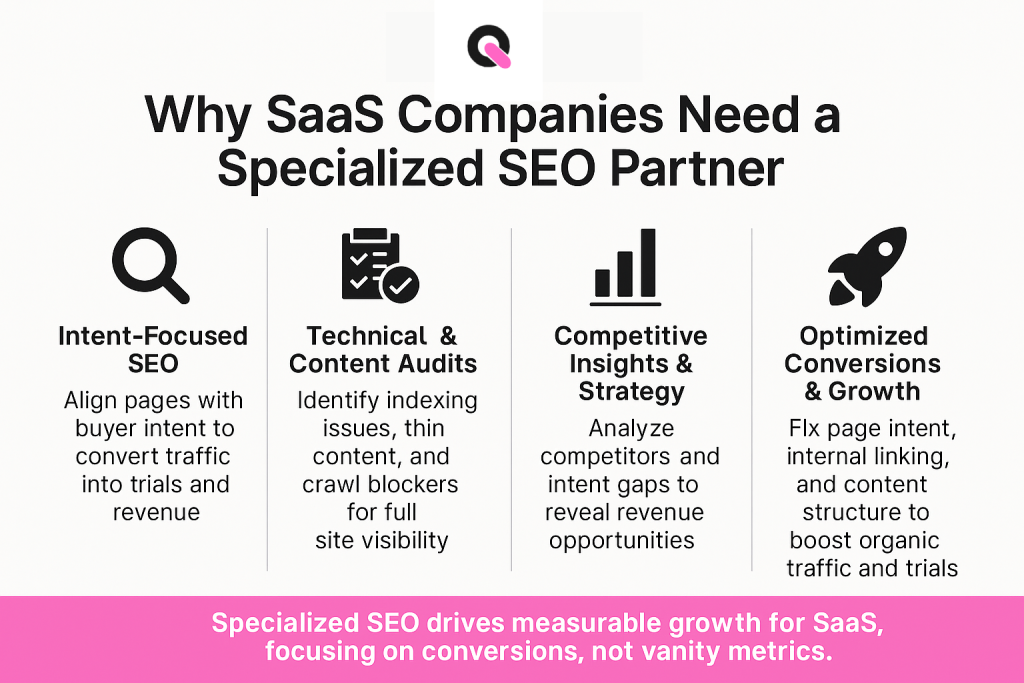
When buyers search, your pages must answer their intent or you lose revenue. Many saas companies see traffic but not trials because keyword targeting misses buyer intent or pages lack clear conversion paths. Consistent investment in SEO delivers an average 748% ROI over three years, making it one of the most powerful growth channels for SaaS companies.
Queen of Clicks audits these gaps and finds issues like “Discovered – currently not indexed,” thin content, and poor intent matching. We surface competitive insights and intent maps that reveal ARR shortfalls.
You get a tailored strategy that aligns solution pages, comparisons, and use cases to how potential customers actually search. That means organic traffic that compounds instead of short-lived spikes.
- You operate in a crowded category where search dynamics shift fast; focus on business goals, not vanity metrics.
- Competitive analysis explains why your website underperforms even while you ship new features.
- Fix crawl/index blockers, tighten page intent, and build internal links to boost visibility and conversions.
What Sets an SEO Company for SaaS Apart
A results-first approach shifts focus from raw traffic to measurable revenue and pipeline expansion. You need work that ties rankings and clicks to sign-ups, not just impressions.
Revenue-Focused Strategy Over Vanity Metrics
You get a revenue-first strategy that maps keyword intent to page types and conversion flows. That means the team targets buyer stages that actually drive demos and trials.
Clear reporting links execution, like when a link goes live, to rankings, clicks, and conversions so you see impact fast.
CAC-Efficient Growth Within Months
Specialized providers aim for profitable CAC payback in under 12 months when execution is prioritized. The embedded model brings an SEO lead, technical specialist, content writer, outreach manager, and project manager to act like an in-house team.
This setup reduces acquisition costs, as it focuses on high-value keywords, relevant page types, and targeted outreach that move revenue.
- Embedded team behavior that accelerates growth
- Experience across startups to large platforms for faster decisions
- Frameworks that deliver near-term wins and long-term authority
| Capability | What it Drives | Timing to Impact | Why it Matters |
| Keyword mapping | Targeted discovery & evaluation | 1–3 months | Improves conversion fit and lowers wasted spend |
| Technical fixes | Indexing & speed | 1–2 months | Unlocks visibility and better UX |
| Outreach & links | Authority and referral traffic | 3–9 months | Supports sustained rankings and revenue |
Core SEO Strategy That Drives Predictable Growth
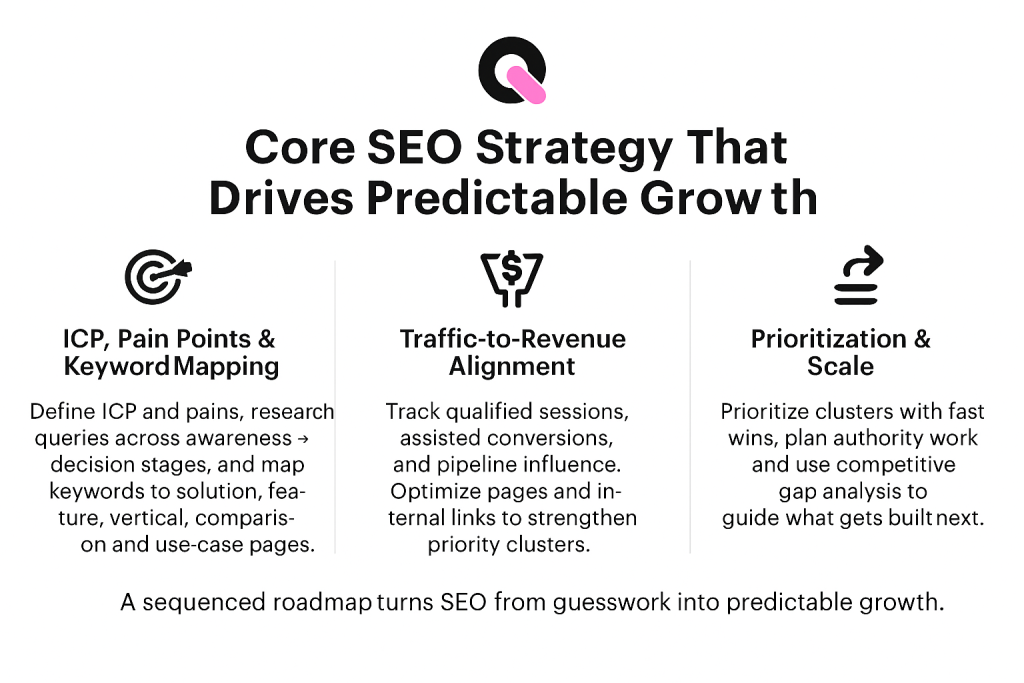
First, define who you sell to and which pains trigger their search so every page answers a real need. That foundation makes keyword work deliberate rather than scattershot.
ICP, Pain Points, And Keyword Mapping
Start with an ICP and pain inventory to anchor your keyword research. Use tools like Ahrefs or SEMrush to spot gaps and surface queries buyers use at awareness, consideration, and decision stages.
Map those keywords to the right page types, solution, feature, vertical, comparison, and use-case pages, so intent matches the page’s conversion goal.
Traffic-To-Revenue Alignment And Page Targeting
Assign metrics to each page: qualified sessions, assisted conversions, and pipeline influence. That ties traffic to real goals and keeps teams accountable.
On-page optimization and internal linking then pass authority into priority clusters to improve crawl efficiency and conversion fit.
Prioritization Frameworks For Fast Wins And Scale
- Prioritize clusters that deliver near-term traffic and revenue while scheduling head-term authority work.
- Follow a sequenced roadmap to avoid context switching and wasted effort.
- Use competitive gap analysis and click-potential models to validate what you build next.
Technical SEO Foundation For Crawlability And Speed
Fix how search engines discover and render your most valuable pages. A focused technical audit reveals crawl depth, coverage gaps, and render issues so priority URLs actually appear in results.
Crawl, Index, And Site Architecture Optimization
Use Screaming Frog, Google Search Console, and server logs to map what bots see. Audit coverage reports and sitemaps to find “Discovered – currently not indexed” signals and blocked paths.
Refine architecture so link equity flows to revenue-driving pages. Adjust XML sitemaps, canonical controls, and internal linking to reduce crawl waste on low-value URLs.
Remediate common traps: duplicate content, faulty canonicals, pagination loops, and parameter bloat that hold back rankings.
Page Experience: Speed, Mobile, And Core Web Vitals
Use PageSpeed Insights to drive targeted optimization. Improve LCP, INP, and CLS with image compression, critical CSS, and resource deferral.
Address mobile readiness with responsive patterns, lazy loading, and proper viewport handling so pages render quickly on phones and tablets.
- Audit logs and coverage to ensure priority pages are indexed and rendered.
- Streamline architecture so link equity reaches conversion pages.
- Fix duplicate content, canonicals, and parameter issues to lift rankings.
- Improve Core Web Vitals and mobile speed to boost engagement signals.
- Apply structured data to clarify entities and improve SERP eligibility.
- Set regression alerts to catch index drops after deployments.
| Issue | Remedy | Expected Impact |
| Not indexed | Resubmit sitemap, fix render blockers | Improved visibility in engines |
| Thin crawl path | Rebuild internal links, prioritize sitemap | Faster discovery of priority pages |
| Poor page experience | Optimize LCP/INP/CLS, mobile fixes | Better engagement and rankings |
SEO Content That Wins Search And Converts
Content that answers intent and shows implementation wins both clicks and sign-ups. Build pages that teach buyers, compare options, and prove product fit. That approach lifts visibility and drives measurable conversion.
Topical Maps, Clusters, And Search Intent
Create topical maps that group clusters around buyer problems and features. Use keyword research to match queries at awareness, evaluation, and decision stages.
Solution Pages, Comparisons, And Conversion Copy
Design solution pages and comparison pages to match high-intent search. Write conversion-focused copy that leads users to demos or trials. Add screenshots and examples to show implementation.
Editorial Operations And SME-Backed Content Creation
Operationalize content creation with briefs, SME interviews, and quality checks. That process secures accuracy and EEAT signals while speeding publication.
- Internal linking channels authority from educational clusters into decision pages.
- Track engagement and assisted pipeline to spot lift and iterate.
- Differentiate with implementation details that prove product fit to your audience.
| Content Type | Intent | Impact |
| Topical pillar | Awareness | Traffic & visibility |
| Solution/comparison | Decision | Conversion lift |
| SME guides | Evaluation | Trust & accuracy |
Link Building And Outreach For Authority
Build a lasting backlink profile that points real authority to your highest-value pages. Link building for SaaS means a focused outreach program that combines credibility, relevance, and scale to lift visibility, where it drives sign-ups and demos.
Start with competitor backlink analysis to spot winable placements. Then craft outreach assets that match editorial needs and your product voice. Keep tactics ethical and aligned to buyer intent so links remain sustainable.
High-Quality, Relevant Backlinks At Scale
You pursue link building that targets topically relevant, authoritative websites. Prioritize placements that feed commercial or comparison pages to speed rankings and conversions.
Diverse Tactics: Digital PR, Guest Posts, And HARO
- Digital PR to earn coverage on high-authority sites and industry publications.
- Guest posts and selective link insertions to place contextual links on relevant websites.
- HARO and expert commentary to secure natural citations and referral traffic.
- Coordinate outreach with brand voice to improve replies and link acceptance.
| Type | Benefit | Timing |
| Guest posts | Topical relevance; control of anchor text | 1–3 months |
| Digital PR | Wide reach; brand signals | 2–6 months |
| HARO / Mentions | Fast citations; referral traffic | Weeks |
Reporting ties each live placement to domain metrics, relevance, anchor text, and expected impact on rankings and traffic. Maintain strict quality standards to protect your domain and long-term gains.
From Audit To Execution: Your SaaS SEO Process
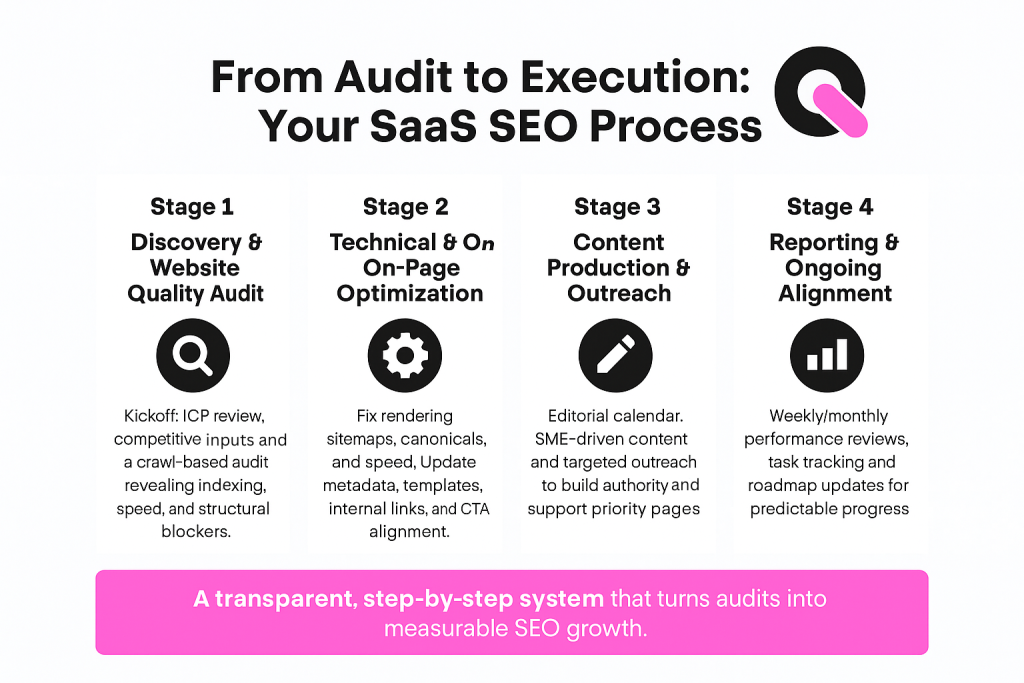
Clear steps and regular cadence keep work transparent and tied to outcomes. A SaaS SEO starts with structured discovery and moves into a full website quality audit that surfaces technical and content gaps. That SaaS SEO audit guides a prioritized roadmap so fixes happen where they matter most.
Discovery, Website Quality Audit, And Technical Fixes
You begin with a kickoff, ICP and competitor questionnaires, and a crawl-based audit. The audit finds indexing, speed, and structural blockers and ranks them by impact.
The technical fixes focus on rendering, sitemap updates, canonical rules, and speed improvements so priority pages are visible and fast.
On-Page Optimization And Internal Linking
On-page work updates metadata, templates, and internal links. You get a prioritized list of pages with recommended keyword placement, headings, and CTA alignment.
Template-level changes scale optimization across similar pages to save time and keep messaging consistent.
Content Production, Outreach, And Iteration
Content creation runs on an editorial calendar with briefs, SME interviews, and review cycles. Link building runs in parallel to support priority pages and lift domain authority.
You iterate monthly based on performance deltas, adjusting keywords, page depth, or content type to improve results fast.
Reporting Cadence And Stakeholder Alignment
Weekly or monthly calls review rankings, traffic, completed tasks, and next steps. Task tracking in Notion or Asana provides real-time transparency.
The collaboration model assigns a core team that manages work and keeps stakeholders aligned during the agreed months of engagement.
- Discovery and audit → prioritized roadmap
- On-page + templates → consistent optimization
- Content calendar + outreach → authority and conversions
- Regular reports → clear insights and predictable timeframes
Timelines, Results, And What To Expect
Expect clear early signals that show the work is taking hold before large traffic lifts appear. These leading indicators prove the project is on track and guide next steps.
First Signals, Compounding Gains, And Time To Impact
You should see indexation fixes, impression growth, and modest movements in rankings within weeks.
Meaningful increases in organic traffic usually compound over months as topical authority builds and more pages win related queries.
Less competitive keywords can move within 30 days; highly competitive software terms often need 6–24 months to reach stable first-page results.
Ranking Dynamics For Competitive Keywords
Competitive keywords require steady content, technical work, and link signals. Expect gradual rises rather than instant jumps.
You’ll get a post-audit estimate of time to impact per cluster and ongoing projections that adjust with real data.
- Early indicators: indexation, impressions, rank nudges.
- Compounding gains: clustered pages lifting traffic over months.
- Timeline reality: 6–24 months for top competitive terms; faster for mid- and long-tail targets.
- Flexible planning: reallocate effort toward pages showing highest velocity.
| Signal | When You Might See It | What It Means |
| Indexation improvements | Days–weeks | Search engines are discovering priority pages |
| Impression growth | Weeks–months | Visibility expands; queries begin to match content |
| Ranking movement | Weeks–months | Queries start to favor your pages; traffic may follow |
| Traffic lift | Months | Compound effect from authority and more matched pages |
What you’ll get: ongoing scenario plans, regular updates, and a refined timeline per cluster so your team can budget and prioritize with clarity.
Investment, Team Structure, And Engagement Models
Match monthly retainers to a mapped roadmap that ties tasks to measurable outcomes. That makes budgets predictable and keeps work aligned to your growth goals.
Retainers, scope, and resource planning
You typically engage on a monthly retainer that covers content, technical fixes, link acquisition, and reporting. Agreements are rolling and flexible to adapt as performance signals appear.
Plan resourcing against the roadmap so website and content work are sequenced to maximize impact each phase. Expect meaningful outcomes in 6–18 months depending on competition and targets.
Embedded cross-functional team
You get an embedded team: a strategist, a technical specialist, a content lead, and an outreach manager. A project lead coordinates tasks and keeps timelines on track.
- Transparent reporting: rankings, links, completed tasks, and milestones.
- Focused optimization: work compounds across topic clusters and lifts visibility in search engines.
- Predictable cadence: regular check-ins and clear handoffs to support your business.
| Model | Deliverables | Timing |
| Monthly retainer | Content, tech fixes, outreach, reporting | Ongoing |
| Embedded team | Strategy, technical, content, outreach | Immediate |
| Rolling scope | Adjust based on KPIs and traffic signals | Every 1–3 months |
How Queen of Clicks Helps SaaS Businesses Grow
A clear, revenue-centered plan makes organic work a repeatable growth channel for your product. We focus on the pages and keywords that drive demos, trials, and measurable pipeline progress.
Why Partner With Queen of Clicks
Practical, measurable work. With Queen of Clicks, you get a roadmap that ties content, technical fixes, and link building to business outcomes. Weekly and monthly reports keep stakeholders aligned.
- Revenue-centered approach: align keywords, page strategy, and content with your pipeline so organic efforts convert to demos and sales.
- Technical excellence: resolve crawlability, indexation, speed, and UX blockers using tools like Google Search Console, Screaming Frog, Ahrefs, and PageSpeed Insights.
- Content engine: our team produces content creation mapped to intent, solution pages, comparisons, and educational pieces that convert potential customers.
- Link building: digital PR, guest posts, and expert sourcing to earn high-quality links that lift visibility and referrals.
- Transparent delivery: embedded team structure and clear reporting show results and next steps every week or month.
Start a conversation today. Book a call with Queen of Clicks to review your current performance, identify quick wins, and map a path to durable growth.
Conclusion
The right mix of technical fixes, intent-led content, and targeted outreach turns steady effort into measurable pipeline gains.
You’ve seen how a specialized SEO strategy, executed by an embedded team, can lift visibility and rankings while driving organic traffic that converts.
Get the fundamentals right: clean crawlability, intent-matched pages, and thoughtful link building that supports conversion and long-term authority.
Use clear reporting and shared goals to keep work accountable and aligned with your marketing and business objectives. Prioritize the keywords and pages that matter most to your website.
You can move forward with confidence. Book a call with Queen of Clicks to validate opportunities, set timelines, and start executing the roadmap that meets your goals.
FAQs
When should a SaaS company hire an SEO partner?
You should hire an SEO partner when you need predictable growth, you’re expanding into competitive categories, organic traffic isn’t converting, or internal teams lack time or technical skills to maintain search performance. Early-stage SaaS companies benefit from faster discovery; mid- and late-stage companies benefit from scale and efficiency.
How long does SEO take for SaaS businesses to see real results?
Most SaaS companies see the first signs, indexation fixes, impression lift, early rankings, within weeks, but meaningful traffic and demo growth usually takes 3–6 months for mid-tail keywords. Highly competitive SaaS terms may need 6–24 months depending on domain authority, competition, and execution speed.
What KPIs should SaaS companies track to measure SEO success?
Track metrics tied to revenue and pipeline: qualified organic sessions, demo and trial conversions, assisted conversions, pipeline influence, keyword movement for high-intent pages, indexation rates, and backlink quality. Vanity metrics like raw traffic or impressions add little value without conversion context.
Should SaaS companies invest in SEO if they already run PPC?
Yes. PPC is fast but expensive, while SEO compounds and reduces CAC over time. The strongest SaaS growth strategies use both: PPC for immediate pipeline and SEO for sustainable, cost-efficient acquisition that strengthens brand authority and lowers long-term reliance on paid channels.
What types of content does a SaaS SEO company create?
They typically create solution pages, comparison pages, integration pages, product-led tutorials, customer use-case pages, and educational blog content. All content is mapped to buyer intent, from awareness to evaluation to decision, so each page supports sign-ups or demos.