SaaS SEO Tips: Proven Strategies to Drive Qualified Traffic
SaaS SEO is the process of attracting buyers who are actively searching for solutions like yours and turning that demand into consistent, high-intent traffic. Unlike general SEO, it focuses on product-led pages, use cases, integrations, and comparison queries that map directly to how SaaS products are researched and purchased.
Doing SEO for your SaaS is important because SaaS growth depends on predictable demand. Paid channels stop the moment budgets pause, while SEO compounds over time and captures intent at every stage of the funnel, from problem awareness to vendor evaluation. When done right, SaaS SEO lowers customer acquisition costs, supports sales and product teams, and becomes a durable growth channel rather than a traffic experiment.
Key Takeaways
- Organic search builds durable, cost-efficient traffic that compounds over time.
- Align content and SEO to real buyer journeys to increase trials and conversions.
- Follow a repeatable workflow: research, create, optimize, link, measure, refresh.
- Combine technical fixes, product-led content, and targeted pages for best results.
- Use briefs, templates, and QA to maintain consistent output at scale.
What SaaS SEO Is And Why It Fuels Compounding Growth
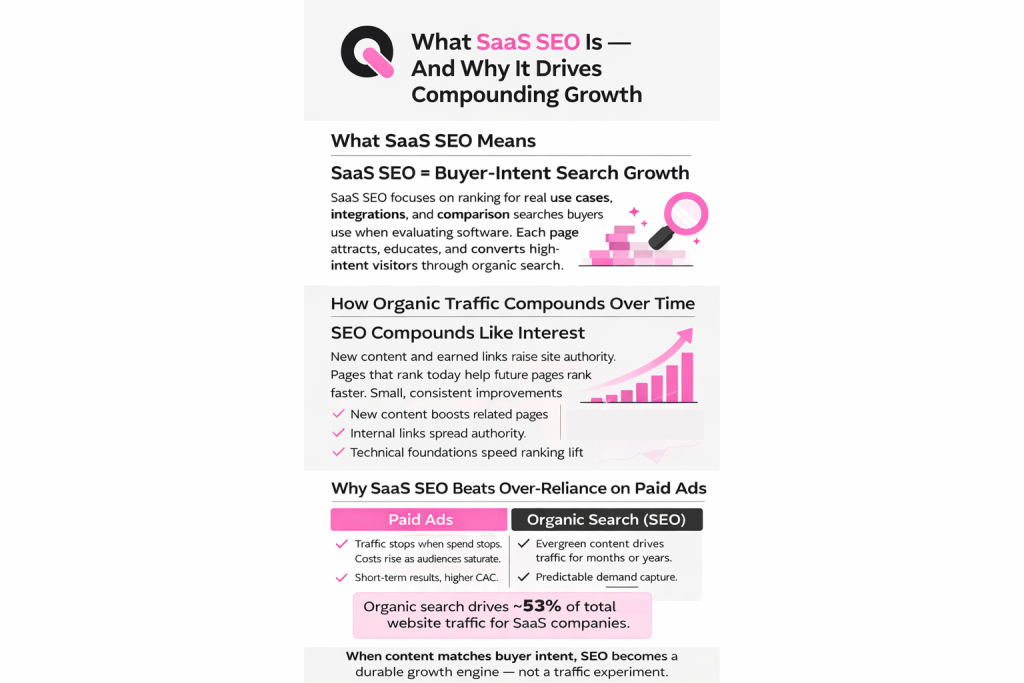
When content aligns with buyer intent, each new page becomes an investment that grows over time. It is the process of optimizing your website and content to attract, educate, and convert buyers through search. This work makes traffic more predictable because rankings reflect real keyword demand.
For SaaS companies, this means targeting queries that reflect real use cases and buying intent, so organic search becomes a reliable driver of qualified leads and sustainable growth, with organic search still driving around 53% of total website traffic for SaaS sites.
How Organic Traffic Compounds Over Time
New, high-quality content and earned links lift the authority of related pages. Over time, gains stack: a page that ranks today helps others rank tomorrow.
- Growth behaves like interest on capital, small, steady gains accelerate with consistent execution.
- Technical foundations and internal linking speed the lift across a site.
Why SEO Beats Over-Reliance On Paid Channels
Paid acquisition often faces rising costs as audiences saturate. Evergreen content can keep driving leads for months or years after publication.
- Organic visibility feeds retargeting, email capture, and sales enablement to multiply downstream performance.
- Focused strategy wins intent-rich terms that bring solution-aware and product-aware visitors who convert better.
Mapping The SaaS Buyer Journey To Search Intent
Buyers use search differently at each stage, and your content must match those differences. Visitors land with varying awareness: curious, comparing, or ready to buy. Treat every session as an independent moment in the funnel.
Top, middle, and bottom queries map to distinct assets. Top funnel queries ask “what” or “how” and suit explainers and guides. Middle funnel visitors want feature pages, industry examples, and integrations. Bottom funnel queries focus on comparisons, pricing, and trials.
- Guide broad explainers into tighter solution pages to reflect jobs-to-be-done.
- Shift messaging from education (problem-aware) to differentiation (product-aware).
- Answer follow-ups and common objections within MOFU and BOFU pages to reduce drop-off.
- Use SERP cues and on-site behavior to validate that pages meet search intent and lower pogo-sticking.
Design clusters that link top funnel explainers to product and integration pages. Tag pages by funnel stage and track engagement. That lets you measure gaps and tune CTAs, lead magnets at the top, interactive demos mid-funnel, and trials or sales routes at the bottom.
SaaS SEO Tips: A Brief Overview
Focus your content program on problems your buyers actually search to win intent-driven visits. Start with interviews and support feedback to surface urgent pains. Combine that qualitative research with query data to confirm demand.
Prioritize Topics That Match Real Pain Points
Cluster content by jobs-to-be-done so pages form a coherent set instead of isolated posts. Prioritize terms where your team can add unique data, frameworks, or product-led workflows.
Evaluate intent fit and monetization potential alongside volume. Not every high-volume keyword drives pipeline.
Balance Quick Wins With Long-Term Moats
- Target lower-difficulty, mid-volume queries for near-term wins that boost traffic and confidence.
- Invest in authoritative pillar pages to establish topical authority over time.
- Use internal links to channel authority into key MOFU and BOFU pages that influence conversion.
- Plan regular refresh cycles for time-sensitive content to protect rankings.
| Focus | Short-Term | Long-Term |
| Topic Selection | Low difficulty, mid volume | Pillars with original data |
| Execution | Repeatable outlines, fast production | In-depth research, cross-linking |
| Measurement | Traffic and keyword movement | Assisted conversions and demo starts |
Keyword Research For Each Funnel Stage
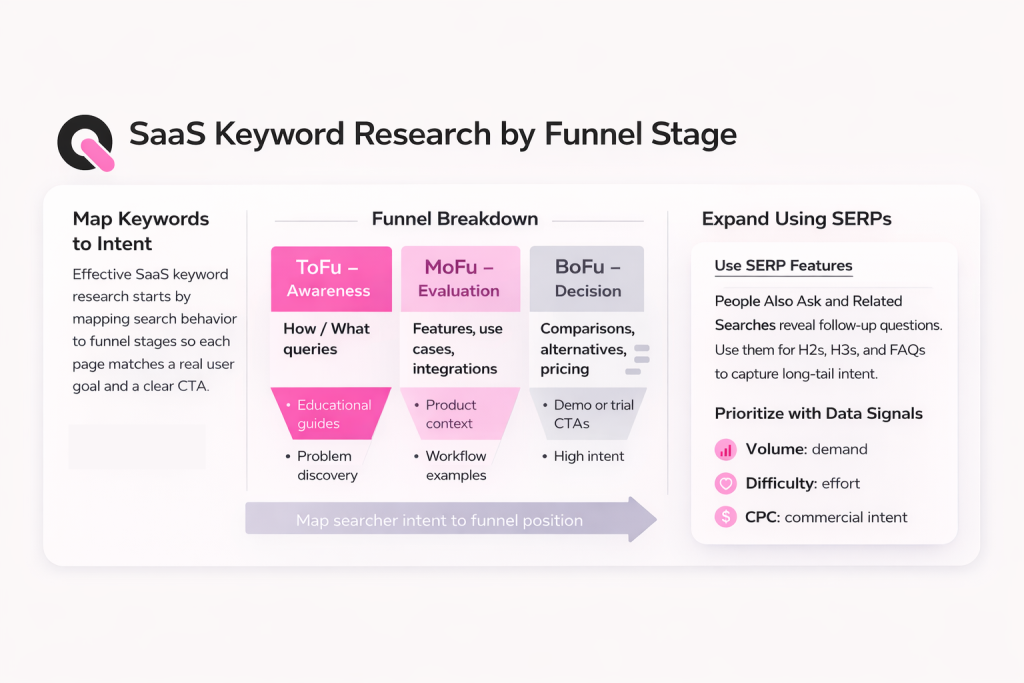
SaaS keyword research means mapping search behavior to funnel stages first; then building keyword sets that reflect real user goals. Segmenting queries ensures the right content appears with the right call to action.
Building ToFu, MoFu, And BoFu Keyword Sets
Top funnel focuses on broad how/what guides. Middle funnel groups by categories, features, integrations, and industries. Bottom funnel targets comparisons, alternatives, and pricing to influence final selection.
Reading SERPs: People Also Ask And Related Searches
Mine People Also Ask and Related Searches to expand clusters and capture adjacent questions. Use those results for H2/H3s and FAQs so pages answer follow-up queries and reduce pogo-sticking.
Assessing Volume, Difficulty, And CPC Signals
Use volume and difficulty to balance quick wins with long-term plays. CPC acts as a proxy for commercial value; prioritize terms where CPC and difficulty indicate strong intent and feasible effort.
Incorporating Error-Fix And Troubleshooting Keywords
Include queries with “error,” “not working,” and troubleshooting phrases to capture urgent, solution-ready sessions. These pages often convert faster when paired with clear fixes and product-led examples.
- Segment queries by funnel stage and set matching CTAs.
- Mine SERP features for subtopics and long-tail phrases.
- Balance volume, difficulty, and CPC when prioritizing targets.
- Map each keyword to one primary page to prevent cannibalization.
Technical SEO: Build A Fast, Crawlable, And Scalable Engine
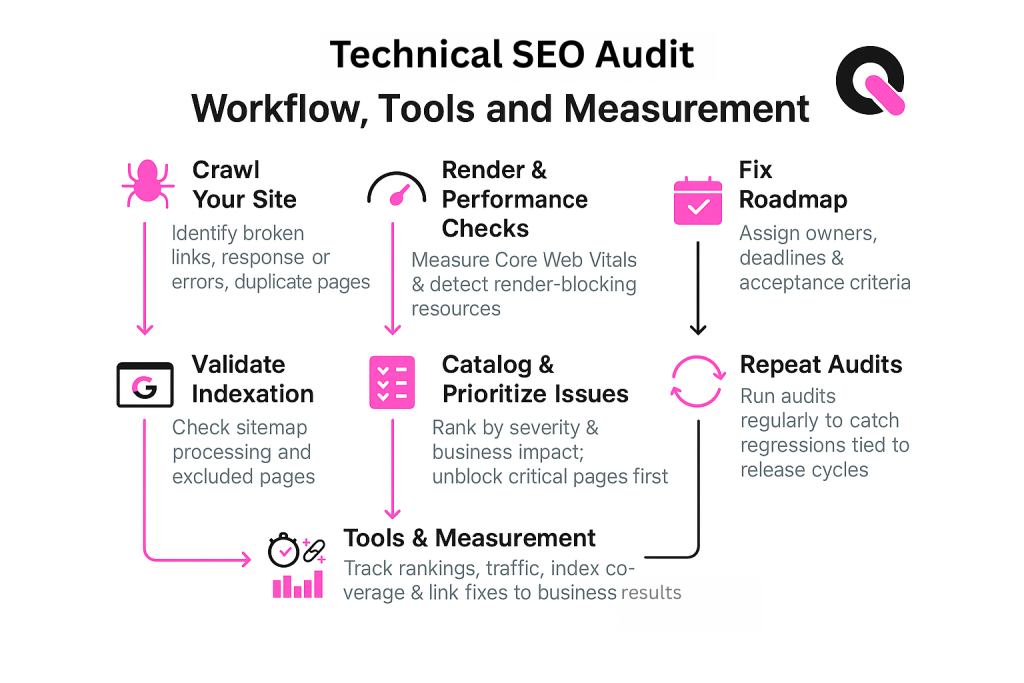
Technical SEO for SaaS is the practice of ensuring your website is fast, crawlable, indexable, and stable so search engines can reliably discover, understand, and rank your product, feature, and content pages.
Sitemaps, Indexing, And Robots Directives
Ensure sitemap.xml lists all indexable, priority pages and is submitted to publisher search tools for faster discovery.
Control crawling with robots directives and use noindex for low-value pages to avoid index bloat.
Schema Markup And Canonicals Done Right
Implement Organization, Article, and relevant structured data to clarify page types for search engines and unlock SERP features.
Set canonical tags to prevent duplicate content and concentrate relevance signals on a single canonical page.
301 Redirect Hygiene And URL Strategy
Use 301 redirects carefully during URL changes or migrations to preserve link equity.
Adopt clean, descriptive URL patterns aligned to topic clusters and internal linking plans.
Performance, Mobile Responsiveness, And Core Web Vitals
Optimize performance budgets: compress images, defer non-critical scripts, and prune unused CSS to hit Core Web Vitals.
Validate mobile responsiveness and tap targets to protect engagement on smaller screens.
- Monitor crawl stats and index coverage daily for anomalies and fix promptly.
- Document a repeatable technical change protocol to reduce risk and shorten time to recovery.
- Use audit tools to schedule scans and track improvements over time.
- Submit sitemap.xml and manage indexing.
- Add schema and canonical tags correctly.
- Consolidate equity with careful 301 redirects.
- Ensure mobile and Core Web Vitals compliance.
On-Page SEO That Meets Search Intent
On-page work shapes how your pages answer real queries and move visitors toward conversion. Group related content so users and crawlers find logical paths from broad explainers to decision pages.
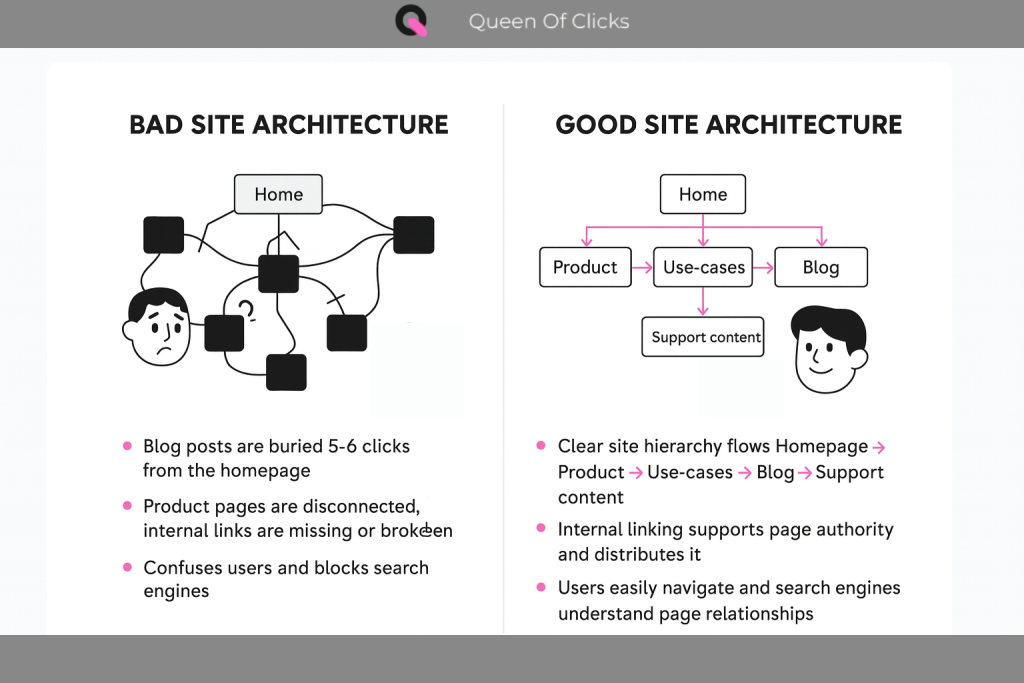
Clear Information Architecture And Internal Linking
Design clusters that surface key MOFU and BOFU destinations. Use clear parent pages and short subpages to keep navigation simple.
Build linking paths that connect pillar pages, supporting posts, and product pages to flow authority where it matters.
Semantic Keyword Placement Without Stuffing
Place primary and secondary terms naturally in titles, H1/H2s, intros, and alt text. Avoid repetitive use and focus on context.
Write scannable headings and short paragraphs so readers find answers fast and the site signals relevance for search intent.
Compelling Meta Titles And Descriptions
Craft metas that state the pain, the outcome, and a clear next step. A succinct title and outcome-focused description lift CTR and set expectations for the page.
Value-Adding Visuals: Screenshots, Diagrams, And Data
Use screenshots and diagrams to show steps, not decoration. Add captions and alt text to improve accessibility and indexing.
- Include structured FAQs to capture long-tail queries and featured snippets.
- Match CTAs to stage: guides for discovery, demos for evaluation, trials for decisions.
- Review on-page elements in refresh cycles and use audit tools to keep alignment with evolving intent.
| Element | Best Practice | Outcome |
| Internal structure | Cluster topics and link pillars | Faster discovery, stronger authority |
| Meta tags | Pain → outcome in title/description | Higher CTR from results |
| Visuals | Instructional images with alt text | Better user experience and clarity |
Product And Landing Pages That Convert
Decision-stage pages must reduce friction and show clear pathways to value for busy evaluators. Focus each page on one outcome and one clear next step: demo, trial, or contact.
Feature, solution, use-case, and integration pages should tie capabilities to jobs-to-be-done and quantified outcomes. Use brief headers, bullets, and one-line results so a reader grasps value in seconds.
- Map features to exact pains and metrics for each target audience.
- Write solution pages for top industries and roles with real-world setups.
- Show integration workflows and quick setup steps for ecosystem tools.
Optimizing demo, pricing, and trial flows
Make demo, pricing, and trial pages fast and scannable. State expectations, time-to-value, and required steps up front.
- Place social proof and logos near CTAs to reduce anxiety.
- Offer interactive elements, calculators or sandboxes, to shorten time to value.
- Keep navigation consistent and CTAs persistent as users scroll.
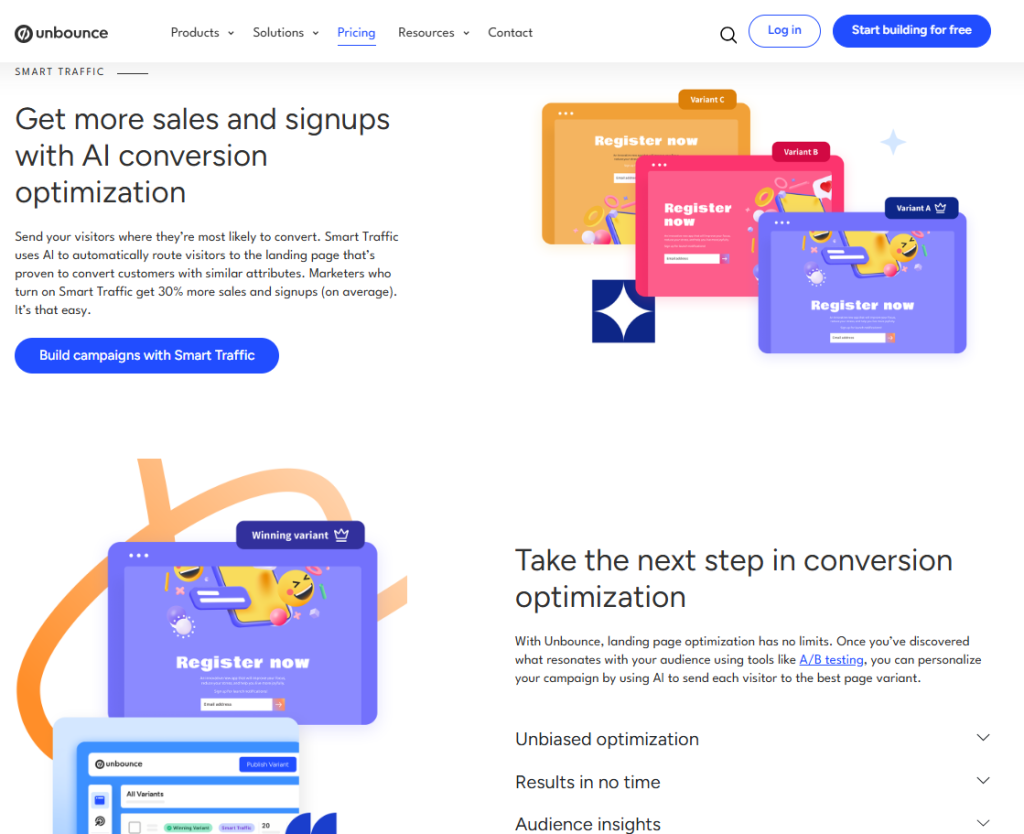
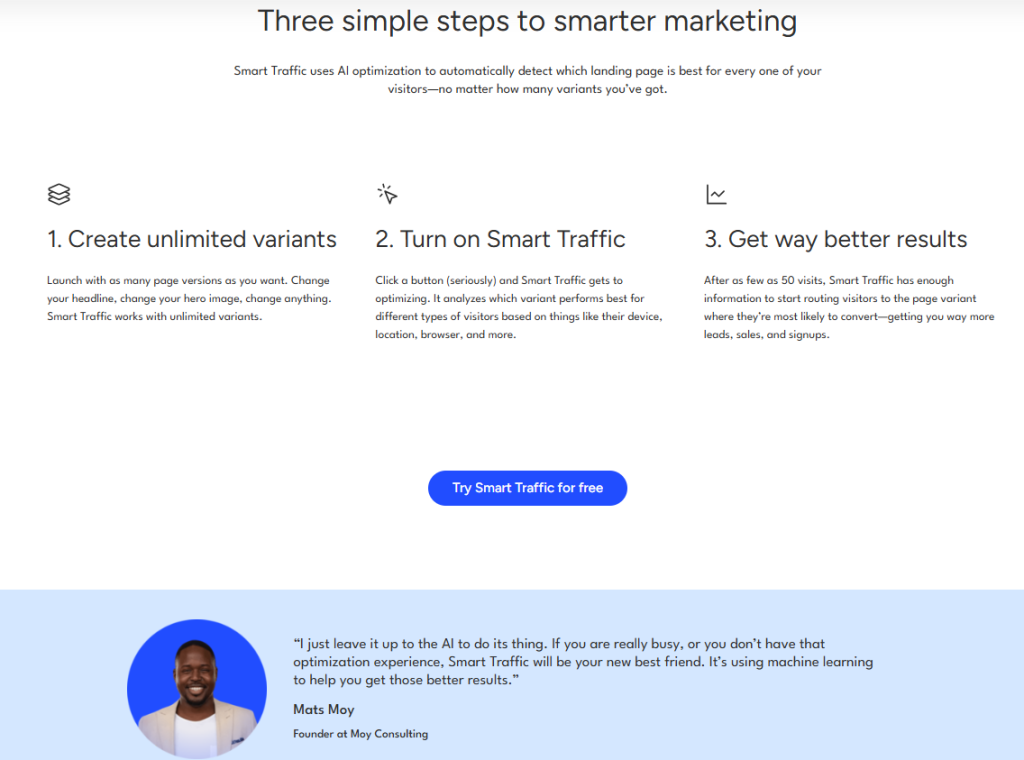
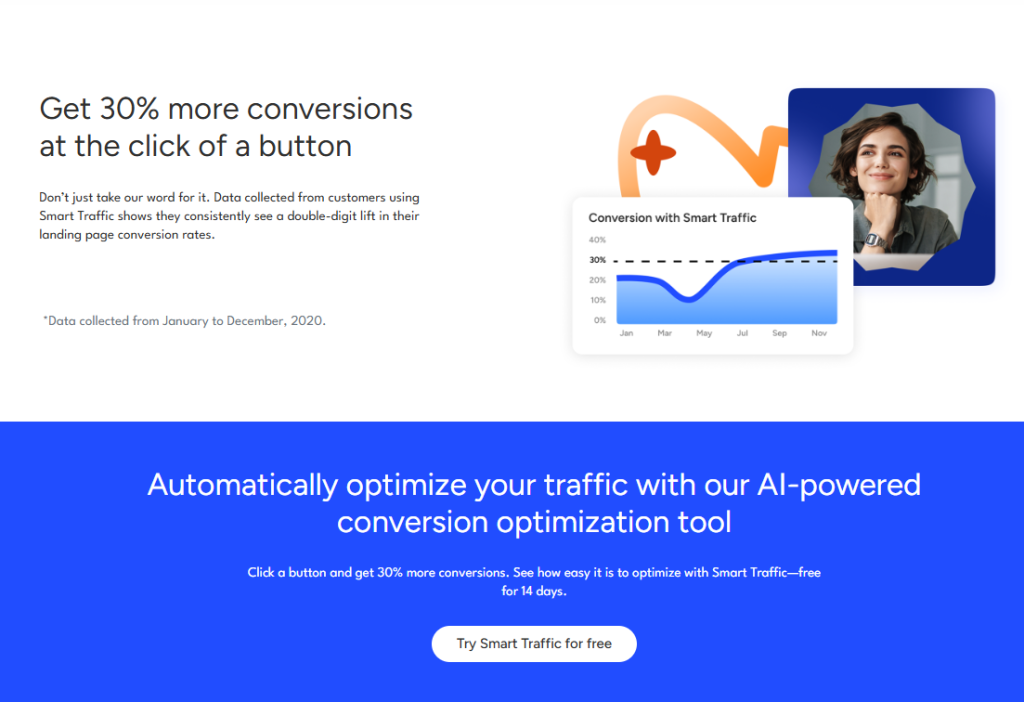
Here’s an example of Unbounce high-converting landing page:
Creating Product-Led Blog Content That Drives Signups
Product-led blog content wins readers, as it teaches a practical skill before it asks for a signup. Start each piece with a clear promise: solve a real pain and deliver a usable outcome. That builds trust and opens the path to demonstration.
Educational Guides With Natural Product Tie-Ins
Prioritize educational guides that show step-by-step workflows. Use screenshots and short examples to illustrate each move.
Weave the product in as a tool inside the workflow, not the headline. Reserve explicit offers for sidebars or CTAs so the main narrative stays useful and unbiased.
From Topic Pain Points To Practical Playbooks
Turn common pains into playbooks with checklists, templates, and timelines readers can implement immediately. Include metrics and instrumentation advice so they can validate impact.
- Target mid-intent keywords where hands-on guidance matters.
- Add internal links to related MOFU and BOFU pages to guide next steps.
- Use schema, clear headings, and FAQs to win snippets in search.
- Track assisted conversions to measure pipeline influence from blog posts.
Comparison And Alternatives Content For Decision-Stage Buyers
Comparison pages work best when they explain methodology, scenarios, and measurable trade-offs. Decision-phase content should guide a buyer through clear criteria and honest contrasts so the best option becomes obvious.
Positioning Without Naming Competitors In Your Metadata
Avoid naming companies in meta titles and descriptions. Instead, frame the result around use cases, selection criteria, and outcomes to earn clicks from search results.
State the methodology and target audience in the meta to set expectations without inviting legal or negative reactions.
Structuring Fair, Trust-Building Comparisons
Define scoring, list side-by-side features, and show pricing trade-offs. Add scenarios that explain which product fits which team or workflow.
- Be transparent: show how criteria were chosen and scored.
- Offer downloadable checklists and RFP templates to help internal reviews.
- Include FAQs on procurement, security, and migration to reduce friction.
| Criteria | Best Fit | Trade-Off |
| Feature depth | Large teams needing customization | Longer setup time |
| Speed to value | Small teams wanting quick wins | Fewer advanced options |
| Pricing flexibility | Growing companies with variable seats | Higher per-user cost at scale |
Link each comparison page to product, integration, and pricing pages. Encourage trials with sample imports and track engagement depth and CTA clicks to improve conversion over time. Keep content current and clearly dated. Queen of Clicks recommends this approach for fair, useful decision content.
Topic Clusters And Pillar Pages For Topical Authority
Pillar pages act as the hub that organizes related content and guides readers from broad overviews to detailed answers. They define a topical boundary and ensure the site surfaces the right page for each query and funnel stage.
Designing Pillars, Subtopics, And Cross-Linking
Define each pillar around a core job-to-be-done and map subtopics across the top funnel, mid-funnel, and decision stages. Assign one primary keyword to each page and use secondary variants on supporting posts to prevent overlap.
Build consistent URL patterns and navigation so clusters are easy to explore. Use strategic cross-links to move users from overview to deep dives and into product pages.
Maintaining Cluster Health Over Time
Audit clusters regularly for ranking performance, internal link coverage, and engagement. Refresh stale sections, expand with new subtopics, and consolidate thin assets to strengthen authority.
- Include FAQs and concise summaries on pillars to capture featured snippets.
- Use schema across pillar and subtopic pages to clarify relationships.
- Align CTAs inside the cluster to the reader’s likely stage for better conversion.
Link Building: The Strategy That Accelerates Rankings
When doing link building for SaaS, think of links as the oil that helps your content engine run faster. Internal links guide authority from established pages to priority product and conversion assets. Backlinks from trusted publishers add pressure that moves rankings in search engines.
Internal Links For Context And Authority Flow
Map internal links from high-authority pages to the pages that drive signups. Standardize anchor text so it matches the destination’s main topic and intent. Reinforce new pages at launch with multiple internal routes to speed indexing.
Backlink Strategies That Earn Relevance
Pursue backlinks with original research, benchmarks, and useful tools that companies and journalists cite. Focus on relevance over raw volume: a few high-quality referring domains beat many weak links.
Brand Mentions And Digital PR For Authority
Monitor unlinked brand mentions and outreach with a short, value-forward ask to convert them into links. Align PR calendars with content releases to amplify coverage and create natural linking opportunities.
- Build calculators, frameworks, and data studies that attract natural references.
- Avoid manipulative schemes; prioritize editorially earned placements.
- Track link growth, referring domains, and ranking impact for priority terms.
| Action | Why It Works | Metric |
| Map internal flow | Channels authority to conversion pages | Internal link count → indexed priority pages |
| Create original data | Attracts editorial backlinks | Referring domains → referral traffic |
| Convert mentions | Turns awareness into link equity | Linked mentions / outreach success rate |
Optimizing For AI Overviews And Zero-Click Realities
AI-powered overviews reward pages that deliver ultra-clear answers in a few lines. Structure key sections so machines and people find the answer immediately, then offer one clear next step for deeper engagement.
Write short definitions, numbered steps, and concise lists. Keep claims factual and cite sources or link to documented evidence when possible. This helps search engines and overview models verify accuracy.
Concise Answers, Lists, And Fact-Checked Claims
Lead with a one-line TL;DR for common queries. Then add a 3–5 item ordered list that outlines the solution or process.
- Provide a single-sentence answer at the top.
- Follow with a numbered mini-guide for quick implementation.
- Include one original example that shows real-world application.
E-E-A-T Signals And Originality
Show expertise with an author byline, transparent sourcing, and brief credentials. Add original data points or frameworks to avoid commodity summaries.
Use structured data (Article, FAQ, and Author schema) to clarify relationships for machines and increase eligibility for rich results.
- Fact-check all statistics and link authoritative sources.
- Keep language plain so a broad audience understands complex ideas.
- Monitor result features for target queries and adjust formatting as they evolve.
| Format | When to Use | Why It Helps |
| One-line answer + TL;DR | FAQ and quick queries | Feeds zero-click panels and improves CTR for deeper pages |
| Numbered steps | Tutorials and troubleshooting | Scannable for users and mirrors structured AI outputs |
| Original example | Any explanatory page | Differentiates content and boosts E-E-A-T |
| Schema + author info | All authority pages | Signals credibility to search engines and overview models |
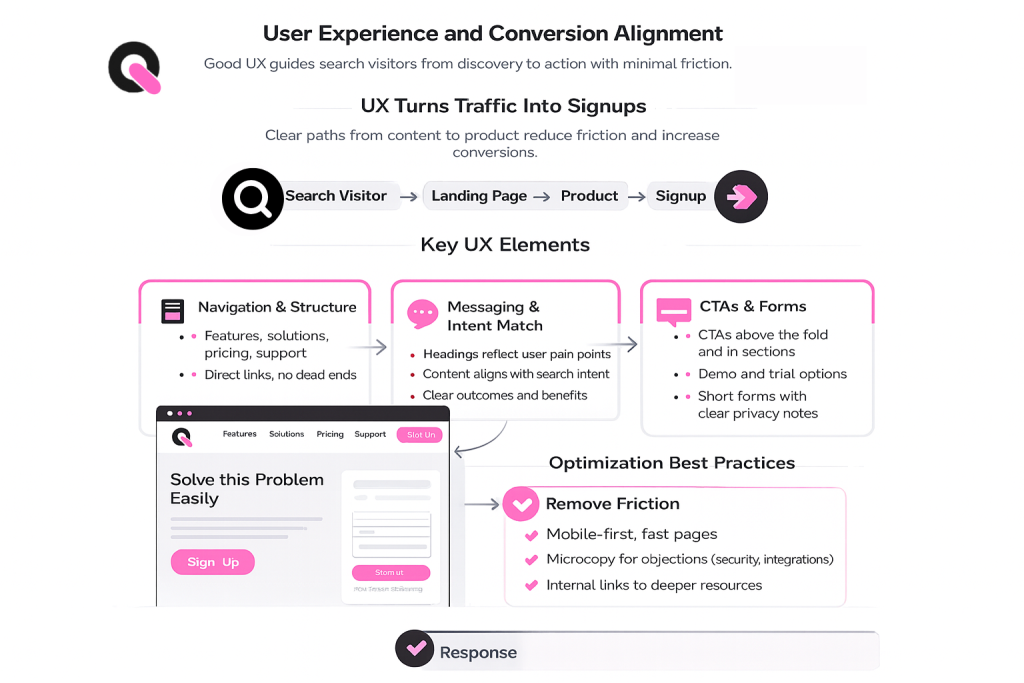
User Experience And Conversion: From Visitors To Trials
Strong trust signals and smooth flows turn casual visitors into trial users fast. Design pages so proof sits next to the CTA and next steps are obvious. Good user experience lowers anxiety and boosts demo and trial starts.
Trust Signals, Social Proof, And Clear CTAs
Place badges, customer quotes, and case highlights near primary CTAs to reassure evaluators. Use short headlines that state outcomes so visitors know what to expect after they click.
Make CTAs outcome-focused: show benefit and time to value (example: “Start 7‑day trial, import sample data in 5 minutes”).
Reducing Friction In Signups And Onboarding
Minimize fields, support SSO, and spell out what happens after submission on each key page. Offer chat and email for quick buying questions to keep momentum.
Provide onboarding checklists, guided tours, and short content that helps new users reach first value fast. Personalize next steps by role or integration interest to raise activation rates.
- Trust badges and brief case highlights near CTAs
- Actionable, context-rich CTAs that aid conversion
- Short forms, SSO, and clear post-submission expectations
- Onboarding checklists, guided tours, and role-based next steps
- Fast, mobile-friendly pages and multiple contact options
Analytics, Iteration, And Content Refresh Cycles
Start with metrics that show true influence, not just headline traffic numbers. Set up dashboards that connect page-level rank and session data to conversions and pipeline impact. This makes content management a measurable part of your marketing strategy.
Tracking Rankings, Sessions, And Assisted Conversions
Track rankings, impressions, clicks, and assisted conversions by page and funnel stage. Use event tracking to link content engagement with demo and trial behaviors.
Segment reports by ToFu, MoFu, and BoFu to see where the site drives real action versus where it only generates visits.
Identifying Decay And Refresh Opportunities
Detect decay by falling clicks or position shifts. Prioritize pages showing drops in clicks or conversions.
Refresh with updated research, new stats, clearer structure, improved visuals, and stronger internal links. Establish quarterly audits to prune, consolidate, or expand pages.
Attribution Across The Full Funnel
Use multitouch attribution so top- and mid-funnel content gets credit for pipeline influence. Align reporting cadence with product launches and seasonal demand.
Tie goals to pipeline metrics, not just vanity traffic increases, and feed win/loss feedback into content updates.
- Dashboards per page type for ranks, clicks, and assisted conversions.
- Segment performance by funnel stage to reveal investment gaps.
- Event tracking that maps content reads to demo/trial starts.
| Metric | Why It Matters | Where To Track | Action |
| Rank & Impressions | Signals visibility and keyword fit | Search console / rank tracker | Refresh titles, headings, and meta |
| Sessions & CTR | Shows engagement and snippet performance | Analytics platform | Improve meta, add concise TL;DR |
| Assisted Conversions | Reveals cross-funnel influence | Attribution tool / CRM | Credit ToFu/MoFu and refine CTAs |
| Engagement → Trials | Links content to revenue actions | Event tracking / product analytics | Optimize flows and onboarding content |
Scaling Your SaaS Content Operation
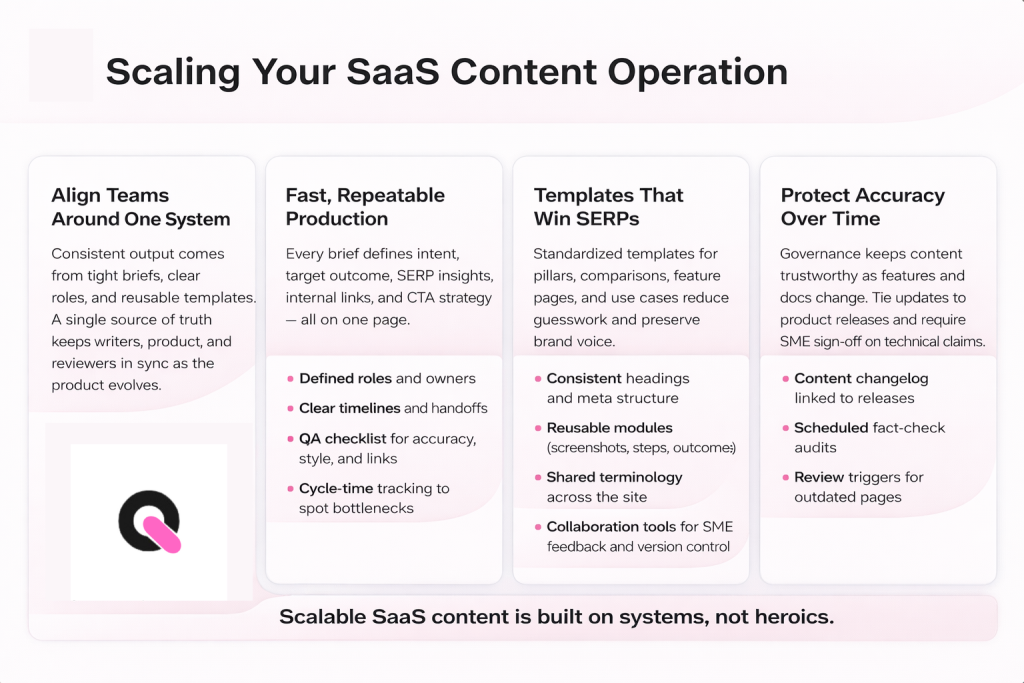
Consistent output comes from tight briefs, clear roles, and reusable templates that reduce guesswork. Build a single source of truth so writers, product teams, and reviewers move in sync. Operational controls keep pages accurate as features and docs evolve.
Briefs, Editorial Workflow, And QA
Use briefs that state intent, target outcomes, SERP findings, internal link paths, and CTA strategy. Keep each brief under one page so contributors can act fast.
Define roles, timelines, and a QA checklist to catch factual errors, style issues, and missing links before publication. Track cycle time to find bottlenecks.
Templates For Consistent SERP-Winning Pages
Build templates for pillars, comparisons, feature pages, and use-case pages. Standardize headings, meta structure, and visual formats to speed production and preserve brand voice.
- Standard voice and terminology across the site.
- Reusable modules for screenshots, steps, and outcomes.
- Collaboration tools for version control and SME feedback.
Governance For Accuracy And Updates
Maintain a changelog tied to product releases that flags pages for review. Require SME sign-off on technical claims and run periodic fact-check audits.
How Queen of Clicks Helps SaaS Teams Win With SEO
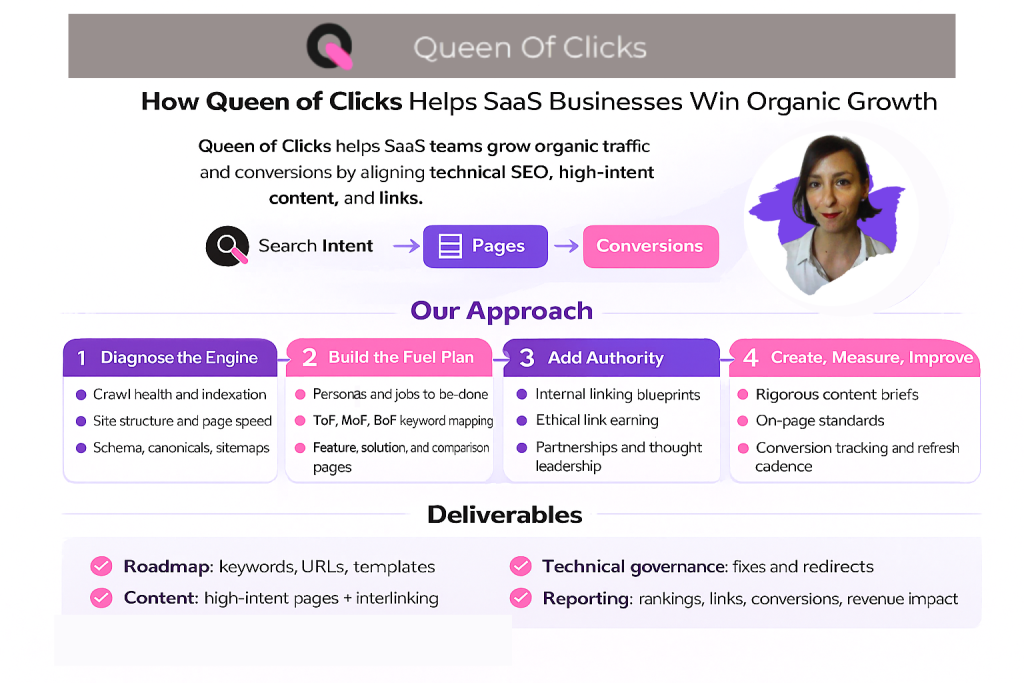
Queen of Clicks helps growth teams turn search intent into repeatable content that drives trials. We focus on mapping buyer pain to stage-based keyword sets and pages that match real intent.
Our programs combine technical hygiene, product-led content, and measurement so your marketing and product teams move together. That reduces friction and speeds time to value for evaluators.
- Tailored SEO strategy: align ICP pains with keyword portfolios and high-impact pages.
- Technical delivery: audits and fixes to make sites fast, crawlable, and scalable.
- Content creation: product-led guides and comparison assets that educate, then convert.
- Topic architecture: clusters and internal links that compound authority and lift rankings.
- Authority growth: ethical link building and digital PR to strengthen domain trust.
- Decision optimization: improve pricing, demo, and trial flows to raise qualified conversion.
- Reporting & governance: analytics, refresh cadences, and close partnership with product marketing.
Ready to grow? Book a call to explore how Queen of Clicks can help your company win with organic search.
Conclusion
Close with a short roadmap that shows how targeted pages, ethical links, and measurement compound into steady growth.
Build a dependable engine: fast technical work, clustered content, and clear interlinking. Map search intent to each page and align CTAs to buyer readiness so visitors find next steps fast.
Keep a steady cadence of production, measurement, and iterative refreshes. Operational rigor, briefs, templates, QA, scales quality. For example, one repeatable approach can turn mid-funnel guides into decision-stage conversions for people evaluating your product.
FAQs
How long does it take for SaaS SEO to show real results?
Most SaaS companies start seeing early signals (impressions, rankings, assisted conversions) in 6–8 weeks, but meaningful pipeline impact usually takes 3–6 months. Competitive BOFU terms and comparison pages can take longer, while lower-difficulty MOFU content may drive demos sooner.
How much should a SaaS company budget for SEO?
There is no universal number, but effective SaaS SEO typically requires consistent monthly investment rather than one-off projects. Budget should cover content creation, technical maintenance, and link acquisition. The right level depends on competition, ICP value, and how critical organic growth is to your pipeline.
Should early-stage SaaS companies invest in SEO or wait?
Early-stage SaaS should invest selectively. Focus on high-intent MOFU and BOFU pages (use cases, integrations, comparisons) rather than broad awareness content. This builds future authority while still supporting near-term revenue.
Can SaaS SEO work without a large content team?
Yes. Many SaaS teams succeed with a small team by using clear briefs, templates, and SME reviews. Fewer, better pages that target real buying intent outperform high-volume publishing without strategy.
How do you avoid keyword cannibalization as content scales?
Assign one primary keyword and intent per page, map content before publishing, and regularly audit overlapping URLs. Consolidate or redirect pages when two assets compete for the same query to protect rankings and conversions.
Is AI-generated content safe for SaaS SEO?
AI can speed drafts and research, but SaaS SEO still requires human expertise, original insights, and product accuracy. Pages that lack real examples, workflows, or validation struggle to rank and convert, especially for decision-stage queries.
What metrics matter most beyond traffic for SaaS SEO?
The most important metrics are assisted conversions, demo or trial starts, engagement depth, and pipeline influence. Traffic alone is not success; SaaS SEO should be measured by how well it supports revenue and activation.