What Is a SaaS SEO Expert and Why Do You Need One
A SaaS SEO expert designs a strategy that maps keywords to stages of research, evaluation, and conversion.
Unlike generic SEO work, a SaaS SEO approach aligns pricing, features, integrations, and support pages to capture qualified users across longer sales cycles. The right team fixes site hygiene, internal linking, and technical issues so search engines crawl and index pages that drive pipeline.
Core services usually include audits, keyword mapping, content planning, and link building tied to trials, demos, and revenue. Agencies and companies that invest in this model often see compounding growth instead of one-off traffic spikes.
Key Takeaways
- A focused specialist links product and content so search drives qualified users.
- Specialized strategy covers pricing, features, integrations, and support pages.
- Technical fixes, internal linking, and audits are foundation work that boosts visibility.
- Keyword mapping, content planning, and link building should tie to trials and revenue.
- Set budgets and timelines with realistic expectations for competitive growth.
What Is a SaaS SEO Expert
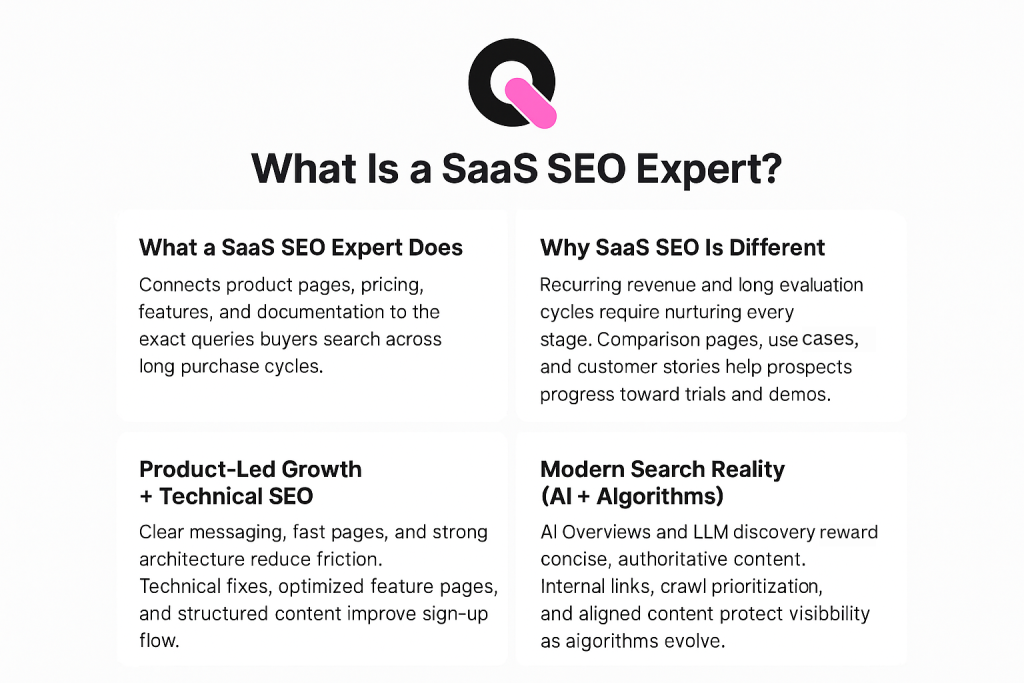
One role ties product pages, pricing, and documentation to the searches your buyers use. That role builds a content and technical strategy so your site attracts qualified users across long purchase cycles.
How SaaS differs: Recurring revenue and long cycles mean you must nurture consideration. Comparison pages, use-case content, and customer stories keep prospects moving toward trials and demos.
How SaaS Differs: Recurring Revenue, Long Cycles, Product-Led Funnels
Product-led funnels push emphasis to on-site UX and clear messaging. You reduce friction when you align feature and integration pages with conversion paths. Technical SEO fixes and fast pages make sign-up flows work.
Present-Day Context: AI Search, Algorithm Shifts, And Your Organic Moat
Modern search now includes AI overviews and LLM discovery. Engine optimization for these surfaces needs concise, authoritative content that engines favor. Site architecture, internal links, and crawl budget prioritization protect visibility as algorithms change.
- Map buying stages to pages and high-intent queries.
- Coordinate research, briefs, and link building across your team.
- Measure outcomes by pipeline, not vanity traffic.
The Business Case: Why Your SaaS Needs Specialized SEO
Turning visibility into booked demos starts with prioritizing the pages that buyers use at decision time. You must link product, pricing, and comparison content to measurable business outcomes so organic work feeds pipeline.
From Visibility To Pipeline: Turning Organic Traffic Into Trials And Demos
Map intent to pages that convert: solution, pricing, feature, and integration assets. Measure trials and demos, not just sessions, to show real results.
Use conversion rate optimization and on-site optimization to lift the quality of traffic you already earn. Link building amplifies authority for bottom-funnel pages so they rank faster and win qualified clicks.
ROI Benchmarks: 702% Average ROI and ~Seven-Month Breakeven
For B2B SaaS companies, industry data shows an average ROI of 702% with breakeven near seven months. Share these benchmarks with leadership when you request budget versus paid channels.
Dashboards should report leads, qualified pipeline, and influenced revenue so your team can defend investment and track long-term growth.
- Align intent mapping to reduce wasted traffic and increase sign-ups.
- Coordinate your team and agency work around high-intent pages.
- Use cohort attribution to tie organic results to LTV and payback.
| Metric | Immediate Action | Business Outcome |
| Trials & Demos | Prioritize pricing & comparison pages | Higher qualified pipeline |
| ROI | Set 7-month breakeven benchmark | Budget clarity vs paid channels |
| Authority | Targeted link building for decision pages | Faster rankings and better-quality clicks |
Core Responsibilities Of A SaaS SEO Expert
A central role brings product, content, and sales together to make search-driven acquisition practical. You get a single owner who maps work to commercial outcomes and keeps teams aligned.
Aligning Content, Product, And Sales Across The Full Funnel
ASaaS SEO expert leads cross-functional briefs so content reflects product differentiators and sales insights. That coordination covers awareness, consideration, and decision pages.
Translating Search Intent Into ICP-Aligned Pages
They turn keyword intent into feature, integration, comparison, and pricing pages that match buyer needs. The result is better conversion for high-value prospects.
On-Page, Off-Page, And Technical SEO Orchestration
They scope technical SEO to remove crawl, indexation, and speed blockers. They also drive off-page authority via editorial mentions and links.
- They standardize the content process: briefs, drafts, review, and publication.
- They ensure analytics track trials, demos, assisted conversions, and influenced pipeline.
- They prioritize fixes by commercial impact and manage change during migrations or redesigns.
| Responsibility | Owner | Primary Deliverable | Business Impact |
| Content & Briefing | Content Lead | Buyer-stage briefs & published pages | Higher qualified sign-ups |
| Technical Audit | Engineering | Fixes for crawl, index, speed | Improved discoverability |
| Off-Page Authority | Outreach / PR | Editorial links & mentions | Stronger topical trust |
SaaS SEO Services You Should Expect
Your search program should deliver mapped keywords, technical fixes, content that converts, and earned links tied to business goals. Each service targets a clear outcome: visibility, qualified traffic, and influenced conversions.
Keyword Research & Mapping for Awareness, Consideration, Decision
They’ll do SaaS keyword research across the full journey so pages match awareness topics, comparison queries, and decision modifiers like pricing or alternatives.
Technical SEO Audits: Crawlability, Indexing, Speed, Mobile
They’ll run technical SaaS SEO audits that inspect crawlability, indexation, Core Web Vitals, and mobile UX. Tools include GSC, ScreamingFrog, PageSpeed, and GA to surface blockers and fixes.
On-Site Optimization & Internal Linking for Better Rankings
They’ll implement metadata, headings, schema, and internal linking to lift rankings and CTR. Site UX improvements reduce drop-off and guide buyers to conversion pages.
Content Strategy & Creation That Converts for SaaS
They’ll prioritize high-intent assets, pricing, comparison, and feature pages, while supporting them with informational posts to broaden topical coverage.
They’ll establish a content creation workflow that balances subject-matter input with editorial quality and regular publication cadence.
Link Building & Digital PR to Earn Authoritative Backlinks
They’ll plan outreach that includes competitor backlink analysis, guest posts, link insertions, HARO, and influencer outreach to secure relevant backlinks without risk.
- They’ll define measurement for each service: visibility, qualified traffic, and influenced conversions.
- They’ll schedule ongoing content refreshes, internal linking updates, and keyword re-mapping as markets shift.
- They’ll align services and campaigns to quarterly business goals so your company sees tangible impact.
| Service | Primary Focus | Tools | Immediate Outcome |
| Keyword Research & Mapping | Intent alignment (awareness→decision) | GSC, SEMrush, Ahrefs | Pages that match buyer queries |
| Technical Audit | Crawl, index, speed, mobile | ScreamingFrog, PageSpeed, GA | Resolved blockers, better indexation |
| On-Site Optimization | Metadata, schema, internal links | CMS, GSC | Higher rankings and CTR |
| Link Building & PR | Backlinks and authority | Ahrefs, outreach platforms, HARO | Faster authority gains for priority pages |
How A SaaS SEO Strategy Comes Together
A clear, prioritized plan turns scattered ideas into measurable growth for your product and content. It starts with data so you know which gaps will move demos and trials fastest.
Data-Driven Research, Gap Analysis, And Prioritization
Begin with competitive and SERP research to spot where your content can win. Prioritize opportunities by likely impact on trials, not just traffic.
Content Hubs, Product-Led Pages, And Feature/Integration Pages
Architect content hubs that lead users toward feature and integration pages. This strengthens internal link equity and focuses authority on the pages that convert.
Campaigns, Sprints, And Iteration Based On Results
Translate opportunities into sprint plans that sequence quick wins and strategic bets. Run campaigns that combine publication, internal linking, and selective link acquisition for priority pages.
- Define briefs that map product use cases to keywords.
- Measure weekly and monthly, then iterate on topics and templates.
- Keep a prioritized backlog that shifts with rankings and user behavior.
| Phase | Primary Activity | Immediate Outcome |
| Research & Gap Analysis | Competitive SERP and keyword research | Prioritized opportunities for demos |
| Hub & Asset Build | Create content hubs plus feature/integration pages | Stronger internal link equity and conversions |
| Sprints & Campaigns | Execute publication, linking, and outreach | Quick wins and compounding visibility |
| Review & Iterate | Analyze performance and recycle insights | Continuous optimization and growth |
The SaaS SEO Process: From Audit To Ongoing Growth
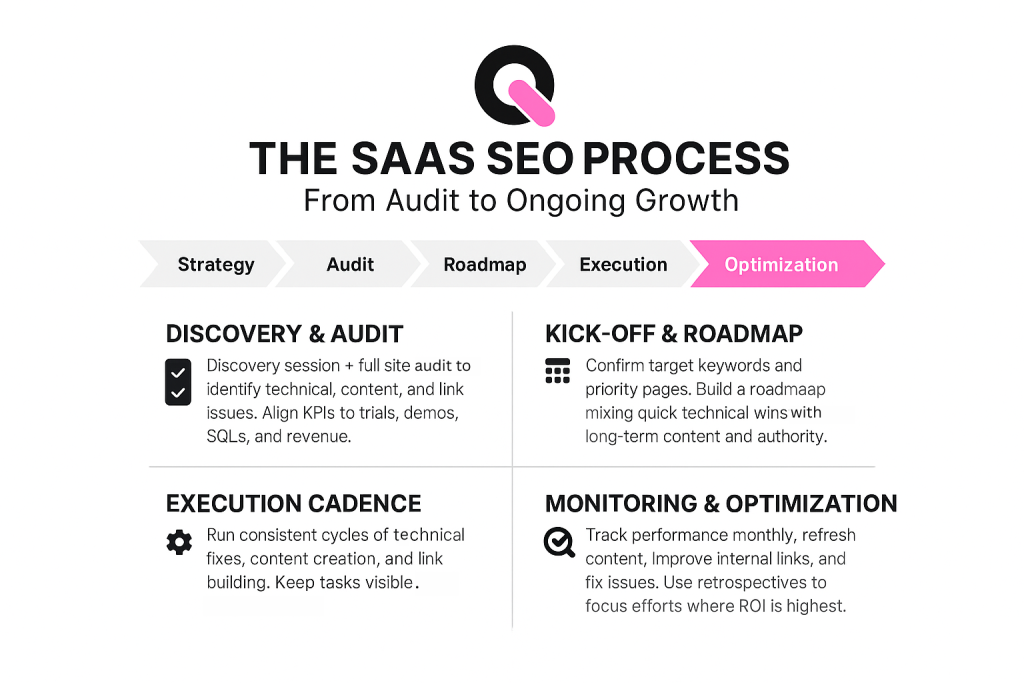
A structured onboarding path aligns your site, metrics, and team around conversion goals. It turns discovery and an audit into a repeatable process that drives measurable results.
Discovery, Website Quality Audit, And KPI Alignment
They’ll begin with a discovery session and a full website quality SaaS SEO audit. This surfaces technical, content, and link issues that block rankings and traffic.
From there, they align KPIs to trials, demos, SQLs, and influenced revenue so reporting ties directly to growth.
Kick-Off, Roadmapping, And Execution Cadence
A kick-off confirms target keywords, priority pages, and the cadence your team can sustain.
The roadmap balances quick technical wins with strategic content builds and authority development. Tools like Google docs keep tasks and deliverables visible.
Monitoring, Reporting, And Optimization Loops
Implement tracking for multi-touch attribution so reports reflect true impact. Run weekly or monthly reviews to assess rankings, qualified traffic, and conversion progress.
Maintain an optimization loop of content refreshes, internal linking, and technical fixes. Document responsibilities, surface risks, and use sprint retrospectives to reallocate effort toward the best results.
- Free strategy session → discovery → agreement → kick-off.
- Roadmap with quick wins and long-term pieces.
- Weekly or monthly reviews and clear stakeholder updates.
Timelines, Budgets, And Resources
Clear timelines and realistic budgets turn marketing plans into measurable growth for your product. Set expectations about cost, time, and internal effort before you sign an agreement.
The fees vary and usually cover content production, backlinks, tools, technical fixes, and reporting. Many engagements start with a 2‑month trial before moving to a longer cadence.
Typical Retainers And What They Include
- They’ll scope retainers to include research, technical fixes, content, link acquisition, and reporting so resources align to outcomes.
- Budget for tools and production alongside agency time to reflect total services needed to compete.
- Protect migration and redesign budgets to safeguard rankings during major site work.
Ranking Windows: From Quick Wins To 6-24 Months For Competitive Keywords
Less competitive terms can move in the first 30 days. First-page rankings for competitive keywords often take 6–24 months. Timelines depend on keyword difficulty, domain strength, and site health.
- Allocate internal reviewers, SMEs, and dev time to avoid bottlenecks that slow visibility.
- Build contingency for algorithm updates and market shifts that affect traffic trajectories.
- Schedule quarterly roadmap reviews and confirm success criteria for renewing or scaling investment.
How To Choose The Right SEO Agency For SaaS
The SaaS SEO agency you hire should show clear links between keyword wins and booked demos. Your selection process must prioritize measurable business impact, not just traffic numbers.
Proven SaaS Case Studies: From Rankings To Revenue
Ask for case studies that map rankings to trials, demos, and ARR. Request real numbers: conversion lifts, pipeline influenced, and time-to-breakeven.
Insist on client names or verifiable results so you can validate claims. Good case studies show a timeline from research to revenue.
Technical Depth, Content Engine, And Link Building Results
Verify technical skill in crawling, indexation, and site performance for complex product sites. Check how the team handles migrations and architecture.
Examine the content engine: briefs, SME involvement, editing, and publishing velocity. Vet link building for relevance, authority, and transparent sourcing of links.
Forecasts, Reporting, And Alignment With MRR/ARR
Require forecast models that tie keyword opportunities to potential pipeline and ARR impact. Look for clear dashboards that report demos, qualified traffic, and revenue influence.
- Request case studies proving demo and revenue movement.
- Evaluate technical depth and content process.
- Vet link quality, forecast models, and reporting cadence.
- Confirm team resourcing and campaign maturity before signing.
| Selection Factor | What You Ask For | Desired Outcome |
| Case Studies | Names, metrics, timelines | Proof of pipeline impact |
| Technical & Content | Audit samples, briefs, cadence | Fewer blockers, steady content output |
| Forecasting & Reporting | Models tied to MRR, dashboards | Clear ROI and renewal signals |
KPIs That Matter For SaaS Companies
Measure what moves the business: focus on metrics that link crawling health and page quality to booked trials, demos, and revenue. Choose indicators that validate progress early and prove long-term impact.
Leading Indicators
The SaaS SEO experts track indexation and crawl health so they know the site is discoverable. Watch rankings movements and qualified organic traffic to confirm topics and keyword research are working.
Core Outcomes
Prioritize trials, demos, and SQLs as primary outcomes. Tie leads and influenced pipeline to revenue so marketing shows direct contribution to growth.
Quality Signals
Monitor backlinks, topical depth, and page experience to protect gains. Use cohort metrics like conversion-to-paid and LTV for downstream measurement.
- Segment by page type (features, comparisons, pricing) to find what drives the most leads.
- Benchmark search share for priority terms against category leaders.
- Operationalize sprint-level reporting so the team can act fast on decay or opportunity.
| Metric Type | Example KPI | Why It Matters | Actionable Threshold |
| Leading | Indexed pages, ranking moves, qualified traffic | Shows direction early | Index rate >95%, weekly ranking gains |
| Outcomes | Trials, demos, SQLs, influenced revenue | Proves marketing impact | Month-over-month demo growth 10%+ |
| Quality | Backlinks, topical authority, Core Web Vitals | Sustains visibility and rankings | Domain links growth, CWV scores in green |
Multi-Regional And International SEO For SaaS
Managing international search means designing your site to serve markets, languages, and buying habits without fragmenting authority. A clear plan reduces duplicate content issues and boosts regional visibility.
Start with architecture and hreflang. They’ll plan localized URLs, correct hreflang tags, and separate sitemaps so search engines index the right pages for each locale. Canonical rules should prevent cross-region conflicts.
Hreflang, Localized Content, And Regional Link Building
Localize metadata, on-page copy, and CTAs while keeping brand voice consistent. Run market-specific keyword research to capture synonyms and search intent that differ by region.
Pursue regional links and citations to grow authority. Local references and industry mentions help each market rank faster and send more qualified traffic.
Consistent NAP, Market-Specific Research, And GMB Where Relevant
Maintain consistent NAP citations and optimize Google My Business for markets with local discovery. For product-led companies, GMB can surface nearby trials, events, or support contacts.
- Coordinate translation and transcreation workflows so content reads naturally and converts.
- Standardize templates but allow localized differentiation to improve conversion per market.
- Monitor rankings, traffic, and conversions by region and report by market to refine priorities.
| Focus | Action | Expected Outcome | Owner |
| Hreflang & URLs | Implement hreflang, localized sitemaps, canonical rules | Correct indexing per locale | Engineering + content |
| Localized Content | Regional keyword research, transcreation, metadata | Higher relevance and conversion | Content team + translators |
| Local Authority | Build local links, maintain NAP, optimize GMB | Improved regional visibility and traffic | PR / outreach |
Modern Trends: Generative Engine Optimization And Beyond
Modern engine optimization blends concise content, authoritative citations, and structured pages to win new discovery paths. The SaaS SEO expert prepares for AI overviews and LLM-driven discovery while keeping quality high for human readers.
Optimizing For AI Overviews And LLM-Powered Discovery
Format answers so models can pull clear snippets. Use brief headings, factual citations, and schema where useful.
Link building and backlinks raise trust signals that influence inclusion in AI summaries. Continue research into changing SERP behavior to guide formatting and media use.
Programmatic Pages, Content Refreshes, And Topical Clusters
Identify repeatable patterns for programmatic pages, but enforce quality checks on templates. Run a steady refresh cadence to keep examples, stats, and internal links current.
Expand topical clusters to show depth and support higher intent pages. Test new formats, checklists, comparisons, calculators, to match intent and lift engagement.
- Map experiments to measurable outcomes: rankings, traffic, and conversions.
- Prioritize ethical, user-first strategies that last beyond short algorithm shifts.
| Trend | Action | Outcome |
| AI Overviews | Concise answers + citations | Higher eligibility for summaries |
| Programmatic Pages | Template quality checks | Scalable, useful pages |
| Content Refresh | Quarterly updates | Sustained visibility and growth |
🚀 How Queen of Clicks Helps SaaS Brands Win Organic Search
Queen of Clicks pairs product insights with tactical content to turn organic search into a predictable growth channel. With our SaaS SEO services, you get a focused program that blends technical fixes, content marketing, and link building so your product pages convert visitors into leads.
What You Get
- A full-funnel roadmap that maps keywords to awareness, consideration, and decision, covering features, integrations, comparisons, and pricing pages.
- A website quality audit and remediation plan for crawlability, indexation, Core Web Vitals, and mobile UX.
- Content strategy and production support that prioritizes high-intent assets with internal linking and refresh schedules.
- Link building and digital PR to earn authoritative placements that accelerate page authority.
- Reporting that ties work to trials, demos, SQLs, and revenue so you can attribute results and plan confidently.
Why It Works
Data-driven prioritization focuses effort on keywords and pages most likely to create pipeline for SaaS companies.
Cross-functional collaboration aligns messaging with product and sales so organic visits convert to leads. Ongoing optimization loops, technical fixes, content updates, and authority building, compound growth over time.
Transparent project management keeps your team aligned and accountable for measurable results.
Highlights
- Specialized SaaS SEO processes for complex product sites.
- Ethical, relevance-first link building that strengthens trust and rankings.
- Measurement frameworks that prove impact on visibility, leads, and revenue.

Next Steps
Book a call with Queen of Clicks to review your current performance, identify high-ROI opportunities, and receive an action plan.
Conclusion
Turn the strategic work you’ve read about into a measurable program that drives trials and revenue.
Align technical health, content, and authority into a simple roadmap so SaaS SEO and wider strategy deliver steady growth. Set clear KPIs and expect early wins on low-difficulty targets while planning 6–24 months for competitive rankings.
Measure outcomes by search-driven trials, demos, and influenced revenue rather than raw traffic or impressions. Preserve user-first writing while using engine optimization and link building to protect and expand visibility.
Prioritize the pages that move prospects, product, features, comparisons, and pricing, and sequence campaigns to compound results. If you want help turning this into execution, connect with Queen of Clicks to align on goals and accelerate your next phase of growth.
FAQs
What makes a SaaS SEO expert different from a regular SEO consultant?
A SaaS SEO expert specializes in long buyer journeys, recurring revenue models, and product-led funnels. They align product features, pricing, and integration pages to search intent, something generic SEO consultants rarely do.
Does my SaaS company need a full-time SEO expert or can I hire an agency?
If you lack internal resources for technical fixes, content production, and link building, an agency is more efficient. Fast-growing teams with strong internal content may benefit from a full-time expert who owns execution.
How long does it usually take for SaaS SEO to show results?
Expect quick wins within 30–60 days on low-competition terms, with competitive keywords taking 6–24 months depending on domain strength, site health, and content quality.
What type of content does a SaaS SEO expert prioritize first?
They prioritize decision-stage assets, pricing, comparison, features, and integration pages, because these pages influence trials, demos, and revenue.
Do AI search and AI overviews change how SaaS SEO works?
Yes. Experts now structure concise, authoritative content with clear answers and schema so it can appear in AI summaries and LLM-powered discovery surfaces.
How does a SaaS SEO expert use keyword mapping?
They map keywords across awareness, consideration, and decision stages, ensuring that every page serves a clear buyer intent and moves users through the funnel.
Can SaaS SEO improve trial and demo conversions directly?
Yes. By mapping search intent to product pages, optimizing CTAs, and improving site speed and UX, SaaS SEO increases qualified traffic that converts to trials and demos.