What Is a SaaS SEO Agency & Why Your SaaS Business Needs One
A SaaS SEO agency is a marketing agency that specializes in helping Software-as-a-Service companies improve their visibility and rankings on search engines like Google. Unlike general SEO firms, these agencies understand the unique challenges of SaaS businesses, long buyer journeys, subscription-based revenue, product-led growth, and highly competitive markets.
They focus on strategies such as content marketing, keyword research tailored to different stages of the funnel, on-page SEO, link building, and landing page optimization to increase organic traffic and generate high-intent leads. On average, SEO drives 20‑40% of total traffic for SaaS companies, depending on maturity and competitiveness. A SaaS SEO agency helps SaaS companies get found by the right audience and convert that search interest into trials, demos, and paying subscribers.
Key Takeaways
- You’ll learn what a specialized partner does day-to-day and why specialization matters for pipeline over clicks.
- Core components include technical foundations, content strategy, link authority, and conversion alignment.
- Expect pricing from low-thousand consulting retainers to $10k+/month for full management and multi-month commitments.
- KPIs should predict SQLs and revenue, not just ranking or traffic vanity metrics.
- Answer Engine Optimization and AI search are shifting how discovery works; adapt to stay visible.
Understanding What a SaaS SEO Agency Does Today
A modern partner turns search intent into predictable product demand and links content, tech, and UX. You get a focused team that aligns content and conversion paths to buyer stages so traffic becomes trials and demos.
Technical work starts with deep auditing: crawlability, indexation gaps, page speed, Core Web Vitals, and internal linking. Fixes here clear the path for important pages to surface in search and improve organic visibility.
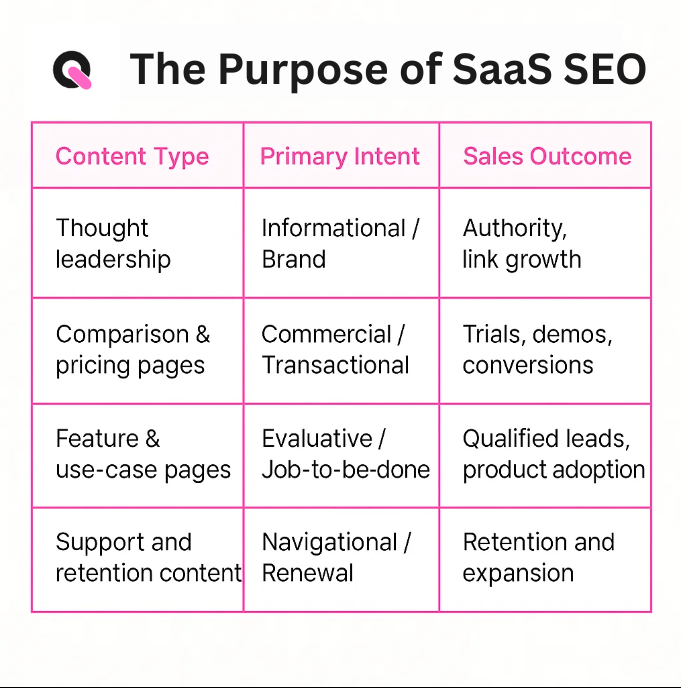
Your content program maps topics to stages, awareness, evaluation, and purchase, with BOFU landing pages, solution and comparison pages, and thought leadership that earns links. On-page optimization pairs CTAs, risk-reversal, and UX to lift conversion rates.
- Your partner runs ethical link building and digital PR to build domain authority and better chances at competitive rankings.
- You receive forecasting tied to SQLs and pipeline, plus monthly reporting that focuses on qualified leads and revenue influence rather than vanity metrics.
Work is sprint-based, with testing roadmaps for content refreshes, internal link experiments, schema tweaks, and CRO rounds. That regular cadence keeps momentum as search and market signals change.
Why SaaS SEO Is Different From Traditional SEO
Your organic work must do more than lift rankings; it must feed predictable demand. For product-led businesses that face recurring revenue models, long buyer journeys, and multi-person committees. That changes what content and measurement look like, and the SaaS SEO does that.
Recurring Revenue, Long Sales Cycles, And Complex Buying Committees
You need content that supports the full lifecycle: acquisition, retention, and expansion. Pages must speak to end users, evaluators, managers, and executives with clear success signals for each group.
Focus shifts from one-off traffic spikes to assets that nurture trials, demos, and renewals. That means bottom-of-funnel pages for comparisons and pricing, plus thought pieces that earn authority over time.
From Search To Pipeline: Aligning Content, Product, And Sales
Top performers map keywords to buying committees and tie terms to SQLs and opportunities. You align product narratives with conversion paths and sales enablement so search becomes a predictable pipeline channel.
- Balance brand and non-branded queries to scale net-new demand.
- Use programmatic internal linking to boost BOFU pages from flagship assets.
- Track attribution and forecasting that connect priority keywords to revenue influence.
- Optimize for answer engines so expertise surfaces in AI summaries buyers use.
Core Services You Should Expect From a SaaS SEO Partner
You should see a technical backlog that tracks crawl depth, duplicate pages, canonical issues, indexation gaps, schema, and Core Web Vitals. These items clear the path for higher visibility and better rankings.
Technical SEO: Crawlability, Indexation, Site Speed, And Internal Linking
Expect speed improvements and structured internal linking guidelines that lift high-intent pages. The team should run advanced fixes and monitor results in a sprint cadence.
Content Strategy: Thought Leadership, Bottom-Of-Funnel Pages, And Topic Clusters
You’ll get an editorial calendar with BOFU money pages, mid-funnel assets, and thought leadership. Hub-and-spoke clusters map to buyer personas for scalable topical relevance.
Link Building And Digital PR To Build Authority
White-hat link acquisition and targeted digital PR earn placements on authoritative domains to boost domain authority and referral traffic.
On-Page Optimization And Conversion Alignment
On-page optimization ties message hierarchy, proof elements, CTAs, and UX tests to conversion metrics like trials and demos. Reporting focuses on SQLs, pipeline, and revenue with scenario forecasting.
- Sprint-based execution with transparent progress and QA
- Content refresh frameworks to reclaim aging traffic
- Dashboards linking impressions to pipeline outcomes
| Service | Primary Output | Business Impact | Timing |
| Technical backlog | Fixes, CWV, indexation | Improved visibility, fewer crawl errors | Weeks–months |
| Content program | BOFU pages, clusters | Higher conversions and authority | Months |
| Link & PR | Earned placements | Domain authority, referral reach | Ongoing |
| On-page CRO | Message, CTAs, UX tests | Increase in demos/trials | Sprints |
Comparing SaaS SEO Agency Service Models
Different service models fit different needs. Your choice should match team maturity, bandwidth, and revenue goals. Below we compare focused search specialists with full-funnel firms, and execution retainers with consulting and enablement.
SEO-Only Specialists vs Full-Funnel Digital Marketing Agencies
Choose SEO-only specialists when you want deep organic expertise and tight technical focus. They concentrate on crawlability, content, and link growth without channel dilution.
Full-funnel firms blend organic work with paid media, ABM, and CRO. This model helps when you need coordinated demand generation across channels and tighter alignment with sales.
Done-For-You Management vs Consulting And In-House Enablement
Done-for-you retainers suit teams that lack bandwidth. Senior practitioners execute strategy, own the backlog, and deliver outputs end-to-end.
Consulting and enablement work well when you have internal resources. You get playbooks, QA, and oversight to accelerate capability building without full handoff.
- Define scope: technical backlog ownership, content volumes, link targets, and CRO collaboration.
- Set governance: weekly standups, monthly reviews, and quarterly strategy resets.
- Match model to maturity: early-stage often needs DFY; growing teams blend DFY and enablement.
- Agree on success metrics at kickoff, SQLs, opportunities, and revenue influence.
| Model | Primary Strength | Best For | Typical Retainer |
| SEO-only specialists | Deep organic and technical focus | Teams needing concentrated search expertise | $3k–$10k+/month |
| Full-funnel firms | Cross-channel demand generation | Companies wanting integrated paid and organic | $10k+/month |
| Done-for-you retainers | End-to-end execution and delivery | Teams with limited bandwidth | $5k–$15k+/month |
| Consulting / enablement | Playbooks and capability building | Companies with in-house marketing resources | Project fees or lower retainers |
Pricing And Engagement Models You’ll Encounter
Pricing models vary widely; what matters is clarity on deliverables and expected lift. You should judge proposals by how well they map outputs to pipeline, not by hourly rates or vague promises.
Typical Retainers And Minimum Commitments
Consulting retainers commonly sit in the low thousands per month while managed programs start near five figures. Initial commitments often run from ~120-day pilots up to 12-month agreements.
Project-Based Audits, Pilots, And Month-To-Month Options
You can start with a one-off technical or content audit to validate gaps and build a roadmap. Pilot sprints that prioritize BOFU pages and high-impact fixes let you test velocity and collaboration before a larger rollout.
- Require line-item clarity: deliverables, content volume, link targets, and expected quarterly lift.
- Ask for scenario-based forecasts tied to KPIs so budget talks align with pipeline and revenue goals.
- Define go/no-go checkpoints, payment milestones, and ramp-down terms to protect your team.
- Negotiate hybrid models, retainer plus performance incentives, if tracking attribution is solid.
| Model | Typical Cost | Best For |
| Consulting retainers | $2k–$5k/month | Strategy and enablement for companies |
| Managed programs | $10k+/month | Full execution and demand results |
| Audits & pilots | $5k–$20k one-time | Validation and short-term testing |
Metrics That Matter Beyond Vanity Rankings
Measure what moves revenue, not just where pages rank. Keyword positions and impressions are useful signals. They are directional, not the end goal.
From Keyword Positions To SQLs, Pipeline, And Revenue
You should track leads and opportunities that organic efforts actually create. Map each page to a funnel stage, TOFU, MOFU, or BOFU, and log how many SQLs each group produces.
Use consistent UTMs, CRM source fields, and multi-touch models to attribute pipeline and revenue to organic work. That lets you show real value from content and technical fixes.
- Use keyword positions and impressions as directional signals, not success endpoints.
- Track SQLs and opportunities by page type and funnel stage.
- Attribute pipeline via UTMs, CRM fields, and multi-touch models.
Forecasting Scenarios And ROI Expectations
Model scenario forecasts that tie priority terms to expected traffic, conversion rates, SQLs, and average deal value. Update these quarterly with actuals.
Monitor time-to-value, cohort performance, and lag-to-impact by initiative type. Compare authority gains by referring domain quality rather than raw link counts.
| Metric | Why It Matters | How To Measure |
| Visit → Trial | Shows acquisition efficiency | Page-level conversion rates, UTM data |
| Trial → SQL | Reflects product + sales alignment | CRM funnel stages, cohort tracking |
| Influenced Revenue | Direct ROI from content | Multi-touch attribution, revenue reporting |
Practical rule: report on pipeline and revenue influence first, then show rankings and organic traffic as supporting context. Include AEO/AI visibility metrics where possible to reflect modern search results for businesses breaking into AI-driven discovery.
The Balance: Technical SEO vs Content vs Links
Balance means choosing the right short-term fixes and long bets so you show progress while building authority.
Remove blockers: indexation, duplication, and speed issues. Those fixes often unlock immediate gains and improve crawl efficiency.
Ship or refresh core BOFU pages next. Solutions, comparisons, and pricing pages convert intent into trials and demos faster than broad thought pieces.
Build a sitewide internal linking framework to channel authority toward commercial pages. Pair this with CRO work, proof points, CTAs, and risk reversal, to raise conversion rates.
- Phase 1: technical seo fixes and high-potential page refreshes for quick wins.
- Phase 2: BOFU-first content sprints, then MOFU guides, then TOFU thought leadership for long-term growth.
- Phase 3: digital PR and link campaigns to expand authority into adjacent use cases.
| Phase | Focus | Expected Results |
| Quick wins | Technical fixes, refreshes | Faster discovery, more conversions |
| Scaling | Internal linking, BOFU pages | Higher conversion rates |
| Authority | Clusters, PR, AEO | Long-term growth in search |
Adopt quarterly roadmaps with measurable outcomes and scenario forecasts. Treat AEO as a parallel stream: structure entities and content for AI-driven discovery as you build classic authority.
AI And Answer Engine Optimization For SaaS
Generative engines surface short answers, and designing crisp, cited content raises your chance to be quoted. You should treat AI overviews as another search surface that rewards clarity, authority, and structured signals.
Optimizing For AI Overviews And Generative Engines
Design concise answer blocks near the top of pages that directly address question-style queries. Use short summaries, numbered steps, and clear definitions for people, products, and categories.
Implement structured data and consistent entity names so machines understand relationships. Cite credible publications and link to primary sources to build trust signals AI models prefer.
Structuring Content For Discoverability Across Search Channels
- Place FAQs and TL;DR summaries for quick reads.
- Use schema for product, author, and how-to markup.
- Create clusters and internal links to reinforce core entities and use cases.
- Monitor emerging AI surfaces and adapt layout for inclusion.
| Focus | Why It Helps | Quick Metric |
| Concise answers | Higher chance of AI quote | Citation growth |
| Structured data | Better machine understanding | Schema validations |
Keep traditional SEO healthy while investing in AEO. Precision, originality, and thought leadership make your content more visible across both AI and classic search channels.
Choosing The Best SaaS SEO Fit For Your Goals
Pick a partner who shows measurable pipeline outcomes, not just traffic lifts. Your selection should focus on demonstrated expertise, senior team access, and a clear process that maps to revenue.
Assessment Criteria: Specialization, Team Seniority, And Process
Ask for examples that prove domain expertise with saas companies and breaking b2b scenarios.
Insist senior strategists lead strategy and that the core team you meet is the team that will deliver.
- Request granular audits, prioritization frameworks, and sprint cadence.
- Require scenario forecasting tied to SQLs, pipeline, and revenue.
- Confirm role clarity: who crafts strategy, who executes, who reports results.
Red Flags: Traffic-First Reporting And Over-Reliance On Vanity Metrics
Watch for reports that celebrate clicks without linking to deals. Junior-led account handoffs and vague scopes are common pitfalls.
Ensure cross-functional collaboration with product and sales so search work converts into trials and revenue.
Practical evaluation checklist
- Senior access on kickoff and recurring reviews.
- Scenario forecasts and CFO-ready dashboards.
- Ethical link acquisition and quality standards.
- Ability to deliver quick wins and scale to long-term impact.
| What to Verify | Good Sign | Bad Sign | Why It Matters |
| Team seniority | Named strategists in proposals | Junior account handoffs post-signature | Impacts strategy quality and speed |
| Process clarity | Defined sprints, QA, prioritization | Vague deliverables and scope creep | Drives predictable outcomes |
| Reporting | Revenue-tied forecasting and SQLs | Keyword-only dashboards | Shows true business impact |
| Collaboration | Integrated with product & sales | Channel sprawl without depth | Ensures feature value becomes discoverable |
🚀 Partner With Queen of Clicks: The SaaS SEO Agency Built For Revenue
Choose a partner that turns high-intent queries into trials, demos, and measurable pipeline. Queen of Clicks pairs content and outreach into a data-led roadmap so you see real business impact, not vanity metrics.
Why Choose Queen of Clicks
Specialized SaaS SEO services: You get a team that builds programs for subscription models and complex buying committees.
- Pipeline-first philosophy: initiatives map to SQLs, opportunities, and revenue influence.
- Full-funnel content: BOFU pages, MOFU education, and thought leadership to capture intent and trust.
- Technical excellence: playbooks to fix crawl, indexation, speed, and internal linking so your best pages rank.
- Ethical authority building: earned links and coverage that lift visibility for demanding keywords.
- Transparent forecasting: scenario models and pacing plans executives can trust.
How We Work With Your Team
- Discovery and alignment on KPIs tied to SQLs, pipeline, and revenue.
- Data-led roadmap that prioritizes quick wins and compounding initiatives.
- Execution sprints with continuous testing, content marketing refreshes, and CRO collaboration.
- Regular insights reviews focused on business outcomes and next best moves.
Get Started
Start the path to predictable growth in three clear steps.
- Schedule a strategy call to assess fit and surface opportunities.
- Receive a tailored plan that matches your growth stage, ICPs, and goals.
- Turn search into a reliable customer acquisition engine with Queen of Clicks.

Conclusion
A specialized SaaS SEO agency bridges the gap between visibility and growth, and aligns technical precision, content strategy, and conversion optimization with your unique buyer journey. Whether you’re a startup seeking traction or an established SaaS looking to expand market share, partnering with the right agency can transform search into a consistent pipeline engine. With the right mix of expertise, transparency, and measurable results, your organic presence becomes more than traffic; it becomes your most reliable growth channel.
FAQs
How long does it take to see results from a SaaS SEO campaign?
Most SaaS SEO campaigns begin showing measurable results within 3–6 months, depending on your domain authority, competition, and content maturity. However, the most sustainable growth, consistent SQLs, demos, and MRR impact, typically appears after 6–12 months of consistent execution.
Can a SaaS SEO agency help with product-led growth (PLG)?
Yes. SaaS SEO agencies are experienced in integrating SEO with product-led growth strategies. They optimize content and on-page elements to highlight in-app experiences, use cases, and value triggers, helping convert free trials into active users and paying customers.
How does SEO support SaaS companies with long sales cycles?
SEO helps SaaS companies nurture prospects throughout the entire buyer journey. With targeted content for every stage, awareness, evaluation, and decision, SaaS businesses can educate potential customers, build trust, and stay top-of-mind during longer decision-making periods.
What types of content work best for SaaS SEO?
For SaaS companies, effective content includes bottom-of-funnel assets like comparison pages, use-case guides, pricing pages, and case studies, along with thought leadership articles and how-to guides that establish authority and support early-stage discovery.
Do SaaS SEO agencies also handle paid search or PPC campaigns?
Some do. Many SaaS SEO agencies offer full-funnel marketing that includes PPC, retargeting, and ABM (Account-Based Marketing) alongside organic strategies. However, others specialize purely in organic growth and collaborate with your paid media team for alignment.
Can SaaS SEO work for early-stage startups?
Yes. Early-stage SaaS startups can benefit from SEO, as it builds topical authority, generating qualified traffic, and creating scalable content assets early on. A good agency can tailor a phased approach, starting with technical foundations and BOFU pages, to deliver ROI within budget constraints.