
Programmatic SEO for SaaS: A Complete Guide [with a Template]
Programmatic SEO for SaaS is a scalable SEO strategy that automatically generates hundreds or thousands of targeted landing pages using templates and structured data, turning datasets like features, integrations, use cases, or industry verticals into unique SEO content that captures long-tail search demand without manually writing each page. Instead of the traditional one-blog-post-at-a-time approach, programmatic SEO systematically fills gaps in search intent and drives organic growth.
For example, one SaaS company grew its organic traffic by 398.49% (from 1,920 to 9,571 monthly users in 18 months) by creating just over 100 programmatic SEO pages focused on high-intent keywords.
Key Takeaways
- Clear definition and realistic outcomes for teams tackling large-scale search publishing.
- Systematic, repeatable workflows drive compounding growth and lasting value.
- Major building blocks: keywords, templates, data, publishing, and iteration.
- Scale means many helpful pages, not mass low-quality pages.
- Focus on high-intent traffic and conversion-focused page design.
What Is Programmatic SEO for SaaS
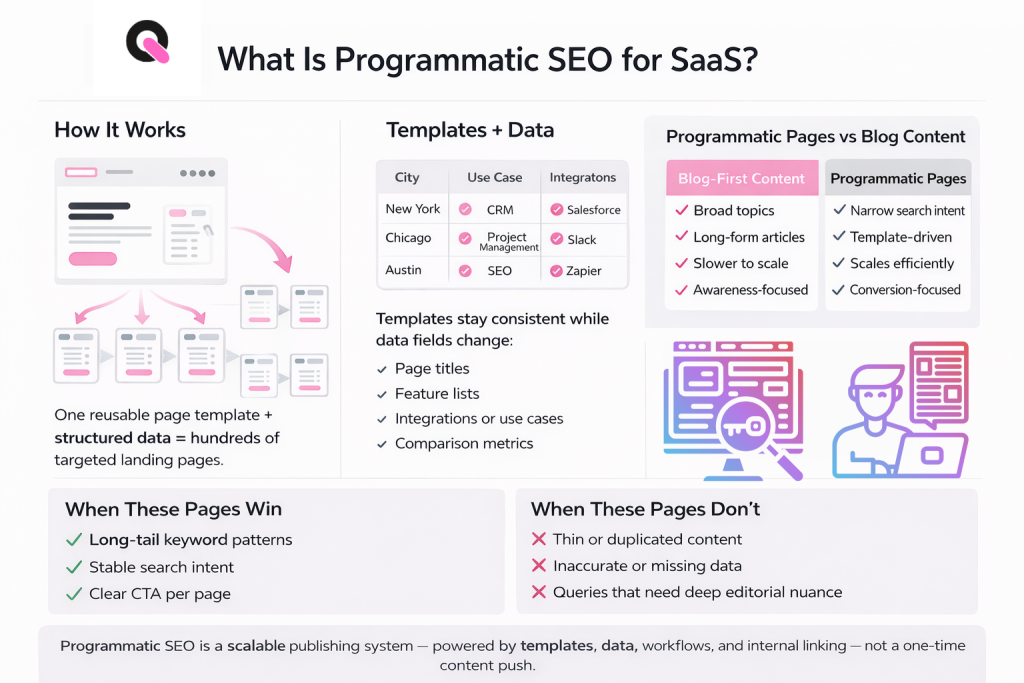
Learn how a single template and a clean dataset can scale into hundreds of useful landing pages. This method pairs a repeatable template with structured data so each page answers a specific query. The result is many unique pages that share a clear on-page structure while swapping variables like seed term and modifier.
What Templates + Data Do
A single template becomes dozens or hundreds of pages that replace data fields: titles, feature lists, local names, or comparative metrics. That keeps the structure consistent while keeping content relevant to each search intent.
How This Differs From Blog-First Work
Editorial blogs use long-form posts and calendars that cover broad topics. Template-driven pages target narrow intents, scale faster, and map directly to conversions. Both approaches can coexist; one focuses on breadth, the other on repeatable specificity.
When These Pages Win, And When They Don’t
- Win: long-tail query sets, stable intent across variations, clear conversion action tied to the page.
- Lose: missing accurate data, thin or duplicate content, or queries that need deep editorial nuance.
- Remember: scale is a productized publishing system, supported by workflows and internal linking, not just a rapid burst of pages.
Why You Should Consider Building Programmatic SEO Systems
Recent advances in AI and modern data pipelines make large page sets practical today. Teams can create and maintain many targeted pages with far less manual effort.
What changed: AI-assisted drafting, enrichment pipelines, and publishing automation combine to lower the cost of scale. These capabilities let teams keep pages current and useful over time.
From One-Off Pages to a Repeatable Engine
Automation reduces repetitive work like drafting, formatting, publishing, and internal linking. That frees product and marketing teams to focus on strategy, QA, and conversion improvements.
- Faster iteration cycles let you test page sets, learn, and scale winners quickly.
- Well-scoped templates plus clean data let most teams avoid heavy engineering investment.
- Maintain minimum quality bars and ongoing management to prevent thin or stale content.
Why this matters: Building an engine that compounds traffic creates predictable growth. Measurable outcomes, indexing, rankings, and conversions, follow when tools like enrichment pipelines and thoughtful management are in place.
How Programmatic SEO for SaaS Captures High-Intent Demand
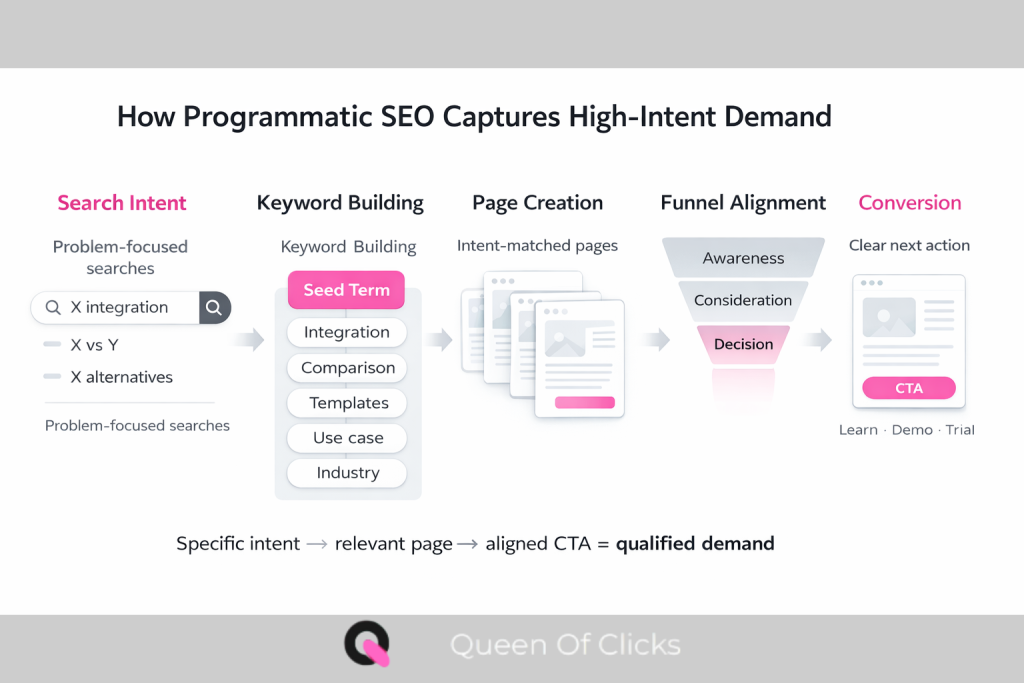
Buyers search with tight, problem-focused phrases; aligning pages to those phrases wins qualified visits. Seed terms plus modifiers form a predictable set of permutations that map to real product needs. That lets teams turn a few core topics into many useful pages.
Seed Terms, Modifiers, and Long-Tail Query Patterns
Seed terms are the base words: product categories, feature names, or workflows. Add modifiers like “integration,” “template,” or “how to” to create a keyword matrix that covers evaluating, switching, integrating, implementing, templating, and operating use cases.
- Common long-tail patterns: integration, comparison, alternatives, versus, templates, use cases, industries.
- Validation should prioritize intent and usefulness over volume; a small number of high-intent queries outperforms broad, vague terms.
Mapping Page Types to Funnel Stages and Conversion Actions
Map each pattern to a funnel stage and pick one clear action per page. Examples:
- Awareness — “how to” guides with a documentation entry point or template download CTA.
- Consideration — comparison or use-case pages with product tour or demo request CTA.
- Decision — alternatives and versus pages with signup or direct trial CTA.
High-intent demand often shows up as specific, problem-framed queries, not broad categories. Designing pages that match intent, structure, and CTA reduces bounce and lifts qualified pipeline. Avoid mismatches and use progressive CTAs that move a visitor from learning to action without a hard sell on purely informational queries.
Core Fundamentals That Keep Programmatic Pages Ranking and Converting
Scaling content safely starts with accuracy and clear design. When you publish many pages, small errors can copy across a set and harm trust. That multiplies risk and reduces long-term value.
Content Accuracy At Scale
Accuracy is non‑negotiable. Erroneous facts spread quickly and create compounding trust issues.
- Data sourcing standards: authoritative feeds, field-level provenance, and timestamping.
- Validation rules: schema checks, range checks, and spot rechecks.
- Update cadence & ownership: scheduled refreshes and a named owner for each dataset.
| Standard | Example | Owner |
| Source | Internal product API | Product Ops |
| Validation | Automated schema tests | Data Team |
| Cadence | Monthly sync | Content Lead |
Depth Over Thin Pages
Depth is more than word count. Add structured details, tables, workflows, FAQs, and decision aids that match intent and add value.
Thin-page failure modes are predictable: near‑duplicate copy, missing specifics, and pages that don’t answer the query. Those lower rankings and harm authority.
Scalability Without Breaking The Pattern
Define strict template rules, fallback logic for missing fields, and a QA sampling plan before each batch launch. Keep templates flexible but bounded so quality stays consistent.
User Experience, Design Quality, And Clear CTAs
Design must be scannable, fast, and mobile-first. Place a primary CTA above the fold, add contextual CTAs through the body, and finish with an end‑of‑page CTA that matches intent.
Measure outcomes: accurate content and solid UX drive better rankings, higher conversion rates, and stronger topical authority over time.
Choosing The Right Programmatic Page Types for Your SaaS
Picking the right page types makes scaling targeted landing content far more predictable. Decide by intent first: what the searcher wants determines the page format you should build.
Integration Pages That Target “Tool A + Tool B” Searches
Integration pages capture bottom-of-funnel intent. Users expect clear capabilities, example workflows, setup steps, and a direct CTA to connect or try the integration.
Comparison Pages That Win Evaluators
Comparison pages should offer honest side-by-side features, pricing signals, and trade-offs. Use neutral scoring, highlight your product advantages, and add proof points to aid evaluators.
Alternatives Pages That Capture “X Alternatives” Queries
Build alternatives lists that explain fit, cost, key differences, and who each option suits. Include selection criteria so the page feels useful, not just promotional.
Versus Content That Leverages Head-to-Head Searches
Create versus pages when search volume and competitor interest justify effort. Stay credible and show tests, feature matrices, and balanced pros and cons while noting where your product excels.
Template Libraries That Turn Utility Into Signups
Template collections convert when they deliver immediate value. Offer downloadable templates, quick previews, and a clear path to sign up to customize or import them.
Use Case And Industry Landing Pages For Tailored Positioning
Targeted landing pages that address specific pain points, features, and proof points improve both rankings and conversions. Start with pages that match your integrations, available proof assets, and strongest competitor gaps.
- Selection guidance: begin with integration or template pages if you have many connectors or assets. Build comparison and alternatives where competitors show up in search. Use industry pages when you have case studies or vertical proof.
Keyword and Seed Phrase Research That Scales Beyond Search Volume
Start keyword research with real customer language, not raw volume charts. Use conversations and tickets to learn the exact terms people use before buying.
Customer-First Ideation: What People Actually Search
Collect phrases from sales calls, onboarding notes, support threads, and product analytics. Those queries reveal intent that tools miss.
Map common question types into short lists of keywords and quick prototypes you can test.
Common Seed Patterns and How They Expand
Typical seed patterns include integrations, templates, how-to, and comparisons. Each seed plus modifiers creates many useful keywords without chasing raw volume.
Building A Keyword Matrix That Scales
Create columns for seed terms, modifier groups, and intent tags. Add rules to block irrelevant combinations and merge near-duplicates.
Use lightweight spreadsheets or simple tools to track which cells map to templates, data needs, internal hubs, and publishing batches.
Prioritize by intent signals (evaluation, switching, implementation), not only volume. De-duplicate with taxonomy rules so one intent maps to one page.
Validating Page Set Opportunities Before You Build Thousands of Pages
Before investing in hundreds of landing pages, run quick checks that prove demand and reduce risk. Validation protects crawl budget, prevents poor indexing, and avoids diluting site authority with low-value pages.
Start with a SERP and competitor reality check to see what ranks now. Look at link profiles, content depth, and UX quality. Note whether search results are dominated by long-form guides, product pages, or user forums.
SERP Reality Checklist
- Types of pages ranking (docs, comparisons, templates).
- Depth and structure of top pages (tables, FAQs, examples).
- Apparent backlink and domain authority levels needed to compete.
Assess Competitor Gaps Without Copying
Map gaps in clarity, structure, and conversion paths. Improve on missing data, cleaner headings, and stronger action cues rather than mirroring content.
Permutations, Minimum Viable Scale, And Trends
Estimate permutations from seed + modifier groups. Aim for a few hundred to a thousand valid permutations before committing to full scale.
Filter out low-intent or ambiguous terms and check trend stability; avoid short spikes and account for seasonality.
- Launch a small pilot batch.
- Measure indexing rate, early search performance, and conversion signals.
- Scale only after positive results and steady demand.
| Metric | What To Track | Goal |
| Indexing | Pages indexed within 4–8 weeks | High coverage |
| Search Performance | Impressions and clicks growth | Improving CTR |
| Conversion | Trial signups or demo requests | Clear pipeline lift |
Programmatic Landing Page Template Structure That Supports Rankings
Well-designed landing pages balance discoverability and decision-making with a clear template. Use a repeatable blueprint that keeps core elements consistent while allowing page-level variation.
On-Page Power Factors
Write dynamic title tags that include the primary keyword and a unique modifier. Keep meta descriptions concise and action-oriented to boost click-through. Align the H1 with the page intent, then use H2–H3 headings to expand related subtopics.
Breadcrumbs, Hubs, and Internal Linking
Implement breadcrumb trails and hub pages to improve crawlability and user browsing. Hubs let you distribute internal link equity across related pages and surface high-priority content to search engines.
Trust Content Blocks and Conversion
Add repeatable trust blocks: social proof snippets, compact workflow steps, and comparison tables. Place a primary CTA above the fold and sprinkle contextual CTAs inside explanatory sections so calls to action match intent.
- Unique intros per page
- Data-driven sections and page-specific FAQs
- Related pages modules and “popular in this category” lists
Quality templates drive rankings and conversions. Use strict rules for variable fields, add page-level uniqueness, and connect pages with clear internal hubs to help both users and search engines find value.
Click below to get a free copy of the programmatic SEO template. Open the Google Sheet and make an editable copy for your team.

Data, Content, and Automation Workflows to Populate Pages
Well-structured data pipelines turn raw signals into landing pages that actually help users make decisions.
Data choices determine whether a page feels useful or thin. Depth often needs structured information, spec sheets, step lists, or user cases, rather than long generic paragraphs.
Using Internal Data Vs Third-Party Data
Internal sources (product metadata, integration fields, support docs) supply precise facts and customer examples. Third-party feeds (public specs, review signals, directories) add context and competitiveness. Use internal data when accuracy matters and external feeds to broaden coverage.
Scraping And Enrichment Pipelines
A practical workflow: collect raw inputs, normalize fields, deduplicate entities, enrich with attributes, then store a single source of truth. Enrichment tools attach pricing, category tags, and sample use cases.
AI-Assisted Copy That Stays Useful
Generate drafts from structured inputs, enforce style and fact rules, then run human review samples. Keep automation touchpoints for creation, scheduled refreshes, and logging edits so management and accuracy scale.
- Scalable blocks: comparison tables, step lists, FAQs, and compact workflows.
- Safeguards: validation rules, spot checks, and rapid rollback processes.
- Outcome: lower cost per page, faster iteration, and better conversion because the content is specific.
| Stage | Action | Outcome |
| Collect | Aggregate internal & external feeds | Comprehensive dataset |
| Normalize | Standardize fields and dedupe | Consistent variables |
| Enrich | Add attributes, examples, and context | Higher page depth |
| Publish | Trigger templates and log changes | Trackable production |
Publishing, Crawl Budget, and Indexing Strategy for Large Page Sets
A deliberate rollout keeps indexing predictable and turns publishing into a measurable growth activity. When you publish many pages at once, crawl capacity can be strained and indexing slows. That creates long waits and uneven search performance.
Use a batch-launch playbook to reduce risk. Start small, validate, then expand.
How to Launch in Batches to Reduce Risk
- Publish a pilot set of priority pages (50–200) linked from a hub.
- Wait 2–6 weeks to confirm indexing, impressions, and initial engagement.
- Roll out the next wave (larger) only after signals improve.
- Keep later waves for lower-priority variants and thin permutations.
Google Search Console Workflows: Submitting Hubs and Monitoring Coverage
Submit hub URLs to the Inspect URL tool first, then request indexing. Track the Coverage report to find excluded or error pages.
Watch indexing rate over time and flag spikes in excluded URLs or crawl errors. Use sitemaps segmented by batch to speed reporting and isolate issues.
Internal Links That Help Search Engines Discover And Prioritize Pages
Hubs should link to child pages and child pages should link back. Add related-pages modules and include high-value pages in primary navigation when appropriate.
Prioritize pages by intent, conversion potential, and data completeness when deciding which waves go first.
| Operation | Action | When | Expected Result |
| Pilot Publish | 50–200 pages + hub; submit hub to GSC | Week 0 | Early indexing & baseline metrics |
| Coverage Check | Review GSC Coverage and Inspect URLs | Weeks 2–6 | Identify excluded or canonical issues |
| Scale Wave | Publish priority pages in controlled batches | After positive pilot signals | Steady index growth and improved performance |
| Ongoing Hygiene | Sitemap segmentation, canonical rules, noindex low-value | Continuous | Sustained crawl efficiency and stable rankings |
Expect indexing to take several weeks per batch. Treat indexing as part of content management and link architecture, not an afterthought. Clear technical hygiene, measured rollout waves, and strong internal links make discovery faster and improve long-term search performance.
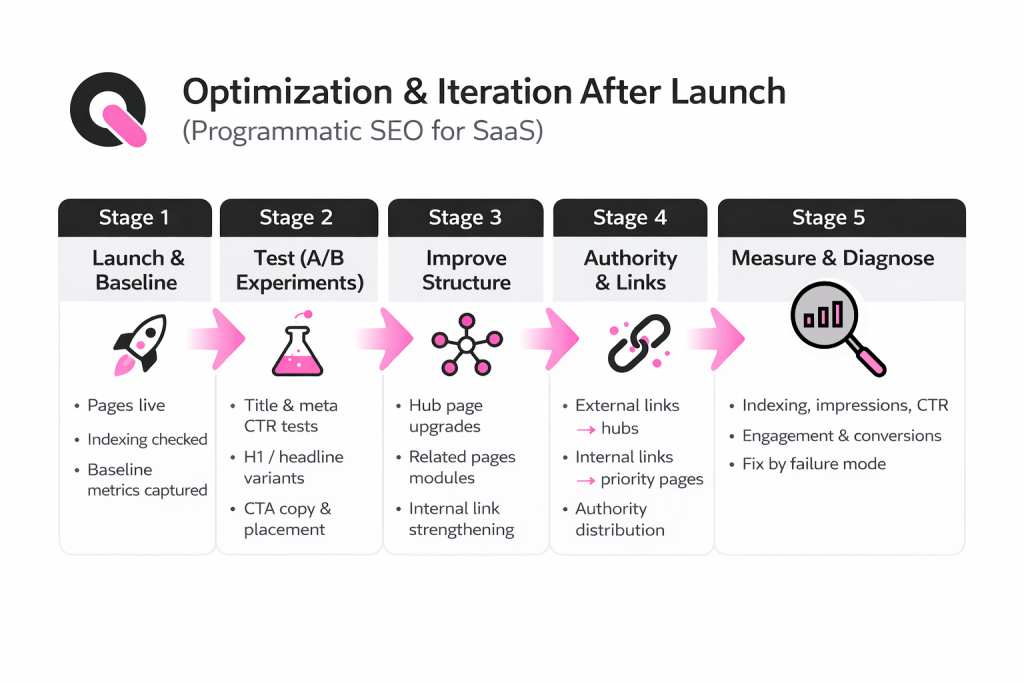
Optimization and Iteration After Launch
Post-launch work is where small template changes produce outsized improvements across many pages. Treat the rollout as an ongoing experiment. Use measured cycles to lift performance and improve results across the set.
A/B Testing Titles, Headlines, and CTA Placement
Prioritize A/B tests that impact click behavior and conversion. Start with title and meta variations to boost CTR. Then test H1 and headline phrasing to better match intent.
Move CTAs: try different copy, position, and color on a sample of pages. Measure clicks and conversions before wide rollout.
Improving Navigation, Related Pages, and Hub Architecture
Upgrade hub pages, add clear category filters, and strengthen related-pages modules. Better pathways reduce pogo-sticking and increase session depth.
Link Building That Supports Hubs And Priority Pages
Link building for SaaS means focus external link outreach on hubs and top-priority pages. Use internal links to distribute authority and surface high-value pages across the network.
Tracking Performance: Indexing Rate, Impressions, Clicks, And Conversions
Track indexing rate, impressions, clicks, CTR, average position, engagement, and conversions by page set and hub.
Diagnose by failure mode: low indexing → crawl or sitemap fixes; low CTR → title/meta tests; low engagement → expand content blocks. Each measured change compounds, making ongoing optimization highly leveraged growth.
🚀 How Queen of Clicks Helps SaaS Companies Win With SEO
Queen of Clicks helps SaaS companies turn SEO strategy into consistent organic growth. We focus on building high-impact pages, clear site structure, and conversion-driven content that attracts qualified traffic and supports revenue goals.
Our approach combines strategic planning with hands-on execution so every SEO effort is intentional, measurable, and tied to business outcomes.
What You Get When You Partner With Queen of Clicks
Queen of Clicks acts as an extension of your team, owning both the SEO strategy and the execution needed to turn visibility into results.
- Role: A strategic and execution partner that designs and delivers SEO systems built for sustainable rankings and conversions.
- Outcomes: Clear keyword strategy, prioritized landing pages, and content that aligns with buyer intent across the funnel.
- Operations: Structured workflows for publishing, updating, and maintaining SEO assets to protect quality and long-term performance.
Structured Support From Strategy to Execution
We keep SEO efforts focused and effective and combine strong foundations with ongoing optimization. Every page is built with clear intent, accurate content, and a defined conversion goal.
Our SEO support includes:
- Keyword research and intent mapping based on how SaaS buyers actually search
- High-impact landing page and blog strategy tied to funnel stages
- On-page SEO structure, internal linking, and hub architecture
- Content quality standards, QA processes, and post-launch iteration
- Continuous optimization through testing, performance tracking, and refinement
Measurable results matter
We measure success by qualified traffic, engagement, and conversions. Book a call to discuss an SEO roadmap tailored to your SaaS growth goals.
Conclusion
The central thesis is simple: programmatic SEO, paired with strong data and templates scales targeted pages that capture long‑tail, high‑intent demand.
Non‑negotiables: accuracy, content depth, consistent templates, and a clear user path to conversion. Keep internal links and hubs tight.
Follow the flow: choose page types, build a keyword matrix, validate opportunities, design templates and hubs, implement data workflows, publish in batches, then iterate.
Treat this as a system with inputs (data, keyword lists), outputs (pages and conversions), and feedback loops (tracking and testing). Expect indexing and ranking to take time, but steady growth comes from scaling what works.
Next actions: pick one page type, assemble a pilot dataset, launch 50–200 pages, and measure performance. Prioritize user value to sustain results.
FAQs
How long does it take to see results from programmatic SEO for SaaS?
Most SaaS teams see early indexing and impression signals within 4–8 weeks after launch. Meaningful traffic and conversions typically follow in 3–6 months, depending on domain authority, internal linking strength, and page intent. Programmatic SEO compounds over time rather than delivering instant spikes.
Is programmatic SEO suitable for early-stage SaaS companies?
Yes, if the product has clear use cases, integrations, or repeatable workflows. Early-stage teams benefit most when they focus on a narrow, high-intent page set instead of thousands of pages. The key is controlled scale, not volume for its own sake.
How many pages do you need for programmatic SEO to be effective?
There’s no fixed minimum. Some SaaS companies see strong results with 50–100 well-scoped pages, while others need several hundred. Effectiveness depends on intent quality, internal linking, and conversion alignment, not raw page count.
What are the biggest risks of programmatic SEO if done incorrectly?
The main risks are thin content, duplicated pages, outdated data, and poor internal linking. At scale, small mistakes multiply quickly. Without strong QA, ownership, and refresh cycles, programmatic SEO can hurt trust and site quality.
Do programmatic SEO pages require backlinks to rank?
Not always. Many long-tail programmatic pages rank primarily through relevance, internal linking, and topical authority. External links are most valuable when pointed at hub pages, which then distribute authority across the page set.
Who should own programmatic SEO inside a SaaS organization?
Ownership usually sits between SEO, product marketing, and data or ops teams. SEO defines intent and structure, product ensures accuracy, and ops or growth teams manage workflows. Clear ownership prevents pages from becoming stale.
Can programmatic SEO replace content marketing or blogging?
No. Programmatic SEO and editorial content serve different purposes. Blogs build brand authority and narrative depth, while programmatic pages capture specific, conversion-ready intent. The strongest SaaS strategies use both together.
What tools are needed to run programmatic SEO effectively?
At minimum: a spreadsheet or database for structured data, a CMS that supports templates, and analytics tools like Google Search Console. More advanced setups add enrichment tools, automation, and AI-assisted drafting, but complexity should match scale.
How do you know when to stop scaling programmatic pages?
Stop scaling when new pages show low indexing rates, weak engagement, or no conversion lift. Programmatic SEO should be expanded only when earlier batches perform well. Scaling is a performance-driven decision, not a publishing goal.