
Fintech SEO: Your Comprehensive Guide
Fintech SEO is the practice of optimizing a financial technology website so it ranks higher in search engines and attracts the right users at every stage of the customer journey, from learning and comparing to signing up. Strong SEO drives visibility, builds credibility, and captures high-intent organic traffic that paid ads can’t sustain long-term.
Organic search remains a dominant channel for discovery, as over 45% of all search clicks come from organic results, meaning fintech brands that earn top placements can significantly increase visibility and qualified traffic.
Key Takeaways
- Fintech SEO links rankings, trust, and conversions for sensitive money topics.
- The guide covers strategy, content, technical, links, measurement, and AI search adaptation.
- Regulation, complex terminology, and high trust thresholds set this work apart from general SEO.
- Target audience: U.S. fintech firms and SaaS teams focused on growth and acquisition.
- Results come from compounding improvements across content quality, site performance, and authority building.
What Is Fintech SEO?
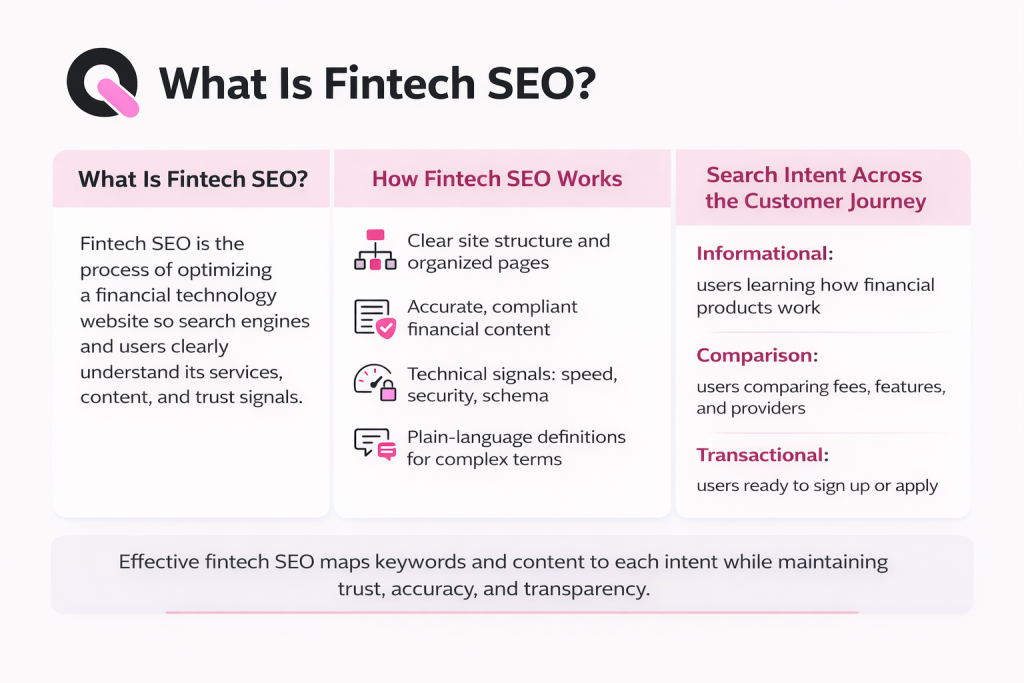
Fintech SEO is the practice of optimizing financial technology websites to rank higher in search results while meeting strict trust, accuracy, and compliance standards. Optimizing a financial technology website for search helps the right customers find your services at each decision point. This kind of work makes pages, content, and site infrastructure clear to engines and to people who are researching money topics.
Fintech SEO Definition for Financial Services Websites
In plain terms, it means organizing pages, writing accurate content, and using technical signals so search engines can understand and rank your services. The goal is to be recommended to users who need reliable information or want to compare options.
How Search Intent Drives Visibility, Trust, and Conversions
Users arrive with different intent: informational (learning how something works), commercial investigation (comparing options), and transactional (ready to sign up). Each intent needs distinct page formats and elements.
- Match titles and headings to user questions to improve click-through rates.
- Use clear definitions for terms beginners search first; this boosts discoverability.
- Balance education and conversion: teach without exaggeration so trust stays intact.
Winning means mapping queries and keyword targeting across the full journey, not only chasing volume. Consistent terminology, accurate information, and visible security signals support credibility and higher rankings.
Why Is SEO Important for Fintech Companies
Organic discovery on the web remains the primary gateway for people comparing financial products. In the U.S. market, buyers use web search to compare providers long before they contact sales or install an app.
Organic Traffic as a Sustainable Growth Channel vs. Paid Ads
Organic traffic compounds over time. Paid campaigns stop delivering the moment spend stops. For many fintech companies, that makes search-driven content a lower-cost way to expand pipeline and reduce blended CAC.
Remember: 75% of users don’t look beyond page one. Small ranking moves can change monthly leads and business results materially.
Trust Signals in a YMYL Category: Why Credibility Impacts Rankings
Google’s E-E-A-T standards matter more in money-related topics. Accuracy, author bios, citations, and clear disclaimers all feed trust.
Trust signals also include secure site behavior, transparent fees, and visible compliance cues. These affect both user decisions and how search engines evaluate pages.
How Search Engines Shape the Customer Journey From Research to Signup
- Top-of-funnel: educational queries that build awareness.
- Mid-funnel: comparison content that aids evaluation.
- Bottom-funnel: decision keywords tied to signup, demo, or application.
Even app-first products rely on web content to drive discovery and consideration. Strong SEO and reliable content keep that funnel full.
Key Challenges That Make SEO for Fintech Different
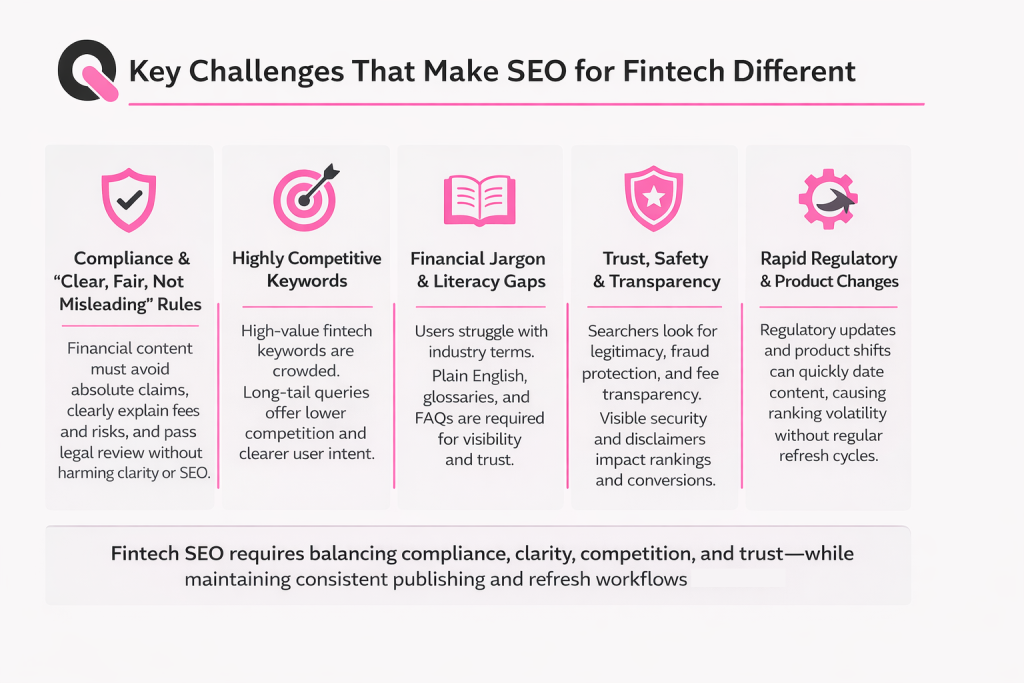
Financial services websites face a unique set of content and compliance hurdles that change how you plan organic growth. These limits shape claims, pace, and publishing workflows.
Compliance Constraints and “Clear, Fair, Not Misleading” Messaging
Legal reviews often slow cycles. You must avoid absolute promises about returns and clearly show fees and risks.
Include concise risk disclaimers so pages stay compliant without losing readability.
Competitive Keywords and the Need for Long-Tail Opportunities
High-value keywords are crowded. Targeting longer, specific phrases reduces competition and matches clearer user intent.
Complex Terminology and Financial Literacy Gaps
Many users find industry terms confusing. Translate jargon into plain American English and add glossaries and FAQs for clarity.
Trust Barriers: Safety, Transparency, and Risk Disclaimers
Search behavior often reveals trust questions: “is it legit,” fraud protection, and fee transparency. Visible security signals and clear comparisons matter.
Fast-Moving Industry Trends That Date Content Quickly
Regulatory updates and product changes can make pages stale fast. Without refresh workflows, ranking volatility follows.
- Operational friction: long review cycles, stakeholder alignment, and missed timing.
- Solutions preview: later sections cover E-E-A-T, topic clusters, technical trust, and content refresh processes.
Building Trust With E-E-A-T for Financial Content
High-stakes money topics demand visible proof that your team understands real-world financial outcomes. E-E-A-T stands for Experience, Expertise, Authority, and Trust. In YMYL contexts this framework guides how to publish reliable content and protect users.
Experience and Expertise
Experience signals show how services perform in practice. Use case studies, product walkthroughs, and real scenarios that explain outcomes and trade-offs.
Expertise signals include named authors, short bios with credentials, and editorial review notes. Cite primary sources when you present figures.
Authority Through Mentions and Links
Authority grows from consistent topic coverage plus third-party validation. Aim to earn mentions in reputable publications and build high-quality backlinks through thoughtful link building and research assets.
Trust: Accuracy and Transparency
Trust is both content and technical. Show accurate numbers, clear fee language, secure HTTPS pages, and visible disclaimers. Add “last updated” dates and changelogs to maintain currency.
- Define policies and show editorial review steps.
- Publish expert-reviewed guidance for complex claims.
- Schedule proactive refreshes for sensitive pages.
| Signal | Action | Why It Matters | Outcome |
| Experience | Case studies & walkthroughs | Demonstrates real use and results | Higher engagement and credibility |
| Expertise | Named authors & citations | Shows qualifications and sources | Lower review friction and trust |
| Authority | Mentions & backlinks | Third-party validation | Improved rankings and referrals |
| Trust | Accurate figures & clear disclaimers | Reduces user doubt | Higher conversion and fewer support issues |
Keyword Research for Fintech: From Broad Terms to High-Intent Wins
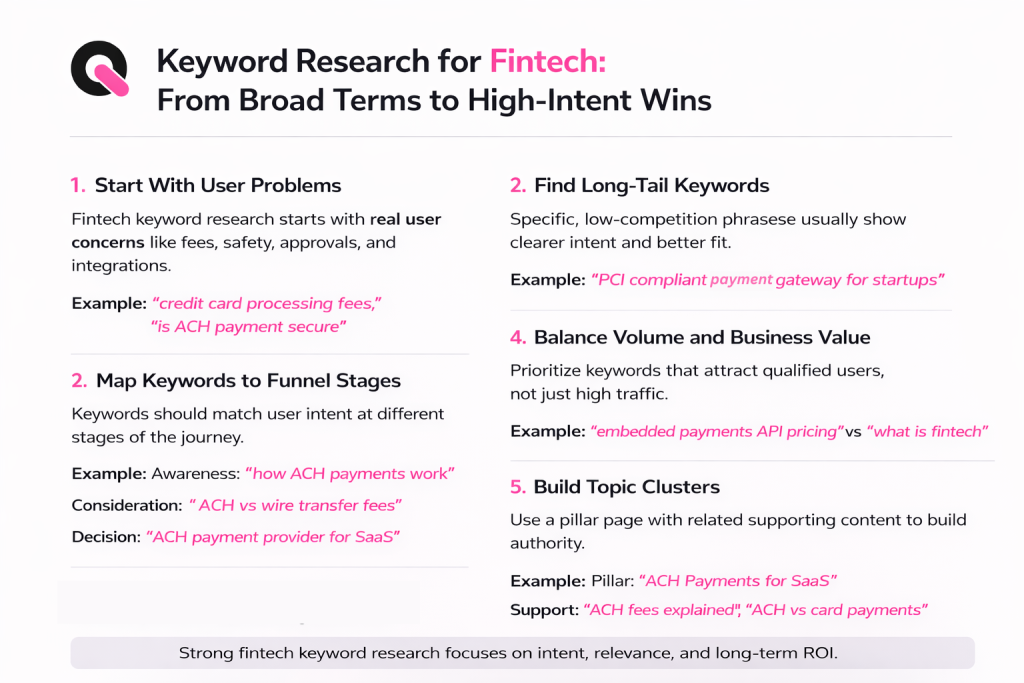
Keyword research for financial products starts with real user problems, not just high-volume phrases. Begin by listing common concerns: fees, safety, approval steps, setup time, and integrations. These problems map directly to intent and funnel stage.
Mapping Keywords to Funnel Stages
Awareness queries teach and inform. Use educational keywords to build trust and capture early interest.
Consideration keywords compare options and highlight trade-offs. These support in-depth content and comparison pages.
Decision keywords target users ready to act and belong on product and signup pages.
Finding Long-Tail Opportunities
Search for specific, low-competition phrases that describe a single problem or use case. Long-tail keywords often show clearer intent and better match product fit.
Balancing Volume, Difficulty, and Business Relevance
Prioritize keywords that attract qualified traffic over vanity volume. Weigh monthly search volume against competitiveness and potential ROI.
Building Topic Clusters
Create a pillar page for a core topic and add supporting articles, FAQs, and a glossary. Use internal links from supporting pieces to pillar and to product pages to guide readers gently toward action. Keep keyword lists updated; ongoing research is essential as search patterns and AI-driven queries shift.
Fintech Content Strategy That Educates, Converts, and Stays Compliant
A practical content plan combines plain explanations, compliance checks, and formats that earn links. Write with clear definitions for terms, avoid hype, and show fees and risks where they matter. Use named authors and short bios to boost credibility for complex claims.
Formats That Earn Attention and Links
Prioritize original research summaries, calculators, step-by-step guides, and webinar recaps. These formats give users useful tools and attract natural link building from industry writers and partners.
Glossaries and Jargon Busters
Build a glossary that targets definitional searches. Link each term to deeper how-to guides and relevant product pages to guide users from understanding to action.
Editorial Workflow and Refresh Cadence
Follow: brief → draft → compliance/legal review → QA → publish → monitor → refresh. Track pages that drive signups and update those first with new numbers and clarity.
Outcome: Better content quality raises qualified traffic, boosts on-page engagement, and increases conversion rates on bottom-of-funnel pages.
| Task | Why It Matters | Frequency | Metric |
| Glossary entries | Captures definitional queries | Ongoing | Search impressions, clicks |
| Tool and calculator updates | Provides real utility and links | Quarterly | Backlinks, time on page |
| Compliance review | Protects trust and legal standing | At draft and major update | Publish velocity, issue count |
| High-value page refresh | Maintains rankings and accuracy | Every 3–6 months | Traffic, conversions |
On-Page SEO That Improves Rankings and User Experience
A focused on-page approach makes product and signup pages clearer and more persuasive to both users and engines. Start work where it matters most: pages that influence conversions and pipeline.
High-Impact Page Prioritization
Begin with product, pricing, signup/application, and comparison pages. These pages tie directly to revenue and should get the first round of copy, metadata, and UX fixes.
Optimizing Title Tags, Meta Descriptions, and Headings
Write title tags that match intent and set accurate expectations. Use meta descriptions to highlight a single benefit and a clear CTA without exaggeration.
Keep H1s concise and use H2/H3 to break content into scannable sections. Proper heading structure helps users and search engines understand page purpose.
Internal Linking That Moves Users From Education to Action
Link contextually from articles and glossaries to product and signup pages. Use descriptive anchor text that signals next steps rather than generic phrases.
Schema and Structured Data for Richer Search Results
Apply FAQ, HowTo (when relevant), and Organization/Author markup to improve visibility and support AI extraction. Structured data helps results show useful snippets.
On-Page UX and Lightweight QA
Above-the-fold must state value, show trust signals, and reduce friction on mobile. Make sections scannable and include transparent disclosures.
| QA Check | Action | Why |
| Title & Meta | Match intent, keep length | Improves CTR |
| Headings | Clear H1/H2 hierarchy | Better readability |
| Links | Contextual anchors to CTAs | Guides journey |
| Schema | FAQ/Author markup | Richer results |
Technical SEO for Fintech Websites: Performance, Security, and Crawlability
Technical foundations shape how search engines find and trust your pages, and they directly affect user confidence on money-related journeys.
Site Speed Optimization to Reduce Bounce Rate and Build Confidence
Slow pages drive users away fast, especially for money tasks. Prioritize image compression, reduce third-party scripts, and enable caching to cut load time.
Choose hosting and CDNs that improve Core Web Vitals. Measure perceived performance with real-user metrics and iterate.
Mobile-First Design for Users Researching and Managing Money on Phones
Most people research and apply on mobile. Use responsive layouts, readable typography, and touch-friendly CTAs.
Keep forms short and reduce input friction. Every extra field raises abandonment risk.
Site Architecture, Indexation, XML Sitemaps, and Robots.txt Basics
Clean architecture and consistent internal linking help crawlers and users find important pages. Maintain a clear XML sitemap and update it when pages change.
Use robots.txt to block duplicate or staging areas, not to hide critical content. Regularly audit indexation to avoid “invisible” pages that waste content effort.
HTTPS, Data Protection Signals, and Technical Trust Foundations
HTTPS everywhere, secure forms, and visible privacy notes are minimum trust signals. Display data-handling summaries and contact options near conversion steps.
These measures reduce friction and increase conversions by reassuring visitors their data is safe.
- Why it matters: technical work is both a ranking lever and a trust lever for money topics.
- Speed themes: image compression, script reduction, caching, infrastructure upgrades.
- Mobile needs: responsive design, legible text, touch targets, simplified forms.
- Crawl hygiene: clear architecture, XML sitemap upkeep, correct robots directives.
- Trust basics: HTTPS, secure forms, privacy cues, and audit cadence.
| Area | Quick Fixes | Why It Helps | Cadence |
| Performance | Compress images, defer scripts, use CDN | Faster loads reduce bounce and improve Core Web Vitals | Monthly |
| Mobile | Responsive CSS, larger fonts, simplified forms | Better conversions and lower abandonment on phones | Quarterly |
| Crawlability | Update XML sitemap, fix broken links | Prevents pages from becoming unindexed and wasted effort | Monthly |
| Trust | HTTPS, secure forms, privacy summary near CTAs | Signals safety to users and engines, boosts conversions | As changes occur |
Link Building and Digital PR for Fintech Authority
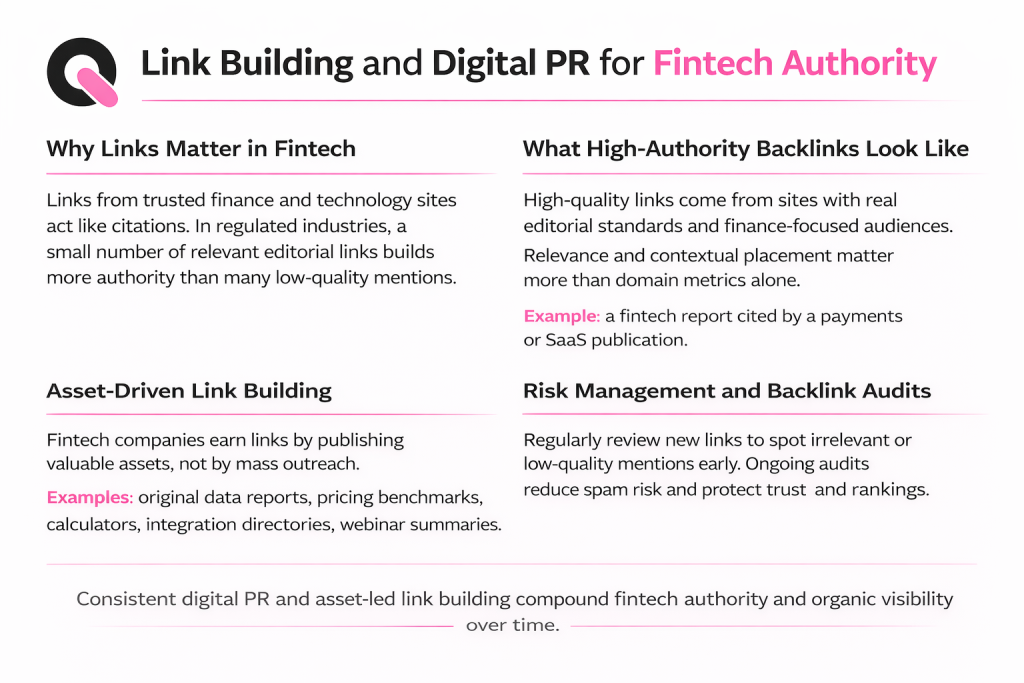
Links from trusted finance-focused sites act like citations: they tell search systems your content deserves attention and help users find credible resources. In regulated markets, a few relevant, editorial links beat many low-quality mentions.
Quality Over Quantity: What High-Authority Backlinks Look Like
High-authority backlinks come from sites read by finance and tech audiences, with real editorial standards and contextual mentions. Relevance and placement matter more than domain metrics alone.
Asset-Driven Link Building: Reports, Tools, Webinars, and Research
Create linkable assets that earn attention: original data reports, interactive calculators, benchmarking studies, integration directories, and webinars with published takeaways.
- Craft newsroom-friendly landing pages for each asset.
- Pitch angles tied to data points, not generic publicity.
- Repurpose webinar highlights into shareable summaries and visuals.
Backlink Audits, Risk Management, and Avoiding Spam Signals
Monitor new backlinks and flag irrelevant or low-quality mentions early. Regular audits reduce the chance of spam patterns that hurt trust. Use manual review plus automated alerts.
| Check | Action | Cadence |
| New backlinks | Evaluate relevance and anchor context | Weekly |
| Toxic link patterns | Disavow or outreach removal | As needed |
| Referring domains | Track editorial quality and topical fit | Monthly |
Digital PR workflow: build targeted outreach lists, craft data-led pitches, publish landing pages optimized for journalists, and follow up with value-driven assets. Consistent promotion and asset refreshes compound authority over time.
When done carefully, link building raises visibility for competitive terms, strengthens mid-funnel content, and delivers measurable results for the company.
Adapting to AI Search, LLMs, and AI Overviews
Large language models often pull short explanations from the web, so extraction-ready content can win prominent exposure.
Generative search changes the funnel: users can get summarized mid-funnel answers without visiting many pages. That means brands must earn inclusion through clear writing, visible authority, and factual signals.
How generative search changes discovery for mid-funnel queries
AI overviews favor definitional and how-it-works answers. Queries about comparisons, safety, fees, and eligibility now surface as short snippets in answers panels.
Writing clear, extractable answers without sacrificing depth
Start with a short, direct definition or step list that machines can extract. Follow with a more detailed explanation, examples, and caveats.
Best practices: use consistent terminology, concise bullets, and labeled tables for fees or steps.
Entity clarity, structured data, and author signals for AI visibility
Make product names consistent across pages and add a clear “Who this is for” sentence. Use schema (Article, FAQ, Author) and visible author bios to boost machine trust.
- Track pages that gain AI-driven impressions and update them to match evolving summaries.
- Keep short answers factual, then expand with assumptions and risk notes to preserve depth and compliance.
| Signal | Action | Why it helps |
| Structured data | FAQ/Author markup | Enables richer AI extraction |
| Entity clarity | Consistent naming & roles | Reduces ambiguity for models |
| Author signals | Names, credentials, review notes | Improves perceived authority |
Measure outcomes: monitor which pages earn impressions and clicks from AI features, then iterate content and schema to improve results.
How Queen of Clicks Helps Fintech Companies Win With SEO
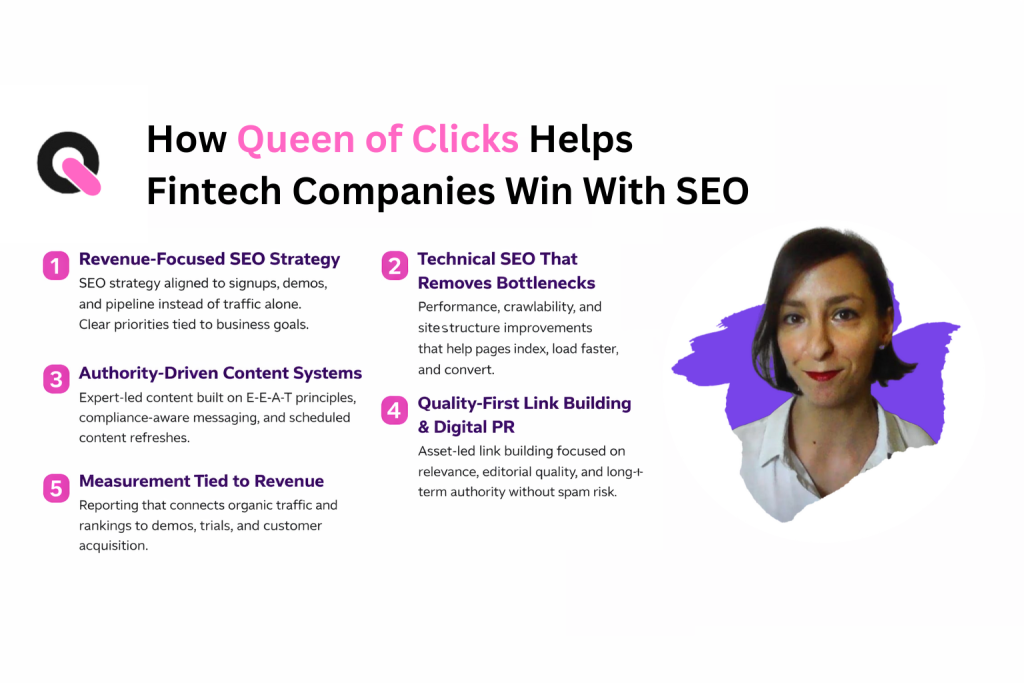
A growth-focused search approach aligns pages, performance, and links to measurable business results. This shifts work from chasing rankings to improving pipeline, signups, and revenue. Teams get clear priorities, timelines, and impact metrics tied to marketing and product goals.
Strategy Built Around Revenue, Not Just Rankings and Traffic
Queen of Clicks prioritizes high-intent pages that drive signups and demos. The plan favors qualified pipeline over raw traffic numbers.
Technical SEO and Performance Fixes That Remove Growth Bottlenecks
We find and fix performance issues, crawlability barriers, and weak site structure so pages index and convert. Faster pages mean fewer drop-offs and better conversion rates.
Content Systems That Build Authority, Earn Trust, and Drive Qualified Leads
Content follows E-E-A-T principles with expert-led briefs, compliance-aware messaging, and scheduled refreshes. That produces consistent, trustable pages that attract and convert targeted visitors.
Link Building and Digital PR Focused on Quality, Relevance, and Safety
Link building is asset-led and relevance-first. Outreach targets editorial placements that move topical authority without introducing spam risk.
Measurement and Reporting That Tie SEO to Pipeline and Signups
Reporting links organic traffic and ranking gains to demos, trial starts, and completed signups. Clean attribution and conversion-focused KPIs show real business results.
How Queen of Clicks helps SaaS businesses grow with SEO:
- Revenue-aligned strategy that prioritizes high-intent pages and keywords tied to signups and pipeline.
- Technical SEO improvements that increase site performance, strengthen crawlability, and remove indexing barriers.
- Content strategy and production that builds authority and trust with clear explanations and consistent updates.
- Quality-first link building and digital PR designed to earn relevant backlinks without introducing spam risk.
- Measurement and reporting that connects rankings and organic traffic to leads, demos, and customer acquisition.
Results and expectations: Teams often see meaningful impact within months, with compounding returns as content, technical fixes, and link signals mature. Typical timelines and ROI vary, but well-executed plans frequently show major gains by month nine.
Book a call with Queen of Clicks to map a practical growth plan tailored to your goals, constraints, and market. The call will surface priorities, quick wins, and a phased roadmap to improve conversions and long-term results.
Conclusion
Sustained traffic gains come from combining reliable content, technical hygiene, and visible credibility.
Start with high-impact product and signup pages, then build supporting topic clusters that answer real user questions. Scale authority through measured link earning and data-led assets.
In finance, credibility and transparency are inseparable from performance. Use clear, fair, not misleading language and show author and compliance signals where they matter.
Keep content fresh, monitor technical health, and adapt answers for AI overviews by writing concise, extractable responses backed by depth and author/entity cues.
Long-term growth is compounding: steady execution of this strategy drives durable visibility, higher conversions, and sustained business growth. Book a call with Queen of Clicks to map next steps.
FAQs
How Long Does It Take to See Results From Fintech SEO?
Most fintech sites start seeing early movement within 2–3 months, but meaningful traffic and conversions typically take 6–9 months. Timelines depend on competition, existing authority, compliance review speed, and how aggressively content and links are built. SEO compounds over time, so results improve as pages age and authority grows.
Is Fintech SEO Better Handled In-House or by an Agency?
In-house teams work well for execution once a strategy exists, but many fintechs rely on agencies for planning, technical audits, and authority building. Agencies bring cross-industry benchmarks, established link relationships, and experience navigating compliance-heavy environments. A hybrid model is common for scaling.
Can Fintech SEO Work Without Publishing Content Frequently?
Yes, but consistency matters more than volume. Publishing fewer, high-quality pages that are well-researched, compliant, and regularly updated often outperforms frequent low-quality posts. Refreshing existing high-value pages can drive more growth than constantly publishing new ones.
What SEO Mistakes Hurt Fintech Sites the Most?
Common issues include exaggerated claims, thin comparison pages, outdated content, weak author signals, and poor site performance. Ignoring compliance language or hiding fees also erodes trust. In fintech, credibility mistakes hurt rankings and conversions at the same time.
Should Fintech Companies Focus on Local SEO or National SEO?
Most fintech products benefit more from national SEO across the U.S., not local listings. However, local SEO can matter for regulated services with geographic constraints, physical offices, or state-specific offerings. The right approach depends on licensing and service availability.
How Do You Measure ROI From Fintech SEO Beyond Traffic?
Strong measurement ties organic pages to demos, applications, signups, or funded accounts. This requires clean analytics, conversion tracking, and CRM attribution. Rankings and traffic are indicators, but pipeline and CAC reduction are the real success metrics.
Can Fintech SEO Scale Into International Markets Later?
Yes, but international expansion requires a separate strategy. U.S.-focused fintech SEO should come first, then expand with localized content, compliance review, and country-specific intent mapping. Simply translating U.S. pages rarely works in regulated financial markets.